TL;DR:
- Measuring digital marketing ROI helps Albuquerque SMBs identify effective channels and optimize spending.
- Setting clear, revenue-linked goals and tracking specific KPIs is essential for achievable, measurable results.
- Local SEO, targeted PPC, and community-focused content deliver high ROI when properly tracked and optimized.
You’re putting real money into digital marketing every month, but when you look at the numbers, you can’t quite connect the spending to actual growth. Sound familiar? Too many Albuquerque small and medium-sized businesses (SMBs) find themselves in this exact position, paying for ads, social media posts, and website updates without a clear picture of what’s working. ROI, or return on investment, is the true measure of whether your marketing dollars are pulling their weight. This guide walks you through practical, proven steps to turn scattered spending into reliable, measurable growth.
Table of Contents
- Understanding digital marketing ROI: Why it matters
- Preparation: Setting ROI-friendly digital marketing goals
- Execution: High-ROI digital marketing tactics for SMBs
- Verification: Measuring and optimizing your digital marketing ROI
- Troubleshooting and common pitfalls in maximizing ROI
- Why Albuquerque SMBs should rethink digital marketing ROI
- Partner with local experts for better digital ROI
- Frequently asked questions
Key Takeaways
| Point | Details |
|---|---|
| Define ROI goals | Clear, measurable objectives are essential for tracking and improving digital marketing ROI. |
| Choose high-impact tactics | Focus on digital strategies proven to deliver the best ROI for Albuquerque businesses. |
| Track and optimize results | Regularly measure outcomes and adjust your approach to maximize your marketing investment. |
| Avoid common pitfalls | Sidestep the typical mistakes that erode ROI, like poor tracking and ignoring local context. |
| Localize for Albuquerque | Tailor digital marketing messages and tactics to fit the Albuquerque market for best results. |
Understanding digital marketing ROI: Why it matters
ROI in digital marketing is the ratio of what you earn compared to what you spend on marketing activities. The basic formula is simple: subtract your marketing costs from the revenue generated, divide that number by your marketing costs, and multiply by 100 to get a percentage. A positive ROI means your marketing is paying off. A negative ROI means you’re losing money on every campaign.
Here’s the problem. Many business owners focus on vanity metrics, things like page views, follower counts, and impressions. These numbers feel good but don’t tell you whether your campaigns are actually generating revenue. Measuring marketing ROI means going deeper, connecting your marketing activities directly to leads, sales, and customer lifetime value.
“ROI is not just a number. It’s a signal. It tells you where to invest more and where to cut your losses before they grow.”
To track ROI effectively, you need a few foundational elements in place:
- A clear baseline: Know your current revenue and costs before launching campaigns.
- Conversion tracking: Set up tools like Google Analytics or Meta Pixel to record when a visitor takes a desired action, such as filling out a form or making a purchase.
- Attribution modeling: Understand which channels and touchpoints are driving conversions, not just clicks.
- A reliable marketing ROI calculator: Use a structured tool to consistently measure returns across different campaigns.
For SMBs, a 5:1 ROI ratio is generally considered a healthy benchmark, meaning $5 earned for every $1 spent. Getting there requires more than guesswork. It requires a system.
Preparation: Setting ROI-friendly digital marketing goals
With a clear understanding of ROI, you’ll need well-defined goals to track progress. Vague goals like “get more customers” or “grow online” don’t give you anything to measure. Specific, measurable goals tied directly to revenue are what move the needle.
Here’s a stepwise framework for setting ROI-friendly digital marketing goals:
- Start with your revenue target. Decide how much additional revenue you want to generate in the next 90 days or 12 months.
- Work backward from that number. If your average sale is $500 and you want $50,000 in new revenue, you need 100 new customers.
- Calculate the leads required. If your current close rate is 20%, you need 500 qualified leads to get those 100 customers.
- Assign marketing channels. Determine which channels (SEO, paid ads, email, social) will generate those leads and at what estimated cost.
- Set KPIs for each channel. KPIs, or Key Performance Indicators, are the specific metrics you’ll track. These might include cost per lead, conversion rate metrics, click-through rate, or customer acquisition cost.
Aligning your KPIs with revenue goals is what separates strategic marketing from random activity. Effective digital marketing methods consistently show that businesses with clearly defined, revenue-linked goals see significantly stronger returns than those chasing broad awareness.
Pro Tip: One of the most common goal-setting mistakes is choosing too many KPIs at once. Pick two or three per channel and track them consistently for at least 60 days before drawing conclusions. Jumping between metrics too quickly leads to bad decisions based on incomplete data.
Here’s a quick reference table to help map your goals to the right channels:
| Business goal | Best channel(s) | Key KPI to track |
|---|---|---|
| Generate local leads | Local SEO, Google Ads | Cost per lead, form submissions |
| Increase online sales | Paid search, email marketing | Conversion rate, revenue per email |
| Build brand awareness | Social media, display ads | Reach, engagement rate |
| Retain existing customers | Email, retargeting ads | Repeat purchase rate, open rate |
| Improve website performance | SEO, CRO | Bounce rate, time on page |
Execution: High-ROI digital marketing tactics for SMBs
Having set your goals, let’s get into practical tactics local businesses can implement for a stronger return. Not all marketing channels are created equal, especially for Albuquerque SMBs competing in a local market with specific geographic and cultural characteristics.
Here are the top ROI-boosting tactics worth your attention:
- Local SEO: Optimizing your website and Google Business Profile for Albuquerque-specific searches puts you in front of people actively looking for what you offer. This is one of the most cost-effective long-term strategies available.
- Paid search ads (PPC): Google Ads lets you target people searching for your exact services right now. When managed well, PPC delivers fast, measurable results.
- Email marketing: With an average industry ROI of $36 to $40 for every $1 spent, email remains one of the highest-performing channels for SMBs.
- Conversion rate optimization (CRO): This means improving your website so more visitors take action. Boosting conversion rates by even 1 or 2 percentage points can dramatically increase revenue without increasing ad spend.
- Social media marketing: Platforms like Facebook and Instagram work well for local businesses when the content speaks directly to the Albuquerque community. Social media ROI tips for local SMBs emphasize authenticity and community engagement over polished corporate content.
Conversion rate optimization best practices consistently show that businesses that test their landing pages, calls to action, and site speed see meaningful improvements in lead volume without spending more on traffic.
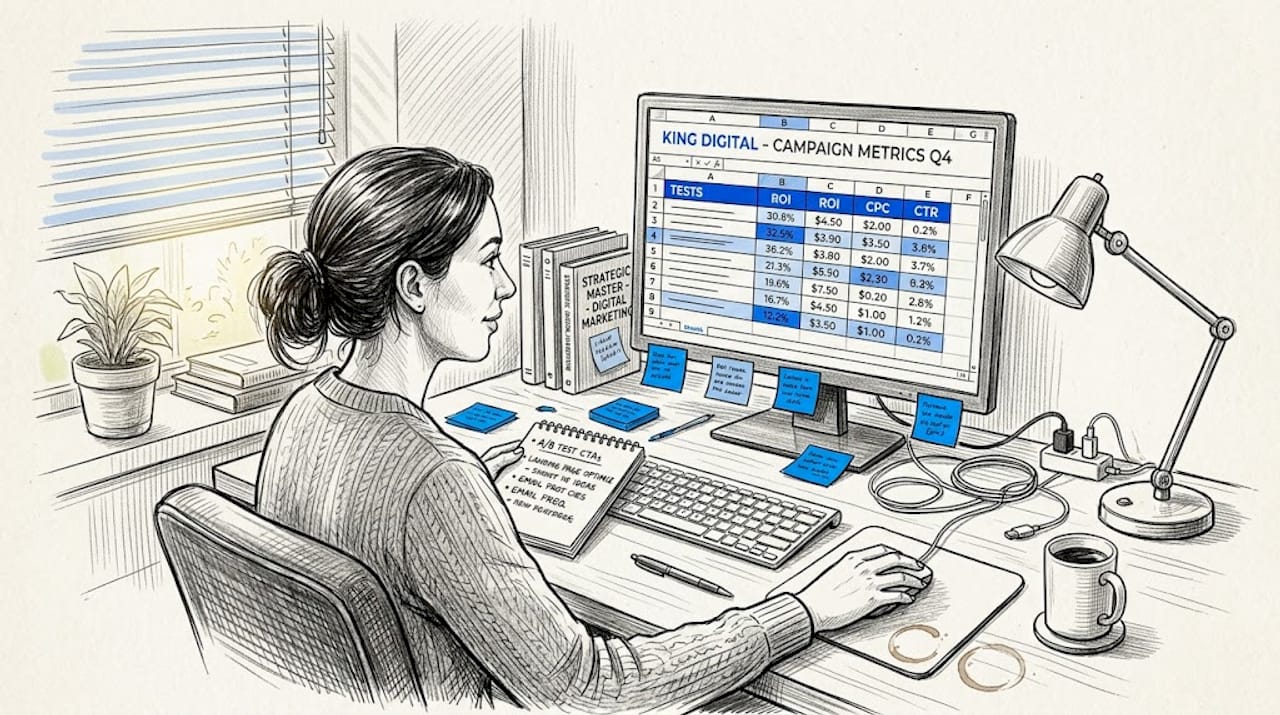
Here’s a comparison of common tactics by cost and expected ROI for Albuquerque SMBs:
| Tactic | Estimated monthly cost | Expected ROI range | Time to see results |
|---|---|---|---|
| Local SEO | $500 to $1,500 | 5:1 to 15:1 | 3 to 6 months |
| Google Ads (PPC) | $500 to $3,000 | 3:1 to 8:1 | 2 to 4 weeks |
| Email marketing | $100 to $500 | 10:1 to 40:1 | 1 to 3 months |
| Social media ads | $300 to $1,500 | 2:1 to 6:1 | 2 to 6 weeks |
| CRO improvements | $300 to $1,000 | 5:1 to 20:1 | 1 to 3 months |
Pro Tip: Albuquerque has a distinct local culture, and generic national ad copy often falls flat here. Reference local neighborhoods, events, or landmarks in your ad copy and social content. Mentioning Old Town, the Balloon Fiesta, or the East Mountains in a relevant context signals to locals that you’re one of them, not just another faceless brand.
Verification: Measuring and optimizing your digital marketing ROI
Now that your campaigns are running, the next step is ensuring they’re really paying off. Measuring ROI is not a one-time task. It’s an ongoing process that requires regular review and adjustment.
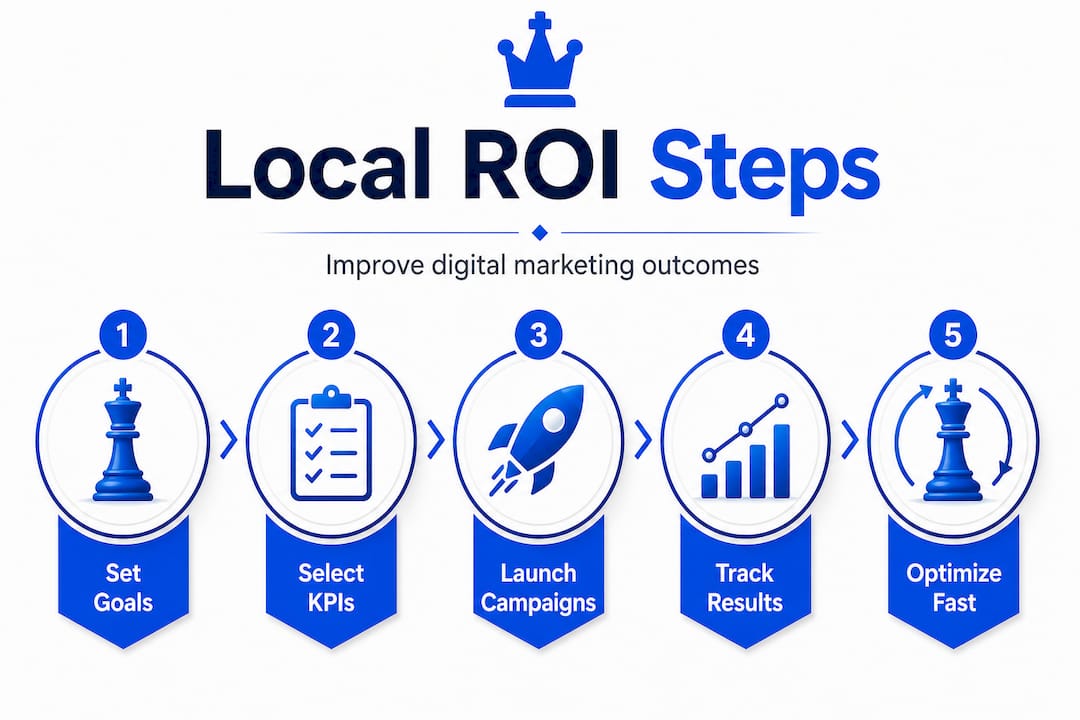
Here’s a step-by-step process for measuring and improving your digital marketing ROI:
- Set up tracking before you launch. Install Google Analytics 4 on your website, configure goal completions, and make sure your ad platforms are connected. If you skip this step, you’ll have no data to work with.
- Review reports on a consistent schedule. Weekly check-ins for paid campaigns and monthly reviews for SEO and email are a good starting rhythm.
- Calculate ROI per channel. Use a dedicated ROI calculation tool to consistently compare what each channel costs versus what it generates.
- Identify your top performers. Double down on what’s working. If local SEO is generating leads at half the cost of paid ads, shift more budget there.
- Cut or fix underperformers. If a channel has been running for 60 to 90 days and still shows a negative ROI, investigate the cause before spending more. Common culprits include poor targeting, weak landing pages, or mismatched messaging.
- Track email ROI measurement separately. Email is often undervalued because it’s inexpensive, but it deserves its own tracking to reveal its true contribution to revenue.
Statistic to know: Businesses that actively measure and optimize their digital marketing ROI consistently outperform those that don’t, with data-driven marketers reporting significantly higher efficiency and revenue growth year over year.
Pro Tip: If a campaign is underperforming, don’t wait for the full month to end before making changes. Give paid campaigns at least two weeks of data, then make one change at a time, whether that’s the headline, the audience, or the landing page. Changing too many things at once makes it impossible to know what actually improved performance.
Troubleshooting and common pitfalls in maximizing ROI
Even with the best strategy, simple mistakes can undercut results. Here’s how to stay on track and avoid the errors that quietly drain your marketing budget.
The most common ROI-killers for Albuquerque SMBs include:
- Poor targeting: Running ads to a broad national audience when your customers are all within 20 miles of downtown Albuquerque wastes money fast.
- No conversion tracking: If you can’t see which clicks turn into customers, you’re flying blind.
- Inconsistent messaging: When your ad promises one thing and your landing page delivers another, visitors leave without converting.
- Neglecting mobile users: A large portion of local searches happen on mobile devices. A slow or clunky mobile site kills conversions before they start.
- Ignoring local cultural cues: Albuquerque has a strong sense of community and identity. Marketing that feels generic or out of touch with local values tends to underperform.
Solutions for each of these problems:
- Use geo-targeting settings in Google Ads and Meta to limit your reach to Albuquerque and surrounding areas.
- Set up conversion goals in Google Analytics and verify they’re firing correctly before launching campaigns.
- Audit your ad-to-landing page message match. The headline on your ad should mirror the headline on your landing page.
- Test your site on a mobile device monthly and use Google’s PageSpeed Insights to catch performance issues.
- Weave local references and culturally relevant language into your content and ads. Understanding digital marketing terminology in a local context helps you speak more precisely to your audience.
“Chasing the latest marketing tool or platform is one of the fastest ways to waste your budget. Mastery of a few proven channels beats dabbling in many.”
Pro Tip: Be especially cautious about paid search budget management. It’s easy to let Google Ads spend money on broad, irrelevant keywords. Review your search term reports weekly and add negative keywords aggressively to protect your budget.
Why Albuquerque SMBs should rethink digital marketing ROI
Here’s a perspective you won’t hear from most national marketing blogs: the standard advice about digital marketing ROI was written for businesses with large teams, big budgets, and the luxury of waiting 12 months for results. That’s not the reality for most Albuquerque SMBs.
What I’ve seen working with local businesses is that speed of iteration matters more than perfection. A business that launches a good-enough campaign, measures results in two weeks, and adjusts will consistently outperform one that spends three months crafting the “perfect” strategy. Local markets move fast, and your competitors are not standing still.
There’s also a localization factor that national advice consistently underestimates. Albuquerque is not Phoenix. It’s not Denver. The community here responds to authenticity, local pride, and businesses that feel like neighbors rather than corporations. Local marketing ROI insights specific to the Southwest show that campaigns rooted in local storytelling and community connection regularly outperform generic campaigns, even when the generic campaigns have bigger budgets.
The uncomfortable truth is that many SMBs are copying national brand playbooks that simply don’t fit their market. Rethinking ROI means accepting that your best strategy might look nothing like what a national marketing blog recommends. It means testing faster, listening to your local audience, and trusting data over trends.
Partner with local experts for better digital ROI
If maximizing ROI feels overwhelming, expert partnership can make the difference. At King Digital, we work exclusively with Albuquerque SMBs and understand the local market in ways that generic national agencies simply don’t.
Whether you’re just getting started or looking to sharpen a strategy that’s already in motion, our team can help you identify exactly where your marketing dollars are working and where they’re not. From mastering digital marketing fundamentals to building advanced local SEO campaigns, we bring the same data-driven rigor to every client. Explore our full range of effective digital marketing solutions or start by demystifying digital marketing terms so you can make smarter decisions with confidence.
Frequently asked questions
What is a good ROI for digital marketing for small businesses?
A good ROI for digital marketing is typically considered 5:1 or higher, meaning $5 earned for every $1 spent, though some channels like email can deliver significantly more.
How do I track the ROI of my digital marketing campaigns?
Track ROI by setting up clear conversion goals in Google Analytics, using platform-specific tracking tools, and calculating returns with a structured ROI measurement process based on actual costs and revenue generated.
Which digital marketing channels have the highest ROI for Albuquerque SMBs?
SEO, local search, email, and paid search consistently deliver the highest ROI for Albuquerque small businesses, especially when campaigns are tailored to local audiences and search behavior.
What is the biggest mistake SMBs make that hurts digital marketing ROI?
Not tracking conversions or failing to align campaigns with specific revenue goals are the most damaging mistakes, and understanding your metrics is the first step toward fixing them.
Recommended
- Digital marketing for Albuquerque SMBs: grow local leads
- Social media marketing tips to boost Albuquerque SMBs
- Top content marketing tips to elevate Albuquerque SMB leads
- Social media marketing essentials for Albuquerque SMBs
- Digital Marketing Checklist 2026: 60% More Leads for SMBs
- How to build a powerful online presence for SMBs | Brainiac Media
