Marketing ROI Calculator: 1 Simple Boost to Profit
Why Marketing ROI is Your Most Important Metric
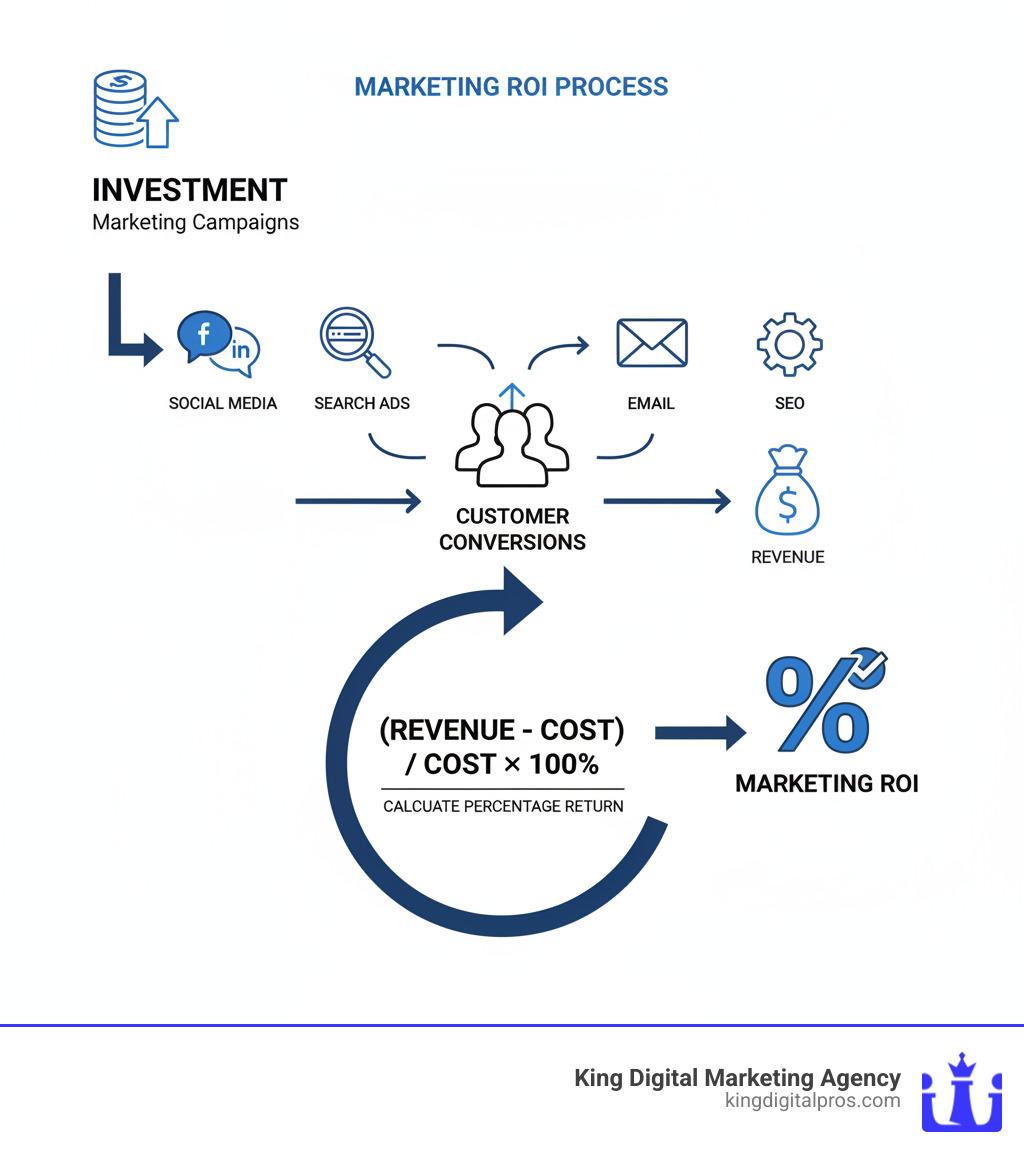
A Marketing ROI Calculator measures the revenue your marketing generates compared to what you spend. It cuts through confusing data to answer one critical question: “Is my marketing actually making money?”
Here’s the basic framework:
What You Need:
- Total revenue from marketing
- Total marketing costs (ads, software, labor, etc.)
The Formula:
- Marketing ROI = (Revenue – Cost) / Cost x 100%
What the Results Mean:
- 0% ROI = Breaking even
- 100% ROI = Doubling your investment (2:1 return)
- 500% ROI = Good performance (5:1 return)
- 1,000% ROI = Excellent results (10:1 return)
According to Marketing Week, over half of large business owners see ROI as their top metric. Yet many local businesses spend thousands on ads, SEO, and social media without knowing if they’re profitable. This uncertainty is a huge challenge. A Content Marketing Institute study found that 44% of marketers don’t measure content ROI, and research from Uptempo reveals 61% struggle with ROI calculations due to data issues.
I’m Bernadette King, founder of King Digital. For over a decade, I’ve helped local businesses use a Marketing ROI Calculator to distinguish profitable campaigns from wasteful ones, enabling smarter budget decisions.
Related content about Marketing ROI Calculator:
How to Use a Marketing ROI Calculator: A Step-by-Step Guide
Calculating ROI can feel overwhelming, but a Marketing ROI Calculator simplifies the process. Think of it like a recipe: gather the right ingredients, and the calculator does the heavy lifting. Within minutes, you’ll know if your marketing dollars are working hard or hardly working.
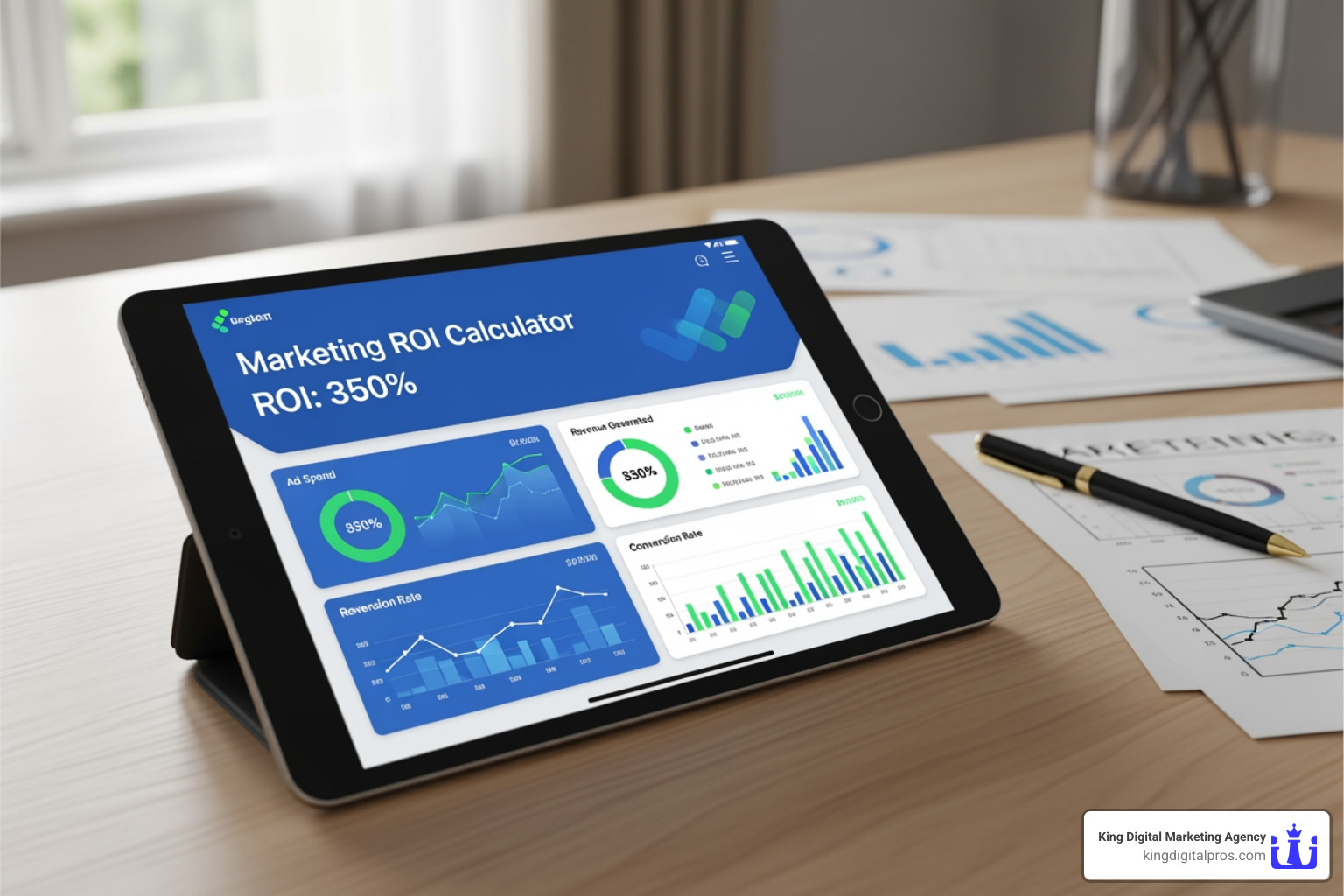
The real power of a Marketing ROI Calculator is getting a definitive answer to the question: “Is this marketing investment paying off?” Let’s walk through how to get that answer.
For a deeper understanding of how to value your marketing results, check out our Lead Value Calculator Ultimate Guide.
Step 1: Gather Your Total Marketing Costs
To get an accurate ROI, you must account for all expenses, not just the obvious ones. Many business owners only track ad spend, which inflates their perceived return.
Here’s what to include:
- Ad Spend: Costs for Google, Facebook, or local publication ads.
- Software Subscriptions: Your email platform, CRM, analytics tools, and design software.
- Labor Costs: The value of your time, your employees’ hours, or agency fees. This is the most commonly forgotten expense. Our PPC Management services help track these costs carefully.
- Content Creation: Expenses for writing, photography, video, and graphic design.
- Other Expenses: Costs for building a landing page or other campaign-specific web development.
For example, if you spent $2,000 on Facebook ads, paid a freelancer $500 for graphics, and spent 10 hours of your own time (worth $500), your true investment is $3,000, not $2,000. Ignoring these costs leads to poor decisions.
Step 2: Attribute Revenue to Your Marketing Efforts
Next, you need to connect sales directly to your marketing campaigns. This can be tricky, but several tools make it manageable.
- CRM System: Your Customer Relationship Management software should track how customers found you and their interactions over time, linking marketing touchpoints to sales.
- UTM Parameters: These are snippets of code added to your URLs (e.g.,
?utm_source=facebook) that tell your analytics exactly where traffic originates. Hootsuite’s research confirms this is vital for accurate social media tracking. - Conversion Tracking: Set up goals in Google Analytics to monitor valuable actions like form submissions, phone calls, or purchases. This shows which channels drive results. For benchmarks, see our guide on Digital Marketing Conversion Rates.
- Offline Methods: Use unique discount codes or dedicated landing pages for offline campaigns. You can also simply ask customers how they heard about you.
Attribution is complex because customers often interact with multiple marketing touchpoints before buying. Our Lead Tracking Services are designed to solve this problem, helping you confidently connect marketing activities to revenue.
Step 3: Input Your Data and Calculate
With your costs and revenue gathered, the final step is simple. Enter your total revenue from marketing and total marketing costs into the calculator.
Hit the calculate button to see your ROI percentage and net profit. A 200% ROI means for every $1 you spent, you got $3 back (your original $1 plus $2 in profit).
For example, a local shop spends $3,000 on a holiday promotion that generates $12,000 in sales. The calculation is:
($12,000 – $3,000) / $3,000 x 100% = 300% ROI.
This means you earned four dollars for every dollar invested. Using a Marketing ROI Calculator regularly transforms marketing from guesswork into a science, allowing you to invest in what works and cut what doesn’t.
Here are some free calculators to get you started:
Deconstructing the ROI Formula: What’s Under the Hood?
Understanding the formula behind a Marketing ROI Calculator helps you appreciate its power and troubleshoot results. You don’t need to be a mechanic to drive, but knowing how the engine works helps.
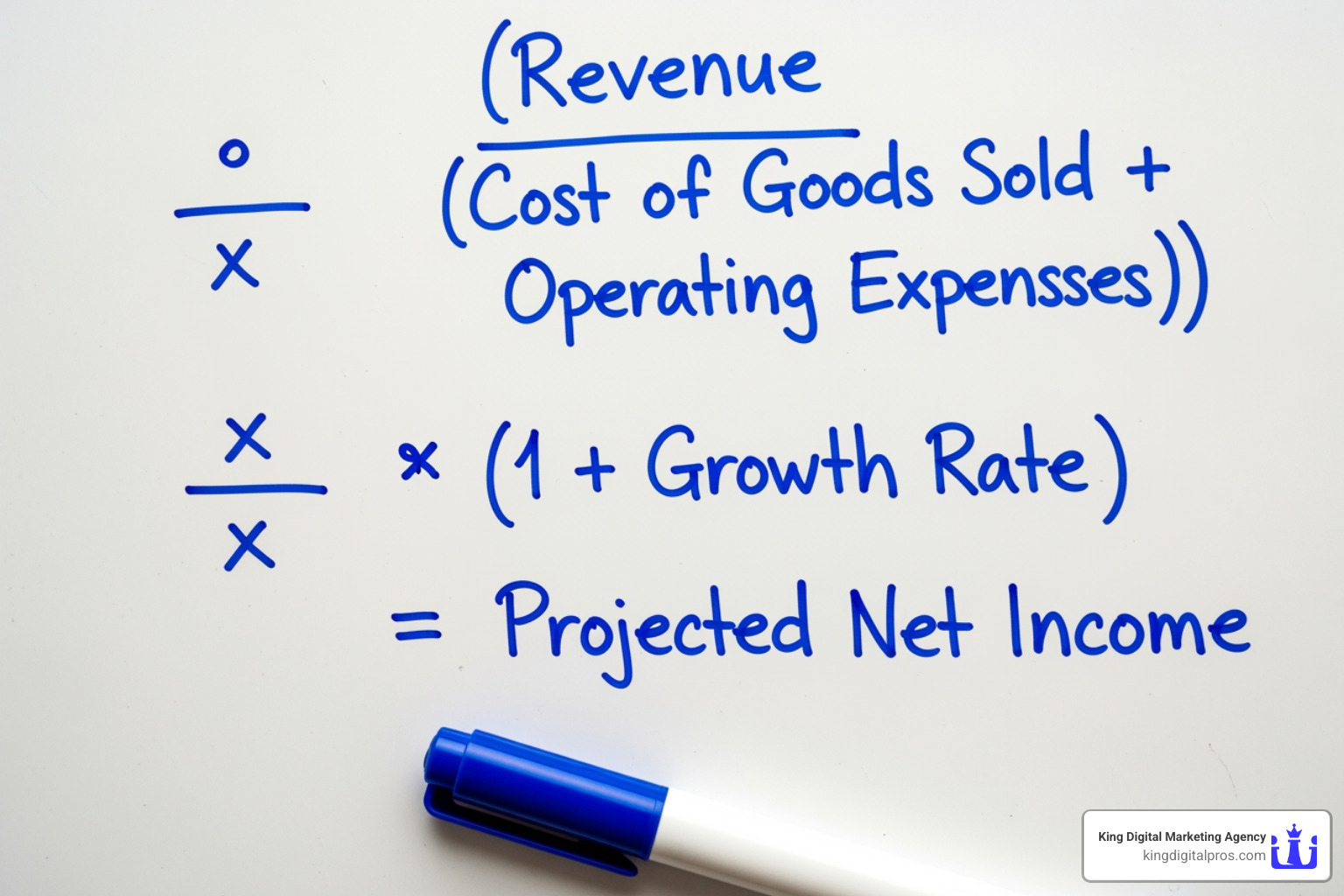
At its core, ROI measures efficiency. For us at King Digital, it’s about ensuring every marketing dollar generates measurable returns. The formula is universal, but what you include in “return” and “investment” can change the story. This is where concepts like gross profit and Customer Lifetime Value (CLV) come in. More info about how to Calculate Lead Value can help you understand these variables.
Key Components of a Marketing ROI Calculator
The basic formula has two main components:
-
Revenue from Marketing (The “Return”): This is the financial gain from your marketing. You can measure it as total sales revenue, but using gross profit (revenue minus cost of goods sold) is more accurate. For a deeper analysis, you can use net profit (which subtracts all operating expenses). For businesses with repeat customers, Customer Lifetime Value (CLV) is a powerful metric, representing the total revenue a customer generates over their entire relationship with you.
-
Cost of Marketing (The “Investment”): This includes all related expenses: ad spend, software, labor, content creation, and agency fees. The more thorough you are, the more accurate your ROI will be.
Here’s how different approaches compare:
| Calculation Type | “Return” Component | “Investment” Component | Formula |
|---|---|---|---|
| Simple ROI | Direct Revenue from Campaign | Total Marketing Costs | (Direct Revenue – Total Costs) / Total Costs x 100% |
| CLV-based ROI | CLV x New Customers Acquired | Total Marketing Costs | ((CLV x New Customers) – Total Costs) / Total Costs x 100% |
The Standard Marketing ROI Formula
The most common formula is:
Marketing ROI = (Revenue from Marketing – Cost of Marketing) / Cost of Marketing x 100%
For example, if a local bakery spends $5,000 on a campaign that brings in $10,000 in sales:
Marketing ROI = ($10,000 – $5,000) / $5,000 x 100% = 100%
A 100% ROI means you doubled your money. A positive percentage means you made a profit; a negative one means you lost money.
Common Challenges When Using a Marketing ROI Calculator
While the formula is simple, real-world application has its challenges.
- Attribution Complexity: The customer journey is rarely linear. A customer might see a Facebook ad, then Google you, then click an email link before buying. Deciding which touchpoint gets credit is difficult. This is why research from Uptempo found that 61% of marketers struggle with ROI calculations.
- Time Lag: Some strategies, like SEO or content marketing, take months or even years to show significant returns. Measuring ROI too early can be misleading. For instance, First Page Sage notes that SEO campaigns can deliver an average ROI of 825%, but this develops over time.
- Unmeasurable Value: How do you quantify the ROI of brand awareness or a glowing customer review? These assets have real value but don’t fit neatly into a formula.
- Incomplete Data: If your tracking isn’t set up correctly or data is siloed, your calculations will be inaccurate. This is why comprehensive Lead Tracking Services are so important.
Despite these problems, calculating ROI is worth the effort. It provides a North Star for your marketing decisions.
What is a “Good” Marketing ROI? (Benchmarks & Context)
A “good” ROI isn’t a single magic number. It depends on your industry, business model, campaign goals, and business stage. For a new business in Edgewood, breaking even might be a win. For an established Santa Fe company, anything less than a 500% return could be a disappointment.

However, there are accepted benchmarks that provide context and help set realistic goals for campaigns across Albuquerque, Rio Rancho, and beyond.
Understanding ROI Percentages
When your Marketing ROI Calculator gives you a percentage, here’s how to interpret it:
- Break-even (0% ROI): You earned back exactly what you spent. You’re not losing money, which can be acceptable for brand awareness campaigns or when testing a new channel.
- Acceptable (100% or 2:1): You’ve doubled your money. Every dollar invested generated two dollars back. This is often considered the minimum threshold for a worthwhile campaign.
- Good (500% or 5:1): You’re getting back five times your investment. This indicates strong performance and a campaign that is generating substantial profit.
- Excellent (1,000% or 10:1): You’ve hit a home run. These campaigns have the right message, audience, and timing. While not every campaign will reach this level, it’s achievable with strategic execution.
These are guidelines, not rules. A campaign to launch a new service in Los Alamos might have a lower initial ROI than a retargeting campaign aimed at warm leads.
Channel-Specific ROI Benchmarks
Different marketing channels have different cost structures and timelines, leading to varied ROI benchmarks. Understanding these helps you set realistic expectations.
- Email Marketing: This channel is a powerhouse, with an ROI that can reach an astounding 3,600%, according to Litmus. The low cost and high engagement with an opted-in audience make it incredibly effective.
- SEO: Search Engine Optimization delivers impressive long-term returns, with an average ROI of 825%, per First Page Sage research. It’s a marathon, not a sprint, often taking 6-24 months to see full results, but the sustained organic traffic it generates is invaluable. Our SEO Services focus on building this long-term value.
- Google Ads: Paid search averages around a 200% ROI, based on Google’s own methodology. While lower than email or SEO, it offers immediate visibility and precise targeting, allowing you to reach customers who are actively searching for your services right now.
Context is key. A 100% ROI from a competitive Google Ads campaign in Rio Rancho might be great, but the same return from an email campaign suggests room for improvement. Always consider the channel you’re measuring.
Actionable Strategies to Boost Your Marketing ROI
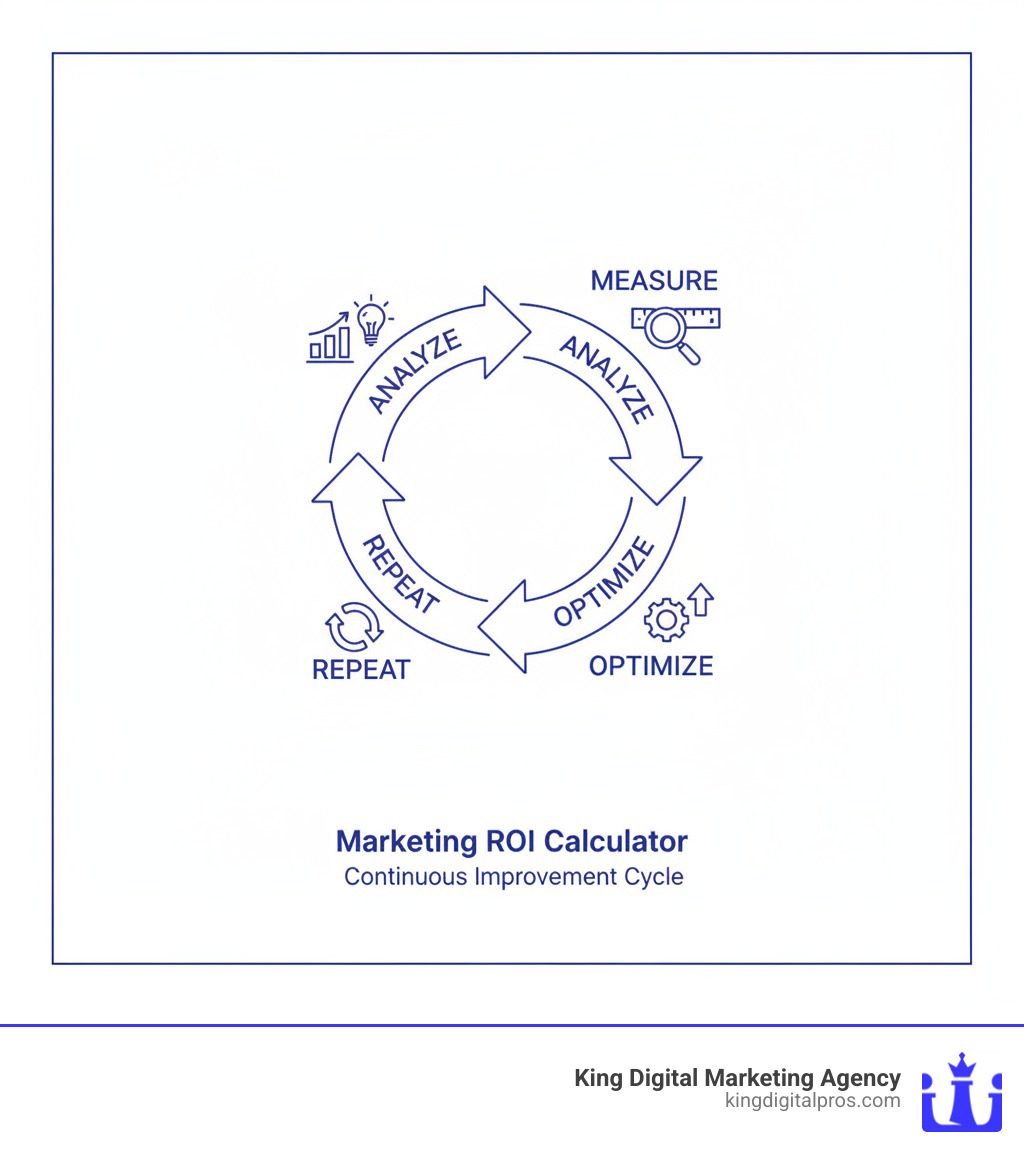
Calculating your Marketing ROI is the first step. The real value comes from using those insights to continuously improve. It’s a cycle: measure, analyze, optimize, and repeat. For local businesses in Albuquerque or Santa Fe, even small improvements can lead to significant growth.
Here are three key strategies to boost your returns.
Optimize Your Conversion Funnel
A high ROI depends on converting traffic efficiently. Your conversion funnel is the path a visitor takes to become a customer. Any friction on this path lowers your ROI.
- Streamline the User Journey: Make it easy for visitors to find what they need and take action. A confusing website leads to lost customers.
- Improve Page Speed: A one-second delay in page load time can reduce conversions by 7%. Ensure your site is fast, especially on mobile.
- Simplify Forms: Long, complex forms kill conversions. Ask only for essential information. Every extra field can decrease completion rates.
- Strengthen Your CTAs (Calls-to-Action): Use clear, action-oriented language like “Get a Free Quote” instead of a generic “Submit.” A/B test different wording, colors, and placements.
Removing these obstacles makes it easier for customers to convert, directly boosting your Marketing ROI. For more, see our Conversion Optimization Complete Guide.
Focus on High-Performing Channels
Not all marketing channels perform equally for your business. A smart strategy involves identifying your highest-ROI channels and reallocating your budget accordingly. It’s like fishing: cast more lines where the fish are biting.
- Analyze Your Data: Regularly review the ROI for each channel—Google Ads, social media, email, SEO—separately. If email delivers a 150% ROI while paid social returns only 30%, you know where to focus.
- Reallocate Your Budget: Shift funds toward the channels generating the best returns. This doesn’t mean abandoning underperformers, but rather optimizing them or reducing investment until they prove their worth.
- Scale Your Success: Once you’ve identified a winning channel, scale it. Can you expand your successful Google Ads campaigns? Can you double down on the SEO tactics that are driving traffic? Strategic scaling maximizes overall ROI.
Learn how to Improve Search Ranking to ensure your local SEO efforts are among your top performers.
Increase Customer Lifetime Value (CLV)
Acquiring a new customer is more expensive than retaining an existing one. By increasing Customer Lifetime Value (CLV)—the total revenue a customer generates over time—you can boost your overall ROI without increasing acquisition costs.
- Implement Loyalty Programs: Reward existing customers to encourage repeat business. A simple points system can make customers feel appreciated.
- Upsell and Cross-sell: Once you’ve earned a customer’s trust, offer them complementary products (cross-selling) or higher-value versions of what they bought (upselling).
- Use Nurture Sequences: Automated email sequences can build relationships post-purchase, offer valuable content, and encourage repeat business.
- Provide Exceptional Customer Service: Happy customers are loyal customers. Great service reduces churn and encourages word-of-mouth referrals, which have zero acquisition cost.
Focusing on CLV is crucial for service providers and retailers who rely on repeat business. More info about Online Sales Lead Management can help you nurture leads into loyal, high-CLV customers.
Frequently Asked Questions about Marketing ROI
We talk to local business owners every day about marketing metrics. Here are answers to some of the most common questions we hear when they use a Marketing ROI Calculator.
How does marketing ROI differ from ROAS?
This is a critical distinction. Both measure performance, but they look at different things.
-
ROAS (Return on Ad Spend) is a narrow metric focused only on advertising. It measures the gross revenue generated for every dollar of ad spend (Revenue / Ad Spend). It’s great for gauging the immediate effectiveness of an ad campaign.
-
Marketing ROI is a broader profitability metric. It accounts for all marketing costs—ads, software, salaries, agency fees, etc.—to determine the net profit of your entire marketing effort.
Think of ROAS as checking one ingredient, while Marketing ROI tells you if the whole dish was a success. For strategic business decisions, Marketing ROI is the more important metric.
How often should I calculate marketing ROI?
It depends on the channel and your sales cycle.
-
For short-term campaigns like PPC or social media ads, calculate ROI weekly or monthly. These channels are fast-moving, and you need to make quick adjustments to optimize performance.
-
For long-term strategies like SEO and content marketing, calculate ROI quarterly or annually. These efforts need time to build momentum. According to Search Engine Journal, SEO can take 6-24 months to show its full impact. Calculating too early could lead you to abandon a potentially profitable strategy.
Also, consider your sales cycle. A business with a long sales cycle needs to measure ROI over a longer timeframe.
Should I include staff salaries in my marketing costs?
Yes, absolutely. Ignoring labor costs gives you an inflated and inaccurate ROI.
Your marketing doesn’t run itself. Someone is planning campaigns, creating content, and analyzing data. That time is a real cost. For an accurate ROI, you must include the portion of salaries and overhead dedicated to marketing.
For example, a campaign might show a 300% ROI based on $2,000 in ad spend. But if you add $1,500 in staff time, the total investment is $3,500, and the ROI drops significantly. This new number is the real picture.
Including these costs is essential when comparing in-house efforts to agency work. The U.S. Bureau of Labor Statistics reports the median salary for a marketing manager is over $140,000, a substantial investment. Using a Marketing ROI Calculator with all costs included helps you make honest, smart decisions.
Conclusion: From Calculation to Conversion
In today’s digital landscape, you need to understand the financial impact of every marketing dollar. The Marketing ROI Calculator is the tool that transforms guesswork into a data-driven strategy, which is essential for local businesses in competitive markets like Albuquerque and Santa Fe.
We’ve covered how to use the calculator, what the numbers mean, and actionable strategies to boost your returns. The journey from calculation to conversion is about continuous improvement: measure, analyze, and optimize to drive sustainable growth.
This approach allows you to justify your marketing spend and prove its tangible value. At King Digital Marketing Agency, we specialize in helping local businesses implement expert strategies that maximize their ROI, ensuring your investments translate into real, measurable profits.
Don’t let your marketing budget be a black hole. Take control, gain clarity, and make smarter decisions.
Use our Marketing ROI Calculator to get started
