
Why Conversion Rate Optimization Best Practices Can Make or Break Your Business Growth
Applying conversion rate optimization best practices is one of the highest-ROI moves any business can make – and the numbers back it up. Here’s a quick-reference snapshot of the core practices:
| CRO Best Practice | Why It Matters |
|---|---|
| Speed up your pages | A 3-second load time makes users 32% more likely to bounce |
| Simplify forms | 27% of users abandon forms that feel too long |
| Add social proof | Customer reviews can lift conversions by up to 270% |
| Use clear, specific CTAs | Personalized CTAs convert 202% better than generic ones |
| A/B test everything | Data-driven changes beat gut-feel decisions every time |
| Optimize for mobile | 53% of mobile users abandon pages that take over 3 seconds to load |
| Reduce checkout friction | 18% of shoppers abandon orders due to a complicated checkout |
The median conversion rate across all industries sits at just 4.3%. That means the vast majority of your website visitors leave without taking action.
The good news? Small, targeted changes can move that number significantly. When Expedia removed a single field from their checkout form, they added $12 million in profit. One travel company changed three words in a CTA and saw homepage conversions jump 104% month over month.
You don’t need more traffic to grow. You need to make better use of the traffic you already have.
I’m Bernadette King, founder of King Digital Marketing Agency and a digital marketing strategist with years of experience helping franchise owners and small businesses implement conversion rate optimization best practices that turn website visitors into paying customers. In this guide, I’ll walk you through exactly what works – no fluff, no guesswork, just proven strategies you can start using today.
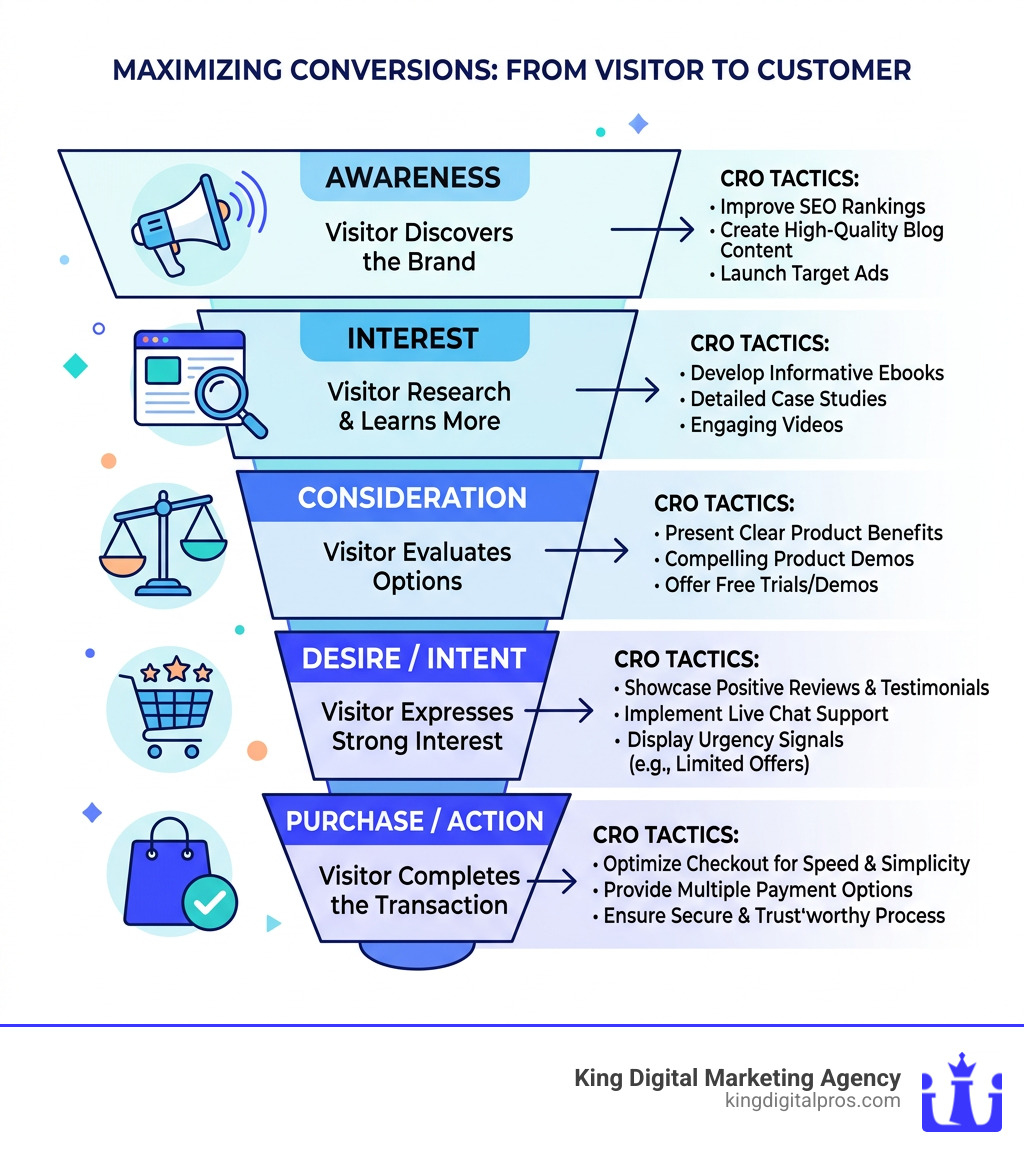
Key terms for conversion rate optimization best practices:
Foundational Conversion Rate Optimization Best Practices for 2025
Before we dive into the “bells and whistles,” we need to talk about the bedrock of any successful strategy. At its core, What is Conversion Rate Optimisation? It is the systematic process of increasing the percentage of website visitors who take a specific, desired action. Whether you are operating in Albuquerque or Santa Fe, the principles remain the same: data must lead the way.
We often see business owners making changes based on “gut feelings” or because a competitor’s site looks a certain way. In conversion rate optimization best practices, your opinion (and ours!) matters far less than what the data tells us.

To build a winning strategy, we combine two types of data:
- Quantitative Analysis: This is the “what.” Tools like Google Analytics show us where people drop off, which pages have high bounce rates, and how long they stay.
- Qualitative Research: This is the “why.” By using session recordings or heatmaps, we can see users getting frustrated with a broken button or a confusing menu.
One of the most powerful foundational elements is social proof. Scientific research on review impact indicates that displaying customer reviews and quotes can increase conversion rates by as much as 270%. If you aren’t showcasing what your happy customers in Rio Rancho or Taos are saying, you’re leaving money on the table.
Aligning Messaging with Search Intent
Every visitor arrives at your site with a “backstory.” Maybe they clicked a Google Ad for “emergency plumbing in Los Alamos” or found your blog post about “how to fix a leaky faucet.” Their Digital Marketing Conversion Rate depends heavily on “message matching.”
If your ad promises a “15-minute consultation” but your landing page doesn’t mention it until the very bottom, you’ve created a disconnect. This “pre-visit context” is central to conversions. To fix this, your hero section (the part of the page visible without scrolling) should immediately mirror the promise made in your marketing. If they searched for a specific keyword, that keyword should appear in your headline. It reassures the visitor they are in the right place.
Reducing Friction in the Customer Journey
Friction is anything that slows a user down or makes them think too hard. High “cognitive load” is a conversion killer. We want to Boost Conversion Rates by making the path to purchase as slippery as a slide.
Common friction points include:
- Navigation Overload: If your menu has 20 items, users get “choice paralysis.” Simplify your navigation to highlight only the most important paths.
- Decision Breaks: These occur when a user has to stop and wonder, “Is this safe?” or “What happens next?”
- User Frustration Signals: We look for “rage clicks” (when a user clicks a button repeatedly because it’s slow) or “dead clicks” to identify where the journey is breaking.
Optimizing Design and User Experience (UX)
Design isn’t just about looking pretty; it’s about guiding the eye. In the digital marketing world, we use specific patterns to ensure visitors see what we want them to see.
| Feature | Mobile Optimization | Desktop Optimization |
|---|---|---|
| User Pattern | Vertical Scrolling | F-Pattern / Z-Pattern |
| Touch Targets | Large, thumb-friendly buttons | Precise cursor-friendly links |
| Load Speed | Critical (53% abandon at 3s+) | Important, but slightly more leeway |
| Visuals | Compressed, vertical images | High-res, wide-screen hero shots |
Page speed is arguably the most important UX factor. Research on bounce rates and speed shows that as page load time increases from 1 to 5 seconds, the probability of a bounce increases by 90%. In our service areas like Edgewood and Tijeras, where mobile data might fluctuate, a fast-loading site is a massive competitive advantage.
Crafting Compelling Calls to Action (CTAs)
Your CTA is the bridge between a visitor and a customer. Following Conversion Funnel Optimisation Best Practices means moving away from boring buttons like “Submit” or “Click Here.”
Instead, use action-oriented language that highlights the benefit. “Get My Free Quote” or “Start My Trial” tells the user exactly what they are getting. Also, don’t ignore the “eye candy” factor. Rounded CTA buttons can receive 17% to 55% more clicks than sharp-angled ones. Why? Because our brains perceive sharp angles as “threatening” and rounded corners as “friendly.” Use contrasting colors (like a bright orange button on a blue background) to make sure they pop.
Streamlining Forms for Higher Completion
Forms are often where the magic happens – and where it dies. Effective Lead Conversion Tracking starts with a form that people actually finish.
The “Expedia Lesson” is famous for a reason: removing just one unnecessary field resulted in $12 million in profit. 27% of users will bail on a form if it’s too long.
- Field Reduction: Only ask for what you absolutely need. If you don’t need their fax number, don’t ask for it!
- Progressive Disclosure: If you must have a long form, break it into steps. It feels less overwhelming.
- Autocomplete: Enable browser autocomplete to save users from typing their address for the thousandth time.
Leveraging Psychology and Social Proof
Humans are social creatures. We look to others to decide what is safe and valuable. This is why social proof is the “secret sauce” in conversion rate optimization best practices.
Research on testimonial impact shows that testimonials alone can increase conversion rates by 34%. But don’t just bury them on a “Testimonials” page. Place them near your CTAs or on your checkout page to provide reassurance at the moment of decision.
Other psychological triggers include:
- Trust Signals: Security badges (like McAfee or SSL icons) and “Money Back Guarantees” reduce the “fear of the unknown.”
- Urgency & FOMO: “Only 2 left in stock” or “Offer expires in 2 hours” can nudge a fence-sitter into taking action. Just make sure it’s genuine – fake urgency destroys trust.
Implementing Conversion Rate Optimization Best Practices in E-commerce
E-commerce is a different beast. Because the transaction happens entirely online, the level of trust required is higher. Our Conversion Optimization Complete Guide emphasizes that high-quality product photography is non-negotiable. Only 25% of e-commerce sites provide enough images for users to properly evaluate a product.
To kill checkout friction:
- Offer Guest Checkout: Don’t force people to create an account before they buy.
- Multiple Payment Options: Include Apple Pay, PayPal, and “Buy Now, Pay Later” (BNPL) options like Klarna.
- Clear Return Policies: 11% of buyers abandon orders because they aren’t happy with the return policy. Put it in your footer so it’s easy to find.
Personalization and Behavioral Targeting
In 2025, “one size fits all” is dead. How to Measure Marketing ROI effectively involves looking at how personalized experiences drive value. Personalized CTAs are 202% more likely to convert than basic ones.
We can use “dynamic content” to show different messages based on:
- Location: “Free shipping to Albuquerque!”
- Browsing History: Showing products similar to what they just viewed.
- Referral Source: If they came from a specific influencer’s post, greet them with a tailored discount code.
The Role of Data Analysis and Experimentation
You can’t improve what you don’t measure. In conversion rate optimization best practices, experimentation is the engine of growth.
We use several tools to get the full picture:
- Heatmaps: These show us where people click, move their mouse, and scroll.
- Session Recordings: Watching a real user struggle to find your “Contact” page is eye-opening.
- A/B Testing: This is the gold standard. We show Version A to half your visitors and Version B to the other half. The winner stays, and then we test a new challenger.
To prioritize what to test first, we use the PIE Framework:
- Potential: How much improvement can be made on this page?
- Importance: How much traffic does this page get?
- Ease: How difficult is it to implement this change?
Measuring Success with Conversion Rate Optimization Best Practices
Success isn’t just a higher conversion rate. We use Lead Tracking Services to monitor a variety of Key Performance Indicators (KPIs):
- Bounce Rate: Are people leaving immediately?
- Average Order Value (AOV): Are our upsells working?
- Micro-Conversions: Are they signing up for the newsletter even if they don’t buy yet?
- Funnel Analysis: Where is the “leak” in our bucket?
Avoiding Common CRO Mistakes
Even the pros can stumble. Here are the pitfalls we see most often in places like Cedar Crest and Sandia Park:
- Intuition-Based Changes: Changing your site because you “like the color blue” is a recipe for failure. Let the data decide.
- Small Sample Sizes: Don’t end an A/B test after 10 visitors. You need statistical significance to ensure the result isn’t just a fluke.
- Ignoring Mobile: With over 60% of web traffic coming from mobile, a “desktop-first” mentality will kill your conversions.
- Over-Complicating Funnels: If your “simple” sign-up involves five different pages, you’re going to lose people at every step. Is Your Website Converting? If not, complexity is usually the culprit.
Frequently Asked Questions about CRO
What is a good conversion rate for my industry?
While the median is 4.3%, “good” is relative. E-commerce often hovers around 2-3%, while high-performing SaaS landing pages can hit 10% or more. The best benchmark is your own historical data – aim to beat your previous month, every month.
How long should I run an A/B test before making changes?
Typically, you want a test to run for at least two full business cycles (usually two weeks) to account for variations in weekend vs. weekday behavior. You also need enough traffic (usually 1,000+ visitors per variant) to reach statistical significance.
Does conversion rate optimization affect my SEO rankings?
Yes! Google pays close attention to user experience signals. If conversion rate optimization best practices help reduce your bounce rate and increase time-on-site, search engines see your site as more valuable, which can lead to higher rankings.
Conclusion
At King Digital Marketing Agency, we believe that your website should be your hardest-working salesperson. Whether you are looking for more leads in Albuquerque or trying to dominate the map listings in Grants, implementing these conversion rate optimization best practices is the key to sustainable growth.
We specialize in helping local businesses enhance their visibility through expert Google Business Profile management and data-driven website improvements. Don’t let your hard-earned traffic go to waste. If you’re ready to turn those clicks into customers, explore our Conversion Optimization Services today. Let’s work together to make your business the king of its local market!