
Local Marketing ROI: Maximize 2025 Profits
Why Local Marketing ROI is Your Business’s North Star
Understanding local marketing roi means knowing what you get back for every dollar spent on marketing. Here’s what you need to know:
Key Components of Local Marketing ROI:
- Revenue Generated – Sales directly attributed to your marketing efforts
- Cost of Marketing – Total investment in ads, tools, and time
- ROI Calculation – (Revenue – Cost) / Cost x 100 = ROI percentage
- Typical Benchmarks – Successful local businesses often aim for a 4:1 to 5:1 return.
The numbers tell a compelling story. Recent studies show that 72% of consumers who search locally visited a store within five miles, and 78% of location-based mobile searches resulted in an offline purchase. Yet, 44% of small businesses aren’t tracking any ROI at all.
This means nearly half of local business owners are flying blind, missing the chance to double down on successful campaigns and cut the ones that drain their budgets.
Over 20% of national brands now spend 25% or more of their budget on local marketing. Companies that track ROI are 35% more likely to invest in local marketing than those who don’t.
The good news is that measuring local marketing ROI isn’t complicated. You don’t need expensive software or a marketing degree, just the right approach and simple tools to track what matters.
I’m Bernadette King, founder of King Digital Marketing Agency. I’ve spent years helping businesses transform their local marketing roi from guesswork into predictable growth. With targeted SEO, reputation management, and conversion-driven strategies, I’ve seen how the right measurement approach turns marketing expenses into profitable investments.
The Core Components of a High-ROI Local Marketing Strategy
A profitable local marketing roi comes from focusing on strategies that drive real customers and revenue. For local businesses, the foundation consists of four pillars: strong local SEO, an optimized Google Business Profile, a stellar online reputation, and localized content. These elements work together, creating a marketing ecosystem that attracts the right customers.
Mastering Local SEO for Maximum Return
Local SEO tells search engines where you are and what you do, directing qualified prospects to your business. Your goal is to appear first in local search results, looking trustworthy and relevant.
NAP consistency is the backbone of local SEO. Your business Name, Address, and Phone number must be identical across all online platforms. Even minor differences like “St.” vs. “Street” can confuse search engines and harm your visibility.
Local citations, or mentions of your business information on reputable websites, signal to Google that you’re an established part of the community, building trust with search engines.
Building quality backlinks from other local businesses, community organizations, and local news sites strengthens your local authority and shows search engines you’re a valued part of your community.
With “near me” mobile searches growing by over 900%, a mobile-friendly website is essential. A poor mobile experience loses customers instantly.
We approach this systematically through thorough Local SEO Keyword Research to understand how customers search. For multi-location businesses, we create targeted Local SEO Location Pages for each community.
The Power of Your Google Business Profile
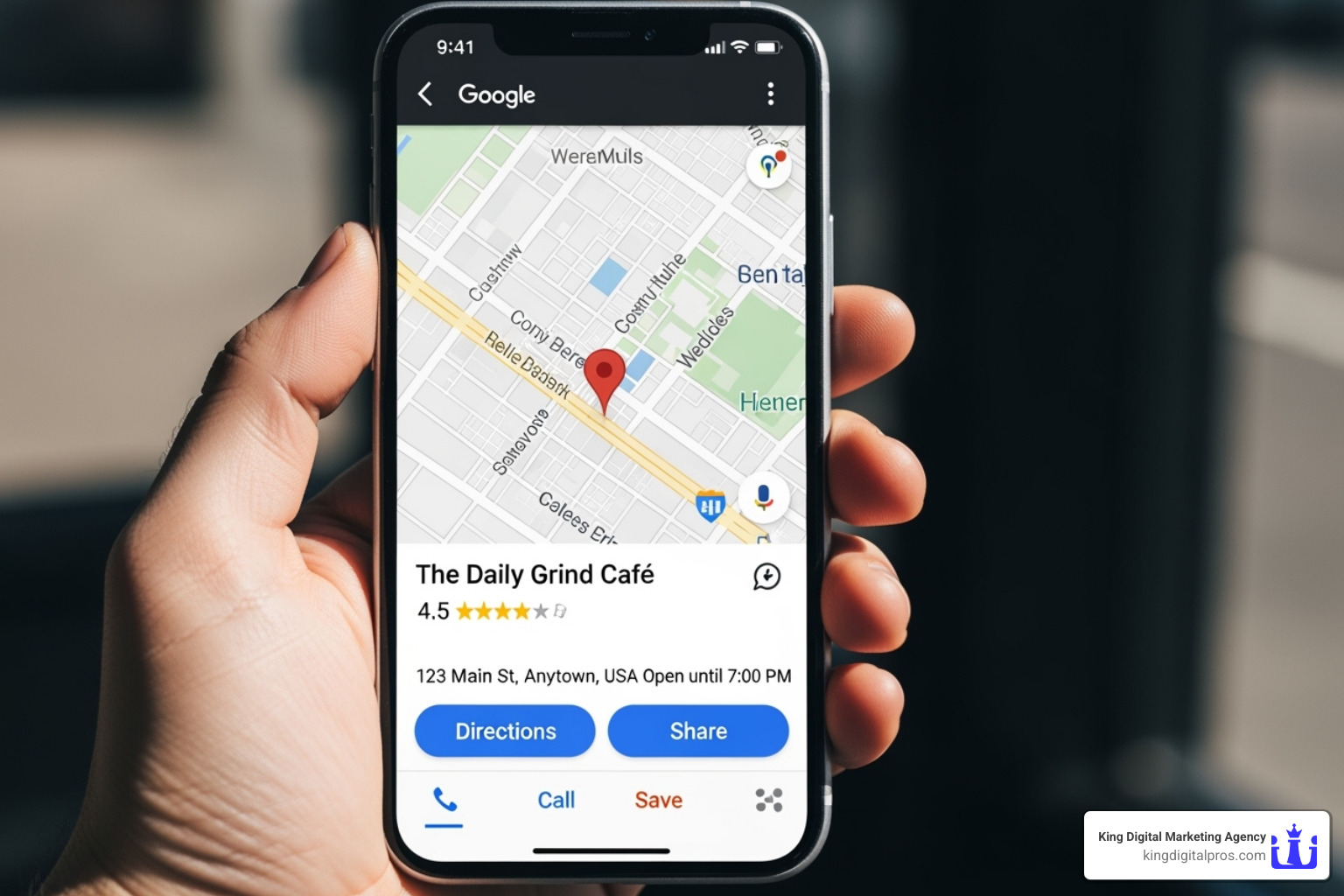
Your Google Business Profile is free, prime digital real estate. It’s often a customer’s first impression and is crucial for your local marketing roi. A complete profile with accurate hours, services, and a compelling description builds credibility with both Google and customers.
Use Google Posts to share updates, special offers, or events. These posts appear in your listing and give customers timely reasons to choose you.
The Q&A feature lets you proactively address customer questions. Monitor it regularly and add your own FAQs to provide helpful information.
Clearly defining your service areas helps Google match your business with the right local searches, which is vital if you travel to your customers.
We specialize in Attracting Customers Via Google Maps by making your listing stand out. Professional Google Business Page Management involves ongoing optimization and strategic use of all features.
Leveraging Online Reviews and Reputation
Your online reputation directly impacts local marketing roi. With 77% of consumers reading reviews for local businesses, your reputation is a powerful marketing tool. Happy customers often forget to leave reviews, so make it easy for them by asking right after they’ve expressed satisfaction.
Respond to all reviews. Thank customers for positive feedback. For negative reviews, respond professionally, acknowledge their concerns, and offer to resolve the issue offline to show you handle problems responsibly.
Star ratings directly impact visibility and conversions. Businesses with ratings above 4.0 stars appear more frequently in local search and get higher click-through rates. Our approach to Leveraging Your Reputation creates systems to consistently generate positive reviews.
Creating Localized Content That Converts
Localized content speaks to your community’s specific needs and interests, creating stronger connections and driving better local marketing roi. Writing about local events, landmarks, or community concerns shows customers you understand their world, building trust quickly.
Voice search optimization is crucial as more people use conversational queries like, “Where’s the best pizza place near downtown?” Create content that answers these natural questions.
Community-focused content, such as posts about local events you sponsor, demonstrates your commitment and often gets shared organically. Localized content receives 12 times more engagement than generic content, leading to more trust and conversions.
We ensure your content strategy aligns with conversion goals by focusing on Is Your Website Converting?, guiding visitors toward becoming customers. When these four components work together, they create a system that delivers strong local marketing roi.
How to Accurately Calculate and Track Your Local Marketing ROI
Measuring local marketing roi can feel like solving a puzzle. You know marketing is working, but proving which specific efforts drove customers can be tricky. Tracking customers from online searches to offline purchases is a common challenge. However, with the right approach and tools, you can measure your marketing’s true financial impact. The key is a system that connects online efforts to real-world revenue, moving beyond vanity metrics like visits and likes.
Setting the Stage: Essential KPIs and Metrics
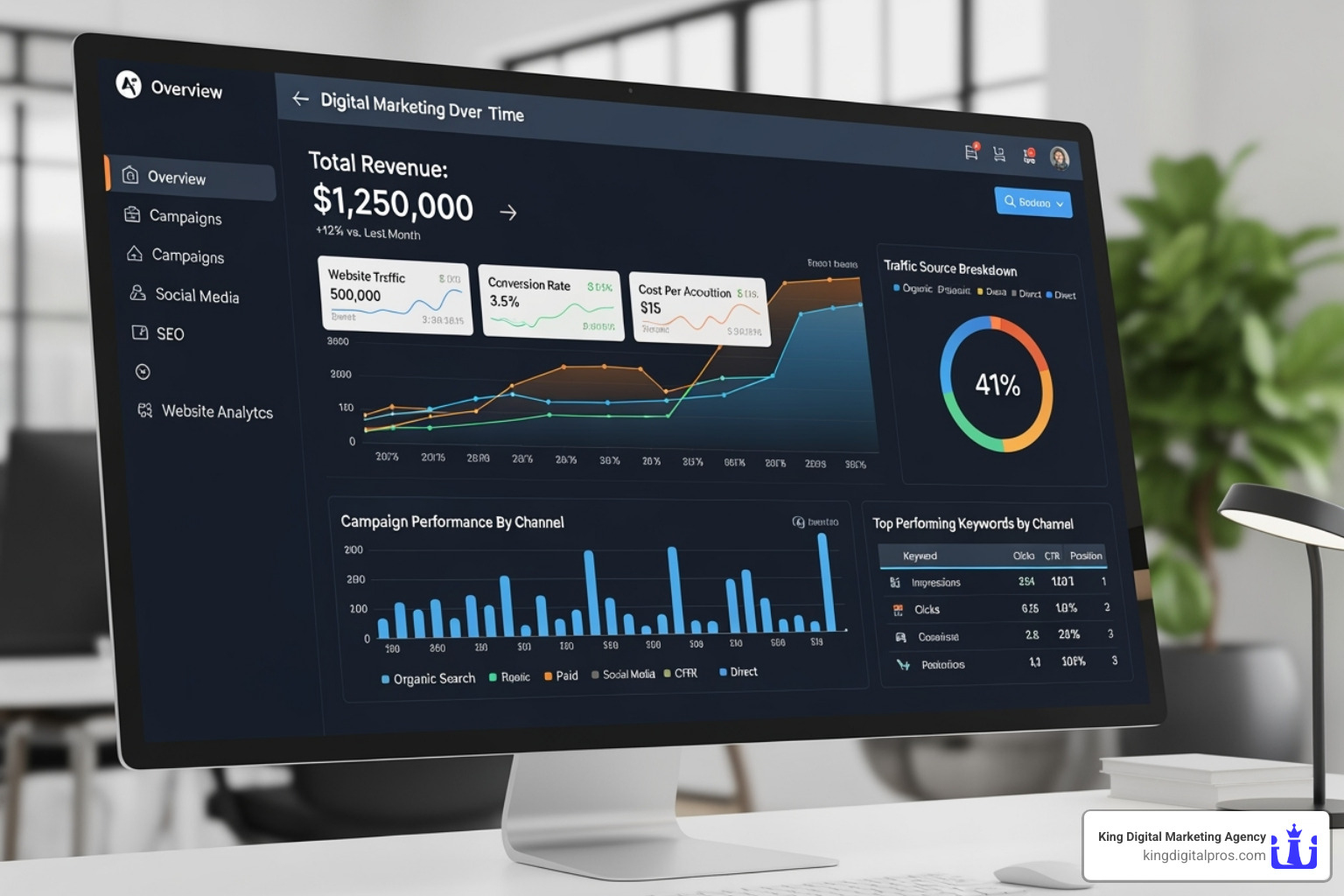
Before calculating ROI, you must define your Key Performance Indicators (KPIs). These are your marketing’s vital signs.
- Conversion rate is the percentage of people who take a desired action (e.g., call, fill a form). A strong Digital Marketing Conversion Rate shows your message is effective.
- Cost Per Acquisition (CPA) is the cost to gain one new customer. A low CPA relative to customer value is ideal.
- Customer Lifetime Value (CLV) is the total revenue a customer generates over time. Understanding CLV helps justify marketing spend to acquire high-value, long-term customers.
- Lead value helps you prioritize efforts. Our Lead Value Calculator can estimate the potential revenue from each lead.
The Formula for Calculating Local Marketing ROI
The basic ROI formula is (Sales Growth – Marketing Cost) / Marketing Cost x 100. For local marketing roi, the key is focusing on attributable revenue – sales you can directly trace to specific marketing efforts. For example, if your business grows 10% organically and a new campaign leads to 25% total growth, the attributable growth from marketing is 15%.
To calculate your true ROI, identify the total revenue from a campaign and subtract your average organic sales growth. Then, add up all marketing costs, including ad spend, tools, and staff time.
A real example: A local restaurant invests $2,000 in Google Ads and local SEO. They track $8,000 in new revenue directly from these efforts. Their ROI is ($8,000 – $2,000) / $2,000 x 100 = 300%. Our Tools & Marketing ROI Calculator simplifies this process.
Bridging the Gap: Tracking Online-to-Offline Conversions
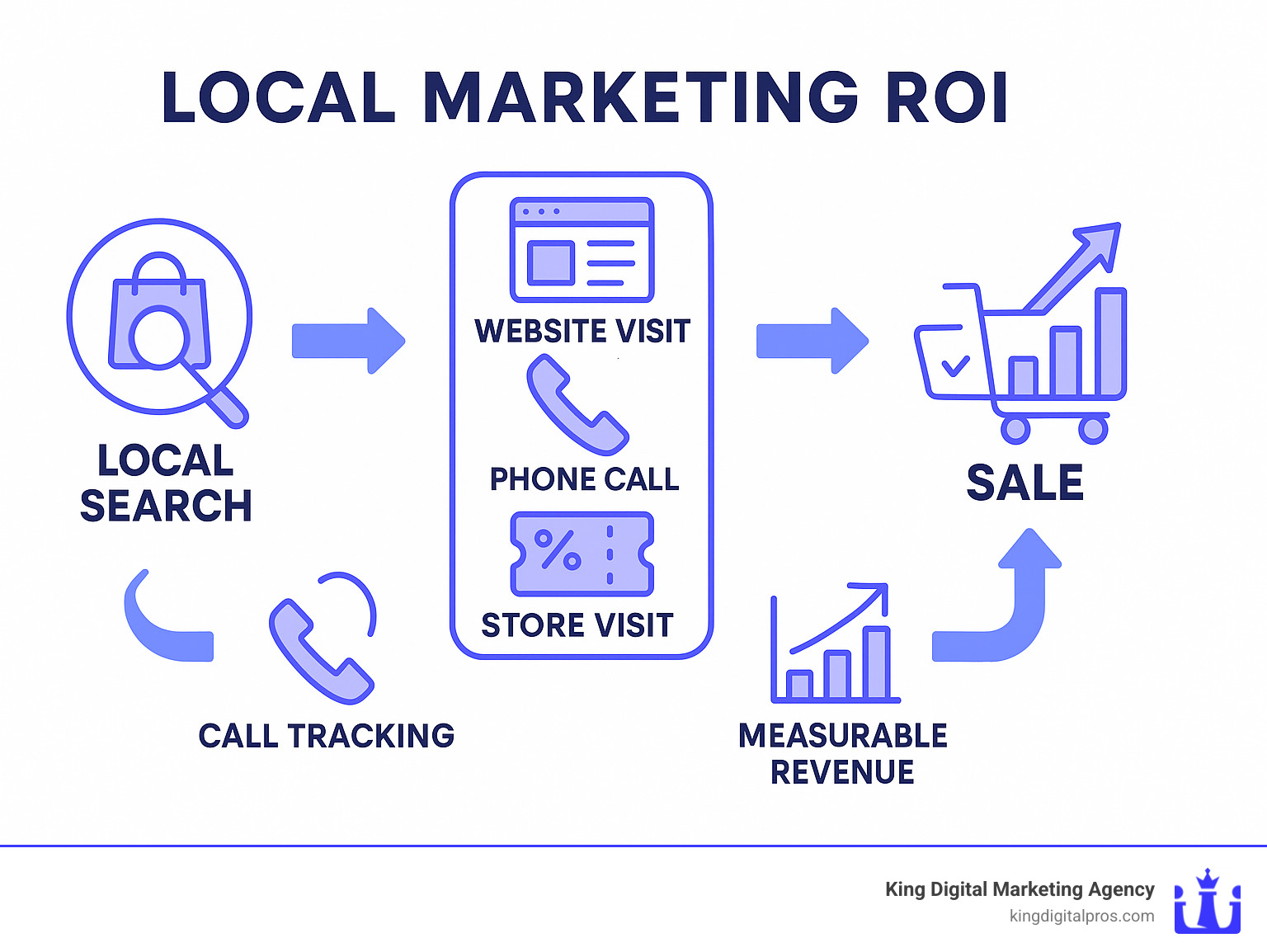
Connecting online activity to offline purchases is a major hurdle. The solution is smart tracking that follows the customer journey.
- Call tracking uses unique phone numbers for each marketing channel (e.g., GBP, website, print ad) to provide clear attribution for phone leads. Tools like CallRail can record calls and integrate with analytics.
- Unique promo codes for each campaign (e.g., “GOOGLE15”) directly link in-store purchases to specific marketing efforts. This is a core tenet of Direct Response Marketing.
- Dedicated landing pages with unique tracking parameters help follow the customer journey from a specific ad or link.
- In-store surveys asking “How did you hear about us?” provide valuable, direct feedback.
Implementing Lead Manager Software centralizes lead data from all channels, giving you a complete picture of customer acquisition.
The Digital Toolkit: Analytics for Better Decisions
Making data-driven decisions for local marketing roi requires the right tools, many of which are free and powerful.
- Google Analytics (GA4) is your website’s command center. It tracks user behavior, traffic sources, and conversions.
- Google Search Console reveals how your business appears in search, including keywords, impressions, and click-through rates – invaluable data for SEO.
- Heatmap tools like Hotjar visually show how users interact with your site (clicks, scrolls), helping you identify and fix conversion roadblocks.
- CRM system integration lets you track leads through the sales pipeline, helping calculate accurate CLV and identify high-quality lead sources.
- Google Business Profile Insights provides direct feedback on your local performance, showing views, calls, clicks, and direction requests.
These tools create a complete picture of your marketing performance. Check our guide to Must-Have Marketing Tools for more resources.
Overcoming Challenges and Maximizing Your Investment
Maximizing your local marketing roi presents challenges like limited budgets and difficult attribution. These are common problems for local business owners. However, with smart planning, you can overcome these issues and turn your marketing budget into a profit generator.

Smart Budgeting and Resource Allocation
Think of your marketing budget like a garden: prioritize channels by investing where you’ll see the most growth, rather than spreading resources too thin. For most local businesses, fundamentals like Local SEO and Google Business Profile optimization deliver the strongest returns by capturing customers actively searching for your services.
Also consider the opportunity cost of inaction. Every day you’re invisible online, potential customers are choosing your competitors. Once you identify what’s working, scale successful campaigns by doubling down on those wins. This data-driven approach ensures every dollar works harder for your local marketing roi.
Investing in professional SEO Services can be more cost-effective than a DIY approach, especially for specialized marketing that requires expertise for measurable results.
Integrating Channels for a Multiplier Effect
Your customers are on multiple platforms. When your marketing channels work together, they amplify each other’s effects. Digital marketing offers precise tracking, while traditional advertising (radio, print) builds brand awareness that can boost digital engagement. Tools like Google Local Service Ads help connect these efforts.
The real power comes from synergy. A customer might hear your radio ad, search for you on Google, read your great reviews, and then call. This seamless experience is the goal of an integrated strategy.
Email marketing is a standout, delivering an average ROI of 3,800%. Social media helps you connect with your community and show your business’s personality.
| Channel Type | Examples | Direct Trackability |
|---|---|---|
| Digital Marketing | Website, SEO, Paid Ads, Email | High |
| Traditional Marketing | Print Ads, Radio, Direct Mail | Low (requires specific tracking methods like unique phone numbers/promo codes) |
The key is a consistent message across all channels, leveraging the strengths of each platform.
Building Customer Loyalty for Long-Term ROI
Keeping existing customers is five times cheaper than acquiring new ones. Loyal customers also become brand advocates. Build strong customer relationships with personal touches that go beyond the transaction. These create emotional connections that foster loyalty.
Use email campaigns to share helpful tips or special offers, keeping your business top-of-mind. Simple loyalty programs, like punch cards or referral discounts, can work wonders. Increasing Customer Lifetime Value (CLV) happens naturally when customers feel valued and trust your business.
When it costs $100 to acquire a customer who spends $2,000 over five years, your initial investment pays off handsomely. This long-term view is crucial for your local marketing roi. Our comprehensive Services focus on this holistic approach, turning one-time buyers into lifelong advocates.
Frequently Asked Questions about Local Marketing ROI
When business owners get serious about local marketing roi, they often ask the same questions. Here are the straight answers to the most common concerns.
What is a good ROI for local marketing?
There’s no single magic number for a good local marketing roi, as it depends on your industry, margins, and goals. However, a common benchmark for success is a 5:1 ratio – $5 earned for every $1 spent. Even a 2:1 or 3:1 return can be excellent, especially for businesses with high customer lifetime value (CLV), like a dental practice where a new patient is worth thousands over time.
The simplest benchmark is that your marketing should generate more revenue than it costs. A positive return means you’re on the right track. What matters most is understanding your own numbers and steadily improving them.
How can I prove local SEO is working without just looking at rankings?
This is a great question. Rankings are a vanity metric; business results are what matter. Shift your focus from rankings to business outcomes. Instead of celebrating a #3 rank, celebrate the 20 new customer calls it generated.
Here’s how to prove real value:
- Track phone calls from your Google Business Profile and organic search results using dedicated numbers.
- Monitor Google Business Profile insights for direction requests, website visits, and calls.
- Measure form submissions from your website and trace their source.
Crucially, focus on lead quality. For instance, with Local SEO for Lawyers, we track how many inquiries become qualified consultations. Local SEO is inherently measurable; every action tells a story of a real person engaging with your business.
What’s the first step for an SMB to start tracking ROI?
Tracking local marketing roi can feel overwhelming, but you’re not alone. Since 44% of small businesses don’t track ROI, simply starting puts you ahead. The key is to start simple.
- Pick one primary goal. Are you trying to get more phone calls, website inquiries, or walk-ins? Focus on one first.
- Choose the simplest tracking method. For phone calls, use a tracking number. For web inquiries, use a simple form-to-spreadsheet system. For walk-ins, ask customers, “How did you hear about us?”
- Start with free tools like Google Analytics, Google Search Console, and your Google Business Profile insights.
For most local businesses, implementing call tracking is the quickest win, as phone calls are valuable conversions and provide clear attribution. The most important thing is to start somewhere. Progress, not perfection, is the goal.
Conclusion: Turn Local Marketing Insights into Profitable Action
We’ve covered how to master local marketing roi, from local SEO and Google Business Profile optimization to smart budgeting and customer loyalty. These strategies transform marketing from an expense into a growth engine. Measuring local marketing roi is about understanding what brings in customers. It’s the difference between guessing and making strategic investments that predictably grow your business.
While 44% of small businesses don’t track ROI, companies that do are 35% more likely to invest confidently in local marketing. They scale successful campaigns and turn their marketing budgets into profit centers.
But knowledge without action is useless. The strategies we’ve covered – from call tracking to loyalty programs – only work with implementation. The best local marketing roi comes from consistent, measured effort over time.
At King Digital Marketing Agency, we simplify tracking and measurement, providing clear insights to turn your marketing investment into measurable growth through our expertise in Google Business Profile optimization, local SEO, and reputation management.
Your potential customers are searching for businesses like yours every day. If you’re not visible, or can’t prove your marketing is working, you’re losing revenue to competitors.
Take control of your local marketing roi with a partner who understands the unique challenges of local businesses.
Get a free consultation with a Digital Marketing Agency for Small Businesses and find how to turn your local marketing efforts into your most profitable investment.