TL;DR:
- Understanding digital marketing terms helps Albuquerque businesses make better decisions and avoid costly mistakes.
- Key terms like SEO, PPC, and conversion rate are essential for designing effective online strategies.
- Mastering the language enables business owners to evaluate agencies, track success, and align tactics with goals.
If you’ve ever sat across from a marketing agency rep and nodded along while secretly wondering what half the words meant, you’re not alone. Phrases like “CTR,” “organic reach,” and “PPC” get tossed around constantly, and for busy Albuquerque business owners, the confusion is real. Here’s the thing: not knowing this vocabulary doesn’t just leave you feeling lost in meetings. It can cost you money, lead to poor decisions, and put you at the mercy of vendors who may not have your best interests at heart. This guide breaks down the most important digital marketing terms in plain language so you can take control of your strategy and grow with confidence.
Table of Contents
- Why digital marketing terms matter for Albuquerque businesses
- Essential digital marketing terms explained simply
- Comparing digital marketing strategies: Which terms align with which goals?
- Turning terminology into action: Using what you know to grow
- Our take: Why digital marketing language must serve your goals
- Ready to put your new knowledge into action?
- Frequently asked questions
Key Takeaways
| Point | Details |
|---|---|
| Vocabulary empowers strategy | Knowing digital marketing terms lets you make informed choices with agencies and campaigns. |
| Match terms to goals | Understanding which jargon fits each tactic leads to smarter business growth. |
| Always push for clarity | If a marketing report or meeting gets confusing, ask for plain language so you can act confidently. |
| Turn knowledge into action | Apply these terms in real conversations to guide your marketing and track results. |
Why digital marketing terms matter for Albuquerque businesses
Imagine hiring a contractor to renovate your restaurant on Central Avenue, but you don’t know the difference between load-bearing walls and decorative ones. You’d have no way to evaluate the work, push back on bad advice, or even know if you were getting value for your money. Digital marketing works the same way. When you don’t understand the language, you hand over the keys and hope for the best.
For small and medium-sized businesses in Albuquerque, this knowledge gap has real consequences. You might approve a campaign that targets the wrong audience, misread a monthly report, or sign a contract without understanding what deliverables you’re actually paying for. None of that is good for your bottom line.
Businesses that clearly understand digital marketing terminology are more likely to craft successful online strategies. That’s not a coincidence. When you know what you’re asking for, you can hold your agency accountable, redirect budgets faster, and spot problems before they become expensive.
The marketing impact of literacy extends beyond meetings. It shapes how you read analytics, evaluate proposals, and measure whether your investment is working.
Here are the key reasons to master marketing terminology:
- You ask better questions and get more honest answers from vendors
- You spot red flags in proposals that use vague language to hide weak strategies
- You make faster decisions because you understand what the data is telling you
- You waste less money by avoiding tactics that don’t align with your goals
- You build stronger partnerships with agencies who respect informed clients
Exploring the full range of types of digital marketing available to small businesses is a great starting point for building that literacy.
Now that we’ve set the stage for why this matters, let’s break down the essential terms every Albuquerque business owner should know.
Essential digital marketing terms explained simply
Let’s cut through the noise. Understanding terms such as SEO, PPC, and conversion rate is fundamental to building a digital presence that actually works for your business.
SEO (Search Engine Optimization): This is the process of improving your website so it appears higher in search results without paying for ads. Think of an Albuquerque florist who shows up first when someone searches “flower delivery near me.” That’s SEO working.

PPC (Pay-Per-Click): You pay a fee each time someone clicks your ad. A local tech firm running paid search ads on Google can appear at the top of results instantly, rather than waiting months for organic rankings to build.
Conversion Rate: The percentage of visitors who take a desired action, like calling your shop or filling out a form. If 100 people visit your site and 5 call you, your conversion rate is 5%.
CTR (Click-Through Rate): How often people click your ad or link after seeing it. A low CTR usually signals your headline or offer isn’t compelling enough.
Keywords: The specific words or phrases people type into search engines. Choosing the right keywords helps you improve search ranking and attract the right visitors.
Organic vs. Paid Traffic: Organic traffic comes from unpaid search results. Paid traffic comes from ads. Both matter, but they work differently and cost differently.
Impressions: How many times your ad or content was displayed, regardless of whether anyone clicked.
Engagement: Likes, comments, shares, and interactions with your content on social platforms.
Lead Generation: The process of attracting potential customers and capturing their contact information for follow-up.
| Term | Definition | Business application |
|---|---|---|
| SEO | Improving organic search rankings | Drive free traffic to your website |
| PPC | Paying per ad click | Get fast visibility for promotions |
| Conversion Rate | % of visitors who take action | Measure campaign effectiveness |
| CTR | % who click after seeing content | Evaluate ad and content appeal |
| Impressions | Times content is displayed | Gauge brand awareness reach |
| Lead Generation | Capturing potential customer info | Build your sales pipeline |
Common mistakes business owners make with these terms:
- Confusing impressions with reach (impressions count repeat views; reach counts unique people)
- Treating traffic as success when conversions are what actually matter
- Assuming high engagement means high revenue without tracking the full funnel
Pro Tip: Bookmark one trusted branding strategies resource and one digital marketing blog. Read one article per week. In three months, the vocabulary will feel natural.
Having established the importance of these concepts, let’s define and clarify how these terms connect to your actual marketing choices.
Comparing digital marketing strategies: Which terms align with which goals?
Each digital marketing tactic comes with its own terminology and benefits for business objectives. Knowing the vocabulary is step one. Matching it to the right goal is step two.
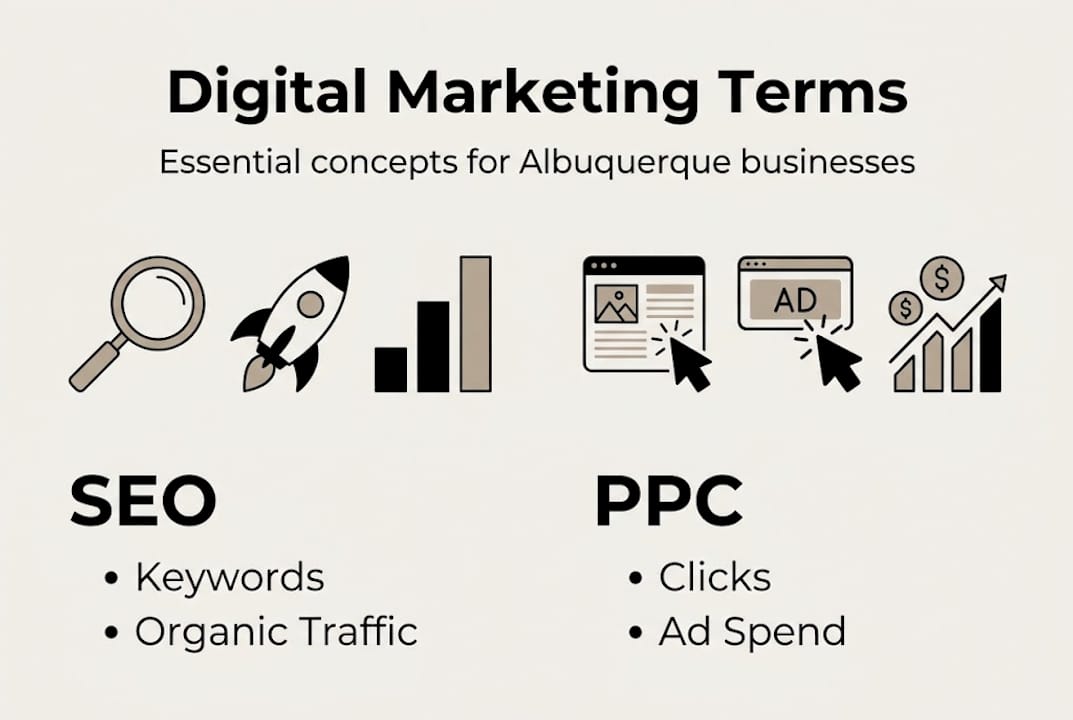
Here’s a comparison of the major channels and the terms that belong to each:
| Channel | Key terms | Best use case |
|---|---|---|
| Search (SEO) | Keywords, organic traffic, rankings | Long-term visibility and trust |
| Paid Ads (PPC) | CTR, cost-per-click, ad spend | Fast leads and promotions |
| Social Media | Engagement, reach, impressions | Brand awareness and community |
| Content Marketing | Organic traffic, lead generation | Educating and nurturing prospects |
| Reputation Management | Reviews, ratings, sentiment | Building trust and credibility |
Understanding digital strategies for your neighborhood means knowing which channel serves which goal. A new Albuquerque restaurant wanting immediate foot traffic should lean on PPC advertising for local leads. An established law firm building authority over time should prioritize SEO and content.
Here’s how to choose the right approach for your business:
- Define your goal first. Are you after brand awareness, leads, or direct sales? The goal determines the channel.
- Match the channel to the goal. Don’t run a social media campaign when you need search-intent leads.
- Learn the key terms for that channel. Each has its own metrics and success indicators.
- Set clear benchmarks. Know what a good CTR or conversion rate looks like for your industry.
- Review and adjust regularly. Digital marketing isn’t set-and-forget. Monthly reviews keep strategy sharp.
Pro Tip: When an agency presents a strategy, ask them to explain which goal each tactic serves. If they can’t answer clearly, that’s a warning sign. Branding role insights remind us that every tactic should ladder up to a clear business objective.
Armed with a glossary, let’s see how to put your new vocabulary to work every day.
Turning terminology into action: Using what you know to grow
Knowing the terms is powerful. Using them confidently in real conversations is where the growth happens. Mastery of digital marketing vocabulary makes it easier to evaluate providers, campaigns, and reports without second-guessing yourself.
Picture this: you’re in a monthly review with your marketing agency. They tell you impressions are up 40% but leads are flat. Before, you might have nodded and moved on. Now, you know to ask: “What’s our conversion rate, and what’s driving the gap between impressions and actual leads?”
That one question can redirect an entire campaign.
Here are questions to ask during agency meetings using your new vocabulary:
- “What is our current CTR, and how does it compare to industry benchmarks?”
- “Are we generating organic traffic or relying entirely on paid spend?”
- “What is our cost per lead, and is it trending up or down?”
- “How is our understanding of conversion rates reflected in the landing page design?”
- “Which keywords are driving the most qualified traffic to our site?”
These aren’t trick questions. They’re the questions any informed business owner should be asking. Agencies who welcome them are the ones worth working with.
“Clarity in communication is the foundation of every successful marketing partnership. When clients understand the language, campaigns perform better because expectations are aligned from day one.”
Using your digital marketing launchpad effectively means treating vocabulary as a tool, not a barrier. The more fluent you become, the more control you have over your results. Branding ideas that resonate always start with clear communication between the business and its marketing partners.
Now that you know the words and strategies, here’s our perspective on keeping it all focused on what truly matters.
Our take: Why digital marketing language must serve your goals
Here’s something we’ve seen too many times at King Digital: business owners get dazzled by impressive-sounding reports filled with metrics that don’t connect to revenue. Impressions are up. Engagement is climbing. And yet, the phone isn’t ringing.
Jargon can be a smokescreen. Some agencies, not all but some, hide behind complex terminology to avoid accountability. When you can’t decode the report, you can’t challenge the results.
Our honest take is this: every term you learn should serve one purpose, and that’s growing your business. If a metric can’t be tied to leads, sales, or customer retention, question why you’re tracking it at all.
We always encourage our clients to push for plain language. Ask your agency to explain any term in one sentence. If they can’t, they may not fully understand it themselves. Explore the full digital marketing types guide to see how each channel connects to real business outcomes.
Pro Tip: Never be afraid to say “I don’t understand, can you explain that differently?” Your business success depends on clarity, not on sounding sophisticated in meetings.
Ready to put your new knowledge into action?
Understanding digital marketing terminology is the first step. Applying it with the right strategy and partner is what actually moves the needle for your Albuquerque business.
At King Digital, we translate marketing language into real results. Whether you need SEO website design for Albuquerque, help with social media essentials, or a clear plan to improve your search ranking, our team speaks your language and your customers’ language. We offer personalized consultations where we audit your current digital presence and show you exactly where your budget can work harder. No jargon. No guesswork. Just clear strategy built for local business growth.
Frequently asked questions
What are the most important digital marketing terms for small businesses?
Core terms include SEO, PPC, conversion rate, engagement, keywords, and impressions, each vital for understanding how your online presence attracts and converts customers.
How does SEO differ from PPC in digital marketing?
SEO builds your website’s organic rankings over time through content and technical optimization, while PPC involves paying for ads that appear immediately in search results or social feeds.
Why is learning digital marketing terminology important for business owners?
Knowing the terms helps you make smarter choices with agencies, evaluate reports accurately, and ensure your marketing budget is being spent on tactics that align with your actual goals.
Where can I learn more or get help applying marketing concepts in Albuquerque?
King Digital offers local guides and hands-on services tailored for Albuquerque SMBs, and you can start by exploring resources on how to improve search ranking and build a stronger digital presence right here in New Mexico.
Recommended
- Why invest in digital marketing: grow your Albuquerque business in 2026
- Digital marketing for Albuquerque SMBs: grow local leads
- What is local digital marketing? A guide for Albuquerque SMBs
- Social media marketing tips to boost Albuquerque SMBs
- Exhibit Graphics in Marketing: Boosting Trade Show Impact
