What Is Digital Marketing for Businesses (And Why It Matters Right Now)
Digital marketing for businesses is the use of digital channels — like search engines, social media, email, and websites — to reach customers, build brand awareness, and drive sales.
Here’s a quick overview of what it covers:
| What It Is | What It Does | Who It’s For |
|---|---|---|
| SEO, PPC, email, social media, content | Attracts, engages, and converts customers online | Businesses of all sizes, B2B and B2C |
| Measurable, targeted, and adaptable | Replaces or supplements traditional marketing | Startups, SMBs, and enterprises |
| Paid, owned, and earned channels | Builds visibility, trust, and revenue | Any industry with an online audience |
Digital marketing isn’t one thing. It’s an ecosystem of strategies that work together to get your business found, trusted, and chosen.
If you’re a local business owner, the stakes are especially high. 68% of online experiences start with a search engine — which means if you’re not showing up online, you’re invisible to the majority of potential customers before they ever find you.
The good news? You don’t need a massive budget or a marketing degree to compete. You need a clear strategy, the right channels, and consistent execution.
I’m Bernadette King, founder of King Digital Marketing Agency, and I’ve spent years helping franchise owners and small businesses grow their online presence through targeted SEO, paid advertising, and conversion-driven content — making digital marketing for businesses practical, measurable, and genuinely effective. This guide will walk you through everything you need to know to get started and get results.
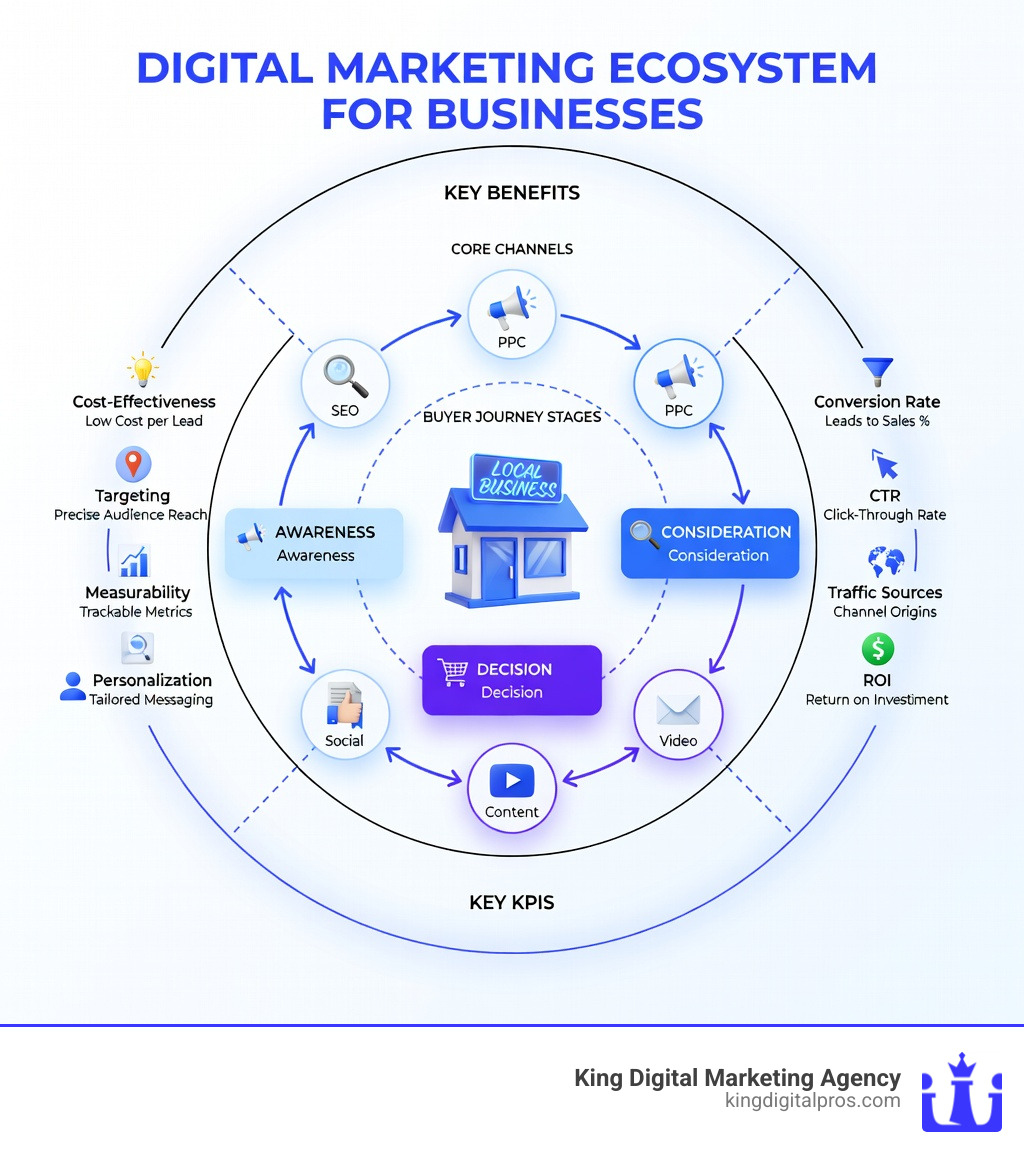
Explore more about Digital marketing for businesses:
Understanding the Shift: Digital vs. Traditional Marketing
For decades, marketing meant big billboards on I-25 or ads in the local Albuquerque newspapers. While those still have their place, the shift toward digital has completely leveled the playing field for businesses in New Mexico. Unlike a radio spot that plays once and vanishes, digital marketing creates a lasting, interactive presence.
The primary difference lies in the direction of communication. Traditional marketing is often a “one-way” shout into a crowd. Digital marketing for businesses, however, is a two-way conversation. It allows us to listen to what our customers want in real-time and adjust our message instantly.
| Feature | Traditional Marketing | Digital Marketing |
|---|---|---|
| Reach | Mostly local/limited | Global or hyper-local |
| Cost | High (Print, TV, Radio) | Scalable (Free to Paid) |
| Targeting | Broad demographics | Precise interests & behaviors |
| Measurement | Difficult/Estimated | Real-time & Accurate |
| Engagement | Passive (Watching/Reading) | Active (Clicking/Commenting) |
One of the most powerful statistics in our industry is that 68% of online experiences start with search. This means people aren’t just waiting to be sold to; they are actively looking for solutions. If you are a plumber in Rio Rancho or a cafe in Santa Fe, being the first result when someone types “near me” is the modern equivalent of having the biggest neon sign in town.
Why Digital Marketing for Businesses is Essential in 2025
As we move through 2025, the “set it and forget it” mindset is officially a relic of the past. Today’s consumers expect personalization. They don’t want a generic ad; they want a solution that feels tailored to them. For small and medium-sized businesses (SMBs), this is actually a massive advantage. We can be more agile than giant corporations, using data to pivot our strategies in days rather than months.
Furthermore, 80% of marketers found content marketing successful in recent years, proving that providing value is the best way to earn trust. In 2025, digital marketing isn’t just about “getting leads”—it’s about building a brand that survives algorithm changes and intense competition. Whether you’re in Los Alamos or Taos, your digital footprint is often the first (and sometimes only) impression a customer gets of your business.
Core Channels and Strategies for Growth
To master digital marketing for businesses, you need to understand the different “levers” you can pull. We often categorize these into three buckets: Owned, Paid, and Earned media.

- Search Engine Optimization (SEO): This is the art of making your website “attractive” to Google. By using researched keywords and optimizing your technical setup, you can rank higher on search engine results pages (SERPs). For local businesses, this includes managing your Google Business Profile to dominate the “Map Pack.”
- Pay-Per-Click (PPC): This is paid advertising where you only pay when someone clicks your ad. It’s a great way to get immediate traffic while your SEO efforts build up over time.
- Social Media Marketing: Platforms like Facebook, Instagram, and TikTok allow us to humanize our brands. Interestingly, influencer marketing has an average engagement rate of nearly 16% on platforms like TikTok, making it a powerhouse for B2C brands.
- Email Marketing: Often called the “ROI king,” email allows you to talk directly to people who have already expressed interest. With a return of roughly $36 for every $1 spent, it’s a channel no business can afford to ignore.
- Content Marketing: This involves creating blogs, videos, and infographics that answer customer questions. The industry is projected to be worth $107 billion by 2026, showing just how much businesses are investing in “value-first” marketing.
For more detailed insights on how these work together, check out our Local Business Online Marketing guide.
Effective Low-Cost Digital Marketing for Businesses
We often hear from business owners in smaller areas like Edgewood or Grants who are worried about budget. The truth is, you can do a lot with very little if you’re strategic.
- Local SEO: Claiming and optimizing your Google Business Profile is free. It’s the single most effective thing a local business can do to get noticed.
- User-Generated Content (UGC): Encourage your customers to post photos of your products or services. It’s free “word-of-mouth” that carries more weight than any paid ad.
- Organic Social Media: You don’t always need to “boost” posts. Sharing behind-the-scenes content or helpful tips can build a loyal community.
- Email Newsletters: Using tools like Mailchimp (which has a free tier) allows you to stay top-of-mind without spending a dime on ad placement.
If you’re just starting out, our resource on Startup Success: Your Digital Marketing Launchpad offers a roadmap for building momentum on a budget.
Mapping the Buyer’s Journey and Cross-Channel Cohesion
A common mistake in digital marketing for businesses is treating every customer the same. In reality, a customer goes through a “journey” before they hand over their credit card.
- Awareness Stage: The customer realizes they have a problem (e.g., “My sink is leaking”). Here, we use SEO and social media to show them we exist.
- Consideration Stage: The customer is looking at options (e.g., “Who is the best plumber in Albuquerque?”). This is where HubSpot Content Marketing principles come in—offering guides, reviews, and comparison charts.
- Decision Stage: The customer is ready to buy. We use retargeting ads, discounts, and strong Calls to Action (CTAs) to seal the deal.
To succeed, your message must be cohesive across all channels. If your Instagram looks fun and modern, but your website looks like it was built in 1998, you’ll lose trust. Marketing automation tools can help maintain this consistency by sending the right message at the right time, ensuring no lead falls through the cracks.
Measuring Success: KPIs and ROI for Digital Marketing for Businesses
If you can’t measure it, you can’t improve it. One of the greatest gifts of digital marketing is the sheer amount of data available. However, that data can be overwhelming if you don’t know what to look for.
Key Performance Indicators (KPIs) we track include:
- Conversion Rate: The percentage of visitors who take a desired action (like calling you or buying a product).
- Click-Through Rate (CTR): How many people clicked your ad or link compared to how many saw it.
- Traffic Sources: Where are your visitors coming from? (Google Search, Facebook, Email?)
- Return on Investment (ROI): This is the big one. By comparing your campaign costs to the revenue generated, you can see exactly what’s working.
Using tools like Google Analytics is non-negotiable for modern businesses. It allows you to see the “why” behind the “what.” For example, if you have high traffic but low conversions, there might be an issue with your website’s checkout process or mobile optimization. For a deeper dive, read our Local Marketing ROI Complete Guide.
Frequently Asked Questions about Digital Marketing
How long does it take to see results from digital marketing?
While PPC ads can drive traffic instantly, evergreen strategies like SEO and content marketing typically take 3 to 6 months to show significant results. Digital marketing is a marathon, not a sprint, but the results build on themselves over time.
What is the minimum budget needed for a small business?
There is no “minimum,” but we recommend starting with enough to test at least two channels (e.g., Google Ads and Local SEO). For many small businesses in New Mexico, even $500–$1,000 a month can produce a measurable impact when targeted correctly.
How do I choose the right channels for my specific industry?
Look at where your customers spend their time. B2B businesses often find success on LinkedIn and through SEO-driven whitepapers. B2C businesses (like retail or restaurants) usually see better results on Instagram, TikTok, and through Local SEO.
Conclusion
The world of digital marketing for businesses is constantly evolving. From the rise of AI-driven search to the increasing importance of video content on YouTube, staying ahead requires a willingness to learn and adapt. However, the fundamentals remain the same: understand your audience, provide genuine value, and measure your results.
At King Digital Marketing Agency, we specialize in helping businesses in Albuquerque, Rio Rancho, Santa Fe, and beyond dominate their local markets. Our focus is on expert management of Google Business Profiles and map listings to ensure that when your neighbors search for what you offer, they find you first.
Ready to take your business to the next level? Explore our Digital Marketing Services and let’s build a strategy that delivers real growth.
