TL;DR:
- Personalized marketing leverages real behavioral data to craft relevant messages that significantly outperform generic campaigns. It builds emotional loyalty and increases conversions throughout the customer lifecycle by reducing decision friction and fostering trust. Effective personalization depends on strategic segmentation, proper governance, and focusing on actual customer behaviors rather than assumptions.
Personalized marketing is the practice of tailoring messages and offers to individual customers using real behavioral and preference data, and it consistently outperforms generic campaigns by a measurable margin. Companies that excel at personalization generate up to 40% more revenue than their peers, and personalized approaches can convert up to six times more effectively than non-personalized ones. That gap exists because of one principle: relevance. When Amazon recommends a product you actually want, or Netflix surfaces a show that fits your exact taste, you don’t feel marketed to. You feel understood. That distinction is why personalized marketing works, and why every serious marketing professional needs to understand the mechanics behind it.
Why personalized marketing works better than generic campaigns
The core mechanism behind personalized marketing is perceived relevance, the degree to which a message connects to a consumer’s actual needs, context, and moment. Generic campaigns broadcast the same message to everyone and hope it lands. Personalized campaigns use real data to reduce the psychological distance between the message and the recipient’s current situation. That reduction in friction is what drives higher engagement and conversion.

Behavioral science backs this up. When a message feels relevant, consumers experience less cognitive resistance at the decision point. They don’t have to translate a generic offer into their personal situation. The work is already done for them, and that ease translates directly into action.
Here is what the research confirms about the advantages of personalized marketing:
- Real data outperforms simulated personalization significantly. A meta-analysis found real consumer data produces an effect size of d = .28, while scenario-based personalization scores d = -.15. Simulated personalization not only fails to help, it actively hurts persuasion.
- Covert behavioral personalization beats overt name usage. Consumers respond better to subtle relevance, like product recommendations based on browsing history, than to messages that repeatedly use their first name or reference personal details in ways that feel intrusive.
- Relevance reduces friction at the buying decision. When a message connects to a consumer’s real-life context, the path from awareness to purchase shortens. This is how personalized marketing increases sales without increasing ad spend.
- Emotional connection drives loyalty beyond price. When customers feel understood, they build emotional loyalty that makes them less sensitive to competitor pricing and more likely to return.
“Personalization is not about using someone’s name in an email. It’s about making every interaction feel like it was designed specifically for that person’s situation.” This distinction separates brands that see real ROI from those that see marginal lifts.
Pro Tip: Start personalization by mapping what your customer needs to feel or believe before they take the next step, not just what data you have available. The best campaigns are built backward from the customer’s decision moment.
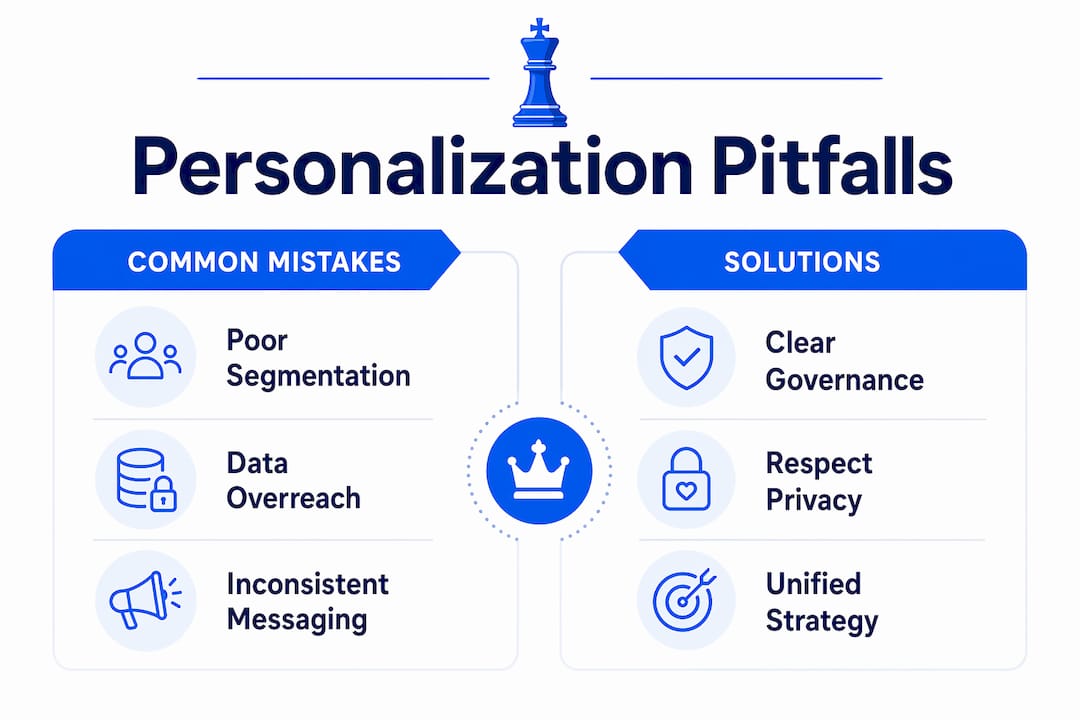
Common personalization pitfalls and how to avoid them
Most personalization programs that underperform do so not because of technology failures, but because of poor segmentation and weak strategic intent behind the targeting logic. The tools are rarely the problem. The thinking behind them usually is.
Here are the most common mistakes, and how to correct them:
- Confusing name insertion with real personalization. Dropping a first name into a subject line is customization, not personalization. True personalization uses behavioral signals, purchase history, and contextual data to shape the entire message, not just the greeting.
- Over-segmenting your audience. Breaking your audience into dozens of micro-segments creates fragmented, incoherent messaging and operational chaos. The most effective personalization strategies apply a small number of distinct behavioral audience states rather than overly granular demographic slices.
- Relying on stale data. Data has a shelf life. A customer who browsed winter coats in November does not want coat ads in April. Data decay logic, the practice of retiring behavioral signals after a set period, keeps your targeting current and your messaging credible.
- Ignoring governance across channels. Without clear rules about which data signals drive which messages, different teams send conflicting communications. A customer who just filed a support ticket should not receive a promotional upsell email the same day.
- Falling into the intrusiveness trap. Consumers prefer covert, relevant personalization over overt references to their personal data. Referencing that someone visited your pricing page three times in a single email feels surveillance-like, not helpful.
Pro Tip: Build a simple governance document that defines which data signals are off-limits for messaging, how long behavioral data stays active before expiring, and which team owns each channel. This single document prevents most personalization failures before they happen.
How personalized marketing impacts the entire customer lifecycle
The importance of customizing marketing strategies extends well beyond acquisition. Most teams focus personalization on getting new customers, but the real revenue impact comes from using it across the full customer lifecycle, from first touch through retention and expansion.
Consider what lifecycle-wide personalization actually looks like in practice:
- Acquisition: Targeted ads on Meta or Google that reflect a user’s browsing behavior and purchase intent bring in higher-quality leads at lower cost per acquisition.
- Onboarding: Triggered email sequences that adapt based on which features a new user has or has not engaged with reduce early churn dramatically.
- Retention: Brands that use data to predict friction and intervene before a customer disengages see measurably higher retention rates. Pausing a sales sequence when a customer submits a support ticket is a simple example of this logic in action.
- Upsell and cross-sell: Personalized product recommendations based on purchase history, like those used by Shopify merchants through tools like Klaviyo or Attentive, consistently outperform blanket promotional emails.
- Win-back: Lapsed customers respond to messages that acknowledge their specific history with the brand, not generic “we miss you” campaigns.
The marketing funnel optimization required to execute this well depends on integrating data from marketing, sales, and customer support into a single view of the customer. Without that integration, personalization at each stage operates in isolation and misses the compounding effect.
| Lifecycle stage | Personalization tactic | Primary benefit |
|---|---|---|
| Acquisition | Behavioral ad targeting | Higher-quality leads |
| Onboarding | Feature-based email triggers | Reduced early churn |
| Retention | Friction prediction and intervention | Higher lifetime value |
| Upsell | Purchase history recommendations | Increased average order value |
| Win-back | History-aware re-engagement | Recovered revenue |
Authentic data-driven vs. superficial personalization: what actually converts
Not all personalization is equal, and the gap between authentic and superficial approaches is wider than most marketers expect. The meta-analysis from the ARF makes this concrete: real consumer data produces a positive persuasion effect, while simulated or assumed personalization produces a negative one. Guessing at relevance is worse than sending a generic message.
Authentic personalization is grounded in actual behavior: pages visited, products purchased, support tickets filed, emails opened. Superficial personalization is grounded in demographics or assumptions. A 35-year-old woman in Albuquerque is not a behavioral profile. Her last three purchases, her browsing session from Tuesday, and the fact that she abandoned a cart at checkout are.
| Approach | Data source | Effect on persuasion | Key risk |
|---|---|---|---|
| Authentic personalization | Real behavioral and purchase data | Positive (d = .28) | Privacy perception if overt |
| Superficial personalization | Demographics, name insertion | Neutral to negative (d = -.15) | Wasted spend, low trust |
| Agentic personalization | Real-time signals, CRM integration | High conversion lift | Requires strong data infrastructure |
The agentic AI marketing approach represents the next level of authentic personalization. It uses real-time signals to pause, pivot, or accelerate marketing sequences based on what a customer is doing right now, not what they did last month. This is where the benefits of personalized marketing compound most aggressively.
Pro Tip: Audit your current personalization tactics and ask one question for each: is this based on what this customer actually did, or on what we assume about people like them? Replace every assumption-based tactic with a behavior-based one, even if it means running fewer campaigns initially.
Key takeaways
Personalized marketing works because it uses real behavioral data to deliver relevant messages that reduce friction, build emotional loyalty, and drive measurably higher conversions across every stage of the customer lifecycle.
| Point | Details |
|---|---|
| Relevance is the core driver | Perceived relevance reduces decision friction and is the primary mechanism behind personalization’s effectiveness. |
| Real data beats assumptions | Authentic behavioral data produces a positive persuasion effect; simulated personalization produces a negative one. |
| Lifecycle coverage multiplies ROI | Personalization applied across acquisition, retention, and upsell compounds revenue impact far beyond single-stage use. |
| Governance prevents failure | Poor segmentation and lack of strategic intent cause more personalization failures than technology gaps. |
| Subtlety builds trust | Covert behavioral personalization outperforms overt name-heavy tactics and avoids the intrusiveness trap. |
What 15 years of watching personalization programs succeed and fail taught me
I’ve seen marketing teams spend six figures on CRM platforms and personalization software, then use them to send emails that say “Hi [First Name], here’s a deal you might like.” That’s not personalization. That’s a mail merge with a monthly subscription fee.
The teams that actually see the impact of personalized marketing share one trait: they start with the customer’s decision moment, not the data they happen to have. They ask, “What does this person need to believe or feel to take the next step?” and then they use data to answer that question. Most teams do it backward. They look at what data is available and build campaigns around it. That produces campaigns that feel like they were designed for a spreadsheet, not a person.
The other pattern I’ve noticed is that personalization fails at the seams between departments. Marketing sends a warm, personalized nurture sequence. Sales calls with a cold script. Support resolves a complaint. Then marketing sends a promotional email the next morning. The customer experiences four different companies in one week. Real personalization requires a shared data layer and shared accountability across teams. That’s an organizational challenge, not a technical one.
The future belongs to what HubSpot calls agentic personalization: systems that read real-time signals and adjust automatically. But you don’t need to start there. Start by retiring your three oldest audience segments, building two new ones based purely on recent behavior, and setting a governance rule that pauses promotional messages for any customer with an open support ticket. Those three changes will outperform most personalization overhauls I’ve seen.
— Bernadette
How Kingdigitalpros helps you build personalization that actually converts
Kingdigitalpros works with small and medium-sized businesses in Albuquerque and beyond to build data-driven marketing programs that go well past name insertion. From CRM integration and behavioral segmentation to conversion rate optimization and targeted ad campaigns, the team at Kingdigitalpros designs personalization strategies grounded in real customer behavior. If your current marketing feels like it’s broadcasting to a crowd instead of speaking to individuals, that’s the gap Kingdigitalpros closes. You can also explore how an SEO-friendly website structure creates the technical foundation that makes personalized campaigns perform at their highest potential. Reach out to Kingdigitalpros to find out where your personalization strategy has the most room to grow.
FAQ
Why does personalized marketing work better than generic advertising?
Personalized marketing works because it delivers perceived relevance, reducing the cognitive friction consumers experience at decision points. When a message connects directly to a person’s real needs and context, they are far more likely to engage and convert.
How much can personalization increase revenue?
Companies that excel at personalization generate up to 40% more revenue than competitors, and personalized campaigns can convert up to six times more effectively than non-personalized ones. The revenue gap widens when personalization is applied across the full customer lifecycle rather than just acquisition.
What is the biggest mistake in personalized marketing?
The most common mistake is confusing name insertion or demographic targeting with true personalization. Poor segmentation and weak strategic intent cause more program failures than any technology limitation.
Does personalization work for small businesses?
Personalization works at any business size because the core principle, relevance, does not require enterprise-level tools. A small business using Klaviyo, Mailchimp, or even a well-organized CRM can deliver behavior-based messaging that outperforms generic campaigns.
How do I avoid making personalization feel intrusive?
Focus on covert behavioral personalization based on what customers actually did, such as browsing history or past purchases, rather than overt references to personal details. Set clear governance rules about which data signals are off-limits to protect customer trust.
Recommended
- From Zero to Hero: How Business Growth Marketing Can Transform Your Enterprise | King Digital Marketing Agency
- Funnel Marketing Strategy: 6 Essential Steps for Growth
- Local marketing strategy: Unlock 2025 Growth
- Local marketing expertise: Unlock Growth 2025