Funnel Marketing Strategy: 6 Essential Steps for Growth
The Blueprint for Customer Growth
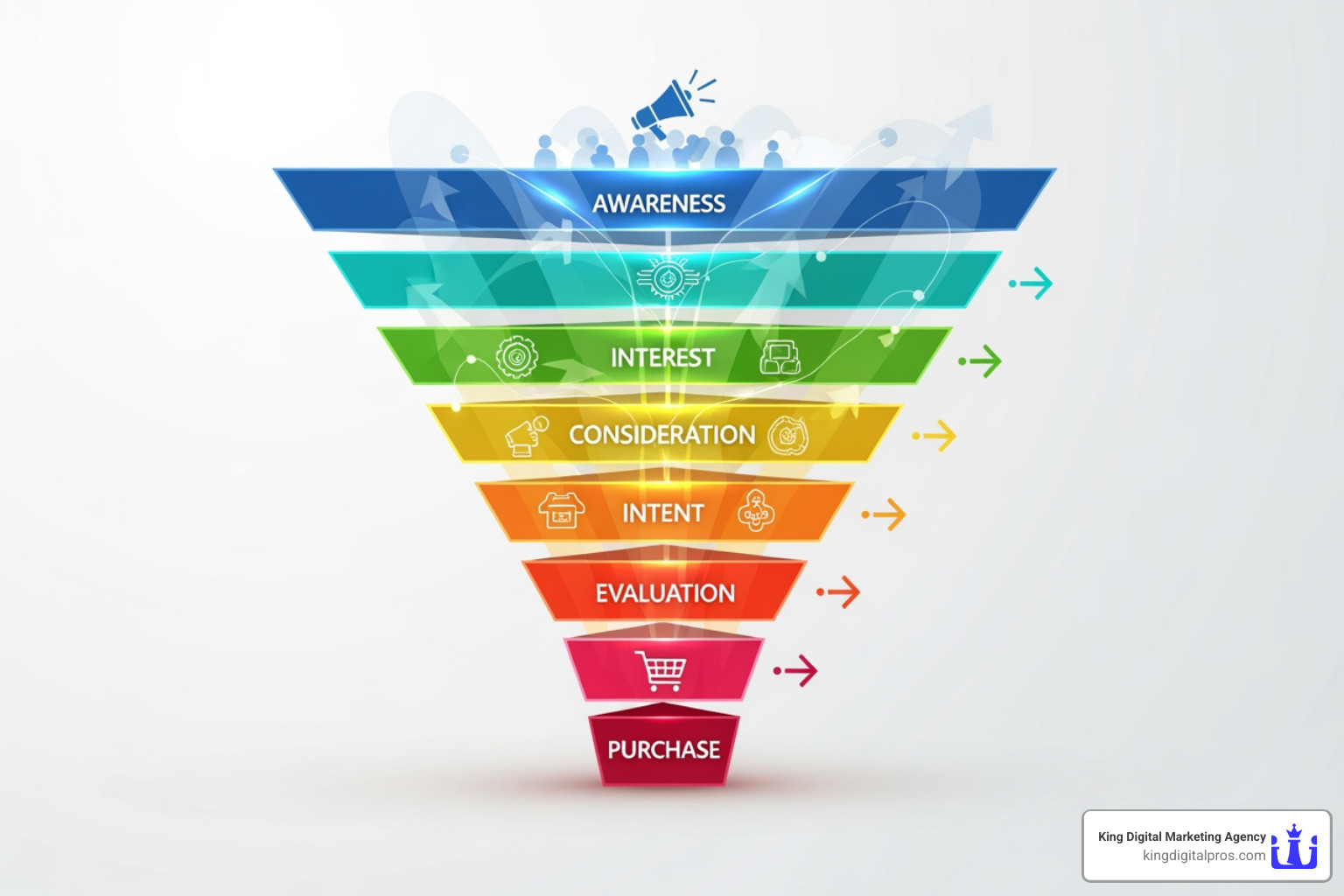
A funnel marketing strategy is a systematic approach to guiding potential customers from their first interaction with your brand to purchase and beyond. It’s a framework that maps the customer journey through distinct stages, allowing you to tailor content and messaging to match where prospects are in their buying process. Why does it matter? Businesses with a full-funnel approach see up to 3x more brand awareness and 2x more purchases, leading to better lead quality and higher conversion rates.
With 84% of shoppers starting product searches on channels outside a brand’s website, a clear strategy is essential to capture attention. Consider that 98% of visitors don’t convert on their first visit. A well-designed funnel provides multiple touchpoints to re-engage them, build trust, and win their business. Crucially, it costs five times more to acquire a new customer than to retain an existing one, highlighting why effective funnels must extend beyond the initial sale.
For local business owners, this framework is invaluable. Competing against bigger brands with larger budgets requires a smart approach. A targeted funnel strategy helps you attract local customers, build community trust, and turn one-time buyers into loyal advocates.
I’m Bernadette King, founder of King Digital, and I’ve spent my career helping businesses transform visibility into growth through strategic funnel marketing strategies. In this guide, I’ll show you how to build, optimize, and measure a funnel that drives results for your business.
The Anatomy of a Marketing Funnel: From Awareness to Advocacy
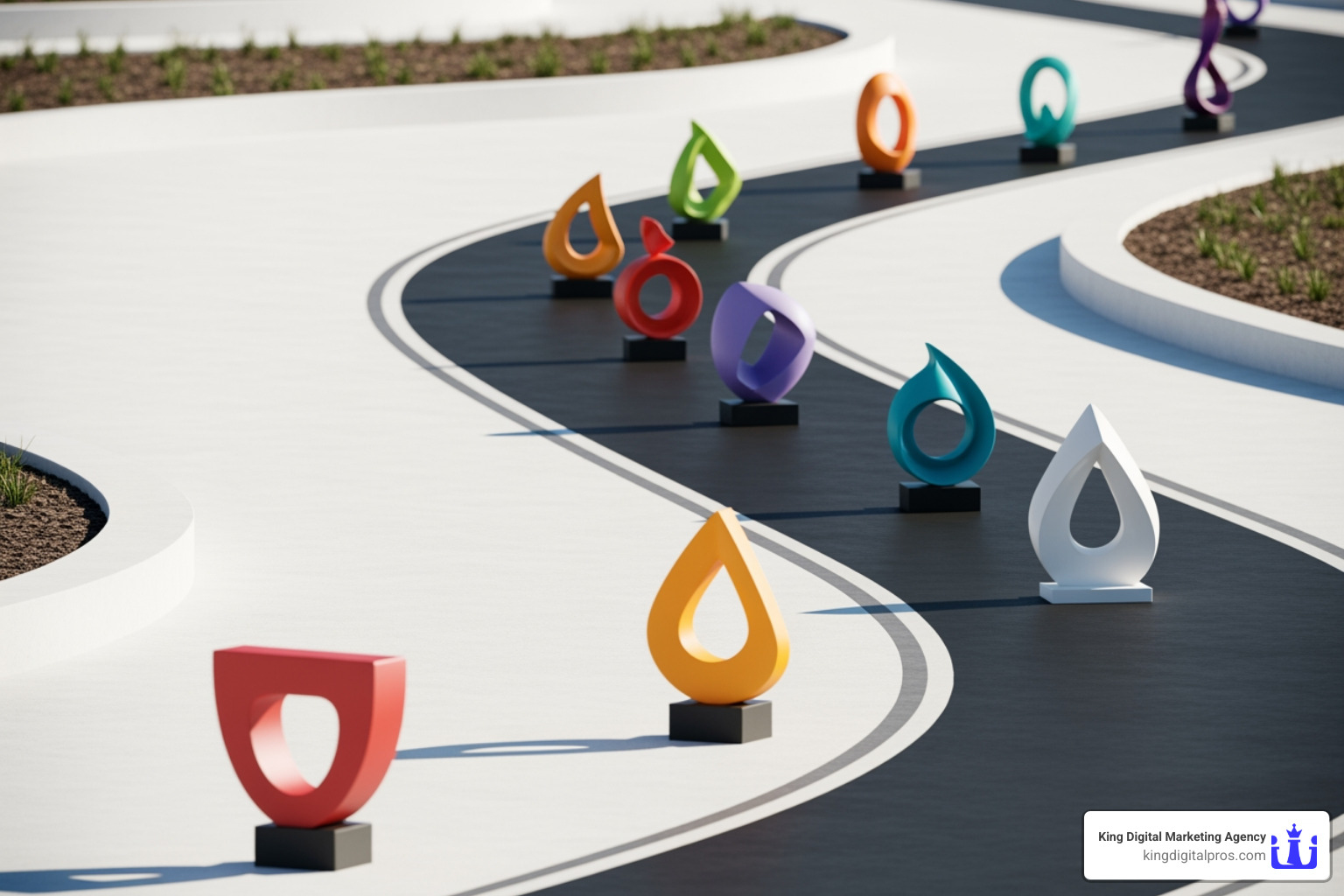
Your funnel marketing strategy is a roadmap for the customer journey, from the moment someone first hears of you to long after they’ve purchased. While the path isn’t always linear–prospects might skip stages or circle back–this framework helps you anticipate their needs at every point.
The concept of mapping customer journeys dates back to 1898, when Elias St. Elmo Lewis created the AIDA model. He identified four phases: Awareness, Interest, Desire, and Action. Today’s digital channels are vastly different, but the core psychology remains: people need to know you, trust you, and then buy from you.
The 6 Core Stages of the Customer Journey
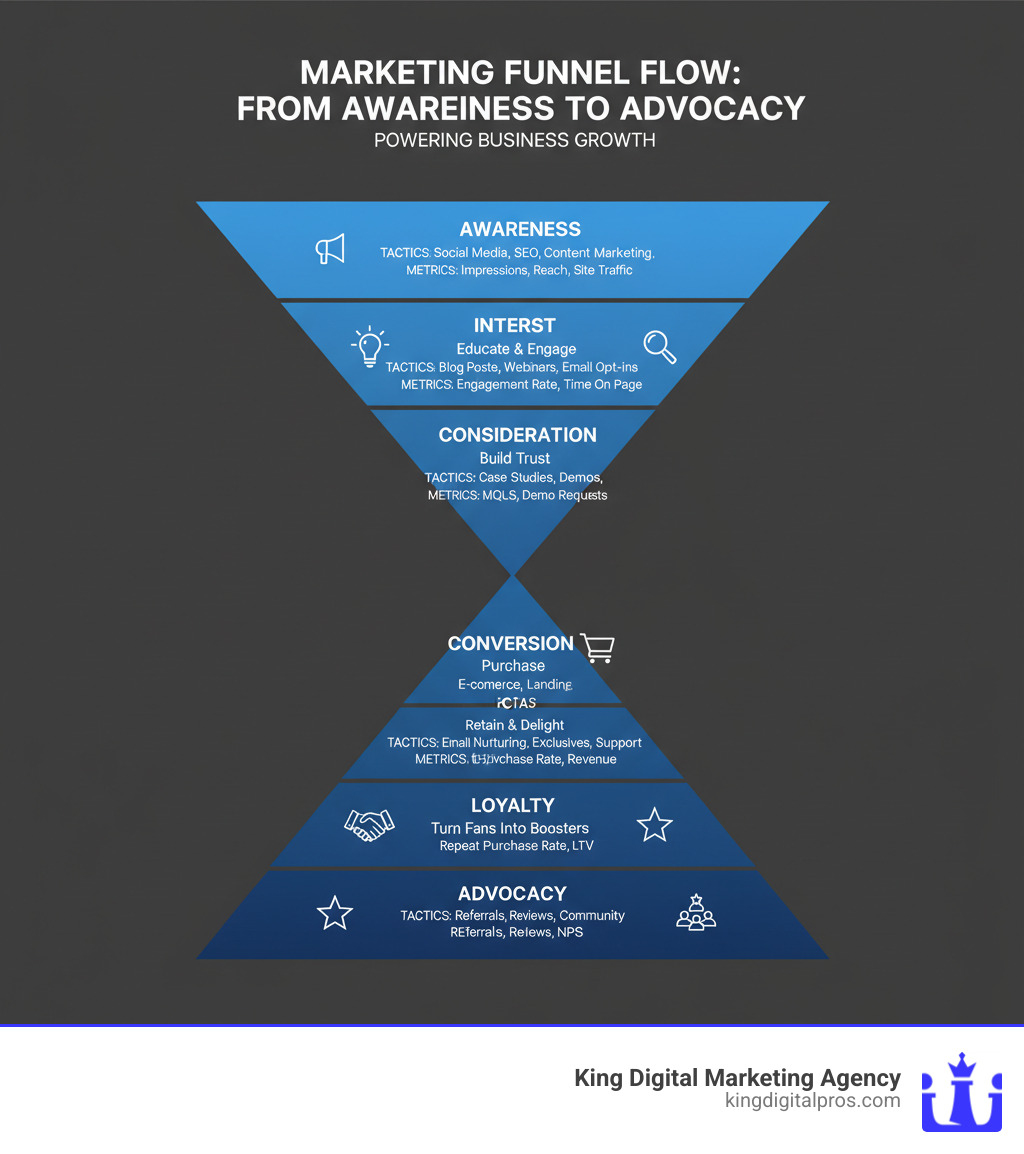
Modern funnels extend beyond the sale, encompassing six core stages:
- Awareness: Prospects find your brand. They may not even realize they have a problem yet. Your goal is to get noticed and make a good first impression.
- Interest: They start paying attention, visiting your site and consuming your content. They’ve identified a need and are exploring solutions.
- Consideration: Prospects are now seriously comparing you against competitors. They’re examining features, reviews, and pricing, asking, “Why choose you?”
- Conversion: The decision is made. Your focus is to make the purchase process as smooth and frictionless as possible.
- Loyalty: The post-purchase experience begins. Delivering exceptional value here encourages repeat business, which is crucial since retaining a customer is far cheaper than acquiring a new one.
- Advocacy: Satisfied customers become your best marketers. They leave positive reviews, refer friends, and champion your brand, driving new prospects into your funnel.
Understanding the TOFU, MOFU, and BOFU Framework
Marketers group these stages into three actionable categories:
- Top of the Funnel (TOFU): Covering Awareness and early Interest, this stage is about casting a wide net with educational or entertaining content like blog posts and social media updates. The goal is to establish your brand as a trusted resource.
- Middle of the Funnel (MOFU): Encompassing late Interest and Consideration, this is where lead nurturing happens. Prospects need more substantial content like case studies, webinars, and comparison guides to build trust and prove your value.
- Bottom of the Funnel (BOFU): This is the conversion stage. Prospects are ready to buy and need a final push from product demos, free trials, testimonials, or special offers.
Marketing Funnel vs. Sales Funnel vs. Conversion Funnel
These related terms are not interchangeable:
- The marketing funnel is the big picture, covering the entire journey from awareness to advocacy. It focuses on attracting and nurturing leads for long-term relationships.
- The sales funnel is narrower, focusing on the Consideration and Conversion stages. The sales team works with qualified leads to close deals.
- The conversion funnel is the most specific, tracking the steps to complete a single goal, like a purchase or a signup. You can have multiple conversion funnels within your main marketing funnel. For example, an e-commerce checkout is a conversion funnel, and our guide on Conversion Funnel Optimisation Best Practices offers specific tactics for improvement.
All three must work in harmony to drive sustainable growth.
Essential Strategies and Tactics for Each Funnel Stage
An effective funnel marketing strategy isn’t about a one-size-fits-all message. It’s about meeting people where they are in their journey and giving them what they need at that moment. You wouldn’t propose on a first date, and similarly, you shouldn’t push a sale on someone who just finded your brand. Let’s walk through what works at each stage.
Top-of-Funnel (TOFU): Casting a Wide Net
At the top, your goal is to attract a wide audience and build awareness. These individuals are just starting to look for solutions or may not even know they have a problem.
- SEO: Optimizing for search engines is crucial. For local businesses, mastering Local SEO Best Practices ensures you’re visible when nearby customers search for your services.
- Content Marketing: Create helpful blog posts, guides, and videos that answer common questions. The focus is on educating and building trust, not selling.
- Social Media Marketing: Extend your reach, share valuable content, and show your brand’s human side. Paid Services: Social Media Advertising can strategically place your content in front of ideal audiences.
- PPC Campaigns: Drive traffic quickly with targeted ads on Google or social platforms, reaching people actively searching for related topics.
Middle-of-Funnel (MOFU): Nurturing Leads into Prospects
Now that you have their attention, the goal is to educate and build trust. These prospects are evaluating solutions, and you need to show them why yours is the best fit.
- Lead Magnets: Offer valuable resources like e-books or webinars in exchange for an email address to continue the conversation.
- Case Studies & Comparison Guides: Show real results and transparently compare your offerings against alternatives. This social proof and honesty builds trust.
- Email Marketing: Use automated sequences to deliver value over time, nurturing the relationship with educational content rather than constant sales pitches.
- Retargeting: Re-engage interested visitors who left your site with reminder ads. HubSpot’s guide to retargeting offers excellent strategies.
At this stage, engaged leads become Marketing Qualified Leads (MQLs), signaling they are ready for more focused attention, as noted by sources like Gartner.
Bottom-of-Funnel (BOFU): Sealing the Deal
Prospects are ready to decide. Your goal is to convert them into customers by making the choice easy and risk-free.
- Product Demos & Free Trials: Let prospects experience your value to remove final doubts.
- Testimonials & Reviews: Feature stories from satisfied customers to provide powerful social proof that tips the scales.
- Clear CTAs: Use compelling calls-to-action like “Buy Now” or “Start Your Free Trial” to make the next step obvious.
- Simplified Processes: A complicated checkout kills conversions. Minimize steps and remove friction. Our Conversion Optimization Complete Guide details how to optimize every element.
Prospects here are often Sales Qualified Leads (SQLs), ready for direct sales conversations.
Post-Purchase: Creating Loyalty and Advocacy
Acquiring a new customer costs five times more than keeping an existing one, yet many businesses neglect this stage. The goal is to retain customers and turn them into advocates.
- Onboarding: Welcome new customers with emails that help them get the most from their purchase.
- Loyalty Programs: Reward repeat business with discounts or exclusive access to make customers feel valued.
- Exceptional Customer Support: Be responsive and helpful. A resolved issue often creates a more loyal customer.
- Reviews & Referrals: Ask satisfied customers to share their experience. Their testimonials become the social proof that fuels the top of your funnel.
Building and Optimizing Your Funnel Marketing Strategy
A successful funnel marketing strategy is a living system that requires constant testing and refinement. A powerful approach is to build your funnel backwards: start with your ideal outcome (a loyal advocate) and work backward, defining what needs to happen at each preceding stage. This reverse-engineering ensures every step serves the ultimate goal.

How to Create Your Marketing Funnel from Scratch
- Define Audience Personas: Go beyond demographics. Understand your customers’ pain points, challenges, and the language they use. The more specific you are, the better your messaging will resonate.
- Set Measurable Goals: Assign clear KPIs to each funnel stage (e.g., increase website traffic by 20% for awareness). Concrete targets help you measure progress and spot problems.
- Choose the Right Channels: Don’t try to be everywhere. Focus on the platforms where your audience spends their time. For a business in Albuquerque, local search may be more effective than a global social platform.
- Create and Map Content: Every piece of content should have a purpose. A blog post fits the top of the funnel, a comparison guide fits the middle, and a demo fits the bottom. Ensure your site has an SEO Friendly Website Design Structure so prospects can find this content.
Measuring Success: Key Metrics and KPIs for Each Stage
A well-structured funnel is wonderfully measurable, turning guesswork into strategy. Track these key metrics:
- Awareness Stage: Monitor reach, impressions, website traffic, and branded search volume to gauge how many people are seeing and seeking out your brand.
- Consideration Stage: Watch your click-through rate (CTR), cost per lead (CPL), engagement rates, and MQL to SQL conversion rate. This tells you if you’re nurturing leads effectively.
- Conversion Stage: Focus on your conversion rate, customer acquisition cost (CAC), and return on ad spend (ROAS) to measure profitability and efficiency.
- Loyalty/Advocacy Stage: Track customer lifetime value (CLV), retention rate, repeat purchase rate, and Net Promoter Score (NPS) to gauge long-term health and satisfaction. Our guide on How to Measure Marketing ROI provides a comprehensive look at calculating overall effectiveness.
Essential Tools and Technologies for Optimization
The right tech stack makes optimization easier. Start with these essentials:
- Google Analytics: The cornerstone for tracking website traffic, user behavior, and conversion paths. The free Google Analytics Academy is a great place to learn.
- CRM Software: Your command center for managing lead data, tracking interactions, and automating follow-ups.
- Email Marketing Platforms: Enable automated nurturing sequences and audience segmentation based on behavior.
- Heatmap & Session Recording Tools: Provide visual data on how users interact with your site, revealing where they click, scroll, and get confused.
- A/B Testing Software: Experiment with different headlines, images, and layouts to scientifically improve performance.
- Lead Tracking Services: Monitor how prospects move through the entire funnel to identify which channels and content drive the best results. We offer Best Lead Tracking Services to provide this comprehensive view.
B2B vs. B2C Funnels: Key Differences and Adjustments
Not all funnel marketing strategies are created equal. A strategy for a local Santa Fe cafe will differ greatly from one for a B2B software company. The reason lies in the fundamental differences between business-to-business (B2B) and business-to-consumer (B2C) buying processes.
Consider your own behavior. Buying a coffee maker might take twenty minutes of online research. Evaluating a new CRM system for your company, however, is a major decision involving weeks of research, multiple stakeholders, and significant budget considerations. B2B funnels involve longer buying cycles and logical, ROI-driven decisions, while B2C funnels are often shorter and driven by emotion and brand appeal.
| Feature | B2B Funnel | B2C Funnel |
|---|---|---|
| Buying Cycle | Longer, often months to years | Shorter, often impulsive or days/weeks |
| Decision-Makers | Multiple stakeholders, buying committees | Often individual or household |
| Content Focus | Educational, logical, ROI-driven, data-heavy | Emotional, aspirational, benefit-driven, visual |
| Relationship | Built on trust, expertise, long-term partnership | Transactional, brand loyalty, customer experience |
| Sales Involvement | Direct sales interaction early and throughout | Less direct, often self-service or retail |
| Average Order Value | High | Lower |
Key Elements of a B2B Funnel Marketing Strategy
In the B2B space, patience is a requirement. The longer sales cycle demands sustained engagement through robust lead nurturing. You’re not just convincing one person; you’re educating multiple stakeholders with different concerns (e.g., IT, finance, operations). Your content must address them all.
Successful B2B content includes high-value assets like whitepapers, detailed case studies, industry reports, and webinars. Many companies also use Account-Based Marketing (ABM), which targets specific high-value accounts with personalized campaigns. Throughout the process, direct sales interaction is key for providing consultations and demos. A seamless handoff from Marketing Qualified Leads to sales is critical.
Key Elements of a B2C Funnel Marketing Strategy
B2C funnels operate at a faster pace. The shorter sales cycle means you must capture attention and guide prospects to purchase efficiently. Emotional buying triggers are paramount; you’re selling an experience or a solution, not just a product.
Brand awareness is built through mass-market channels like social media and influencer partnerships. Social proof, such as customer reviews and user-generated content, holds immense power. For online businesses, e-commerce optimization is non-negotiable–a confusing checkout process will send customers to competitors. This is especially true for local businesses in areas like Grants or Edgewood, where a seamless online-to-offline experience is vital. Our Local Business Online Marketing services help create this frictionless journey.
Frequently Asked Questions
What is the primary goal of a marketing funnel?
The primary goal of a funnel marketing strategy is to guide potential customers on a journey from awareness to purchase and beyond. It’s about building relationships, not just processing transactions. While maximizing conversions is a key objective, the ultimate aim is to increase your return on investment (ROI) by creating a sustainable pipeline of loyal customers who make repeat purchases and advocate for your brand.
How does a funnel strategy benefit a local business?
For a local business, a funnel strategy is especially powerful. It helps you attract the right local customers through tactics like local SEO, ensuring you appear when people in your service area (like Los Alamos or Taos) are searching. It also builds community trust by establishing you as a valuable local resource. A well-optimized funnel drives foot traffic, improves local search visibility, and allows you to compete effectively with larger brands by leveraging your local knowledge and personal touch. Our Attract Local Customers Ultimate Guide offers more practical strategies.
How often should I optimize my marketing funnel?
Funnel marketing is not a “set it and forget it” activity. Optimization should be a continuous process. Monitor your KPIs regularly to spot issues early. Make data-driven adjustments based on where users drop off or fail to convert. Consistently A/B test elements like headlines and calls-to-action to find what works best. As noted by sources like MarketingProfs, acting on data is key to success. At a minimum, conduct comprehensive quarterly reviews to assess long-term trends and keep your strategy aligned with your goals.
Master Your Funnel and Accelerate Your Growth
We’ve covered the entire journey, from the AIDA model’s origins to the nuances of B2B and B2C funnels. The key takeaway is this: a robust funnel marketing strategy is the blueprint for sustainable business growth. It’s a dynamic framework that requires a customer-centric approach and continuous optimization based on real data.
By implementing a funnel, you transform casual browsers into loyal customers and passionate advocates. I’ve seen local businesses in Albuquerque, Santa Fe, and Rio Rancho transform their growth by mastering their funnels, moving from struggling to compete to becoming the go-to choice in their communities. They stopped guessing and started strategically guiding their customers.
Most businesses lose customers not due to a poor product, but because of leaks in their funnel–poor visibility, unclear messaging, or a complicated purchase process. These are all fixable problems.
At King Digital, we specialize in helping businesses master every stage of the funnel. Our expertise in local SEO, content strategy, and conversion optimization ensures your funnel performs. Ready to turn your marketing into a powerful growth engine? Let’s talk about optimizing your strategy to drive real, measurable growth.
Services: Conversion Optimization
