Why Choosing the Right Online Reputation Management Package Can Make or Break Your Business
Choosing the right online reputation management packages is one of the most important – and most confusing – decisions a local business owner faces today.
Here’s a quick breakdown to help you compare your options fast:
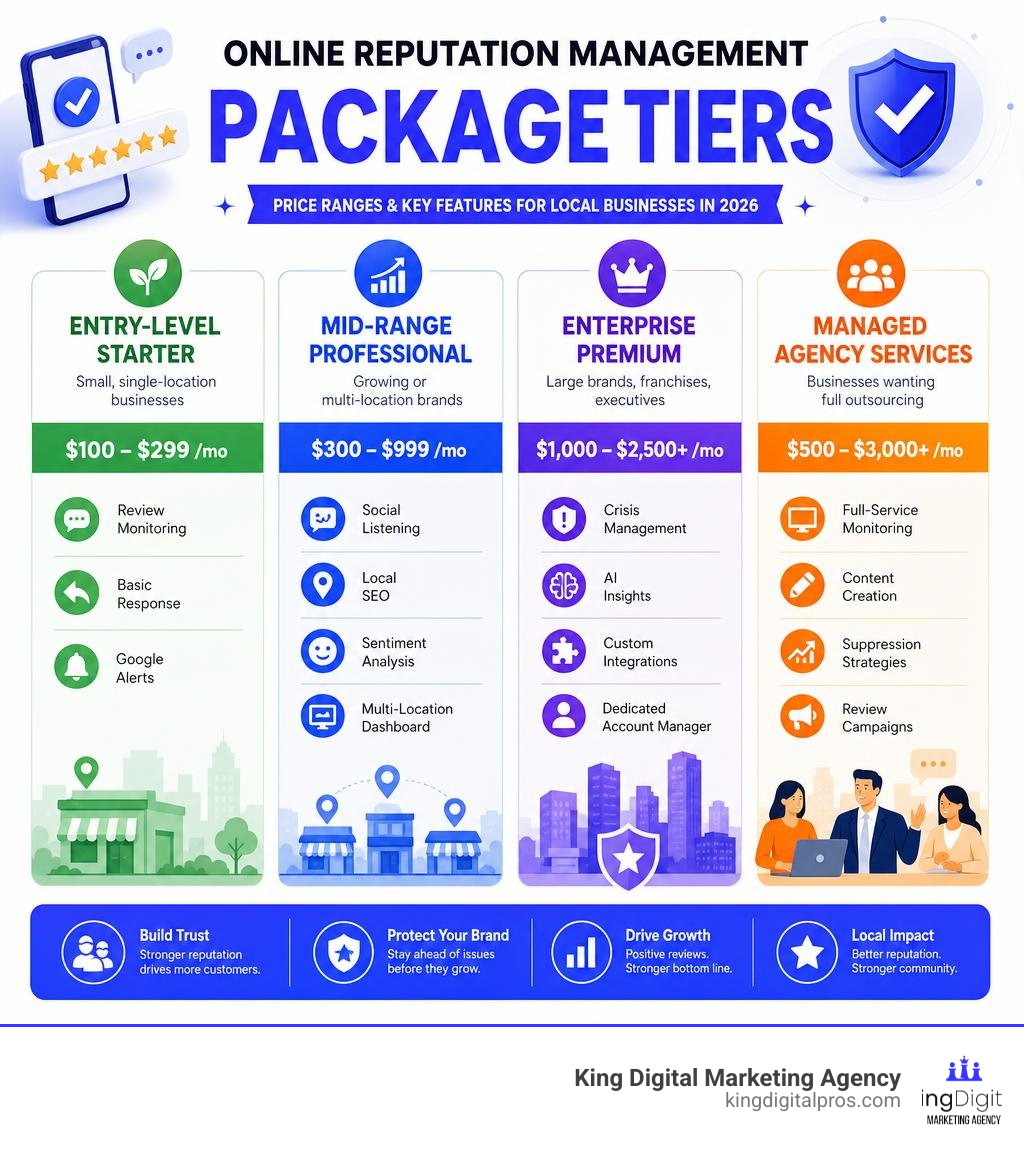
| Package Tier | Best For | Typical Monthly Cost | Core Features |
|---|---|---|---|
| Entry-Level / Starter | Small, single-location businesses | $100-$299/mo | Review monitoring, basic response, Google Alerts |
| Mid-Range / Professional | Growing or multi-location brands | $300-$999/mo | Social listening, local SEO, sentiment analysis, multi-location dashboard |
| Enterprise / Premium | Large brands, franchises, executives | $1,000-$2,500+/mo | Crisis management, AI insights, custom integrations, dedicated manager |
| Managed / Agency Services | Businesses wanting full outsourcing | $500-$3,000+/mo | Full-service monitoring, content creation, suppression, review campaigns |
The numbers behind this decision are hard to ignore. Research consistently shows that 97% of consumers find local businesses online – and a single negative review can cost you up to 30 potential customers. Meanwhile, 60% of consumers say negative reviews pushed them away from a business entirely.
That’s not a small risk. That’s a revenue problem.
The challenge is that the market is flooded with options – from $100/month DIY tools to $3,000/month fully managed agency services. Without a clear framework, it’s easy to overpay for features you don’t need or underspend and miss the protection your business actually requires.
I’m Bernadette King, founder of King Digital Marketing Agency, and I’ve spent years helping franchise owners and small businesses navigate online reputation management packages to find solutions that fit their goals and budgets without the guesswork. In this guide, I’ll walk you through exactly how to compare your options and choose the right tier for where your business is right now.
Online reputation management packages vocab explained:
- clean up internet reputation
- effective online reputation management
- medical online reputation management
Why Your Digital Standing Dictates Business Success in 2026
In June 2026, the path to purchase is more compressed than ever. Consumers no longer just search on Google, browse a website, and make a call. Instead, their journey often starts and ends directly inside an AI search overview, a quick glance at the Google Map Pack, or a voice-activated prompt. If your business doesn’t look stellar at first glance, you are functionally invisible.
Consider this: only 5% of users look past the first page of search engine results. If a negative review, an unanswered complaint, or a competitor’s highly optimized listing dominates that first page, you’ve lost the customer before they even know your name.
Furthermore, 84% of consumers do not trust traditional advertising and sales messaging anymore. They trust peer recommendations, which makes your review velocity (the frequency and volume of incoming reviews) a critical ranking and trust signal.

For local businesses in communities like Albuquerque, Rio Rancho, Santa Fe, and Corrales, local search visibility is the lifeblood of customer acquisition. When someone searches for a local service, they expect to see a highly rated business with recent, authentic reviews.
Ignoring your digital footprint is a risk no business can afford. In fact, companies that ignore online complaints experience an average 37% decline in customer advocacy. To understand how the broader digital landscape is shifting, check out our guide on Navigating the Digital Landscape: A Guide to the Online Reputation Management Market.
Comparing the Core Tiers of Online Reputation Management Packages
When evaluating online reputation management packages, you will quickly realize that pricing and features are structured across three primary software and service tiers. The goal is to maximize your return on investment (ROI) by matching your budget allocation to your actual business scale and goals.
Whether you are running a single dental practice in Los Alamos or managing a multi-location home service brand across Taos, Santa Fe, and Albuquerque, selecting the right tier is key to building long-term customer trust.
Here is an in-depth look at how these tiers compare:
What to Expect in Entry-Level Online Reputation Management Packages
Entry-level packages are built for small, single-location businesses that need to establish a basic defense system.
At this tier, you should expect:
- Review Monitoring: Automatic tracking of new reviews across major platforms like Google Business Profile and Facebook.
- Automated Review Requests: Simple email or SMS templates to ask happy customers for feedback right after a transaction.
- Basic Sentiment Reporting: Weekly or monthly summaries showing your average star rating and review volume.
These packages are highly cost-effective, typically ranging from $100 to $299 per month. They are perfect for local service providers in smaller markets like Edgewood, Tijeras, or Cedar Crest who want to keep their listings clean without a massive overhead. For a deeper look at how to leverage these entry-level tools, read our Review Management Software Complete Guide.
Mid-Range Solutions for Growing Multi-Location Brands
If you operate multiple locations – say, a franchise with offices in Albuquerque, Rio Rancho, and Santa Fe – an entry-level package will quickly leave you overwhelmed. This is where mid-range professional packages shine.
Mid-range packages focus on:
- Multi-Location Dashboards: A single, centralized inbox where you can view, sort, and respond to reviews across all your locations without logging in and out of different profiles.
- Social Listening: Tracking brand mentions, hashtags, and discussions across social media networks, forums, and local blogs.
- Advanced Local SEO Integration: Syncing and locking your business’s Name, Address, and Phone number (NAP) data across 70+ local directories to boost local map rankings.
- Automated Sentiment Analysis: AI-powered categorization that highlights common themes in your reviews (e.g., “long wait times” or “excellent customer service”).
These solutions help multi-location brands maintain brand consistency while empowering local managers to respond to reviews quickly. Learn more about scaling your brand with our guide to Mastering Franchise Review Management for Multi-Location Success.
When to Upgrade to Enterprise Online Reputation Management Packages
Enterprise-level online reputation management packages are designed for large brands, medical systems, financial institutions, and high-profile executives who require proactive defense and sophisticated data integrations.
At the enterprise level, you are paying for:
- Active Crisis Management & Suppression: Rapid-response protocols to handle coordinated review attacks or viral negative press, including pushing negative search results off page one.
- Advanced API Access & Custom Integrations: Connecting your reputation software directly to your CRM (like Salesforce or HubSpot) or proprietary scheduling systems.
- Dedicated Account Managers: A team of SEO and legal escalation experts who handle review flagging, policy violation removals, and custom content campaigns.
- Custom Brand Entity Work: Optimizing your brand’s digital footprint so that AI search engines (like ChatGPT and Google AI Overviews) pull accurate, highly positive data when answering user queries.
If you are managing a large medical practice or legal firm with significant compliance needs, upgrading to an enterprise tier ensures your brand remains secure. For tips on managing high-stakes corporate reputations, refer to How to Manage Your Online Reputation | Inc..
Essential Features to Look For in a Reputation Platform
As you compare different online reputation management packages, don’t get distracted by flashy, non-essential add-ons. Focus on the core capabilities that drive real business growth and protect your digital assets.
- Review Aggregation & Centralized Inbox: The platform must pull reviews from Google, Facebook, Yelp, and industry-specific sites (like Healthgrades or TripAdvisor) into one unified dashboard.
- AI-Powered Sentiment Tracking: The software should use machine learning to detect whether customer sentiment is shifting positive or negative over time, helping you catch operational issues before they turn into 1-star reviews.
- Automated Response Templates & Workflows: Look for smart reply templates that can be customized by location or sentiment, allowing your team to respond to reviews within 24 to 48 hours.
- Local Listing Synchronization: Your platform should act as a “single source of truth,” instantly pushing updates to your operating hours, phone numbers, and addresses across all major mapping apps and search directories.
To learn how to set up these tools to run on autopilot, check out our guide on How to Master Brand Reputation Monitoring Without Losing Your Mind.
Frequently Asked Questions About Reputation Services
How do online reviews influence local search rankings?
Google’s local search algorithm relies heavily on three main pillars: relevance, distance, and prominence. Your reviews directly feed into “prominence.”
Search engines look at your total review volume, star ratings, review velocity, and the keywords used within customer feedback. A steady stream of fresh, positive reviews tells Google’s algorithm that your business is active, reliable, and highly relevant to local searchers. This is why businesses with active review generation campaigns consistently dominate the local map pack.
Can a business remove negative reviews from Google or Yelp?
You cannot remove a review simply because it is negative or because you disagree with the customer’s perspective. However, both Google and Yelp have strict Terms of Service.
If a review contains profanity, personal attacks, conflicts of interest (such as a competitor leaving a fake review), or off-topic spam, you can flag it for removal. Legitimate platforms have a 30% to 40% success rate in removing policy-violating reviews. For reviews that are negative but compliant with platform guidelines, the best strategy is to respond professionally and use search suppression to push positive content higher.
How long does it take to see results from a reputation management plan?
Reputation management is a marathon, not a sprint. While you can see initial improvements within weeks of launching automated review request campaigns and responding to older reviews, building deep, long-term search engine authority takes time.
Typically, expect 3 to 6 months of consistent review generation, local listing optimization, and content creation to see a dramatic shift in your local map pack rankings and overall online sentiment.
Conclusion
At King Digital Marketing Agency, we specialize in optimizing Google Business Profiles and local map listings to help businesses across Albuquerque, Rio Rancho, Santa Fe, Corrales, Taos, and surrounding New Mexico communities stand out. We know that your online reputation is your most valuable digital asset.
By choosing the right online reputation management packages for your current scale, you can protect your hard work, build deep trust with your local community, and ensure that search engines always showcase your best side.
Ready to take control of how customers see your business online? Let us help you build a squeaky-clean digital presence. Learn more about our customized Online Reputation Management services today!
