From Zero to Hero: How Business Growth Marketing Can Transform Your Enterprise
Why Business Growth Marketing Is the Game-Changer Your Enterprise Needs

Business growth marketing is a data-driven, full-funnel strategy focused on sustainable revenue through continuous experimentation, personalization, and customer lifecycle optimization—rather than one-off campaigns or vanity metrics.
Key components of effective Business growth marketing:
- Full-funnel focus – engaging customers from awareness through advocacy
- Rapid experimentation – A/B testing, high-tempo iterations, and hypothesis-driven tactics
- Data-driven personalization – tailoring messages and offers to audience segments
- Customer lifecycle management – maximizing retention, referrals, and lifetime value
- Cross-channel integration – seamless omnichannel experiences that follow the customer journey
If you’ve ever felt stuck watching competitors pull ahead online while your own efforts plateau, you’re not alone. Many business owners invest in marketing without seeing real, measurable growth. The problem isn’t effort—it’s strategy. Traditional marketing focuses on awareness and acquisition, but Business growth marketing goes further. It treats every stage of the customer journey as an opportunity to test, learn, and optimize for sustainable results.
Growth marketing is, as one expert put it, “just the next evolution of marketing.” It’s a mindset shift from static campaigns to agile, always-on systems that adapt based on what the data tells you. Instead of guessing what works, you experiment. Instead of chasing vanity metrics, you focus on retention, referrals, and revenue. And instead of treating marketing as a cost center, you position it as the engine that drives long-term expansion.
The stakes are high. Research shows that companies using analytics effectively are 1.5 times more likely to achieve above-average growth rates. Meanwhile, 71% of consumers now expect personalized interactions—and 76% get frustrated when they don’t receive them. In 2026, the businesses that win are the ones that marry creativity with data, storytelling with experimentation, and customer obsession with scalable systems.
I’m Bernadette King, founder of King Digital, and I’ve spent years helping local businesses transform their online presence through targeted SEO, paid advertising, and conversion-driven content—all rooted in Business growth marketing principles. Whether you’re a franchise owner or a solo entrepreneur, this guide will show you how to move from scattered tactics to a cohesive growth engine that delivers measurable results.
Business growth marketing terms explained:
- SEO Friendly Website Design
- how to create an seo friendly website design structure
Defining Business Growth Marketing in 2026
As we navigate the landscape of 2026, Business growth marketing has moved from a buzzword to a survival requirement. Unlike traditional marketing, which often stops once a lead is handed to sales, growth marketing is a full-funnel strategy. We look at the entire customer lifecycle, ensuring that the person who clicked your ad today becomes a loyal advocate tomorrow.
In the markets of Albuquerque, Rio Rancho, and Santa Fe, rapid adaptation is the name of the game. You can’t afford to wait six months to see if a billboard worked. Growth marketing relies on real-time data to pivot strategies instantly.
| Feature | Traditional Marketing | Business Growth Marketing |
|---|---|---|
| Primary Goal | Awareness & Acquisition | Retention & Sustainable Revenue |
| Funnel Focus | Top of Funnel (Awareness) | Full Funnel (AARRR) |
| Methodology | Large, Set Campaigns | Continuous Experimentation |
| Data Usage | Historical/Post-Campaign | Real-Time & Predictive |
| Personalization | Broad Segments | Individual 1:1 Personalization |
A major driver in this shift is consumer expectation. According to Statista, 81% of Gen Z consumers prefer personalized ads, a sentiment shared by 57% of millennials. If your messaging feels generic, you aren’t just losing a click; you’re losing a relationship. For local enterprises, working with a Digital Marketing Agency for Small Businesses that understands these nuances is critical for local dominance.
Distinguishing Growth from Performance Marketing
It’s easy to confuse growth marketing with performance marketing, but the difference lies in the depth of the relationship. Performance marketing is often transactional—you pay for a click, you get a lead. Business growth marketing, however, prioritizes brand building and long-term retention.
We aren’t just looking for a one-time sale; we’re looking to improve the entire customer experience. This involves understanding How to Optimize a Marketing Funnel for Conversions so that every touchpoint—from the first Google search to the third repeat purchase—is seamless. While performance marketing might get them through the door, growth marketing makes sure they never want to leave.
The Evolution of Growth Hacking
You might remember when “growth hacking” was all the rage. It was often associated with “hacks” or shortcuts to get famous overnight. Today, growth hacking has matured into Business growth marketing. It has kept the agility—the “sprints” and high-tempo testing—but added a layer of scalability and professionalism.
In 2026, we don’t just “hack” for the sake of a quick spike in traffic. We run experiments to find repeatable, scalable processes. For instance, testing different local landing pages for your business in Los Alamos or Grants isn’t just a one-off task; it’s part of a broader commitment to SEO services that build authority over time. We use these high-tempo tests to de-risk investments, ensuring we only scale what actually moves the needle.
The AARRR Framework: A Roadmap for Sustainable Success
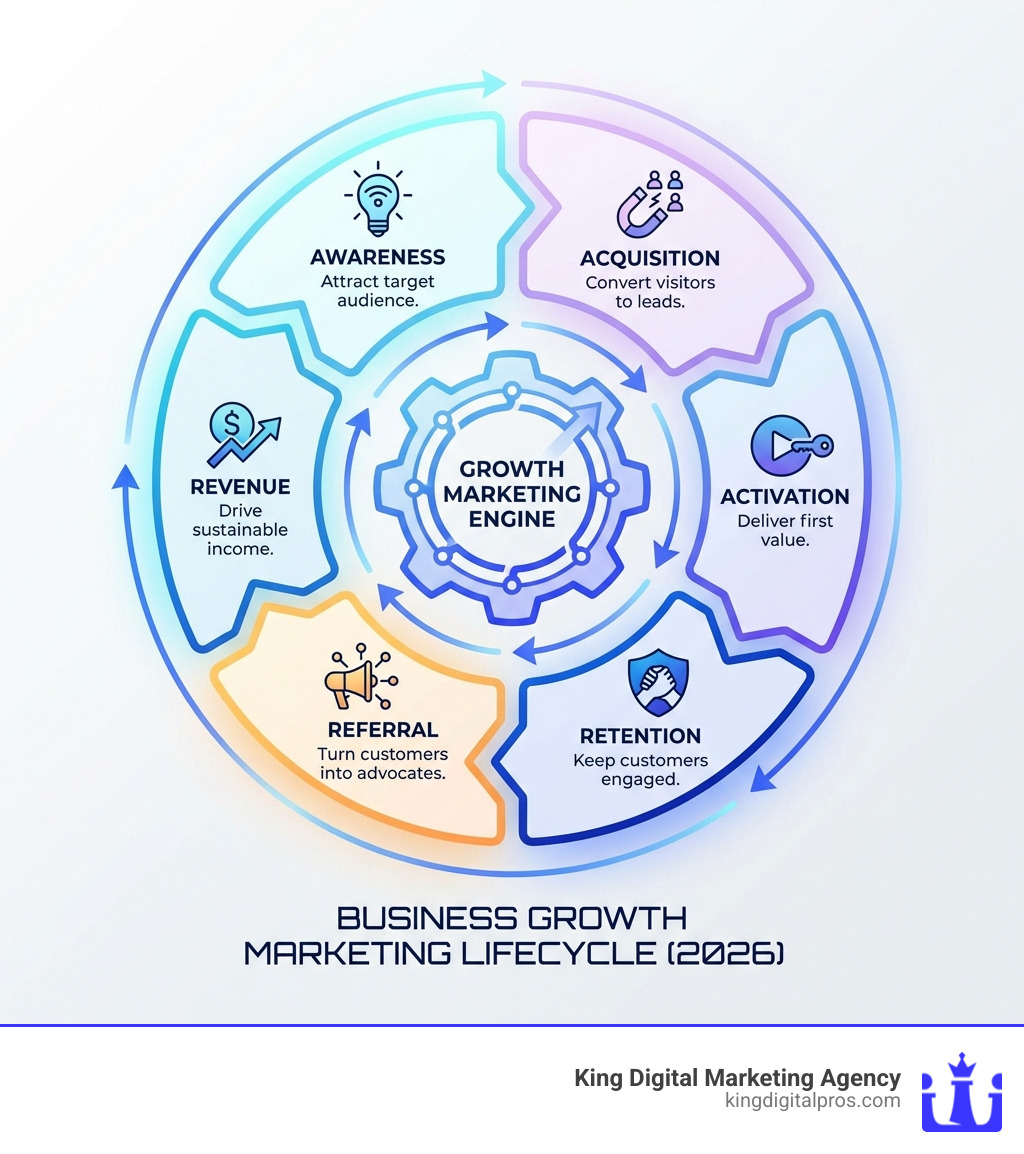
To navigate the complexities of growth, we use what’s affectionately known as “Pirate Metrics”—the AARRR framework. This acronym stands for Acquisition, Activation, Retention, Referral, and Revenue. It provides a holistic view of your company’s health, moving far beyond superficial metrics like “likes” or “impressions.”
Understanding these stages allows us to pinpoint exactly where your business is losing money. If you have great acquisition but low retention, you’re essentially filling a leaky bucket. By learning How to Measure Marketing ROI, you can allocate your budget to the stages that offer the highest return.
Maximizing Retention and Referral Loops
In Business growth marketing, retention is the “holy grail.” It is significantly more cost-effective to keep an existing customer than to acquire a new one. When we build customer loyalty, we create the foundation for “referral loops.”
A referral loop occurs when your existing customers become your best salespeople. Nielsen research shows that 84% of people trust recommendations from people they know over brand advertising. This is why Reputation Management Services are so vital. A single glowing review from a neighbor in Corrales or Edgewood can drive more high-quality leads than a month of paid ads.
Driving Revenue through Activation
Activation is the moment a user realizes the value of your product or service—the “Aha!” moment. In growth marketing, we focus heavily on user onboarding and friction reduction. If a potential customer in Taos visits your site but finds the booking process confusing, you’ve lost them at the activation stage.
We use tools like a Lead Generation Calculator to understand the value of these activated users. By shortening the “time to value,” we ensure that prospects don’t just sign up—they actually use and pay for your services.
Core Elements of an Effective Business Growth Marketing Strategy
A successful strategy isn’t built on a single tactic; it’s a combination of several core elements working in harmony.
- A/B Testing: We test everything—headlines, button colors, email subject lines, and even pricing models.
- Omnichannel Experience: Whether a customer finds you on TikTok, Google Maps, or through an email, the experience should be consistent.
- Customer Feedback: We don’t guess what customers want; we ask them. Surveys and reviews are data goldmines.
Personalization is no longer a luxury. 71% of consumers expect personalized interactions, and failing to provide them can lead to frustration. By focusing on these elements, we can Boost Conversion Rates and turn a stagnant website into a growth engine.
Data-Driven Personalization in Business Growth Marketing
Data-driven personalization involves more than just putting a first name in an email. It’s about audience segmentation and behavioral triggers. If a user in Sandia Park frequently views your “Local SEO” services but hasn’t booked a call, we can trigger dynamic content that addresses their specific pain points.
Our Conversion Optimization Services focus on using this data to create relevant experiences. When a customer feels understood, they are much more likely to convert.
Utilizing High-Tempo Testing Frameworks
The heart of Business growth marketing is the “test and scale” mantra. We start with hypothesis generation: “If we change our Google Business Profile photo to a team photo, we will increase clicks by 10%.”
Next, we run a “minimum viable experiment”—a low-cost way to see if the idea has merit. If it works, we scale it. If it doesn’t, we learn and move on. This cycle of fast learning prevents wasted spend. For a deeper look at how this impacts your bottom line, check out our Marketing ROI Calculator Complete Guide.
Leveraging Modern Channels for Business Growth Marketing
The channels that worked in 2020 are not the same ones driving growth in 2026. Today, short-form video and influencer partnerships are non-negotiable. 84% of consumers say watching a brand’s video convinced them to make a purchase.
For local businesses in Albuquerque and surrounding areas, this means creating authentic video content that shows the human side of your brand. Integrating these videos into Social Media Advertising Services allows you to reach a hyper-targeted audience with a message that resonates.
Integrating SEO and GEO for Business Growth Marketing
While traditional SEO is still vital, we are now entering the era of GEO—Generative Engine Optimization. With the rise of AI-powered search (like ChatGPT and Google Gemini), your business needs to be visible in AI-generated answers.
This requires semantic precision and authority building. We don’t just want to rank #1; we want to be the answer the AI provides. This is especially true for local growth. Our Ultimate Guide to Local Business Growth explores how to position your enterprise to capture this “zero-click” traffic.
Content-Led Acquisition and Storytelling
Content is the fuel for your growth engine. However, in 2026, “content-led acquisition” isn’t about churning out generic blog posts. It’s about building authority through E-E-A-T (Experience, Expertise, Authoritativeness, and Trustworthiness).
Educational resources that solve real problems for your customers in Tijeras or Cedar Crest build trust before a sales pitch even happens. High-quality Content Writing for Business ensures that your brand is seen as a leader in its field, making the eventual conversion much easier.
Preparing Your Operations for Rapid Expansion
One of the biggest mistakes we see is a business that invests in Business growth marketing but isn’t operationally ready for the results. If we double your leads in Albuquerque, do you have the staff to answer the phones? Do you have the infrastructure to handle the overflow?
Successful growth requires:
- Scalable Technology: Systems that grow with you.
- Executive Buy-in: Your leadership must be ready to approve actions based on data, not just gut feelings.
- Infrastructure: Suppliers and vendors lined up to handle increased demand.
For local businesses, using a Geofencing Marketing Complete Guide can help you target customers exactly where they are, but you must be ready to serve them the moment they walk through the door.
Choosing the Right Growth Marketing Tools
You don’t need every tool on the market, but you do need the right ones. A solid growth stack typically includes:
- Analytics: To track user behavior (Google Analytics 4, Mixpanel).
- CRM: To manage customer relationships (HubSpot, Salesforce).
- Automation: To handle repetitive tasks and lead nurturing (Mailchimp, Zapier).
The goal is to Attract More Customers while keeping your internal processes lean and efficient.
Building a Culture of Experimentation
Finally, growth is a mindset. It requires cross-functional teams where marketing, sales, and product development talk to each other daily. It also requires a high tolerance for failure. Not every experiment will work, and that’s okay. In fact, it’s necessary.
Transparency with data ensures that everyone knows the “North Star Metric”—the one key figure that represents long-term value. When your whole team is aligned, you can truly Grow Local Business in a sustainable, exciting way.
Frequently Asked Questions about Business Growth Marketing
What is the difference between growth marketing and growth hacking?
Growth hacking is often focused on rapid, top-of-funnel acquisition using low-cost, creative tactics. Business growth marketing is the “grown-up” version. It encompasses growth hacking but applies it to the entire customer journey, focusing on long-term retention and sustainable revenue rather than just quick spikes in traffic.
How do I choose a North Star Metric for my business?
Your North Star Metric should be the single clearest indicator of the value your company provides to its customers. For a local service business in Rio Rancho, it might be “Completed Appointments.” For a SaaS company, it might be “Daily Active Users.” It should lead to long-term growth, not just short-term profit.
Why is personalization critical for growth in 2026?
Consumers are bombarded with more ads than ever. To stand out, your message must be relevant. Personalization builds trust and reduces friction, making it easier for a customer to say “yes.” With 76% of consumers getting frustrated by non-personalized experiences, it’s no longer optional—it’s a competitive necessity.
Conclusion
Transforming your enterprise from “zero to hero” doesn’t happen by accident. It happens through the deliberate, data-driven application of Business growth marketing. By focusing on the full funnel, embracing experimentation, and preparing your operations for scale, you can unlock levels of growth you previously thought impossible.
At King Digital Marketing Agency, we specialize in making this transition easy for local businesses. Our unique expertise in managing Google Business Profiles and map listings ensures that when people in Albuquerque, Santa Fe, or any of our New Mexico locations search for what you offer, they find you first.
Ready to build your growth engine? Let’s start with an SEO-friendly website design that captures attention and converts visitors into lifelong customers. Together, we can turn your business into the local leader it was meant to be.
