

TL;DR:
- Creating content without a documented workflow leads to inefficiency and inconsistent results for SMBs. Establish clear roles, structured stages, automation, and metrics to optimize content production from ideation to distribution. Regularly measure, refine, and formalize your process to build a scalable and effective content system.
Running content for an SMB without a documented content marketing workflow is like building furniture without instructions. You have all the pieces, but nothing fits together cleanly. Marketing teams at small to medium-sized businesses often juggle too many tools, too many approvers, and no clear ownership over who does what and when. The result is missed deadlines, inconsistent quality, and content that never quite delivers the ROI it should. This guide walks you through every stage of an effective content production workflow, from the first idea through final measurement, so your team can create better content with less friction.
Key takeaways
| Point | Details |
|---|---|
| Map roles before you build | Defining who writes, reviews, and approves content before launching any workflow prevents the most common bottleneck SMBs face. |
| Structure your process in five stages | A five-stage workflow covering ideation, creation, review, optimization, and distribution creates consistency and reduces dropped tasks. |
| Automate logistics, not creativity | Use automation to handle routing and reminders while keeping human judgment at the center of editorial decisions. |
| Separate review gates by type | Reviewing for style, factual accuracy, and publishing readiness in distinct stages cuts revision cycles and speeds up approvals. |
| Measure with your funnel in mind | Track metrics at each funnel stage, from awareness to conversion, to understand what content is genuinely driving business outcomes. |
What you need before building your content marketing workflow
Before you sketch out a single process map, you need three things in place: the right people in clearly defined roles, the right tools to manage tasks and communication, and agreed-upon metrics that tell you whether the work is actually performing.
Team roles and responsibilities
Every functioning content creation process depends on role clarity. You need at least four functions covered, even if one person plays more than one role in a smaller team.
- Content strategist or planner: Owns the editorial calendar, keyword research, and topic prioritization
- Writer or content creator: Executes briefs and drafts content to a defined standard
- Editor and fact-checker: Reviews for quality, accuracy, and brand voice before routing for approval
- Approver or publisher: Gives final sign-off and handles distribution and scheduling
When these roles blur or go unassigned, content stalls. The single most common bottleneck in SMB content operations is not tool failure. It is the absence of a named decision-maker at each handoff point.
Tools that keep the process moving

Your digital marketing workflow does not require an enterprise platform. At the SMB level, a well-configured project management tool paired with a content management system and a basic analytics dashboard covers most needs. Look for tools that support task assignment, deadline tracking, and comment threading in one place. Platforms that also offer automation features for routing content between stages reduce the back-and-forth that kills momentum.
Pro Tip: Start with one central tool where all content tasks live, even if it is just a shared board. Teams that fragment tasks across email, chat, and spreadsheets lose hours every week to status checks alone.
Defining your success metrics upfront
Your content strategy plan should tie specific metrics to specific stages of the buyer journey before you publish a single piece. Build this into your workflow foundation, not as an afterthought. Metrics like organic traffic and time-on-page signal awareness-stage performance. Click-through rates and form submissions measure consideration and conversion. Building your marketing metrics framework around these stages from the start means your team always knows what success looks like.
Content marketing workflow stages: from ideation to distribution
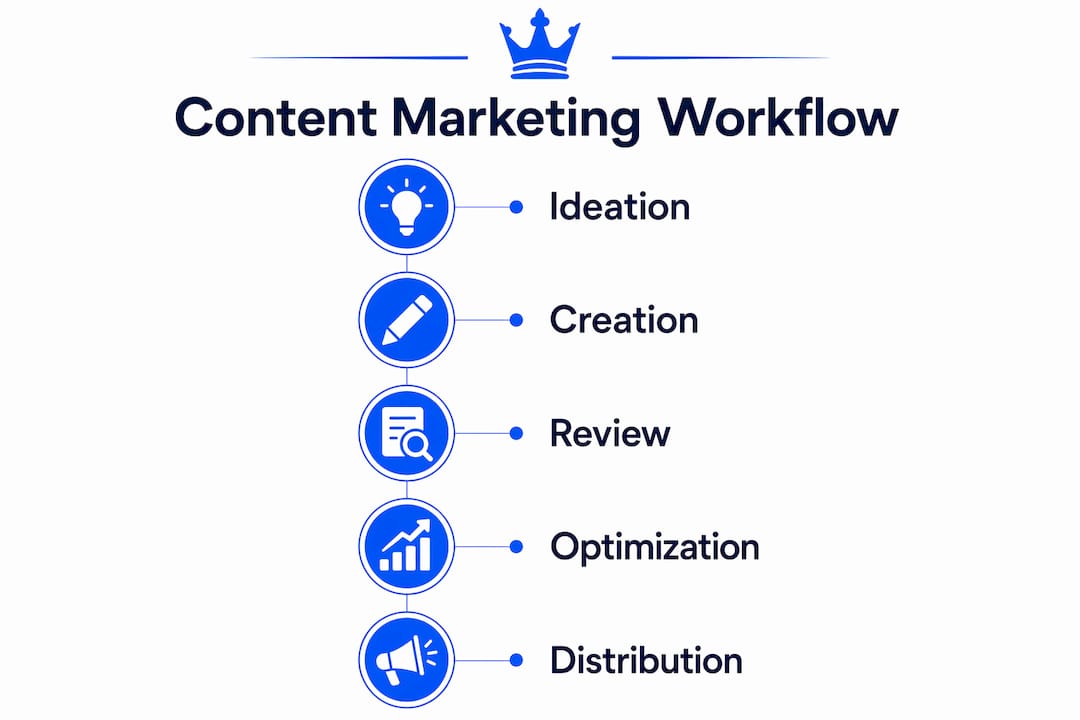
A structured content lifecycle moves through five stages. Each stage has a clear input, a clear output, and a defined trigger that moves work to the next person. Here is how to execute each one.
-
Ideation. Every piece starts with a brief that documents the target keyword, audience intent, content format, and publishing goal. Use a recurring ideation session, weekly or biweekly, where the strategist presents prioritized topics based on search data, sales questions, and competitor gap analysis. Score ideas by business value and production effort to decide what gets scheduled next. This prevents the reactive “let’s write something this week” pattern that derails most SMB content programs.
-
Creation. The writer works from the brief and delivers a first draft by the agreed date. Good briefs dramatically reduce revision cycles. A brief should specify word count, key sections, internal linking targets, and tone notes. When teams skip briefs or treat them as optional, manual coordination explodes through email chains, last-minute changes, and rewritten drafts. Treat the brief as a contract between strategy and execution.
-
Review and approval. This is where most workflows slow down. Structured feedback cycles mean each reviewer has a defined scope. Your editor checks for quality and brand voice. Your fact-checker verifies claims and sources. Your approver confirms the content meets publishing-readiness criteria. Each gate is separate. Reviewing all three dimensions at once creates confusion and revision loops that push publish dates back by days or weeks.
-
Optimization. Before a piece publishes, it passes through an SEO and formatting checklist. This includes confirming the target keyword appears in the title, meta description, first paragraph, and at least one subheading. It means verifying internal links point to live, relevant pages, and confirming image alt text, URL structure, and schema markup where applicable. Assign this step to a dedicated owner rather than leaving it to whoever hits the publish button.
-
Distribution. Publishing is not the finish line. Your distribution stage should include a checklist of every channel where the content will appear: organic search, email newsletter, social media marketing workflow touchpoints, and any paid promotion. Use automation to schedule social posts and email sends at the moment of publish, so distribution does not depend on someone remembering to do it manually.
Pro Tip: Build automation triggers between each stage. When a writer marks a draft “complete,” the system should automatically notify the editor, assign the review task, and set a deadline. This removes the manual handoff and keeps the content production workflow moving even during busy weeks.
The table below maps each stage to its key output and primary automation opportunity.
| Workflow stage | Key output | Automation opportunity |
|---|---|---|
| Ideation | Approved content brief | Auto-create task with brief template |
| Creation | First draft in content tool | Notify editor when draft is submitted |
| Review and approval | Approved final draft | Route to next reviewer; send reminders |
| Optimization | SEO-ready, formatted content | Checklist trigger before publish task |
| Distribution | Published and promoted content | Scheduled social posts and email sends |
For SMB teams building this process from scratch, a practical content tips guide can help you prioritize which channels and formats to tackle first without spreading your team thin.
Getting content approvals right
Approval delays are the most predictable failure point in any content workflow. The good news is that approval bottlenecks are almost always process problems, not people problems. The fix is design, not pressure.
The first design decision is whether your review runs in parallel or in sequence. Parallel review means multiple reviewers look at the content at the same time, which cuts total cycle time significantly. Sequential review means each reviewer waits for the previous one to finish, which adds more accountability but takes longer. For most SMB teams, parallel review with a 24-hour SLA per reviewer is the right balance.
Here is what a functioning approval process looks like in practice:
- Define reviewer scope clearly. Each reviewer only gives feedback within their defined lane. The editor does not comment on SEO. The legal reviewer does not rewrite headlines.
- Set SLAs with escalation paths. If a reviewer misses their 24-hour window, the workflow automatically escalates to their manager or moves to the next stage with a flag.
- Use automation for reminders and audit trails. Automated routing and reminders remove the need for a project manager to chase approvals manually and create a record of who approved what and when.
- Separate review gates. Review content quality and style in one pass, factual accuracy in a second, and publishing readiness in a third. This approach reduces overall cycle time by preventing reviewers from conflating different types of feedback.
Pro Tip: Assign a single person as the “decision owner” for each piece of content. When feedback from multiple reviewers conflicts, this person makes the final call. Without a named decision owner, conflicting feedback creates revision loops that can delay publishing by a full week.
Measuring and refining your workflow performance
A content marketing workflow is only as good as your ability to see where it is working and where it is not. You need two layers of measurement: content performance metrics and workflow efficiency metrics.
Content performance maps to your buyer journey. A full-funnel measurement framework tracks awareness metrics like organic impressions and new visitors, engagement metrics like time on page and scroll depth, consideration metrics like return visits and newsletter signups, and conversion metrics like form fills and sales calls generated.
Workflow efficiency tells you how healthy your process is.
| Efficiency metric | What it tells you |
|---|---|
| Average cycle time per piece | How long content takes from brief to publish |
| Bottleneck stage | Where tasks consistently stall |
| Revision rate | How often content returns from review |
| On-time publish rate | Whether the editorial calendar is holding |
Once you have two to four weeks of data, run a brief workflow audit. Ask three questions: Where are tasks sitting longest? Which stage generates the most revision requests? Which team members are the most frequent bottleneck? Use the answers to redesign the specific stage that is underperforming, not the entire workflow.
A repeatable 30 to 90 day operating cadence that includes content audits, fresh creation, repurposing of top performers, and a measurement review gives SMB teams a stable rhythm instead of a constant reinvention of the process. Pair this with a funnel marketing strategy that aligns your content investment to where buyers actually are in their decision process, and your workflow starts generating compounding returns.
My honest take on content workflows for SMBs
I’ve seen a lot of SMB marketing teams build workflows that look great on a slide deck and collapse in practice. The reason is almost always the same: the workflow was designed for how the team should work, not how they actually work.
In my experience, the teams that see the fastest improvement are not the ones who buy the most sophisticated project management tool. They are the ones who sit down and write out, in plain language, who owns what and what happens when something goes wrong. Escalation rules matter more than most people realize. When a reviewer is out sick, does content sit? When a deadline gets missed, who decides whether to push the publish date or lower the quality bar? Without answers to these questions, every unexpected situation becomes a crisis.
I also think automation gets oversold to SMBs. Strategic automation is a genuine force multiplier for routing, reminders, and status tracking. But I’ve watched teams spend three weeks configuring automation for a workflow they had not yet validated manually. Prove the process works with spreadsheets and task cards first. Then automate the parts that are working.
The teams I respect most are the ones that treat their workflow like a product they are constantly improving. They ship it, measure it, and update it on a predictable cadence. That discipline is what separates the SMBs that build real content engines from the ones that publish in bursts and wonder why nothing compounds.
— Bernadette
How Kingdigitalpros helps SMBs build content systems that deliver
Running a tight content workflow takes more than good intentions. It takes the right structure, tools, and strategy aligned to your specific business goals.

At Kingdigitalpros, we work directly with SMB marketing teams to design and implement digital marketing workflows that fit how your team actually operates, not a generic template. From content strategy and creation to approval processes and performance analytics, our in-house team brings the kind of hands-on guidance that moves you from reactive publishing to a system that consistently generates leads. If you are ready to build a process that scales, explore our digital marketing solutions or take a deeper look at how to master digital marketing for your business. We are ready to help you make every content investment count.
FAQ
What are the main stages of a content marketing workflow?
A content marketing workflow typically includes five stages: ideation, creation, review and approval, optimization, and distribution. Each stage should have a defined owner, a clear output, and a trigger that moves work to the next step.
How do I fix slow content approvals?
Approval delays almost always come from unclear reviewer roles or missing escalation rules, not from tool problems. Define each reviewer’s scope, set 24-hour SLAs, and use automation to send reminders and route content automatically.
What tools do SMBs need for a content production workflow?
You need a project management platform for task assignment and deadlines, a content management system for drafting and publishing, and an analytics dashboard for measuring performance. Many SMB teams get strong results from a single well-configured tool before adding more complexity.
How often should I review and update my workflow?
A 30 to 90 day cadence works well for most SMB teams. Run a brief audit at the end of each cycle, identify the single biggest bottleneck, and make one targeted change before the next cycle begins.
What metrics should I track for content marketing performance?
Track performance at each funnel stage. Use organic traffic and impressions for awareness, time on page and newsletter signups for engagement, and form fills or sales calls for conversion. A full-funnel measurement framework tells you which content is driving real business outcomes, not just page views.
Recommended
- Content marketing strategies that grow Albuquerque SMB leads
- Questions to Ask a Digital Marketing Agency in 2026
- Build a winning content strategy process for Albuquerque SMBs
- Content Writing Business: Build Your Empire 2025