
TL;DR:
- Effective local search ranking relies on understanding and optimizing relevance, prominence, and distance simultaneously.
- A complete Google Business Profile, citation consistency, and review velocity are critical factors that influence visibility and leads.
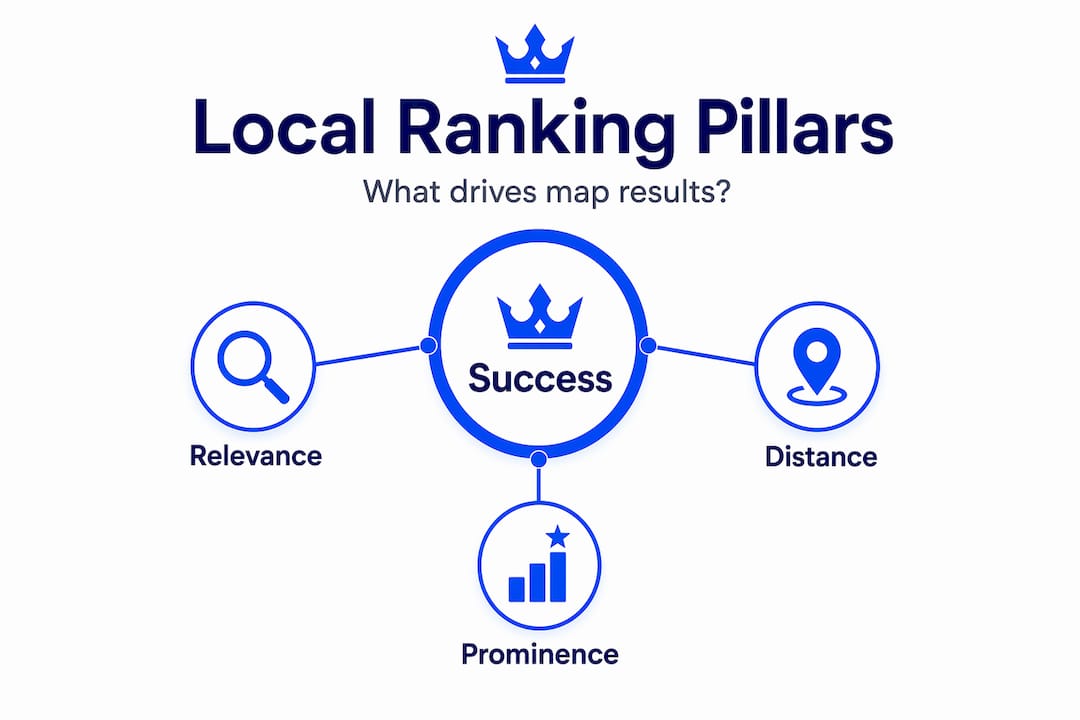
Most local business owners assume showing up in Google’s local results is simply a matter of being the closest option to the customer. That assumption costs them leads every single day. Understanding local search ranking, which the industry formally calls local search algorithm optimization, means grasping that Google weighs three distinct pillars: relevance, distance, and prominence. Proximity is just one piece. A competitor across town with a stronger Google Business Profile, more recent reviews, and better citation consistency will regularly outrank you, even when you are physically closer to the searcher. This guide breaks down exactly why that happens and what you can do about it.
Table of Contents
- Key Takeaways
- Understanding local search ranking: the three-pillar framework
- Optimizing your Google Business Profile and reputation
- Citations, NAP consistency, and local backlinks
- On-page and technical SEO for local visibility
- AI and hyperlocal strategies reshaping local search
- My honest take after years of local SEO work
- How Kingdigitalpros can help you rank and grow
- FAQ
Key Takeaways
| Point | Details |
|---|---|
| Three pillars drive rankings | Google ranks local results by relevance, distance, and prominence. No single pillar dominates alone. |
| GBP signals lead the algorithm | Google Business Profile accounts for 32% of local ranking weight, more than any other factor. |
| Citation accuracy beats quantity | One mismatched phone number can cause Google to distrust your business data across all platforms. |
| Review velocity matters more than volume | A steady flow of new reviews signals healthy activity and outperforms a one-time surge. |
| Hyperlocal content wins in 2026 | Neighborhood-specific content outperforms broad city-wide keyword targeting in AI-filtered results. |
Understanding local search ranking: the three-pillar framework
Local search ranking is not a mystery, but it is misunderstood. Google openly confirms that local results rank by relevance, distance, and prominence before finalizing which businesses appear in the Local Pack. Most marketers focus on distance and ignore the other two. That is exactly where the gap in performance appears.
Relevance measures how well your business matches what the searcher actually wants. Your Google Business Profile categories, the services you list, and the keywords on your website all feed this signal. A plumber who lists “emergency water heater repair” as a service will beat a general plumber for that specific query, even if the general plumber is closer.
Distance is the factor everyone obsesses over, but it is increasingly filtered through the other two pillars. If your prominence score is high enough, Google will surface you beyond your immediate radius.
Prominence is trust and authority in Google’s eyes. It builds from reviews, backlinks, mentions across the web, and your overall online footprint.
Here is how the ranking signals break down by weight in 2026:
| Ranking Signal | Weight |
|---|---|
| Google Business Profile signals | 32% |
| On-page SEO | 19% |
| Reviews | 16% |
| Links | 15% |
| Behavioral signals | 8% |
| Citations | 7% |
Pro Tip: Don’t obsess over ranking in the entire city. Rank dominantly in your immediate zone first, then expand outward. Proximity still provides a competitive edge when everything else is equal.
Businesses that treat local SEO as a coordinated system rather than isolated tasks consistently outperform those who chase single fixes. Think of it as a three-legged stool. Weaken one leg, and the whole structure tilts.
Optimizing your Google Business Profile and reputation
Your Google Business Profile (GBP) is the single highest-leverage asset in your local search toolkit. It carries 32% of the total ranking weight, which means half-finished profiles are half-hearted rankings. Think of your GBP like a storefront: a dark window and a closed sign drive searchers straight to your competitor.
Here is what full optimization actually looks like:
- Claim and verify your profile. An unclaimed profile is a missed opportunity that a competitor or spammer can exploit.
- Select primary and secondary categories with precision. Your primary category signals your core business type. Use secondary categories to capture adjacent searches.
- Complete every field. Hours, phone number, website, attributes, and service areas all contribute to relevance scoring.
- Add photos regularly. Profiles with active photo uploads signal engagement to the algorithm.
- Post weekly updates. Google Posts appear directly in your profile and signal that the business is active.
- Answer every question in Q&A. Unanswered questions hurt trust and can be answered by strangers with inaccurate information.
One critical caution: keyword stuffing your business name in the GBP name field, such as writing “Smith Plumbing Best Plumber Albuquerque,” triggers automatic account suspensions. Your business name should match your real-world signage exactly. Full stop.
On the review side, volume matters, but velocity matters more. Steady, consistent review growth outperforms sudden spikes that look purchased or manufactured. Respond to every review, positive or negative. Unanswered reviews signal neglect to both Google and prospective customers.
Pro Tip: Build review velocity into your customer experience workflow. Send a follow-up text or email within 24 hours of service completion. Consistent timing creates a predictable stream of new reviews that becomes a competitive moat over time.
For a deeper look at what an optimized profile actually looks like in practice, the team at Kingdigitalpros has put together a guide on business profile best practices worth bookmarking.
Citations, NAP consistency, and local backlinks
Citations are online mentions of your business name, address, and phone number (NAP). They appear on directories like Yelp, YellowPages, Apple Maps, and hundreds of industry-specific platforms. Their purpose is to confirm your business’s legitimacy and location to Google’s local crawler.
Here is the critical insight most business owners miss: citation consistency outweighs citation quantity. A single wrong phone number or an old suite number still floating on three directories creates what is called entity fragmentation. Google sees conflicting data and reduces its confidence in your business information across all surfaces.
Here is a practical approach to getting your citations right:
- Audit your existing citations. Use a tool like BrightLocal or Whitespark to pull a full citation report and flag every inconsistency.
- Prioritize tier-one directories first. Google Business Profile, Bing Places, Apple Maps, Yelp, and Facebook are non-negotiable. Get these perfect before chasing smaller directories.
- Fix inconsistencies before adding new listings. Adding more citations with wrong data amplifies the problem, not the authority.
- Pursue local and industry-specific directories. A local Chamber of Commerce listing carries more prominence weight than a generic national directory. Same goes for industry associations.
- Track unstructured mentions. Press coverage, blog features, and local news articles that mention your business by name, even without a link, strengthen prominence in AI-filtered search results.
| Citation Tier | Examples | Priority |
|---|---|---|
| Tier 1 (Core) | GBP, Yelp, Bing, Apple Maps, Facebook | Highest |
| Tier 2 (Authority) | Chamber of Commerce, BBB, local news | High |
| Tier 3 (Industry-Specific) | Houzz, Avvo, Healthgrades | Medium |
| Tier 4 (General Directories) | YellowPages, Foursquare | Lower |
Local backlinks, particularly from organizations like your city’s Chamber of Commerce or a local news outlet, do double duty. They improve your links signal, which holds 15% of ranking weight, and they reinforce your geographic relevance to Google at the same time.
On-page and technical SEO for local visibility
Your website is the second home of your local SEO signals. Your GBP and citations point Google toward your business. Your website confirms everything they are pointing at.
Start with the basics:
- Title tags and headers should include your primary service and city. “Roof Repair in Albuquerque, NM” in a title tag is a direct relevance signal.
- Your NAP must appear in plain, selectable text on your website’s header or footer. NAP embedded in images is invisible to Google’s crawler. This single mistake silently disconnects your site from your citations.
- Add LocalBusiness schema markup. This structured data tells Google exactly what type of business you are, where you are located, and what hours you keep. It is the difference between Google guessing and Google knowing.
- Mobile-first performance is not optional. Google indexes the mobile version of your site first. A slow or broken mobile experience directly suppresses your rankings.
- Core Web Vitals matter. Page load speed, visual stability, and interactivity scores all feed behavioral signals, which account for 8% of local ranking weight.
Pro Tip: Run your homepage and service pages through Google’s PageSpeed Insights monthly. A page that loaded fast six months ago may now drag because of a new plugin or uncompressed image. Speed is not a one-time fix.
A local SEO checklist for small businesses in 2026, like the one available at The SEO Agent, can help you systematically verify each technical element without missing anything.
AI and hyperlocal strategies reshaping local search
Here is where 2026 gets genuinely interesting. The way people find local businesses is shifting fast. AI-driven tools for local business recommendations surged from 6% usage in 2025 to 45% in 2026. That is not a trend to monitor. That is a behavioral shift already happening to your potential customers right now.
AI search tools pull from structured business data, reviews, schema markup, and authoritative citations to decide which businesses to recommend. The businesses with fragmented citations, unanswered reviews, and thin website content are invisible in these results, regardless of their physical proximity to the searcher.
The response is a shift from broad metro-wide targeting to hyperlocal relevance. Instead of writing generic content about “Albuquerque plumbers,” winning businesses write about “water heater replacements in the Northeast Heights” or “emergency plumbing in Nob Hill.” This specificity matches neighborhood-level search behavior and AI filtering simultaneously.
| Strategy | Broad City Targeting | Hyperlocal Targeting |
|---|---|---|
| Keyword focus | “Plumber in Albuquerque” | “Emergency plumber in Nob Hill” |
| Content type | Generic service page | Neighborhood-specific FAQ page |
| Competition level | High | Low to medium |
| AI recommendation visibility | Low | High |
| Conversion intent | General | Specific and ready-to-buy |
For multi-location businesses, programmatic local landing pages solve the scaling problem. Each location gets a unique page with genuinely distinct content covering its specific neighborhood, local landmarks, and community context. Generic copy duplicated across locations creates internal cannibalization and teaches Google that none of the pages are authoritative.
Pro Tip: Before writing neighborhood-specific content, search for the questions people in that area actually ask. Google’s “People also ask” box and local Facebook community groups are goldmines for hyperlocal intent signals.
My honest take after years of local SEO work
I have seen hundreds of local businesses approach local SEO the same way they approach a home repair checklist. They complete a task, check a box, and move on. Claim the GBP? Check. Get a few reviews? Check. Then they wonder why their rankings plateau or slide backward six months later.
Local SEO is not a checklist you complete. It is infrastructure you maintain. Think of it like your reputation in the physical community. You do not build trust with neighbors once and then go silent. You show up consistently, respond when addressed, and stay visible over time.
The highest-impact insight I can share from working with businesses ranging from single-location Albuquerque shops to multi-location service companies is this: profile completeness and review velocity are the two fastest levers. I have watched businesses jump from page two to the Local Pack within 60 days simply by completing their GBP fields and implementing a consistent review request workflow.
What rarely works is obsessing over proximity. Businesses waste energy worrying about a competitor physically closer to a customer when the real gap is in prominence and profile quality. Focus on building genuine local authority, neighborhood by neighborhood, and the rankings follow. The businesses that treat local SEO as a system are the ones still climbing six months from now, while the checklist crowd wonders what went wrong.
— Bernadette
How Kingdigitalpros can help you rank and grow
At Kingdigitalpros, we work specifically with small to medium-sized businesses that want to stop guessing and start ranking. Our team handles the full picture: Google Business Profile optimization, citation auditing and cleanup, review management, local content strategy, and the technical SEO work that most business owners never have time to address. We have helped businesses in Albuquerque and beyond move from invisible to the top of the Local Pack by treating every signal as part of a connected system rather than a standalone tactic.
If you are ready to build the kind of local authority that consistently generates leads, start with our digital marketing guide built specifically for local business growth. You can also explore our local SEO best practices page for a clear breakdown of where to focus first. Whether you need a full-service partner or a one-time strategy session, we are here to help you get it right.
FAQ
What are the top factors affecting local search rankings?
Local rankings are driven by Google Business Profile signals (32%), on-page SEO (19%), reviews (16%), links (15%), behavioral signals (8%), and citations (7%). Optimizing across all six areas produces the strongest results.
How important is NAP consistency for local SEO?
NAP consistency is critical. A single mismatched address or phone number causes Google to distrust your business data, which fragments your entity and suppresses rankings across all local surfaces.
How many reviews do I need to rank in local search?
There is no magic number. Review velocity and recency carry more weight than total volume. A business earning two to five genuine reviews per month consistently will outperform one with 100 old reviews and no recent activity.
Does my website affect my Google Business Profile ranking?
Yes. Your website’s on-page signals, including title tags, local keyword content, NAP in plain text, and schema markup, reinforce and amplify your GBP authority. The two assets work together, not independently.
How is AI changing local search in 2026?
AI tools for local business recommendations jumped from 6% to 45% usage in just one year. Businesses with complete profiles, consistent citations, and hyperlocal content are significantly more visible in AI-generated recommendations than those with thin or fragmented data.
Recommended
- Local Marketing SEO: Unfair Advantage in 2025
- Grow local business: Dominate Search in 2025!
- Local search marketing expert: Unlock Success 2025
- Optimize local search: Ultimate Guide 2025