Most Albuquerque business owners assume that being physically close to a customer is enough to rank at the top of Google’s local results. That assumption is costing them leads every single day. Proximity accounts for 55% of Map Pack rankings, but review quality and Google Business Profile completeness are what separate the top three spots from everyone else. If you’ve been waiting for your location to do the heavy lifting, this guide will show you exactly which levers actually move the needle for local SEO in Albuquerque.
Table of Contents
- Understanding SEO ranking factors in 2026
- Google Business Profile: The #1 driver for local rankings
- The impact of reviews and local relevance
- Site content, authority, and technical ranking signals
- Debunking SEO myths and adapting to algorithm shifts
- Step-by-step: Building your Albuquerque local SEO foundation
- Accelerate your SEO growth with expert help
- Frequently asked questions
Key Takeaways
| Point | Details |
|---|---|
| GBP optimization is critical | A complete and well-managed Google Business Profile remains the strongest driver of local SEO rankings. |
| Reviews carry major weight | The quantity, quality, and recency of reviews can often decide who appears above nearby competitors. |
| Content and site experience matter | Quality content and fast, user-friendly websites are increasingly key to organic visibility in Albuquerque. |
| Follow actionable local steps | A focused plan—GBP, reviews, content, technical audits—brings sustainable lead growth for local SMBs. |
Understanding SEO ranking factors in 2026
SEO ranking factors are the signals Google uses to decide which businesses and websites appear first in search results. Think of them as a scorecard. Google grades every business across dozens of criteria, then ranks results accordingly. For Albuquerque SMBs, those signals fall into three main categories.
Local signals govern your visibility in the Map Pack, which is the block of three business listings that appears above organic results. Organic signals determine where your website ranks in the standard blue-link results below the map. Technical signals reflect how well your site performs for users, covering speed, mobile usability, and security.
Here’s a simplified breakdown of how these categories stack up:
| Ranking category | Primary signals | Estimated weight |
|---|---|---|
| Local (Map Pack) | GBP completeness, reviews, proximity | ~55% local signals |
| Organic (web listings) | Content quality, backlinks, E-E-A-T | ~47% combined |
| Technical (site experience) | Core Web Vitals, mobile, HTTPS | ~28% of organic |
E-E-A-T stands for Experience, Expertise, Authoritativeness, and Trust. It’s Google’s framework for evaluating whether your content and business are credible sources. Quality content, E-E-A-T, backlinks, and Core Web Vitals are the top signals for organic ranking in 2026.
For Albuquerque businesses, local and organic signals work together. A strong Google Business Profile (GBP) boosts your Map Pack position, while a well-optimized website reinforces your authority in organic results. You can learn more about how these interact in our optimize local search guide.
Google Business Profile: The #1 driver for local rankings
With the landscape mapped, it’s clear one ranking factor leads the pack for local Albuquerque businesses. Your Google Business Profile is the single most powerful tool you have for appearing in the Map Pack, and most businesses are leaving it half-finished.
GBP’s primary category and completeness score correlate strongly (0.78) with local pack rankings. That’s a near-perfect correlation. Choosing the wrong primary category, or skipping photos and posts, is like opening a storefront with the lights off. Customers can’t find you, and Google doesn’t trust you.
Having an optimized GBP is foundational before any other SEO effort pays off. Here’s what that looks like in practice:
| GBP element | Optimized profile | Incomplete profile |
|---|---|---|
| Primary category | Exact match to core service | Generic or missing |
| Photos | 20+ updated images | 1-2 stock photos |
| Posts | Weekly updates | Never posted |
| Q&A section | Answered and monitored | Empty |
| Review responses | Replied to all reviews | No responses |
GBP optimization essentials for 2026:
- Select the most specific primary category that matches your core service
- Add at least 20 photos, including interior, exterior, team, and product shots
- Publish a Google Post at least once per week
- Answer every question in the Q&A section proactively
- Fill out every attribute, including hours, accessibility, and payment options
- Add Albuquerque-specific service areas and neighborhood names
- Respond to every review, positive or negative, within 48 hours
Our Google Business page management service handles all of this for you, and our GBP optimization checklist walks you through each step if you prefer the DIY route.
Pro Tip: In high-competition Albuquerque niches like plumbing, HVAC, and restaurants, a fully optimized GBP with 50+ reviews can outrank a competitor located physically closer to the searcher. Proximity matters, but completeness and reputation matter more. You can master your Google Business Profile with the right strategy in place.
The impact of reviews and local relevance
Alongside GBP fundamentals, reviews often make the vital difference. They’re not just social proof for customers. They’re a direct ranking signal that Google weighs heavily.
Review quantity, quality, and recency make up 19-28% of Map Pack rankings and can override proximity for top positions.
That’s a significant slice of your ranking potential sitting in the hands of your customers. Whitespark surveys confirm reviews drive top rankings even more than proximity in competitive niches. The good news is that review growth is entirely within your control.
Reviews that mention specific Albuquerque neighborhoods, like Nob Hill, the North Valley, or Downtown, carry extra weight for local relevance. When a customer writes “best plumber in the North Valley,” Google reads that as a geographic relevance signal. Encourage your customers to be specific.
How to earn 10-20 quality reviews per month:
- Ask every satisfied customer in person immediately after the job is done
- Send a follow-up text or email within 24 hours with a direct link to your Google review page
- Train your front-line staff to make the ask feel natural, not scripted
- Add a review request to your email signature and invoices
- Respond to every existing review to show new customers you’re engaged
- Use a simple template: “We’d love to hear about your experience at [Business Name] in Albuquerque. Your feedback helps our neighbors find us.”
For review management for local SEO, consistency is the key. Ten reviews a month beats a one-time burst of fifty. Google’s algorithm rewards recency, so a steady stream signals an active, trusted business. You can also explore our business profile optimization guide for a broader strategy.
Pro Tip: Set up a review response protocol. Positive reviews get a warm, specific thank-you. Negative reviews get a calm, professional reply that acknowledges the concern and offers a resolution. This signals to Google and future customers that you’re a business worth trusting. For deeper insights on building local authority, local authority insights from Moz offer a solid reference point.
Site content, authority, and technical ranking signals
Even with a top-notch GBP and glowing reviews, your website remains central to ranking. Think of your GBP as the front door and your website as the building behind it. Both need to be solid.

Content quality (25%), backlinks (22%), and page experience via Core Web Vitals (28%) are key to organic ranking in 2026. That means your website’s technical performance is actually the single largest organic ranking factor. A slow, clunky site is actively hurting you.
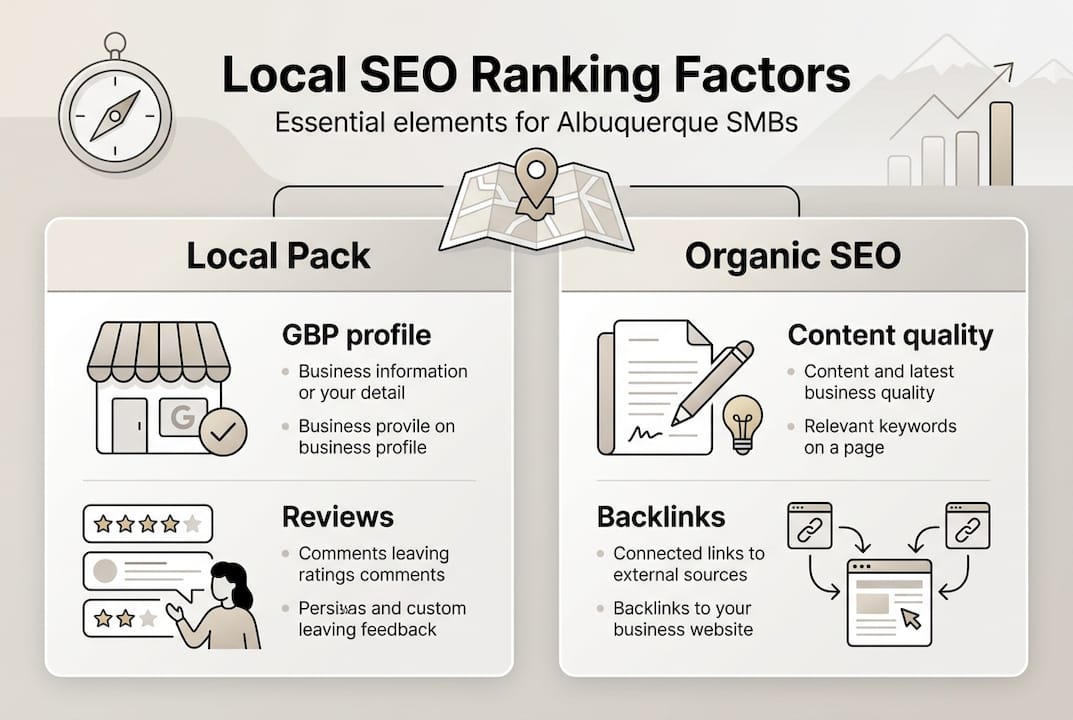
Topical clusters outperform thin pages, and quality links from local organizations matter most. A topical cluster means building a group of related pages around one service. For example, instead of one generic “plumbing services” page, you’d have separate pages for drain cleaning, water heater repair, and emergency plumbing in Albuquerque. Each page reinforces the others.
SEO best practices for content and technical setup:
- Write at least 15 service or location-specific pages targeting Albuquerque neighborhoods
- Aim for an LCP (Largest Contentful Paint) under 2.5 seconds for fast load times
- Build 50+ consistent citations across directories like Yelp, BBB, and local NM directories
- Earn backlinks from Albuquerque Chamber of Commerce, local news sites, and industry associations
- Use schema markup to help Google understand your business type and location
- Secure your site with HTTPS and fix any broken links or crawl errors
| Signal type | Organic weight | Map Pack weight |
|---|---|---|
| Content quality | ~25% | ~10% |
| Backlinks | ~22% | ~8% |
| Core Web Vitals | ~28% | ~5% |
| GBP signals | ~5% | ~55% |
Our business profile optimization service ties your website authority directly to your local profile strategy for maximum impact.
Debunking SEO myths and adapting to algorithm shifts
With the must-do strategies covered, let’s clear away some common local SEO misconceptions that are still circulating in 2026.
Domain age is not a ranking factor. A brand-new Albuquerque business with a well-optimized GBP and 30 strong reviews can outrank a 10-year-old competitor with a neglected profile. Age doesn’t earn you rankings. Relevance and trust do.
AI Overviews now favor E-E-A-T and snippet optimization, not just keywords. If your content doesn’t demonstrate real expertise, Google’s AI features will skip right past you.
Here are the most persistent myths and what’s actually true:
- Myth: More keywords on a page means better rankings. Fact: Keyword stuffing triggers penalties. Write for humans first.
- Myth: Meta keywords boost your ranking. Fact: Google has ignored meta keywords since 2009.
- Myth: You need to be in business for years before SEO works. Fact: Domain age carries no ranking weight.
- Myth: Social media likes directly improve Google rankings. Fact: Social signals are indirect at best.
- Myth: Paid ads help your organic ranking. Fact: Google officially confirms that ads and organic rankings are completely separate.
Mobile-first indexing is now the default for every site Google crawls. Behavioral signals, like how long users stay on your page and whether they click back to search results, also influence rankings. If your site frustrates mobile users, you’re losing ranking ground every day. Managing your Google profile management steps alongside your website keeps both signals aligned.
Step-by-step: Building your Albuquerque local SEO foundation
To wrap up the strategy, here’s how you can turn these insights into concrete results for your local business, step by step.
Effective local SEO starts with a GBP audit, review growth, citation cleanup, localized landing pages, and ongoing tracking. Here’s the sequence that works:
- Audit your GBP. Check every field for accuracy, completeness, and category alignment. Fix anything that’s missing or outdated.
- Launch a review campaign. Set a goal of 10 new reviews per month and build a simple outreach system using the steps above.
- Clean up your citations. Make sure your business name, address, and phone number are identical across every directory.
- Build localized landing pages. Create dedicated pages for each Albuquerque neighborhood or service area you serve.
- Improve your site’s technical health. Run a Core Web Vitals check and fix any pages with LCP over 2.5 seconds.
- Track your progress. Use GBP Insights to monitor profile views, calls, and direction requests. Use Google Search Console to track keyword rankings and click-through rates.
- Iterate every 60-90 days. Review your data, identify what’s working, and adjust your strategy accordingly.
Pro Tip: Set a calendar reminder every 90 days to review your GBP Insights and Google Search Console data side by side. Look for spikes in profile views that don’t convert to calls. That gap usually signals a review problem or a weak website landing page.
Our local search optimization guide gives you a deeper framework, and you can enhance GBP visibility with our step-by-step resource.
Accelerate your SEO growth with expert help
Implementing all of these strategies on your own is absolutely possible, but it takes time, consistency, and a sharp eye for what the data is telling you. Most Albuquerque business owners are already stretched thin running their operations.
At King Digital, we specialize in helping Albuquerque SMBs build the kind of local SEO foundation that generates real, qualified leads. From GBP management to content strategy and technical audits, our in-house team handles the details so you can focus on your business. Explore our local marketing SEO solutions to see how we approach local growth, check out our local SEO location pages for neighborhood-specific strategies, or start with our local SEO checklist to benchmark where you stand today.
Frequently asked questions
What is the single most important SEO ranking factor for local businesses in Albuquerque?
An optimized Google Business Profile is the most effective driver of local rankings for Albuquerque SMBs. GBP’s category and completeness score are the top ranking factors for Map Pack visibility.
Do reviews really impact my business ranking on Google?
Yes, and the impact is larger than most owners expect. Review quantity and quality account for 19-28% of Map Pack ranking weight, often overriding proximity entirely.
Should I focus on content or backlinks for my local website?
Both matter, but in 2026, content quality and Core Web Vitals carry a slightly higher combined weight than backlinks for Albuquerque businesses targeting organic rankings.
Does my business location or domain age matter most for SEO?
Location (proximity) influences local pack rankings, but domain age is not a ranking factor at all. A new business with strong reviews and a complete GBP can outrank an older competitor.
Recommended
- SEO checklist for small businesses: boost local visibility
- Boost your local SEO with expert best practices in 2026
- Website content optimization steps for Albuquerque SMBs
- Albuquerque SEO: Get Found, Get Customers, Get Results | King Digital Marketing Agency
