Google Map rankings: Master for 2025 Success
Why Google Map Rankings Are the Game-Changer for Local Businesses
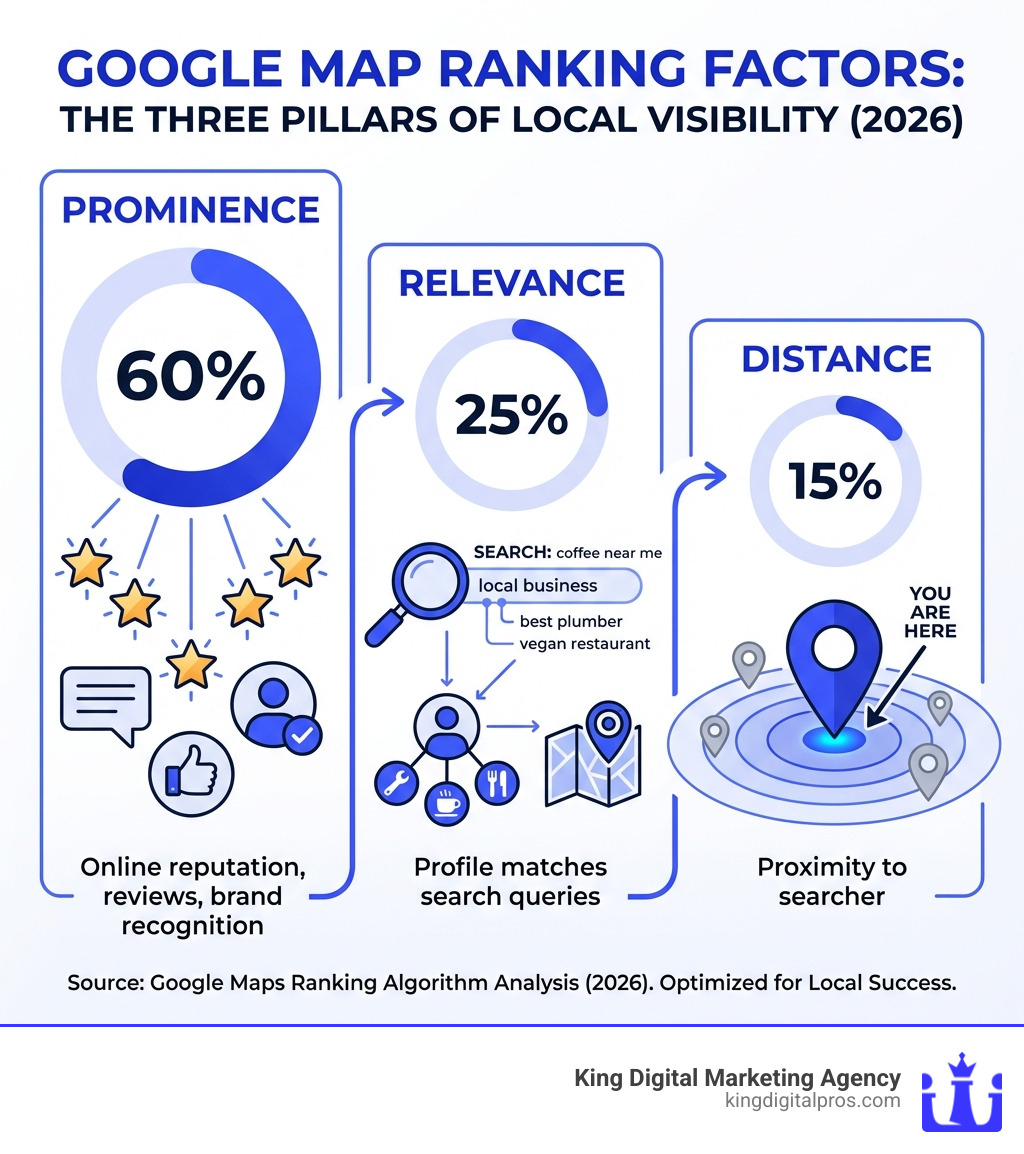
Google Map rankings determine whether your business shows up when customers search for what you sell-or whether your competitors get the call instead. Here’s what drives your position in the Local Pack:
| Ranking Factor | Weight | What It Means |
|---|---|---|
| Prominence | ~60% | Your online reputation, reviews, and brand recognition |
| Relevance | ~25% | How well your profile matches what people search for |
| Distance | ~15% | How close you are to the searcher |
The stakes are higher than ever. 86% of customers use Google Maps to find local businesses, and over half choose one of the top five results they see. If your business sits outside the top three spots-the coveted Local Pack that appears above organic results-you’re invisible to most potential customers.
The Local Pack receives 44% of all clicks from local searches and converts at 14.6%, compared to just 1.7% for paid ads. For mobile users, who click Maps results 50% more often than desktop users, showing up here isn’t optional-it’s essential for survival.
I’m Bernadette King, founder of King Digital Marketing Agency, and I’ve spent years helping local businesses dominate their markets through strategic Google Map rankings optimization. This guide breaks down exactly what you need to do to claim your spot at the top.
Deconstructing the Google Maps Ranking Algorithm
Understanding how Google decides who gets the top spots on its maps is like cracking a secret code. The Google Maps ranking system is fundamentally different from traditional organic search, focusing on local factors. This is crucial for businesses in communities like Albuquerque, Rio Rancho, and Santa Fe, where customers are often looking for immediate solutions nearby.

The local search algorithm is a dynamic beast, constantly evolving with updates and AI. While the core pillars of ranking remain consistent, their weighting can shift. For instance, after the Vicinity update, the importance of distance increased significantly, meaning even a well-optimized business might see fluctuations if it’s not geographically close enough to the searcher.
Machine learning also plays a huge role in personalizing results. Two people searching for the same term from the same location might see different results based on their individual search history, device, time of day, and past interactions with businesses. Google’s AI aims to serve the most relevant and most trusted options for that specific user.
The Core Three: Relevance, Distance, and Prominence
Google’s local ranking system, as outlined in their official guidelines, hinges on three primary factors: Relevance, Distance, and Prominence. Think of them as the three legs of a stool – if one is wobbly, your Google Map rankings will suffer.
-
Relevance (~25%): This is how well your business profile matches a user’s search. If someone in Albuquerque searches for “best Italian restaurant,” Google looks for businesses whose profiles (categories, description, services) accurately reflect that they serve Italian food. Our goal is to make it crystal clear what your business offers.
-
Distance (~15%): This is simply how far your business is from the searcher. While you can’t move your business, we ensure your address and service areas are accurate. The Vicinity update in December 2021 emphasized this factor, making proximity even more critical. A poorly optimized listing can sometimes appear in the Local Pack if it’s exceptionally close to the searcher.
-
Prominence (~60%): This is the big one. Prominence reflects how well-known and reputable your business is. Google knows the most valuable business isn’t always the closest-it’s the one most people choose and trust. It’s influenced by review signals (quantity, quality, recency), citation quality, behavioral metrics (clicks, calls), and brand recognition (backlinks, organic web rankings).
As industry analysis from 2024-2025 suggests, Prominence carries the highest weight, making it our primary target for boosting your Google Map rankings. For more detailed insights into how these factors evolve, we often consult resources like Moz’s Local Search Ranking Factors.
The Impact of Recent Updates and AI
Google’s algorithm is never static. The “Vicinity update” of December 2021 was a massive shake-up that heavily increased the importance of the distance factor. This means businesses physically closer to the searcher gained an advantage. For a business in Rio Rancho, a customer searching from Corrales might now see a Corrales business ranked higher, even if the Rio Rancho business has a better reputation.
Beyond specific updates, Google’s AI personalizes results based on user-specific signals like search history, device type (mobile users click Maps results 50% more often), time of day, and past interactions with your business. These behavioral signals-clicks, calls, and direction requests-are increasingly important, acting as votes of confidence that tell Google your business is valuable. The evolution of Google Maps suggests a future where direct, natural language interactions will further influence local visibility.
The Foundation: A Perfectly Optimized Google Business Profile
Your Google Business Profile (GBP) isn’t just a listing; it’s your digital storefront, your virtual handshake, and often the first impression potential customers in Albuquerque, Santa Fe, or Taos will have of your business. A perfectly optimized GBP is the absolute cornerstone of strong Google Map rankings.
Think of your GBP as a canvas. A blank canvas won’t attract much attention, but a vibrant, detailed masterpiece will. Businesses with complete and accurate information are significantly more likely to show up in local search results. Our goal is to achieve 100% profile completion, leaving no stone unturned.
Claiming and verifying your business is the essential first step. Without verification, you can’t fully manage your profile, let alone optimize it. Once verified, you gain control over the information Google presents to the world. We offer comprehensive Google Business Profile Management by King Digital Marketing Agency to ensure your profile is always in top shape.
Nailing the Basics: NAP, Categories, and Descriptions
The devil is in the details, and for Google Map rankings, these details are your Name, Address, and Phone number (NAP), categories, and business description.
-
NAP Consistency: Accurate NAP details are the foundation of your local SEO success. If Google can’t trust your basic business information, it will be less likely to show your profile to customers. Inconsistent NAP across various online platforms confuses Google’s algorithms, harming your rankings. We ensure your business’s name, address, and phone number are identical everywhere they appear online.
-
Choosing the Right Primary and Secondary Categories: This is critical for relevance. We select the most appropriate primary category (e.g., “Restaurant,” “Plumber”) and add relevant secondary categories to capture more specific searches (e.g., a “Bakery” might also list “Coffee Shop”). Multi-category optimization helps your business appear for a wider range of relevant searches.
-
Keyword-Rich Business Description: Your business description is an opportunity to naturally weave in keywords that describe your services and location without stuffing. For instance, a plumber in Santa Fe might mention “emergency plumbing services in Santa Fe.” However, a crucial warning: Google’s guidelines strictly prohibit including marketing taglines or keywords in your business name itself. Doing so can lead to profile suspension.
-
Accurate Operating Hours: Nothing frustrates a potential customer more than showing up to a closed business. We ensure your standard and special hours (for holidays or events) are always up-to-date. This builds trust and signals to Google that your information is maintained.
Engaging with Visuals and Content
A picture is worth a thousand words, especially when it comes to attracting customers on Google Maps.
-
High-Quality Photos: Businesses with 100+ images see a big jump in calls and clicks. We upload a variety of high-resolution photos, including exterior, interior, and “work in progress” shots to provide visual context.
-
Geotagging Images: For an extra boost, we geotag images before uploading them. This embeds location data into the image file, providing Google with specific, location-based signals and enhancing your Maps visibility.
-
Business Videos: Short, engaging videos (e.g., a quick tour or service demonstration) can significantly increase user engagement on your profile.
-
Google Posts for Updates: We use Google Posts to announce sales, events, or company news. Regular posting signals to Google that your business is active, which can positively influence your Google Map rankings. You can see examples of how businesses leverage these posts for visibility by checking out Sample Posts on Google.
-
Managing the Q&A Section: We actively monitor the Q&A section, providing prompt and helpful answers. This assists potential customers and provides valuable keyword-rich content for Google to crawl.
The Power of Customer Reviews
Customer reviews are arguably the single most impactful factor for Prominence, influencing a large portion of your Google Map rankings. They are social proof, a trust signal, and a goldmine of keyword-rich content.
-
Reviews as a Major Ranking Factor: Google’s algorithm pays close attention to the quantity, quality, and recency of your reviews. A business with many recent, positive reviews will almost always outrank a competitor with fewer or older reviews.
-
Encouraging Customer Reviews: We make it easy for your happy customers to leave feedback by asking directly or providing a simple QR code that links directly to your Google review page.
-
Responding to All Reviews: Whether positive or negative, every review deserves a response. This shows potential customers that you value feedback and are engaged. For positive reviews, a simple “Thank you” is great.
-
Handling Negative Feedback: We never ignore negative reviews. Instead, we respond professionally, apologize for any negative experience, and offer a solution or invite them to discuss it offline. This demonstrates excellent customer service and can mitigate the impact of a bad review.
-
Keywords in Reviews: Reviews that naturally include keywords related to your services (e.g., “The best plumbing service in Edgewood!”) can further boost your relevance for those terms.
Managing this critical aspect of your online presence can be time-consuming, which is why our Customer Review Management Software Complete Guide by King Digital Marketing Agency is a valuable resource for our clients.
Beyond GBP: Advanced Strategies for Better Google Map Rankings
While an optimized Google Business Profile is the bedrock, true local domination requires a holistic approach. We connect your GBP efforts with broader local SEO strategies to create a powerful synergy. This involves building off-page authority and ensuring your website sends strong technical SEO signals that support your Google Map rankings.
The Role of Your Website in Google Map Rankings
Believe it or not, your website’s performance significantly impacts your Google Map rankings. While your GBP is the direct driver for local map results, a strong website builds overall authority and trust with Google.
-
Website Authority Correlation: There’s a strong correlation between organic website traffic and growing positions in the local pack. A well-optimized website signals to Google that your business is legitimate and authoritative.
-
Mobile-Responsive Design: Nearly 60% of Google searches occur on mobile devices. If your website isn’t mobile-friendly, users will bounce, signaling a poor user experience to Google. A responsive design is non-negotiable.
-
Local Landing Pages: For businesses serving multiple communities in New Mexico (like Albuquerque and Santa Fe), creating dedicated landing pages for each service area is highly effective. These pages should be optimized with local keywords (e.g., “plumber in Rio Rancho”) and provide location-specific information.
-
“Near Me” Keyword Optimization: People frequently search for “service near me.” We optimize your website content and GBP to naturally include these phrases, signaling your relevance to local searchers.
-
Local SEO Best Practices 2025 by King Digital Marketing Agency dives deeper into these website optimization techniques.
-
Embedding Google Maps on Your Site: A simple yet effective tactic is to embed your Google Maps listing directly onto your website’s contact page. This reinforces your location to Google and provides an easy way for customers to get directions.
Building Local Citations and Backlinks
Citations and backlinks act as votes of confidence for your business, telling Google that you are a real, reputable entity.
-
NAP Consistency Across Directories: We ensure your business’s Name, Address, and Phone number are consistent across all major online directories. While the direct ranking impact of citations is debated, consistency remains vital for Google to trust your business information.
-
Importance of Accurate NAP Data: Google relies on consistent NAP data to verify your business’s legitimacy. Inaccurate or conflicting information can negatively impact your Google Map rankings.
-
Building Local Backlinks: Backlinks from relevant, high-authority local websites are powerful. These could come from community sponsorships (e.g., a local event in Grants), local partnerships, or local press mentions.
-
Top Citation Directories: We target a variety of platforms for consistent citations:
- Yelp
- Yellow Pages
- Foursquare
- TripAdvisor (for hospitality)
- Angi (for home services)
- Local Chambers of Commerce (e.g., Albuquerque Chamber of Commerce)
- Industry-specific directories relevant to your niche.
Leveraging Schema Markup for Local SEO
Schema markup, also known as structured data, is a powerful tool that helps search engines understand the context of your website content. It’s like giving Google a highly organized instruction manual about your business.
-
LocalBusiness Schema: This specific type of schema tells Google details about your local business, such as its name, address, phone number, operating hours, and even customer reviews.
-
What is Structured Data: Structured data is a standardized format for providing information about a page and classifying its content. When Google crawlers reach your website, they can easily get vital information, thus trusting you more.
-
Address and Opening Hours Schema: We can apply schema markup to your address and opening hours, ensuring Google accurately understands your physical location and operational times.
-
How to Implement Schema on Your Website: For WordPress users, many SEO plugins can simplify the process of adding schema markup. After implementation, we use Google’s Structured Data Testing Tool to verify that the markup is correctly applied and understood by Google.
Tracking Success and Avoiding Common Pitfalls
Optimizing for Google Map rankings isn’t a one-and-done task; it’s an ongoing journey of performance monitoring and continuous improvement. Just as important as implementing best practices is knowing how to track your progress and avoid common mistakes. Our team at King Digital Marketing Agency is dedicated to helping you Improve Search Ranking consistently.
Measuring and Tracking Your Google Map Rankings
How do we know if our efforts are paying off? By carefully tracking key performance indicators.
-
GBP Insights Analysis: Your Google Business Profile provides invaluable insights. We regularly analyze calls, website clicks, direction requests, and profile views to understand how customers are interacting with your listing.
-
Geo-Grid Ranking Reports: These reports are a game-changer, visualizing your search presence across a specific geographic area. This helps us pinpoint opportunities and identify “ranking weak spots” in your service areas like Taos or Albuquerque.
-
Share of Local Voice (SLV): We measure your SLV to understand your overall visibility and market share in local search results compared to your closest rivals.
-
Tools for Monitoring Local Rankings: Various third-party tools assist in tracking these metrics, providing granular data on your performance and competitive landscape.
Common Mistakes That Hurt Your Rankings
Even well-intentioned optimization efforts can backfire if certain pitfalls aren’t avoided.
-
Keyword Stuffing Business Name: This is a major violation of Google’s guidelines. Cramming keywords into your business name (e.g., “King’s Best Plumbers HVAC Albuquerque”) can lead to a profile suspension. Google wants your legal business name, not a marketing tagline.
-
Inconsistent NAP Information: Inconsistencies in your Name, Address, and Phone number across the web can severely damage Google’s trust in your business, leading to lower Google Map rankings.
-
Ignoring Customer Reviews: Not responding to reviews, especially negative ones, signals disengagement to both customers and Google. It can erode your Prominence score and deter potential clients.
-
Outdated Business Information: Failing to update operating hours or services leads to customer frustration and a drop in rankings. Google prioritizes accuracy.
-
Neglecting the Q&A Section: An unanswered question is a missed opportunity to engage with a potential customer and makes your profile seem less active.
-
Using P.O. Boxes or Virtual Addresses: Google favors businesses with verifiable physical addresses. Using a P.O. box or virtual office for your primary listing can significantly hinder your local ranking potential.
Frequently Asked Questions about Google Map Rankings
What is the difference between Google Maps SEO and traditional SEO?
This is a common question, and the distinction is important.
- Google Maps SEO (or Local SEO) primarily focuses on optimizing your presence within Google Maps and the Local Pack. Its core drivers are proximity to the searcher and signals emanating directly from your Google Business Profile, such as the quantity and quality of reviews, NAP consistency across the web, and active engagement (posts, Q&A). It targets users with immediate, local intent.
- Traditional SEO (or Organic SEO) aims to improve your website’s visibility in Google’s main organic search results. It focuses on broader factors like website content quality, technical optimization (site speed, mobile-friendliness), keyword relevance across your site, and the authority of backlinks pointing to your domain. While a strong website supports local SEO, traditional SEO is about ranking for non-local or broader search queries.
How long does it take to improve my Google Maps ranking?
The timeline for seeing improvements in your Google Map rankings can vary, but patience and consistency are key.
- Minor improvements in visibility and engagement might be noticeable within a few weeks, especially after initial GBP optimization.
- Significant gains and movement into the coveted Local Pack generally take longer, often 3 to 6 months of consistent optimization efforts. This is because building Prominence (which accounts for ~60% of your ranking) through reviews, citations, and website authority takes time. Google often takes 60-120 days to fully reward good practices and incorporate new signals into its algorithm.
Can a home service business rank without a physical address?
Yes, absolutely! Home service providers (like plumbers, electricians, or HVAC technicians in Albuquerque, Rio Rancho, or Santa Fe) can and do rank highly on Google Maps without displaying a physical address. These are known as Service Area Businesses (SABs).
- For SABs, it’s crucial to correctly set up your Google Business Profile to indicate that you serve customers at their locations rather than from a storefront.
- You can choose to hide your street address from the public listing.
- Instead, you define your service areas (e.g., specific cities, counties, or a radius around your base location).
- Your ranking will still depend heavily on verification, relevance to the search query, and your overall prominence within those defined service areas, even without a customer-facing address.
Conclusion
Mastering your Google Map rankings is no longer just a good idea; it’s a fundamental requirement for any local business aiming to thrive in 2025 and beyond. From the busy streets of Albuquerque to the serene landscapes of Taos, customers are searching locally, and they expect to find you easily.
We’ve explored the critical components: understanding Google’s algorithm, with its dynamic interplay of Relevance, Distance, and the dominant force of Prominence. We’ve emphasized that a perfectly optimized Google Business Profile, carefully maintained with accurate NAP details, engaging visuals, and a robust review strategy, is your foundation for success. Beyond the GBP, integrating strong website SEO, building local citations, leveraging schema markup, and diligently tracking your performance are the advanced strategies that will set you apart.
The journey to the top of the Local Pack requires dedication, consistency, and expertise. But the reward-increased visibility, more customer calls, and ultimately, more sales-is well worth the effort. At King Digital Marketing Agency, we specialize in changing your local online presence into a powerful customer magnet.
Ready to dominate your local market and see your business climb to the top of Google Map rankings? Let us help you craft a winning strategy. Get a complete local marketing strategy custom to your business today!
