Optimize local search: Ultimate Guide 2025
Why Local Search Optimization Matters More Than Ever
When someone searches for “coffee shop near me” or “emergency plumber Tulsa,” they aren’t just browsing-they’re ready to act. Research shows 76% of people who conduct a local search on their smartphone visit a business within a day, and 28% of those searches lead to a purchase. To optimize local search is to connect with these high-intent customers at the exact moment they need you.
Local SEO is a specialized strategy focused on geographic relevance. It’s how you appear in the coveted Google Map Pack (the top three local results), which can mean the difference between a thriving business and an empty storefront. The good news is that you don’t need a massive budget. Small businesses can outrank larger competitors by focusing on proximity, relevance, and community engagement.
To get started, focus on these core actions:
- Claim and complete your Google Business Profile: Add accurate hours, photos, categories, and respond to reviews.
- Keep your NAP consistent: Your Name, Address, and Phone number must match exactly across all online listings.
- Build location-specific content: Create pages and posts that mention your city, neighborhoods, and local landmarks.
- Earn and manage customer reviews: Ask satisfied customers for reviews and respond professionally to all feedback.
- Add local schema markup: Help search engines understand your business with structured data.
I’m Bernadette King, founder of King Digital. I’ve helped hundreds of local businesses transform their online presence into a steady stream of customers. This guide distills years of hands-on experience into actionable steps that move the needle.
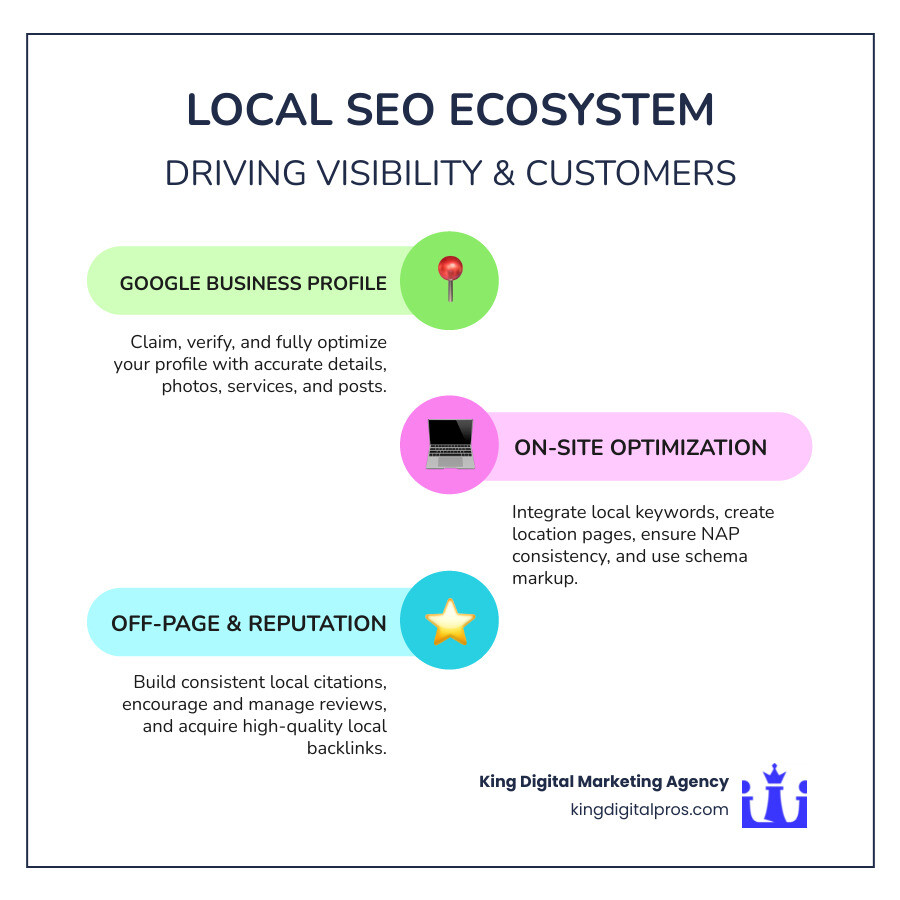
We’ll cover everything you need to optimize local search for your business, from foundational setup to advanced strategies. For a deeper dive into core concepts, check out our guide on Local SEO Best Practices.
Mastering Your Digital Storefront: Google Business Profile Optimization
Your Google Business Profile (GBP) is your business’s front window on the world’s busiest street. It’s often the first impression a local customer has of you, and an optimized profile is the foundation of any effort to optimize local search. Google’s local rankings depend on three factors: relevance (how well you match a search), distance (how close you are to the searcher), and prominence (how well-known your business is). Your GBP directly influences all three.
Think of your GBP as the control panel for your appearance on Google Search and Maps. At King Digital, we’ve seen businesses transform their visibility by taking this profile seriously. If you need expert help, our Google Business Profile Management service can handle this crucial work for you.
Completing and Verifying Your Profile
A complete and accurate profile is non-negotiable. Start by ensuring every field is filled out correctly, then verify your business to prove to Google you’re the rightful owner. This prevents unauthorized changes and is essential for visibility. If you need help with this process, our Google Business Listing Help guide can walk you through it.
Pay close attention to these key areas:
- Business Name, Address, Phone (NAP): Use your real business name (no keywords) and ensure your address and local phone number are precise and consistent everywhere online.
- Website URL: Link directly to your website.
- Business Hours: Keep them updated, including special hours for holidays, to avoid frustrating customers.
- Categories: Choose a specific primary category (e.g., “Italian Restaurant” instead of “Restaurant”) and add relevant secondary categories.
- Business Description: Write a thoughtful description that explains what makes you unique and includes terms customers might use to find you.
Enhancing Your Profile for Maximum Impact
Once the basics are covered, improve your profile to stand out. These elements signal to Google that your business is active and engaged.
- Photos and Videos: Businesses with photos get 42% more direction requests and 35% more website clicks, according to Google. Add high-quality images of your storefront, interior, team, and services regularly.
- Service Areas: If you’re a service-area business, define the specific neighborhoods, cities, or zip codes you serve. It’s better to dominate a smaller area than be invisible in a large one.
- Products & Services: Detail your offerings to give Google more context and match more relevant searches.
- Google Posts: Use these mini-updates to share offers, news, and events. Post weekly with a photo and a call-to-action to show you’re active.
- Q&A Section: Proactively add and answer frequently asked questions. This prevents misinformation and provides another opportunity to include relevant keywords naturally.
An actively maintained GBP is the most powerful tool you have to optimize local search. For more strategies on turning this visibility into customers, see our guide on Attracting Customers Via Google Maps.
Building a Strong Foundation: How to Optimize Local Search On-Site
While your Google Business Profile is your digital storefront, your website is your home base. It’s where customers get to know you, and it must provide a fast, easy-to-use experience that supports your efforts to optimize local search. With over 60% of local searches happening on mobile, Google uses Mobile-First Indexing, meaning your mobile site’s performance is critical for ranking. If your site is slow or hard to use on a phone, you’re losing business.

We emphasize building sites that work beautifully on any device. You can learn more about our approach on our Small Business Web page.
How to optimize local search with keywords and content
Your website content must make it clear where you are and what you do. This means using keywords that reflect how local customers search.
- Incorporate Geo-Specific Keywords: Naturally weave your city, neighborhood, and service areas into your content. Instead of “SEO services,” use “local SEO for Albuquerque businesses.” Mentioning specific neighborhoods like Nob Hill or communities like Corrales and Los Alamos can be a powerful way to connect with residents. For help finding the right terms, visit our Local SEO Keyword Research page.
- Create Localized Content: Write blog posts or create pages about local events, community news, or topics relevant to your area. A Rio Rancho restaurant could write about local family activities, while a Taos law office might cover local regulations. This builds authority and community connection.
- Build Dedicated Location Pages: If you serve multiple areas, create a unique landing page for each one. These pages should feature local testimonials, landmarks, and specific service details for that community. For guidance, see our guide on Local SEO Location Pages and this external resource on how to create a perfect location page.
Technical tips to optimize local search performance
Behind-the-scenes technical elements are crucial for a smooth user experience and strong search signals.
- Mobile-Friendly Design: Your site must be responsive and function perfectly on all devices. Use Google’s Mobile-Friendly Test to check your site.
- Page Speed: A slow site loses visitors. Compress images and use a good hosting provider to ensure your site loads in under three seconds. Check your performance with PageSpeed Insights.
- NAP Consistency: Your Name, Address, and Phone number should appear consistently, especially in the footer of every page.
- LocalBusiness Schema Markup: Implement LocalBusiness schema to give search engines structured data about your location, hours, and services, which can lead to improved search results.
- Embed a Google Map: Add a map to your contact page to help customers find you and reinforce your location to search engines.
Expanding Your Local Footprint: Off-Page Signals and Reputation
To truly optimize local search, you need more than a great website and GBP. Off-page signals-what other sites say about you-tell Google that you’re a trusted, prominent part of your local community. These external validations, like reviews and local mentions, carry more weight than your own marketing. Building this reputation takes time and consistency, but it’s what separates local leaders from the competition. Our Leveraging Your Reputation services help businesses turn these signals into growth.
Building Local Citations and Ensuring NAP Consistency
A citation is any online mention of your business’s Name, Address, and Phone number (NAP). These mentions are foundational for verifying your location and legitimacy. The catch? Your NAP must be exactly consistent everywhere. “123 Main Street” and “123 Main St.” can be seen as different by search engines, creating confusion that hurts your ranking. According to Whitespark’s Local Search Ranking Factors study, citations remain a key part of the algorithm.
Start by ensuring your NAP is correct on major platforms like Google, Facebook, and Yelp, as well as data aggregators (Data Axle, Foursquare). Then, target local directories like the Albuquerque Chamber of Commerce and industry-specific sites (e.g., Avvo for lawyers, Healthgrades for doctors). This process is tedious but essential. Our Local Business Online Marketing guide offers a complete strategy.
Leveraging Customer Reviews and Managing Your Reputation
Reviews are modern word-of-mouth and a major trust signal for both customers and Google. According to BrightLocal’s research, nearly all consumers read reviews before making a purchase. Google rewards businesses with a steady stream of recent, positive reviews.
- Encourage Reviews: Make it easy for happy customers to leave feedback. Ask for a review right after a great service experience using a simple Google review link. Incentivizing reviews is against Google’s policy.
- Respond to All Reviews: Thank customers for positive feedback to show you’re engaged. For negative reviews, respond quickly and professionally. A reply like, “I’m so sorry we didn’t meet your expectations. Please call me at [your business phone number] so I can make this right,” can turn a negative into a demonstration of excellent customer service.
A proactive reputation strategy is crucial. Our Review Management Services can help you build positive reviews systematically.
Acquiring High-Value Local Backlinks
Backlinks are links from other websites to yours, acting as votes of confidence. For local SEO, links from local and industry-relevant sources are gold.
- Sponsor Local Events: Sponsoring a Little League team in Rio Rancho or a charity event in Taos often earns you a link from the organization’s website.
- Partner with Local Businesses: A photographer can partner with local Santa Fe wedding venues, linking to each other’s sites.
- Engage with Local Media: Share newsworthy stories with local news outlets or community blogs to earn valuable mentions.
- Join the Chamber of Commerce: Memberships in local chambers almost always include a directory listing with a backlink.
Focus on earning links authentically by being an active part of your community. For more targeted strategies, see our guide on Local SEO for Service Businesses.
Measuring Success and Adapting to the Future of Local Search
You’ve put in the work to optimize local search for your business-your Google Business Profile sparkles, your website loads fast, and those five-star reviews keep rolling in. But here’s the truth: local SEO isn’t something you do once and walk away from. It’s an ongoing conversation between your business and the search engines, and you need to listen to what the data is telling you.
Think of tracking your local SEO performance like checking your business’s vital signs. When you monitor the right metrics, you can spot opportunities before your competitors do and fix problems before they cost you customers. For businesses across New Mexico-whether you’re serving Albuquerque’s busy metro area or the tight-knit community of Corrales-staying on top of your performance data means staying ahead of the competition. We’ve helped countless businesses transform their visibility through strategic monitoring and adaptation. Learn more about our approach on our Improve Google Local Ranking page.
Tracking KPIs and Analyzing Competitors
The numbers don’t lie, but they do need interpretation. Google Analytics shows you the big picture of your website traffic-who’s visiting, where they’re coming from, and what they do once they arrive. Segment your data by location to find whether your efforts in Santa Fe are paying off differently than your campaigns in Rio Rancho. Are visitors from certain neighborhoods converting at higher rates? That insight alone can reshape your strategy.
Your Google Search Console reveals how Google sees your website. It tracks which local keywords are generating impressions (people seeing your listing) versus clicks (people actually visiting your site). If you’re showing up for “emergency plumber Grants” but nobody’s clicking, either your meta description needs work or your competitors have more compelling listings.
But here’s where many businesses miss gold: Google Business Profile Insights. This dashboard shows exactly how customers interact with your listing. How many people called you directly from your profile? How many requested directions to your Edgewood location? How many clicked through to your website? These actions represent real intent, and tracking them tells you whether your GBP optimization is actually driving business or just looking pretty.
Rank tracking tools let you monitor your position for specific local keywords across different areas. You might dominate “coffee shop Old Town Albuquerque” but barely show up for “coffee shop Nob Hill.” Understanding these geographic variations helps you prioritize your optimization efforts where they’ll have the biggest impact.
The metric that matters most, though, is conversion rate. Traffic is nice. Rankings are exciting. But customers pay the bills. Track how many of those phone calls, direction requests, and website visits turn into actual sales. If your conversion rate is low despite good traffic, the problem might not be your SEO-it might be your service, pricing, or sales process.
Don’t optimize in a vacuum. Competitor analysis reveals what’s working in your local market. Tools like Ahrefs, Moz, or SEMrush (though you can start with free options) show you which local websites link to your competitors but not to you. Maybe the Los Alamos Chamber of Commerce links to three of your competitors-that’s your next citation opportunity. Keyword gap analysis identifies search terms your competitors rank for that you’ve overlooked entirely. Sometimes the best optimization strategy is simply filling obvious gaps.
For more context on how various ranking factors work together, check out this comprehensive overview from Moz’s Local Search Ranking Factors study, which surveys leading SEO experts annually about what drives local visibility.
Preparing for Voice Search and AI
Search is getting smarter, and that changes everything. When someone types “dentist,” they might mean anything. But when someone asks their phone, “Where’s the closest dentist that takes my insurance and is open right now?” that’s a completely different search with much higher intent.
Voice search has exploded because it’s faster and more natural than typing-especially on mobile devices while driving through Tijeras looking for a mechanic. These spoken queries tend to be longer, more conversational, and often phrased as questions. Instead of optimizing for “Italian restaurant Albuquerque,” you need to think about “What’s the best Italian restaurant in Albuquerque that has outdoor seating?”
This shift toward conversational queries means your content needs to sound more human. Write like you’re answering a friend’s question, not filling in a form. Your FAQ section becomes incredibly valuable here. When you answer “What are your hours?” or “Do you serve gluten-free options?” in clear, natural language, you’re positioning yourself for voice search success.
Then there’s AI, which is reshaping how search results appear. Google’s AI Overviews now show up for billions of searches, pulling information from across the web to answer questions directly in the search results. If someone searches “best way to fix a leaky faucet in Santa Fe,” Google might display an AI-generated summary that pulls from multiple sources-potentially including your website if your content is comprehensive and clearly structured.
Platforms like ChatGPT, Claude, and other AI assistants are also becoming search tools. When someone asks ChatGPT for restaurant recommendations in Rio Rancho, it draws from its training data about businesses with strong, consistent online presences. Your complete Google Business Profile, accurate citations, and quality website content all feed into how AI systems understand and recommend your business.
The key to user intent optimization in this AI age is being genuinely helpful. Don’t just stuff keywords into your content-answer the real questions your customers ask. If you run a law firm in Albuquerque, create content that addresses “What should I do immediately after a car accident in New Mexico?” rather than just “car accident lawyer Albuquerque.” AI rewards depth and usefulness.
Here’s how search queries are evolving:
| Traditional Search Query | Voice Search Query |
|---|---|
| “pizza Albuquerque” | “Where can I find a good pizza place in Albuquerque?” |
| “dentist Rio Rancho hours” | “What are the operating hours for dentists in Rio Rancho?” |
| “plumber Santa Fe emergency” | “I need an emergency plumber in Santa Fe right now.” |
Notice how voice searches sound like actual human speech? That’s your target. For deeper insights into how AI and voice search are changing local findy, Search Engine Land offers excellent ongoing coverage of voice search optimization trends and emerging best practices.
Common Mistakes to Avoid
Avoid these common pitfalls that can sabotage your local SEO efforts:
- Duplicate Listings: Multiple Google Business Profiles for the same location confuse Google and split your authority. Audit and consolidate them immediately.
- Inconsistent NAP: Mismatched Name, Address, and Phone information across directories weakens trust signals. Be obsessive about consistency.
- Ignoring Negative Reviews: Silence suggests you don’t care. A professional response can demonstrate great customer service and build trust with potential customers.
- Keyword Stuffing: Don’t cram keywords into your GBP name or description. It looks spammy to both users and Google. Write naturally.
- Neglecting Mobile Optimization: Most local searches are mobile. A slow or broken mobile site is a direct path to losing customers.
Knowing what not to do is as important as knowing what to do. For more insights, read our article on 5 Common Myths About Your Map Listings and Why You Should Hire a Google Business Profile Expert.
Frequently Asked Questions about Optimizing Local Search
Business owners in communities like Albuquerque, Rio Rancho, and Santa Fe often have the same questions about local SEO. Here are some straightforward answers.
How long does it take to see results from local SEO?
Local SEO is a long-term strategy, not an overnight fix. You may see small wins, like more profile views, within a few weeks. However, achieving consistent rankings in the Map Pack for competitive terms typically takes 3-6 months of dedicated effort. The timeline depends on your market’s competitiveness and the consistency of your work. A plumber in a smaller town like Corrales might see results faster than one in a crowded Albuquerque market.
What is the most important factor for local search ranking?
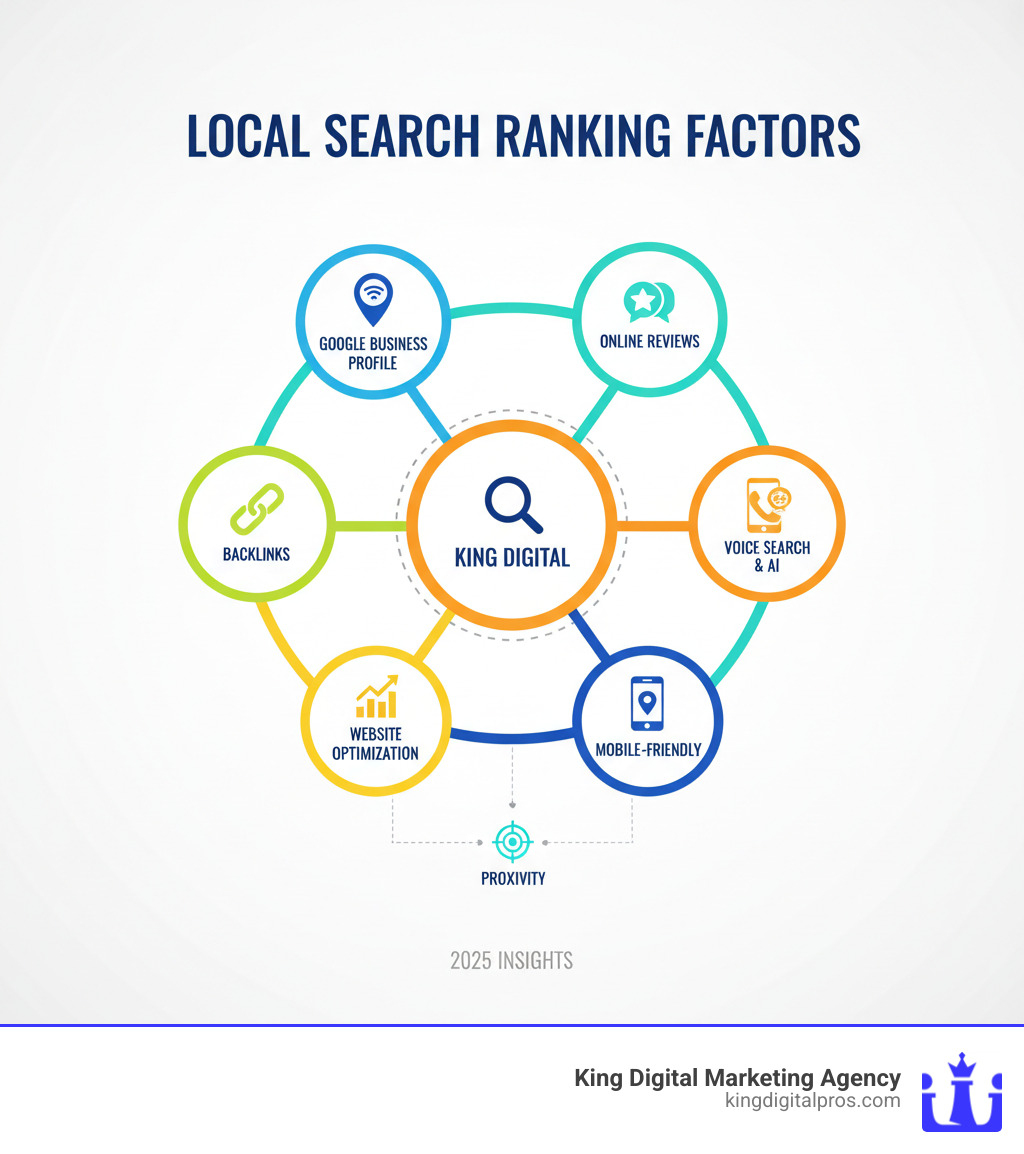
There is no single magic bullet. Local search success comes from a holistic strategy. However, the foundation is a complete and actively managed Google Business Profile. Google’s local ranking algorithm is built on three pillars:
- Relevance: How well your profile matches the search query.
- Distance: How close your business is to the searcher.
- Prominence: How well-known and trusted your business is, based on reviews, links, and online mentions.
Your GBP is critical because it directly influences all three of these pillars.
Can I do local SEO myself or should I hire an agency?
The answer depends on your time, resources, and interest. You can absolutely manage your own local SEO if you’re willing to dedicate a few hours each week to learning and implementing best practices. This is a great budget-friendly option for single-location businesses.
However, if you’re in a competitive industry, manage multiple locations, or simply prefer to focus on running your business, hiring a specialized agency is a smart investment. An agency brings expertise, advanced tools, and consistent execution. For high-stakes industries, professional help often provides a critical edge, a topic we cover in our guide on Local SEO for Lawyers. The right choice depends on where your time is best spent.
Conclusion: Become a Local Leader
You now have a roadmap to take control of your local search presence. Whether your business is in Albuquerque, Rio Rancho, Santa Fe, or another New Mexico community, these strategies can transform how customers find you.
We’ve covered the essential pillars: your Google Business Profile as your digital storefront, your website as your conversion-focused home base, and off-page signals like reviews and backlinks that build trust.
The beauty of local SEO is that it levels the playing field. Success isn’t about having the biggest budget; it’s about consistency, attention to detail, and a genuine commitment to serving your local community. When you optimize local search effectively, you’re making it easy for customers who are ready to buy to find you.
Managing all of this can be overwhelming. At King Digital Marketing Agency, we live and breathe local SEO. We help businesses across New Mexico turn their online presence into a reliable stream of customers by implementing strategies that drive real phone calls, foot traffic, and revenue.
Local SEO is an ongoing process, not a one-time project. Your competitors are already vying for that top spot. It’s never too late to start claiming your share of local customers.
Ready to see your business appear consistently in the Map Pack and attract high-intent customers? Start growing your local business with a professional digital marketing agency that is dedicated to your success. Your community is searching-make sure they find you.
