Unlock Your Online Visibility with Google Business Profile
Why Getting Found on Google Matters for Local Businesses
Get found on Google is the single most important digital marketing goal for local businesses today. Here’s how to make it happen:
- Submit your website to Google Search Console to ensure proper indexing
- Claim and verify your Google Business Profile for local map visibility
- Create high-quality, location-specific content that answers customer questions
- Optimize for mobile devices since most local searches happen on phones
- Build consistent NAP details (Name, Address, Phone) across all platforms
- Earn positive customer reviews to boost trust and rankings
- Improve page speed and technical performance for better user experience
With over 8.5 billion searches happening each day and mobile devices accounting for about half of all global internet traffic, your potential customers are actively looking for businesses like yours right now. The challenge? Over 576,000 new websites launch daily, creating fierce competition for visibility.
Many local business owners feel overwhelmed by Google’s constantly changing algorithms and confusing dashboard tools. You might have a great business, but if customers can’t find you in Google Search or Google Maps, you’re invisible to them. That’s exactly where strategic optimization makes the difference between struggling for leads and having customers come to you.
I’m Bernadette King, and I’ve spent years helping local businesses and franchises get found on Google through targeted SEO and map listing optimization strategies that actually work. My focus is on practical, results-driven tactics that boost visibility without requiring you to become a technical expert.
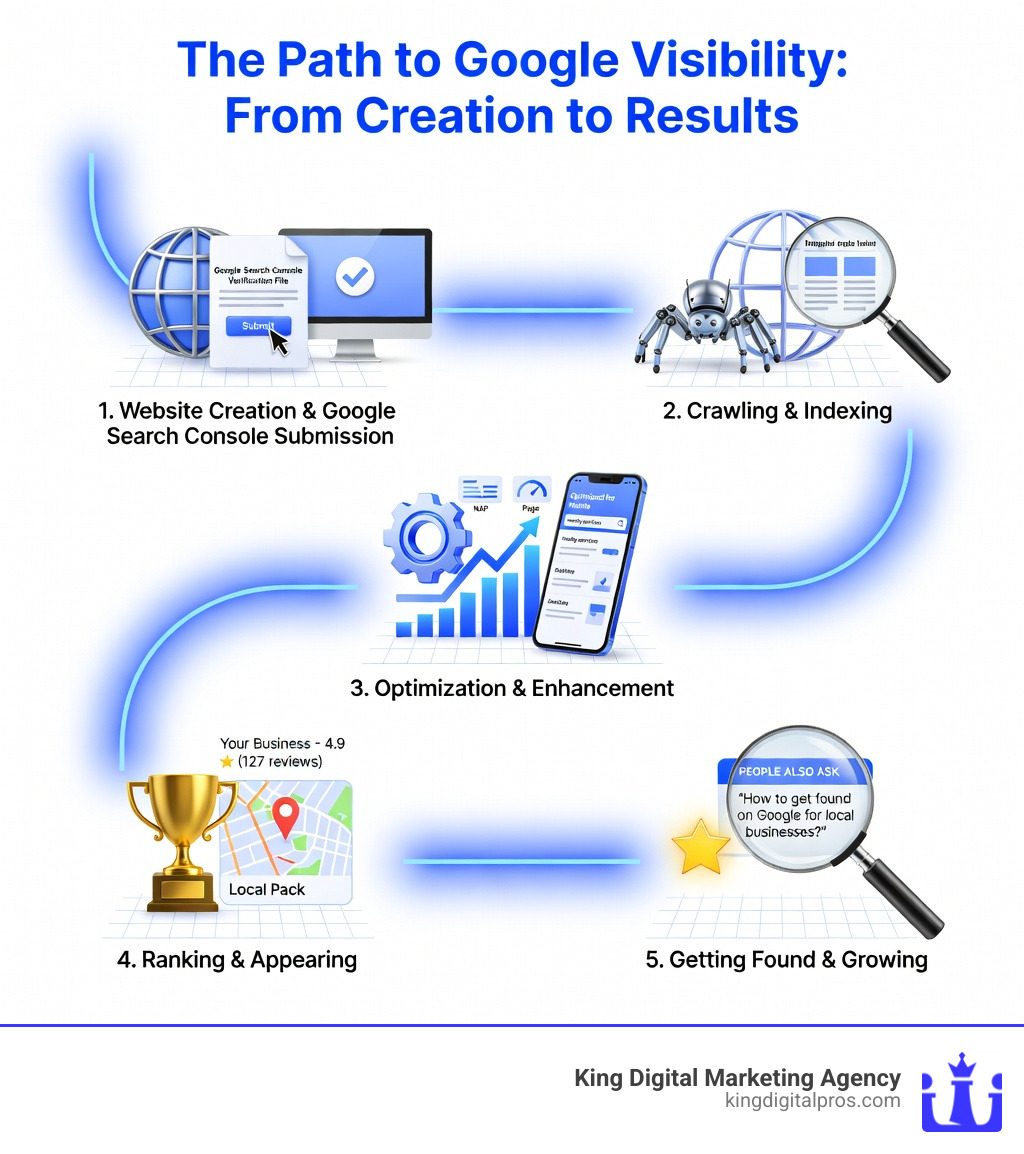
Quick look at Get found on Google:
- YouTube SEO
- Rank YouTube video on Google
- Rank your videos on YouTube
The Fundamentals of SEO to Get Found on Google
Search Engine Optimization, or SEO, is often treated like a dark art, but at its heart, it is simply the process of helping search engines understand your content so they can connect you with the right users. When we talk about how to get found on Google, we are looking at a three-stage journey: crawling, indexing, and serving.

First, Google uses automated programs called “crawlers” or “spiders” to scour the internet for new pages. Once a page is found, Google analyzes it to understand what it’s about—this is indexing. Finally, when someone in Albuquerque or Santa Fe types a query into that famous search bar, Google “serves” the most relevant and high-quality results from its index.
To ensure your business is eligible to appear, you must Understand how Google works with your site. If your site isn’t sending clear signals, Google might struggle to decide what you do or where you are located. This is especially true now that AI is fueling a content boom; if you aren’t proactive about your visibility, you risk being buried under the 4 billion gigabytes of web traffic generated daily.
For our clients from Rio Rancho to Taos, it is vital to understand the difference between Traditional SEO and Local SEO. While they share many principles, their goals are slightly different.
| Feature | Traditional SEO | Local SEO |
|---|---|---|
| Primary Goal | Rank for broad keywords regardless of location. | Rank for “near me” or location-specific queries. |
| Main Tool | Backlinks and high-authority domain signals. | Google Business Profile and NAP consistency. |
| Search Result | Standard blue links (SERPs). | Local “3-Pack” and Google Maps. |
| Content Focus | Informational blog posts and evergreen guides. | Localized landing pages and community events. |
How to Get Found on Google Using Search Console
If you want to be proactive, you cannot simply hit “publish” and hope for the best. We recommend using Google Search Console (GSC), a free tool that acts as your direct line of communication with the search engine. GSC allows us to monitor, maintain, and troubleshoot your site’s presence in search results.
One of the first things we do for our clients is submit an XML Sitemap. Think of this as a digital map that tells Google exactly which pages are the most important on your site. Research shows that proactive indexing can lead to an 8% increase in ranking pages and a 13% increase in keyword value within just three months.
If you’ve recently updated a page—perhaps you’ve added a new service for your business in Corrales—you can use the URL Inspection Tool to request that Google recrawl that specific page. This speeds up the process of getting your new information in front of potential customers. If this sounds like a lot to manage, our SEO Services can handle the technical heavy lifting for you.
Monitoring Performance with Google Analytics
While Search Console tells us how Google sees your site, Google Analytics (GA4) tells us how people interact with it. To truly get found on Google, you need to know which keywords are driving traffic and whether those visitors are actually turning into customers.
GA4 provides detailed insights into user behavior. For instance, if we see that a large number of visitors from Los Alamos are landing on your “Emergency Plumbing” page but leaving immediately, we know we need to improve the page speed or the call-to-action. We track “conversions”—actions like phone calls, form submissions, or bookings—to ensure your SEO strategy is actually growing your bottom line, not just inflating your traffic numbers.
Optimizing Your Google Business Profile for Local Dominance
For local businesses in New Mexico, your Google Business Profile (GBP) is arguably more important than your website’s homepage. It is the listing that appears in the “Local Pack”—that map and three-business list at the top of the search results.
The foundation of a strong profile is NAP Consistency. NAP stands for Name, Address, and Phone number. It sounds simple, but even small discrepancies (like using “St.” on your website and “Street” on your Facebook page) can confuse Google’s algorithm. Accurate NAP details allow Google to match your business with relevant local searches. As expert Avram Gonzales notes, “If Google can’t trust the basics, why would your customers?”
Once your profile is claimed, you must verify it. Google usually sends a postcard with a code to your physical address in places like Edgewood or Tijeras. This verification legitimizes your business. For a deeper dive, check out our Optimize Google Business Listing Guide.
Strategies to Get Found on Google for “Near Me” Searches
Google’s local algorithm relies on three main pillars: Relevance, Distance, and Prominence.
- Relevance: How well your business matches what the user is looking for. If someone searches for “best tacos in Santa Fe,” Google looks for profiles that explicitly mention tacos, have photos of tacos, and reviews mentioning… you guessed it, tacos.
- Distance: How far your business is from the searcher. While you can’t change your physical location, you can ensure Google knows exactly where you are.
- Prominence: How well-known your business is. This is influenced by your reviews, your backlinks, and your overall web presence.
To win at Attracting Customers via Google Maps, you should use “micro-moments” to your advantage. These are intent-rich moments when a person turns to a device to act on a need. By using local keywords in your business description and posts, you signal to Google that you are the best answer for that immediate need.
Managing Reviews and Customer Engagement
Reviews are the lifeblood of local SEO. They provide “brand acknowledgment” and give customers the confidence to purchase. But it’s not just about the number of stars; it’s about engagement.
We always tell our clients: respond to every review. When you respond to a positive review, you build loyalty. When you respond to a negative review professionally, you show potential customers in Albuquerque or Rio Rancho that you value feedback and are committed to quality.
Don’t forget the Q&A section! This is a community feature where anyone can ask a question about your business. We recommend being proactive: post your own frequently asked questions and provide the answers yourself. This saves you time and ensures that the information is accurate. Additionally, frequently uploading high-resolution photos of your work or your storefront in Sandia Park keeps your profile fresh and engaging.
Creating High-Value Content and Technical Excellence
“SEO content” is a phrase we dislike because it suggests content made for robots. To truly get found on Google, you must create content for humans that robots can also understand. Google prioritizes content that demonstrates E-E-A-T: Experience, Expertise, Authoritativeness, and Trustworthiness.
Instead of targeting broad, highly competitive terms, we focus on long-tail keywords. These are specific phrases like “best xeriscaping services in Albuquerque” rather than just “landscaping.” These terms have lower search volume but much higher intent, meaning the people searching for them are closer to making a purchase.
half of all global internet traffic now comes from mobile devices. If your content doesn’t look great on a phone, Google will penalize you under its mobile-first indexing policy.
On-Page Elements and Structured Data
Every page on your site needs to be optimized with specific on-page elements:
- Title Tags: This is the most important on-page factor. It should include your business name, your main keyword, and your location (e.g., “Plumbing Repairs Rio Rancho | King Digital Marketing Agency”).
- Meta Descriptions: While not a direct ranking factor, a compelling description increases your click-through rate.
- Alt Text: Google cannot “see” images, so we use alt text to describe them. This helps you appear in Google Image searches.
- Schema Markup: This is a piece of code that helps search engines understand the context of your data. For a local business in Taos, using “LocalBusiness” schema tells Google exactly what your hours, price range, and location are in a language it speaks fluently.
Technical Performance and Mobile-First Indexing
Your website’s technical health is the foundation upon which your content sits. Users expect pages to load within two seconds; any longer, and your bounce rate will skyrocket. Google measures this through “Core Web Vitals,” a set of metrics that track loading speed, interactivity, and visual stability.
Site structure also matters. You should organize your site logically with descriptive URLs and a clear hierarchy. Internal linking is a powerful tool here; by linking from your high-authority pages to your newer posts, you help Google find and index that new content faster. For more on this, see this guide on proper interlinking.
Advanced Tactics: Backlinks, AI Search, and PPC
Once the basics are covered, we look toward building authority. This is primarily done through backlinks—links from other reputable websites to yours. Think of a backlink as a “vote of confidence.” A link from a local Albuquerque news site or a specialized industry directory carries significant weight.
We are also entering the era of AI-driven search. Google’s “AI Overviews” and featured snippets pull content directly from websites to answer user questions at the top of the page. To appear here, your content needs to be structured clearly with headings and direct answers to common questions.
Immediate Visibility with Pay-Per-Click (PPC)
SEO is a long-term game. It can take weeks or even months to see significant movement in organic rankings. If you need leads today in Grants or Santa Fe, Pay-Per-Click (PPC) advertising via Google Ads is the solution.
PPC allows you to bid on keywords and appear at the very top of the search results instantly. You only pay when someone clicks on your ad. This is an excellent way to gain visibility while your organic SEO strategy matures. By combining SEO and PPC, you can dominate both the paid and organic sections of the search results page.
Regular SEO Audits and Strategy Refinement
The digital landscape changes every day. Google updates its algorithm hundreds of times a year, and your competitors in Rio Rancho aren’t sitting still. This is why regular SEO audits are essential.
An audit involves analyzing your site’s health, checking for broken links, monitoring your keyword rankings, and seeing what your competitors are doing better. We use tools like Ahrefs and Search Console to perform these deep dives. As your business grows, your strategy must adapt. You can learn more about the process in this guide to SEO site auditing.
Frequently Asked Questions about Google Visibility
How long does it take to see my website rank higher on Google?
SEO is not an overnight process. While some technical changes can show results in a few hours, it typically takes 3 to 6 months to see significant movement in rankings for competitive keywords. Factors like the age of your domain, the quality of your content, and the strength of your competition all play a role.
What are common SEO myths or outdated practices I should avoid?
- Keyword Stuffing: Repeating your keyword 50 times on a page will get you penalized, not ranked.
- Buying Links: Google’s spam policies are very good at catching paid links, which can lead to your site being removed from the index entirely.
- Meta Keywords Tag: Google hasn’t used the meta keywords tag for ranking in over a decade.
- Content Length is Everything: Completeness matters more than word count. A 500-word page that perfectly answers a question is better than a 3,000-word page full of fluff.
How can I optimize my content for AI-driven search results?
To appear in AI Overviews and featured snippets, focus on “People Also Ask” questions. Use clear H2 and H3 headers, and provide concise, factual answers (usually 40-60 words) directly below the question. Using structured data (Schema) also helps AI models understand your content’s context.
Conclusion
In today’s competitive market, simply having a website isn’t enough. To truly get found on Google, you need a comprehensive strategy that combines technical excellence, high-value content, and expert management of your Google Business Profile. Whether you are a small shop in Taos or a growing franchise in Albuquerque, visibility is the key to growth.
At King Digital Marketing Agency, we specialize in helping local businesses navigate this complex landscape. We aren’t just marketers; we are your growth partners, dedicated to turning clicks into customers and map listings into revenue. If you’re ready to take the next step, Boost your online presence with YouTube SEO Services or contact us today for a strategy session. Let’s make sure your business is the one customers find first.
