
TL;DR:
- Conversion rate optimization is a research-driven process that increases existing website visitor revenue.
- Effective CRO focuses on compelling copy and understanding customer psychology before design changes.
- Local insights and customer feedback are vital for maximizing CRO success in Albuquerque businesses.
Most Albuquerque business owners think conversion optimization means swapping button colors or running a quick A/B test. That assumption costs real money. Conversion rate optimization (CRO) is a research-driven process that turns your existing website visitors into paying customers, without spending more on ads or traffic. It compounds your return on investment (ROI) and cuts what you pay to acquire each new customer. This guide breaks down what CRO actually is, how it works, and exactly how you can apply it to grow your Albuquerque business strategically and sustainably.
Table of Contents
- Defining conversion optimization and why it matters
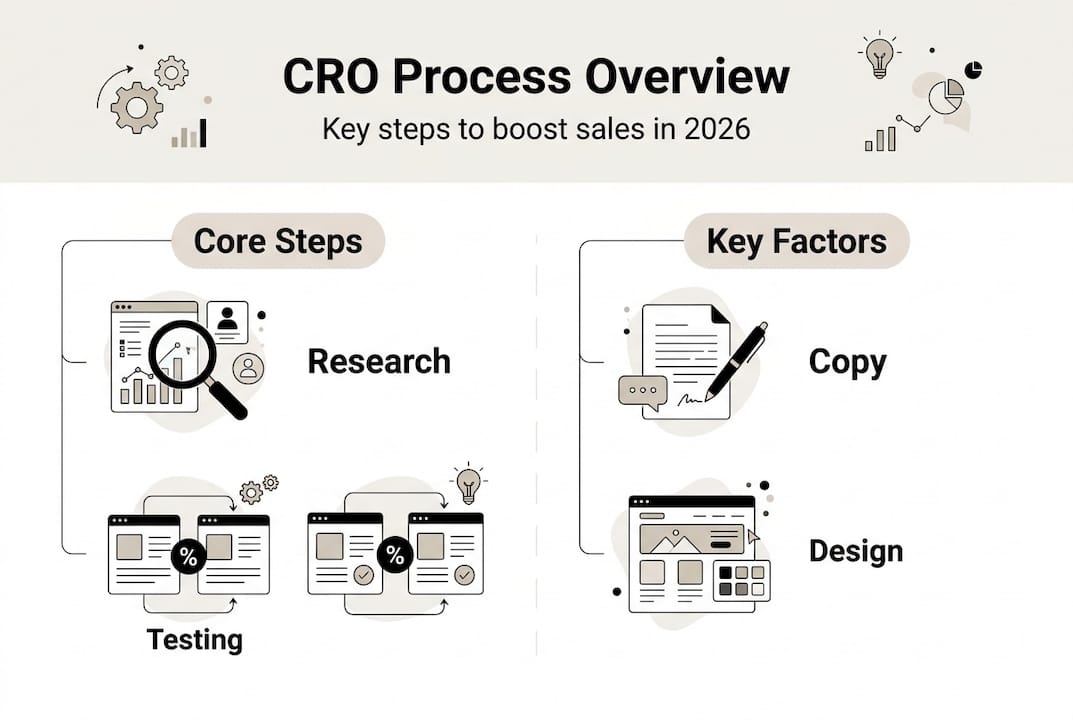
- How conversion optimization actually works: Research, copy, and design
- Common myths about CRO: Why ‘best practices’ aren’t enough
- Applying CRO strategies to your Albuquerque business
- Our take: The overlooked power of local insights in conversion optimization
- Ready to unlock better results? Let’s optimize
- Frequently asked questions
Key Takeaways
| Point | Details |
|---|---|
| Conversion optimization defined | It’s a long-term, research-driven approach to turning more website traffic into sales or leads. |
| Copy-first impact | Messaging and proof points drive much bigger conversion gains than design tweaks alone. |
| Ongoing small wins | Frequent, minor improvements compound over time to multiply results without costly redesigns. |
| Local focus matters | Tailoring CRO strategy to Albuquerque customers produces better ROI than chasing generic online ‘hacks.’ |
Defining conversion optimization and why it matters
Conversion optimization is the process of increasing the percentage of website visitors who take a specific, desired action. That action could be filling out a contact form, calling your business, requesting a quote, or completing a purchase. Every business has a different definition of a “conversion,” but the goal is always the same: turn more of your existing traffic into revenue.
For Albuquerque small and medium-sized businesses (SMBs), this matters enormously. You are likely working with a fixed marketing budget. Every dollar you spend on Google Ads, social media, or SEO brings visitors to your site. If those visitors leave without acting, you have wasted that spend. CRO fixes the leak in the bucket before you pour in more water.
Here is why CRO is non-negotiable for SMBs:
- Higher ROI: You earn more from the same traffic, so every marketing dollar stretches further.
- Lower customer acquisition cost (CAC): CRO compounds ROI by halving CAC without needing more traffic.
- Business resilience: When ad costs rise or traffic dips, a higher conversion rate protects your revenue.
- Competitive edge: Most of your local competitors are not doing this well. That is your opportunity.
Common conversions for Albuquerque businesses include phone calls from a service page, quote request form submissions, online bookings, e-commerce purchases, and email newsletter signups.
“CRO is not a campaign you run once. It is an ongoing, research-based strategy that compounds over time, much like interest in a savings account.”
Our conversion optimization guide walks through the full process in detail, and understanding conversion funnel optimization is a natural next step once you grasp the basics. For a structured approach, the conversion optimization steps outlined in our complete guide give you a clear starting point.
CRO is not a one-time fix. Businesses that treat it as a continuous discipline consistently outperform those that chase quick wins.
How conversion optimization actually works: Research, copy, and design
Understanding what CRO is, let’s break down how and why certain tactics produce bigger results than others.
Effective CRO follows a clear hierarchy. Not all changes are created equal, and knowing where to focus saves you time and money. The copy-first hierarchy shows that headlines and proof points deliver 50 to 200% lifts, UX and design improvements yield 10 to 50%, and technical fixes like page speed contribute 2 to 10%.
| CRO layer | Examples | Typical conversion lift |
|---|---|---|
| Copy and messaging (Tier 1) | Headlines, testimonials, value propositions | 50 to 200% |
| UX and web design (Tier 2) | Layout, navigation, visual hierarchy | 10 to 50% |
| Technical elements (Tier 3) | Page speed, tracking, mobile optimization | 2 to 10% |
This is a counterintuitive truth. Most business owners want to redesign their website when conversions drop. But a redesign sits in Tier 2 at best. Rewriting your headline and adding a compelling customer testimonial sits in Tier 1 and almost always moves the needle faster.
Psychology and emotion drive decisions more than logic. Visitors do not read your site like a contract. They scan, feel, and decide in seconds. A headline that speaks directly to a pain point, such as “Stop losing customers to slow response times,” will outperform a generic “Welcome to our business” every time.

A real-world example: one local service business changed a single headline from a feature-focused statement to a benefit-driven one. The result was a 50% sales lift with no other changes made. That is the power of copy-first thinking.
Pro Tip: Before touching your design, audit your homepage headline. Ask yourself: does this speak to what my customer wants, or does it describe what I do? If it describes you, rewrite it around their outcome.
Strong copywriting strategies underpin every effective CRO effort. Pairing them with proven conversion rate strategies creates a compounding effect. Even your email follow-ups benefit from applying email copywriting tips that keep prospects moving through your funnel.
Common myths about CRO: Why ‘best practices’ aren’t enough
Now that we’ve clarified the pillars of CRO, it’s important to separate facts from fiction so you don’t fall into the usual traps.
Myths about CRO are everywhere, and they lead business owners to waste time and money chasing tactics that simply do not apply to their situation. Let’s clear the air.
Myth 1: CRO is just about button colors.
This is the most common misconception. Button color is a Tier 3 tweak at best. CRO is not only about design or button colors. Research and copy come first, always.
Myth 2: Best practices work for everyone.
Best practices are starting points, not guarantees. What works for a national e-commerce brand rarely translates directly to a local Albuquerque plumber or law firm. Your audience, your offers, and your local context are unique.
Myth 3: CRO is a one-time project.
Customer behavior shifts. Competitors change their messaging. Seasons affect buying decisions. CRO is an ongoing discipline, not a checkbox.
Myth 4: AI tools can handle CRO automatically.
AI can speed up analysis and generate copy variations, but AI amplifies only when paired with real data and human expertise. Without that foundation, AI just produces faster guesses.
Myth 5: A big redesign will fix everything.
Small, research-driven tests consistently outperform expensive overhauls. Most businesses see their biggest gains from targeted tweaks, not total rebuilds.
“80% of effective CRO comes from research, not gut instinct. Skipping the research phase is the single most expensive mistake businesses make.”
Pro Tip: Before running any test, document your hypothesis. Write down what you are changing, why you believe it will work, and what data supports that belief. This one habit separates strategic CRO from random guessing.
Learning to optimize your marketing funnel is the antidote to myth-driven decision making. When you understand how each stage of your funnel performs, you stop guessing and start improving with confidence.
Applying CRO strategies to your Albuquerque business
After debunking common myths, you’re ready to see exactly how practical CRO applies to your business.
Here is a straightforward action sequence you can start this week:
- Audit your current website. Review your top five most visited pages. Identify where visitors drop off using a free tool like Google Analytics or Microsoft Clarity.
- Define your desired actions. List the specific conversions that matter most: phone calls, form fills, quote requests, or purchases.
- Prioritize your highest-traffic landing pages. These pages have the most to gain from even small improvements.
- Review visitor behavior data. Look at heatmaps and session recordings to see where users click, scroll, and abandon.
- Rewrite your primary headline. Apply the copy-first principle. Focus on the visitor’s outcome, not your features.
- Add social proof. Place a relevant customer testimonial or review near your primary call-to-action (CTA).
- Run a focused test. Change one element at a time so you know what actually moved the needle.
- Measure and iterate. Track results for at least two weeks before drawing conclusions.
Here is a snapshot of typical conversion benchmarks and realistic improvement targets for Albuquerque SMBs:
| Business type | Typical conversion rate | Realistic CRO target |
|---|---|---|
| Local service (plumbing, HVAC) | 2 to 4% | 5 to 8% |
| Professional services (law, finance) | 1 to 3% | 3 to 6% |
| E-commerce (local retail) | 1 to 2% | 2 to 4% |
| Healthcare and wellness | 3 to 5% | 6 to 10% |
These numbers show that even modest improvements double your leads without increasing your ad spend. CRO compounds ROI by halving your customer acquisition cost, which means your existing budget suddenly works twice as hard.
Use our ROI calculator to model what a 2% conversion rate increase means for your specific business. Understanding measuring marketing ROI gives you the framework to track progress confidently. When you’re ready to act, our list of ways to boost conversions gives you tested starting points.
Our take: The overlooked power of local insights in conversion optimization
Most CRO guides hand you a list of universal tactics and call it a day. We have seen firsthand why that approach falls short for Albuquerque businesses.
Here is the uncomfortable truth: generic CRO advice is written for a generic audience. Your customers in Albuquerque have specific concerns, local references they trust, and community-based proof points that resonate in ways a national template never will. We have worked with local SMBs that doubled their conversion rates simply by replacing stock photography with real photos of their team and adding testimonials from recognizable Albuquerque neighborhoods.
The biggest lifts we see come from listening to actual customers, not from copying a competitor’s layout or following a trending tactic. When you understand the exact words your customers use to describe their problem, and then mirror those words back in your headline, the response is immediate.
CRO is less about the latest tool and more about genuine customer understanding. Following conversion rate advice grounded in local research will always outperform borrowed tactics from industries or markets that don’t match yours. Invest in understanding your Albuquerque audience first, and the tactics become obvious.
Ready to unlock better results? Let’s optimize
If you want expert support turning these strategies into action, here’s how we can help.
At King Digital, we specialize in helping Albuquerque SMBs build websites and marketing strategies that convert. We do not hand you a template and walk away. We research your audience, audit your current site, and apply data-driven improvements that move real numbers.
Our team integrates SEO-friendly website structure with conversion strategy from the start, because traffic without conversion is just noise. Explore how our design and SEO integration approach builds sites that rank and convert simultaneously. Ready to improve search ranking while growing your conversion rate? Let’s talk about what that looks like for your business specifically.
Frequently asked questions
What is conversion optimization in digital marketing?
Conversion optimization uses research and testing to increase the number of website visitors who take valuable actions. CRO turns website traffic into measurable business results like form submissions, calls, and purchases.
Is conversion optimization only about changing button colors?
No. Most successful conversion optimization comes from research, compelling copy, and deep customer understanding. CRO is not only about design tweaks like button color changes.
How does CRO save Albuquerque businesses money?
By increasing your conversion rate, CRO compounds ROI by halving your customer acquisition cost without requiring more ad spend or traffic.
Can AI tools replace human expertise in CRO?
AI amplifies results but still requires human-driven insights, local research, and continuous testing to be effective for your specific business.
Recommended
- Conversion Funnel Optimisation: The #1 Playbook 2025
- Boost conversion rates: 20 Sky-High Strategies
- The Ultimate Guide to Conversion Funnel Optimization | King Digital Marketing Agency
- Conversion Optimization: 4 Steps to Skyrocket Sales!
- Amazon Conversion-Optimierung: Strategien für mehr Umsatz
- How to Write Seductive Web Copy That Converts Like Crazy