
Copywriting for Print Media: Powerful Strategies 2025
Why Print Still Packs a Punch in a Digital World
Copywriting for print media is the strategic art of crafting persuasive text for tangible materials like brochures, direct mail, magazine ads, and billboards to grab attention, build trust, and drive customer action – even in our digital-first world.
Master Print Copywriting in 6 Key Steps:
- Know your audience – Research demographics and reader habits specific to your print medium
- Focus on benefits, not features – Show customers how your product solves their problems
- Craft a powerful headline – Use questions, statistics, or bold statements to capture attention
- Keep body copy clear and concise – Short sentences, simple words, active voice
- Design a strong call to action – Tell readers exactly what to do next with urgency
- Adapt for the format – Tailor your approach for brochures, direct mail, ads, or billboards
Print marketing offers something digital can’t replicate: a tangible experience. Research from a recent FedEx Office survey shows that 85% of consumers equate the quality of a company’s printed materials with the quality of its services. That aligns with broader findings from organizations like the U.S. Postal Service Office of Inspector General and Two Sides North America that physical media is often more memorable and trusted than purely digital messages.
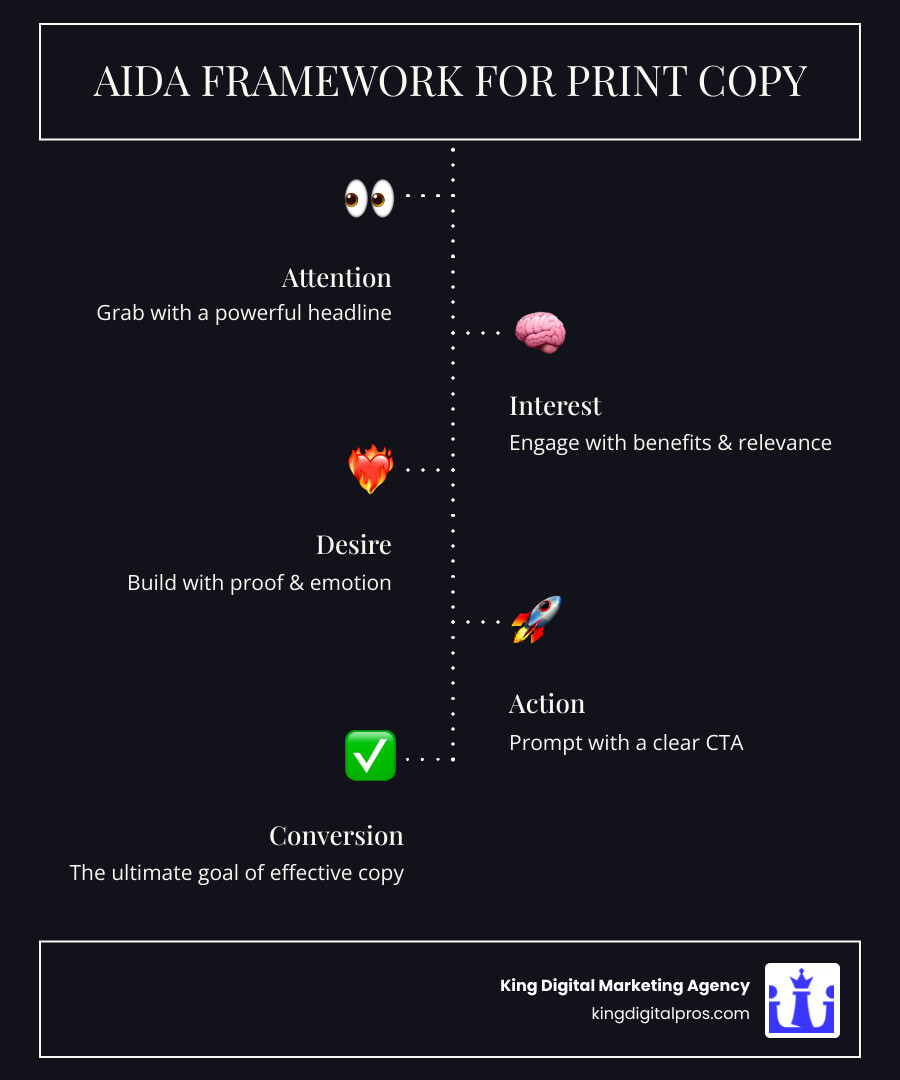
In an era where we’re bombarded by digital ads, print has become a novelty that stands out and creates lasting impressions. The physicality of print – something you can hold, keep, and return to – makes it a powerful tool when your copy follows the proven AIDA model: Attention, Interest, Desire, Action.
At King Digital Marketing Agency, we’ve seen that effective copywriting for print media requires understanding both the medium’s constraints and its unique power to engage readers. The same strategic thinking we apply to optimizing Google Business Profiles and local search visibility helps us ensure your print pieces are not just attractive, but also conversion-focused.
Copywriting for print media terminology:
The Foundation: Audience, Benefits, and Brand Voice
Before we even put pen to paper (or fingers to keyboard, as it were), the most crucial steps in effective copywriting for print media involve understanding who we’re talking to, what problem we’re solving for them, and how we want our brand to sound. These elements form the bedrock of a compelling message, ensuring our print materials in Albuquerque, Santa Fe, or any of our other New Mexico communities resonate deeply. Without this foundational work, even the cleverest words can fall flat. Our goal is to craft a core message, a single-minded proposition that highlights our strengths and addresses competitive weaknesses, all while building trust and credibility with our audience.
Understanding Your Audience for Print Media Copywriting
Just like a seasoned salesperson knows their customer inside and out, we must deeply understand our target audience for copywriting for print media. This means going beyond basic demographics like age and location. We dig into psychographics – their interests, values, lifestyles, and pain points. What keeps them up at night? What are their aspirations?
Consider where your print ad will appear. Is it a flyer in a local community center in Corrales, a magazine ad in a regional publication distributed in Taos, or a direct mail piece sent to homes in Rio Rancho? The context of the publication and the reader’s habits within that context are vital. Magazine readers, for instance, tend to dwell on content longer than newspaper readers, allowing for slightly more detailed copy.
Before we craft a single word, we research and define your target audience. We want to know who they are, where they live, what their hobbies are, and their age range. This research helps us tailor the message to speak directly to them, making it personal and effective. Our copy will focus on how your offering solves their problems or makes their lives easier, which is much more persuasive. For more insights into effective copywriting, explore effective copywriting techniques and broader guidance on audience research from sources such as the Content Marketing Institute.
Highlighting Benefits Over Features
A common pitfall in copywriting for print media is focusing too heavily on features. “Our product has a 3.0 GHz processor!” While technically true, it doesn’t tell the customer what that means for them. Instead, we emphasize benefits. How does that processor translate to faster work, more efficient gaming, or more time for family in Grants?
The golden rule here is W.I.I.F.M. – “What’s In It For Me?” Our copy should clearly articulate how your product or service makes the customer’s life better, easier, or saves them time or money. A feature is a fact about the product; a benefit is what that fact does for the buyer. For example, a car having “350 horsepower” is a feature. The benefit could be “safely merge onto the highway with effortless acceleration” or “enjoy a thrilling drive through the East Mountains.”
We translate specifications into solutions, connecting with our audience on an emotional level. People buy solutions to problems, not just products. By focusing on how we help the customer, rather than just how great our business is, we create a more compelling and persuasive message that resonates with their desires.
Maintaining a Consistent Brand Voice
Your brand voice is your company’s personality expressed through words. Whether we’re designing a flyer for a local event in Cedar Crest or a direct mail campaign for clients in Los Alamos, maintaining a consistent brand voice is paramount. This consistency builds recognition and trust. Our tone should be personable and conversational, making our brand relatable to the reader.
We speak directly to the reader, using “you” and “your” rather than “we” or “our.” This second-person approach creates an immediate connection. Imagine a car ad that says, “We offer great financing options,” versus “You can drive away in your dream car today with our flexible financing.” The latter directly involves the reader.
Every piece of print copy we create – from a billboard in Tijeras to a brochure in Sandia Park – will reflect your brand’s unique identity, value proposition, and differentiators. This ensures that every interaction with your printed materials reinforces who you are and what you stand for. For a deeper dive into shaping and documenting brand voice, you can reference practical frameworks from the Nielsen Norman Group alongside the strategy we develop for your campaigns.
Core Elements of Effective Copywriting for Print Media
Once we have our foundation, we dive into the nitty-gritty of crafting the words themselves. Effective copywriting for print media hinges on making every word count, especially given the often-limited space. Readability, visual harmony, and persuasive techniques like social proof and urgency are vital to ensure our message not only gets read but also drives action.
Crafting Attention-Grabbing Headlines
In a world saturated with information, a headline is your first – and often only – chance to capture attention. It’s the fishing hook that reels in your prospect. For print materials, this is especially true. A strong headline makes people want to read on.
We employ several strategies to create impactful headlines:
- Ask a question: “Tired of High Energy Bills in Albuquerque?”
- State a clear benefit: “Save 30% on Heating Costs This Winter!”
- Create curiosity: “The Secret to a Greener Lawn in Rio Rancho Revealed!”
- Use powerful language or statistics: “Join 5,000 Satisfied Customers in Santa Fe!”
- Alliteration or rhyme: “Fantastic Finds, Fabulous Prices!”
A good headline is eye-catching, succinct, and engaging. It should either grab the reader’s attention with a thought-provoking question, emphasize a key benefit, or use a powerful fact. We often test several headlines to see which resonates most effectively with the target market.
Here are some classic headline formulas we use for copywriting for print media:
- The “How To” Headline: “How to Get a Lush Lawn in Los Alamos Without Breaking the Bank”
- The Question Headline: “Is Your Home in Corrales Ready for Monsoon Season?”
- The Testimonial Headline: ” ‘Our Business Doubled Thanks to King Digital!’ – Local Taos Business Owner”
- The Benefit Headline: “Unwind and Recharge: Experience Ultimate Relaxation in Edgewood”
- The Urgency Headline: “Limited-Time Offer: Secure Your Dream Home in Grants Now!”
Writing Clear, Concise, and Compelling Body Copy
After the headline grabs their attention, the body copy needs to hold it and build interest. For print, conciseness is key. We avoid jargon and overly complex sentences. The goal is to communicate one clear message, effectively and efficiently. Overloading readers with lengthy copy can make the ad look cluttered and deter them from reading.
Our approach to body copy for print involves:
- Short sentences and paragraphs: Ideally, sentences should be no more than 12 words, and paragraphs no more than 4 sentences. This makes the text easy to scan and digest.
- Active voice: This makes your message direct and impactful. Instead of “The service is provided by us,” we say, “We provide the service.”
- Focus on one clear point: Don’t try to cram too much information into a single ad. What’s the single most important thing you want your reader to take away?
- Storytelling (where appropriate): Even in short formats, a mini-story or scenario can create an emotional connection.
- White space: Plenty of white space makes the ad look clean, inviting, and easy to read.
Print ads have limited space. We aim for short, impactful, and actionable copy that guides the reader from interest to desire. For more detailed advice on crafting persuasive text, check out rules for writing better ad copy.
Designing a Strong Call to Action (CTA)
The call to action (CTA) is where we tell the reader exactly what we want them to do next. It’s the bridge from interest and desire to action, and it must be clear, concise, and persuasive. A vague CTA is a missed opportunity.
An effective CTA for copywriting for print media includes:
- Action-oriented verbs: “Call now,” “Visit our website,” “Scan here,” “Enroll today.”
- Specific instructions: “Call 505-XXX-XXXX for a free consultation,” “Visit our store in Santa Fe this weekend.”
- Sense of urgency: “Limited-time offer,” “Expires soon,” “Only 5 spots left.” If people don’t act right away, they might put your offer aside and never return to it.
- Easy-to-follow steps: Don’t make them work to respond. Provide all necessary information.
- Trackable elements: For print, we can use unique phone numbers, coupon codes, or specific short URLs (e.g., a custom landing page) to measure effectiveness. QR codes are also excellent for bridging print to digital, allowing readers to instantly access your website or Google Business Profile.
Our CTAs are bold, clear, and ensure your audience knows the next steps. They should be impossible to ignore and provide all the necessary instructions to take the desired action.
Adapting Your Copy for Different Print Formats
One size does not fit all in copywriting for print media. The format dictates the approach. A billboard requires a different strategy than a detailed brochure, simply because of the context in which it’s consumed. We consider the format’s constraints, the reader’s mindset, and the primary purpose of the material to tailor our message effectively for businesses in Grants, Edgewood, or any of our other service areas.
Brochures and Flyers
Brochures and flyers offer more space than a simple ad, allowing for more detailed information and a storytelling flow. They are often kept by recipients, making them a lasting resource. For a brochure, we can go deeper into the benefits, address common questions, and even include testimonials or reviews to build credibility. For instance, in real estate copywriting, a brochure for a new development in Rio Rancho might include floor plans, neighborhood amenities, and quotes from happy residents.
We structure brochures with multiple panels to guide the reader through a logical progression, building interest and desire. However, it’s crucial to avoid cramming too much information. We aim for a balance of compelling text and ample white space to maintain readability.
Direct Mail
Direct mail, sent directly to a consumer’s home or business, offers a unique opportunity for personalization. We can use teaser copy on the outside of the envelope to pique curiosity – making it look personal or intriguing. Imagine a direct mail piece sent to a potential client in Santa Fe with a unique insignia or a compelling question on the envelope, making them eager to open it.
The copy inside needs to deliver on the teaser, offering a clear and compelling proposition. Direct mail is excellent for new customer promotions, coupons, or special offers. For postcards, brevity is key, focusing on a strong headline, a clear offer, and an unmissable CTA. We can even use different envelope styles or colors to make the piece stand out in the mailbox.
Magazine and Newspaper Ads
Magazine and newspaper ads are “everywhere,” meaning they need to stand out. These typically fall into display ads (with visuals) or classified ads (text-only).
- Display Ads: These can be full-page, half-page, or smaller, appearing in various sections. They always include a headline, a visual, and often subheadlines. We ensure plenty of white space to prevent a cluttered look. The copy needs to be brief, benefit-laden, and entice action. Magazine ads often need to be vibrant and visually engaging, while newspaper ads can sometimes be a bit wordier and more informative, catering to a reader looking for local news and deals.
- Classified Ads: These are brief ads listed under categories, typically without visuals. They demand extreme conciseness. A powerful, short headline (ideally six words or less) is critical, followed by efficient, benefit-driven copy. For example, a classified ad for a service in Corrales might use a headline like “Reliable AC Repair!” and then list a few key benefits and a contact number. We often include a simple code or unique phone number to track which publication generated the lead.
Billboards and Large-Format Prints
Billboards and other large-format prints (like banners) demand the ultimate in brevity and impact. Drivers in Grants or pedestrians in Albuquerque have only seconds to absorb the message. Our copy here is minimal, often just a few words, paired with high-impact visuals. The goal is instant brand recognition and a single, clear message or call to action. Banners, for instance, need to be clean, with only the most important information, vibrant, and visually striking. This isn’t the place for detailed explanations; it’s about making a memorable impression and driving a specific, immediate thought or action.
TABLE: Comparing Copywriting Approaches for Different Print Formats
| Format | Primary Goal | Copy Length | Key Consideration |
|---|---|---|---|
| Brochures & Flyers | Inform, persuade, educate | Medium to Long | Storytelling flow, testimonials, visual hierarchy |
| Direct Mail | Generate leads, drive sales | Short to Medium | Personalization, compelling offer, envelope teasers |
| Magazine Ads | Brand awareness, lead gen | Short to Medium | Visual synergy, publication audience, emotional appeal |
| Newspaper Ads | Local offers, quick action | Short | Brevity, clear offer, immediate call to action |
| Billboards & Banners | Brand recognition, simple CTA | Very Short (3-7 words) | High-impact visuals, single message, instant comprehension |
Refining and Optimizing Your Print Campaigns
Our work isn’t done once the ink dries. Just like digital campaigns, print marketing benefits immensely from refinement and optimization. We want to ensure that our print investments for businesses in Los Alamos, Taos, or any of our other New Mexico locations are delivering the best possible return. This involves measuring success, continuous improvement, and strategically integrating print with digital marketing efforts.
Testing and Refining Your Copy
Even the most experienced copywriters can’t predict every outcome. That’s why testing is crucial. While A/B testing in print isn’t as instantaneous as online, it’s certainly possible and highly effective. We can:
- A/B test headlines: Run two versions of an ad with different headlines in different publications or markets (e.g., one version in Albuquerque, another in Rio Rancho) and compare response rates.
- Track response rates: Use unique phone numbers, specific coupon codes, or custom landing page URLs mentioned only in print ads. This tells us exactly which print effort is performing.
- Experiment with offers: Test different incentives (e.g., “10% off” vs. “Free Gift”) to see what resonates most with your audience.
- Gather feedback: Sometimes, direct feedback from customers or even sales teams can offer invaluable insights into what’s working and what isn’t.
Writing several headlines for print ads and getting feedback before a large print run can prevent costly mistakes. The goal is to continuously refine your copy to maximize its impact.
Connecting Print to Local Search
In today’s interconnected world, print isn’t an island. We can leverage copywriting for print media to drive digital engagement, especially for local businesses in New Mexico.
- QR Codes: Integrate QR codes into your print materials. When scanned, these can lead directly to your Google Business Profile (GBP) for reviews, directions, or a specific landing page with more information. For example, a flyer for a restaurant in Santa Fe could have a QR code leading directly to their online menu and reservation system.
- Trackable Phone Numbers: Use unique phone numbers for specific print campaigns. This allows us to track calls originating from your print ads, providing valuable data on effectiveness.
- Website Mentions: Clearly mention your website and encourage readers to visit for “near me” searches, special offers, or detailed product information. For example, “Visit KingDigitalPros.com for local SEO tips for your Albuquerque business.”
- Driving Online Reviews: Encourage satisfied customers who see your print ad to leave a review on your Google Business Profile. Reviews are a significant local SEO factor and build trust. Ensuring your Name, Address, and Phone number (NAP) are consistent across all online platforms and directories is also crucial for local search visibility, a core service we offer.
Common Mistakes in Copywriting for Print Media and How to Avoid Them
Even with the best intentions, mistakes can happen in copywriting for print media. We help our clients avoid these common pitfalls:
- Too Much Information (TMI): Trying to cram every detail into a small ad overwhelms the reader. Keep it simple and focused. If a reader is faced with a wall of text, they will likely move on.
- Vague Call to Action: “Learn More” isn’t enough. Be specific: “Call for a free estimate,” “Visit our showroom,” “Scan here for directions.”
- No Proofreading: Grammatical errors or typos instantly erode credibility. A flawed ad will be remembered for its flaws, not its message. Every piece of copy we produce is carefully proofread.
- Focusing on Features, Not Benefits: As discussed, always emphasize what’s in it for the customer.
- Inconsistent Branding: A disjointed brand voice across different print materials confuses the audience and weakens your overall message.
- Ignoring the Medium: Copy that works for a social media post won’t necessarily work for a billboard. Each format has its unique requirements and audience consumption patterns. We tailor the copy to the specific print medium.
Conclusion: Convert Readers into Customers with Powerful Print Copy
In a world increasingly dominated by digital noise, copywriting for print media offers a unique and powerful way to connect with your audience. The tangible nature of print creates a lasting impression, cutting through the clutter and building a deeper sense of trust and credibility.
We’ve explored the essential strategies for crafting compelling print copy: from deeply understanding your audience and highlighting benefits, to designing attention-grabbing headlines, clear body copy, and strong calls to action. We’ve also seen how to adapt your message for different print formats – be it a detailed brochure for a new development in Rio Rancho or a concise billboard message for a service in Taos – and how to strategically connect your print efforts to your digital presence for maximum impact.
At King Digital Marketing Agency, we believe that clarity sells. Our expertise in copywriting for print media, combined with our focus on optimizing Google Business Profiles for local businesses in Albuquerque, Rio Rancho, East Mountains, Corrales, Santa Fe, Los Alamos, Taos, Grants, Cedar Crest, Edgewood, Sandia Park, and Tijeras, ensures your message not only reaches but resonates with your target audience. We know that the quality of your printed materials reflects the quality of your services, and we’re here to help you make that impression count.
Ready to transform your print marketing from a cost into a powerful conversion tool? Let us help you craft impactful, persuasive messaging that will make a lasting impression and drive action for your business.
Get expert help with your copywriting needs.