Why Reliable Web Hosting Is the Foundation of Your Online Success
Finding reliable web hosting can feel overwhelming – there are dozens of providers, confusing pricing structures, and technical jargon that makes it hard to know who to trust.
Here’s a quick look at the top reliable web hosting providers for 2026:
| Provider | Uptime | Global TTFB | Starting Price |
|---|---|---|---|
| Interserver | 99.99% | 462ms | $2.50/mo (no markup at renewal) |
| Hostinger | 99.98% | 223ms | $2.69/mo intro |
| InMotion Hosting | 99.99% | 31ms load handling | Varies by plan |
| GreenGeeks | 99.97% | 416ms | Varies by plan |
| Wix | 99.99% | Multi-cloud | Free plan available |
| Namecheap | Guaranteed | Varies | $1.98/mo intro |
| SiteGround | 99.9%+ | Varies | $2.99/mo intro |
| GoDaddy | 99.9% | Varies | $5.99/mo intro |
Your website is your digital storefront. If it’s slow, down, or insecure, you’re losing customers – before they even see what you offer.
A one-second delay in page load time can reduce conversions by 7%. And the difference between 99.5% and 99.9% uptime is the difference between 3.6 hours and just 43 minutes of monthly downtime. For a small business, that gap is real money.
This guide cuts through the noise. It compares the top hosting providers of 2026 using independent performance data – including uptime, speed, pricing, and features – so you can make a confident choice without wasting time.
I’m Bernadette King, founder of King Digital Marketing Agency, and I’ve spent years helping small businesses and franchise owners choose the right digital infrastructure, including reliable web hosting, as the backbone of their online growth strategy. Let’s look at what actually separates the best providers from the rest.
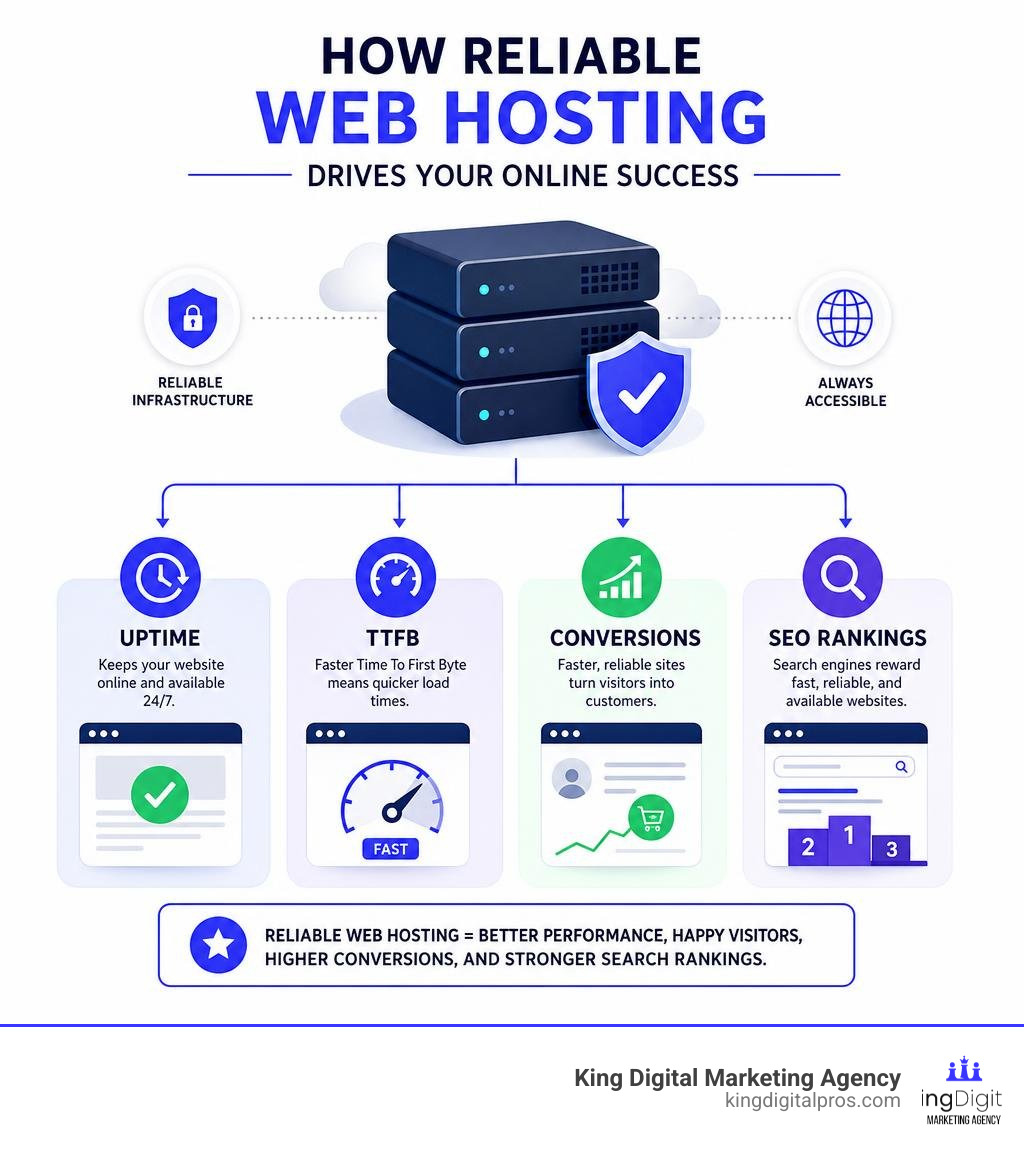
Simple guide to reliable web hosting terms:
Key Factors That Define Reliable Web Hosting

When evaluating web hosts, it is easy to get distracted by flashy marketing claims like “unlimited bandwidth” or “free marketing credits.” However, true hosting reliability boils down to a few cold, hard technical metrics. Understanding these factors is the first step toward finding a platform that keeps your business running smoothly around the clock.
To learn more about identifying these traits in a crowded market, check out our guide on Reliable Hosting Services and How to Spot Them in the Wild.
At its core, reliable web hosting is defined by three pillars:
- Server Uptime: The percentage of time a server is fully operational and accessible to the public. While a 99.9% uptime guarantee sounds impressive, it still allows for over 40 minutes of downtime every single month. For mission-critical sites, you should aim for providers that consistently deliver 99.97% to 99.99% actual uptime. For a deep dive into keeping your site accessible, read our comprehensive resource on Website Uptime Monitoring: Your Essential Guide to Keeping Sites Online.
- Time to First Byte (TTFB): This measures how quickly a hosting server responds to a visitor’s browser request. A low TTFB means your server is snappy and starts delivering content almost instantly, which directly influences how fast the rest of your page loads.
- Load Handling: Uptime is easy to maintain when nobody is visiting your site. The true test of a host is how its servers behave when dozens or hundreds of users land on your site simultaneously. A reliable host handles traffic spikes without dropping connections or slowing to a crawl.
Additionally, physical data center locations matter. If your business primarily serves clients locally in Albuquerque, Rio Rancho, or Santa Fe, having a server located on a major U.S. backbone ensures lower latency. Conversely, if you serve a global audience, utilizing a Content Delivery Network (CDN) with nodes distributed across the world is essential to keep response times low for everyone.
Finally, never underestimate the power of 24/7 customer support. When your website encounters an unexpected issue at 2:00 AM, you do not want to deal with automated chatbots or wait three days for an email ticket response. Real, human operators who can jump in and solve server-side issues immediately are a non-negotiable feature of reliable hosting.
Why Reliable Web Hosting Matters for Small Businesses
For local businesses operating in New Mexico communities like Corrales, Los Alamos, Taos, or Tijeras, a website is often the primary way new customers find your services. When a potential client searches for a local service provider, they expect your website to load instantly.
If your site is slow or offline, visitors will immediately click back to the search results and choose a competitor. This behavior signals to search engines that your site is not providing a good user experience, which can severely damage your local SEO rankings.
Speed and reliability are also directly tied to user trust. A secure, fast-loading website makes your business look professional and established. On the flip side, a site that constantly displays database errors or takes five seconds to load makes your business look neglected. To understand why speed is such a critical driver for local business conversion rates, read our detailed analysis on Why Website Speed is Important for SMB Growth.
Technical Performance Metrics to Watch
To make an informed decision, you need to look past promotional promises and focus on verified testing data:
- Time to First Byte (TTFB): A TTFB under 300ms is considered excellent, while anything over 600ms will feel noticeably sluggish to your visitors.
- Load Handling Capacity: Look for hosts that maintain steady response times even under virtual user pressure. In recent independent testing, some popular budget hosts experienced failure rates over 50% during moderate traffic spikes, while top-tier providers handled the load with average response times under 50ms.
- Server Hardware and Infrastructure: Modern solid-state drives (SSDs) and NVMe storage are significantly faster than traditional hard drives. High-quality hosts also utilize advanced cloud infrastructure, such as Google Cloud or Oracle Cloud, to ensure resource availability.
For practical advice on how to measure and optimize these metrics on your own site, explore our Website Performance Improvement Tips for SMB Success.
Comparing the Top Web Hosting Providers of 2026
To help you find the perfect match for your business, we have analyzed the performance, pricing, and feature sets of the industry’s most popular hosting companies. Whether you are running a simple local portfolio in Edgewood or a high-traffic e-commerce store in Santa Fe, here is how the top contenders stack up.
Performance Leaders: Hostinger, Interserver, and GreenGeeks
When speed and uptime are your top priorities, these three providers lead the pack based on recent independent performance testing:
- Hostinger: Ranking as a top overall performer, Hostinger achieved an outstanding 99.98% uptime and a lightning-fast 223ms global TTFB in Q4 2025 testing across 20 major providers. With traffic load handling response times averaging 31ms, Hostinger is built to handle traffic spikes smoothly. Their custom control panel (hPanel) and integrated AI tools make it incredibly easy for beginners to launch and manage a site.
- Interserver: If you hate the industry trend of massive renewal price hikes, Interserver is a breath of fresh air. They recorded an exceptional 99.99% uptime and earned the highest overall performance score of 7.95/10 in recent tests. Best of all, Interserver maintains a flat $2.50/month price at renewal with a 1.0x markup, making it one of the most honest and cost-effective plans on the market. They also operate their servers at 50% capacity to prevent slowdowns during traffic surges.
- GreenGeeks: For eco-conscious businesses in places like Taos or Corrales, GreenGeeks offers carbon-neutral hosting without compromising on speed. In independent 2025 testing, GreenGeeks delivered the fastest load handling response time in the industry at just 26ms, alongside a solid 99.97% uptime and a 416ms TTFB. They offset 300% of their energy consumption by purchasing wind energy credits, making them a fantastic green option.
Feature-Rich Contenders: InMotion Hosting and Wix
If you need advanced infrastructure, dedicated resources, or an all-in-one website building platform, these providers offer excellent, robust solutions:
- InMotion Hosting: Known for its highly stable, developer-friendly infrastructure, InMotion maintained a stellar 99.99% uptime and a rapid 31ms load handling response time in 2025 benchmarks. Because they own and operate their own infrastructure with data centers on both the East and West coasts, they can offer predictable, high-performance hosting. They are a fantastic choice for growing businesses, offering seamless scaling from shared hosting to VPS, bare metal, and managed dedicated servers without requiring complex site migrations.
- Wix: While primarily known as a website builder, Wix provides incredibly reliable, fully managed multi-cloud hosting. Powered by an enterprise-grade network spanning Google Cloud, AWS, Fastly, and their own data centers, Wix guarantees 99.99% uptime. With Wix, security, backups, and CDN caching are completely handled behind the scenes, making it a hassle-free option for small businesses that want a beautiful website without managing server settings.
Budget and Value Options: Namecheap and GoDaddy
For startups, local service providers in Cedar Crest or Tijeras, or those testing a new business idea, budget-friendly plans can help you get online without breaking the bank:
- Namecheap: Starting at just $1.98/month introductory pricing, Namecheap is highly accessible. They offer one of the lowest renewal markups in the industry at 2.5x (renewing at $4.88/month). While their higher-tier plans are highly reliable, be aware that their entry-level Stellar plan does not guarantee automated daily backups. If you choose Namecheap, we highly recommend upgrading to their Stellar Plus or managed WordPress options to ensure your data is safe.
- GoDaddy: As a household name trusted by over 20 million customers, GoDaddy offers entry-level shared hosting starting at $5.99/month for the first three years. Their plans include unmetered bandwidth, a free domain, and AutoSSL, which automatically assigns and renews security certificates. While GoDaddy is highly user-friendly and offers 24/7 phone support, keep an eye on their renewal rates, which can increase significantly after your initial contract ends.
- HostGator: Hosting over 2 million websites, HostGator is a staple for beginners. Their plans feature unmetered bandwidth, a 99.9% uptime guarantee, and a free site migration tool. It is a highly scalable platform, though like GoDaddy, you will want to budget for higher renewal rates once your introductory discount period expires.
- SiteGround: SiteGround is famous for its top-tier customer support and custom speed optimizations. Built on Google Cloud infrastructure, they offer multi-level caching, a free built-in CDN, and automatic daily backups with 30 days of history. While their renewal prices are higher than budget hosts, the sheer speed and peace of mind they provide make them a favorite for e-commerce and local businesses alike.
Understanding Hosting Types: Which is Best for You?

Choosing the right type of hosting is just as important as choosing the right provider. If you select a plan that is too small, your website will crash during busy periods. If you buy a massive dedicated server for a basic local business site, you will end up wasting hundreds of dollars a month. Let’s break down the most common hosting setups.
Choosing a Reliable Web Hosting Plan: Shared vs. VPS
For most small businesses, the choice comes down to shared hosting or a Virtual Private Server (VPS).
- Shared Hosting: This is the most common and affordable type of hosting. Multiple websites share the resources of a single physical server, including its CPU, RAM, and storage. While modern shared hosting is highly efficient, a massive traffic spike on a neighbor’s website can occasionally slow down your site. To mitigate this, look for modern hosts like Hostney that use container isolation to keep your site’s resources secure and isolated from other users.
- VPS Hosting: A VPS is the perfect middle ground for growing businesses. While you still share a physical server with other users, virtualization technology carves out dedicated resources (like specific RAM and CPU cores) that belong only to your website. A VPS can be restarted independently and offers much tighter security, making it ideal for database-driven websites, online stores, or businesses with steady daily traffic.
To find out which hosting configuration is best suited for your specific industry, take a look at our dedicated guide on Small Business Hosting.
Enterprise Solutions: Dedicated and Cloud Hosting
For large enterprises, high-volume e-commerce stores, or agencies managing dozens of client websites in Albuquerque and Santa Fe, standard hosting plans won’t cut it. You need the power of dedicated or cloud-based infrastructure:
- Dedicated Servers: With a dedicated server, you rent an entire physical machine. You have complete, single-tenant control over the hardware, operating system, and security configurations. There is no virtualization layer and no sharing of resources, making it the ultimate setup for maximum performance, heavy databases, and strict compliance standards.
- Cloud Hosting: Instead of relying on a single physical server, cloud hosting spreads your data across a vast network of virtual servers. If one physical machine fails, another instantly takes its place, providing incredible multi-cloud resilience. Cloud hosting is highly scalable; you can instantly increase your RAM or CPU allocation to handle a sudden media mention or seasonal sales rush, and then scale back down when traffic returns to normal.
Frequently Asked Questions About Reliable Web Hosting
What is the difference between introductory pricing and renewal rates?
Almost all hosting providers offer steep discounts to attract new customers. For example, a host might advertise a rate of $2.99/month, but that price only applies to your first billing cycle (which could be 12, 24, or 36 months). When that initial contract ends, the plan will renew at its standard rate, which is often 2x to 5x higher than the introductory price.
To avoid surprise bills, always check the renewal pricing before signing up. If you want to keep your long-term costs as low as possible, look for providers like Interserver that offer flat-rate pricing with no renewal markups, or lock in a longer-term introductory contract (like 36 months) to delay the price increase as long as possible.
Do I need technical skills to manage a reliable web hosting account?
No, you do not need to know how to code to manage a modern hosting account. Most user-friendly hosts provide intuitive control panels (like cPanel or hPanel) with simple, graphical menus. Many also feature one-click installers that allow you to set up WordPress, Joomla, or WooCommerce in seconds.
If you want a completely hands-off experience, you can opt for managed hosting. With a managed plan, the host’s technical team handles all server maintenance, software updates, security patches, and daily backups for you, allowing you to focus entirely on running your business.
How do money-back guarantees and refund policies work?
Most reputable web hosting companies offer a money-back guarantee to let you test their services risk-free. The industry standard is a 30-day money-back guarantee for shared and VPS hosting plans. Some hosts, like HostArmada, offer extended 45-day trial periods, while others may offer a 14-day free trial with no credit card required.
However, keep in mind that certain add-on fees are almost never refundable. This includes domain registration fees (as the host must pay the central registry to secure your name), setup fees, and SSL certificate costs. Dedicated hosting plans also tend to have much shorter refund windows, typically around 7 days, due to the labor involved in setting up custom physical hardware.
Conclusion
Choosing reliable web hosting is one of the most critical decisions you will make for your business’s online presence. Whether you choose a high-performance host like Hostinger, a budget-friendly option like Namecheap, or a flat-rate plan with Interserver, having a fast, secure, and always-online website is the foundation of digital success.
At King Digital Marketing Agency, we help local businesses across New Mexico, from Albuquerque and Rio Rancho to Santa Fe, Los Alamos, and Taos, stand out online. While a fast website is essential, your customers also need to find you in local search results. We specialize in optimizing Google Business Profiles and managing local map listings to dramatically boost your local visibility and attract more customers right to your door.
Ready to build a secure, fast, and high-converting online presence? Learn more about how we can manage, secure, and optimize your website by exploring our Website Hosting and Maintenance services today. Let’s work together to put your local business on the map!
