TL;DR:
- Website speed directly impacts revenue, search rankings, and customer trust by influencing user experience and conversions. Regular monitoring and optimization of core metrics like LCP, INP, and CLS are essential for maintaining competitive performance. Faster websites improve SEO, lower advertising costs, and enhance overall business growth across digital channels.
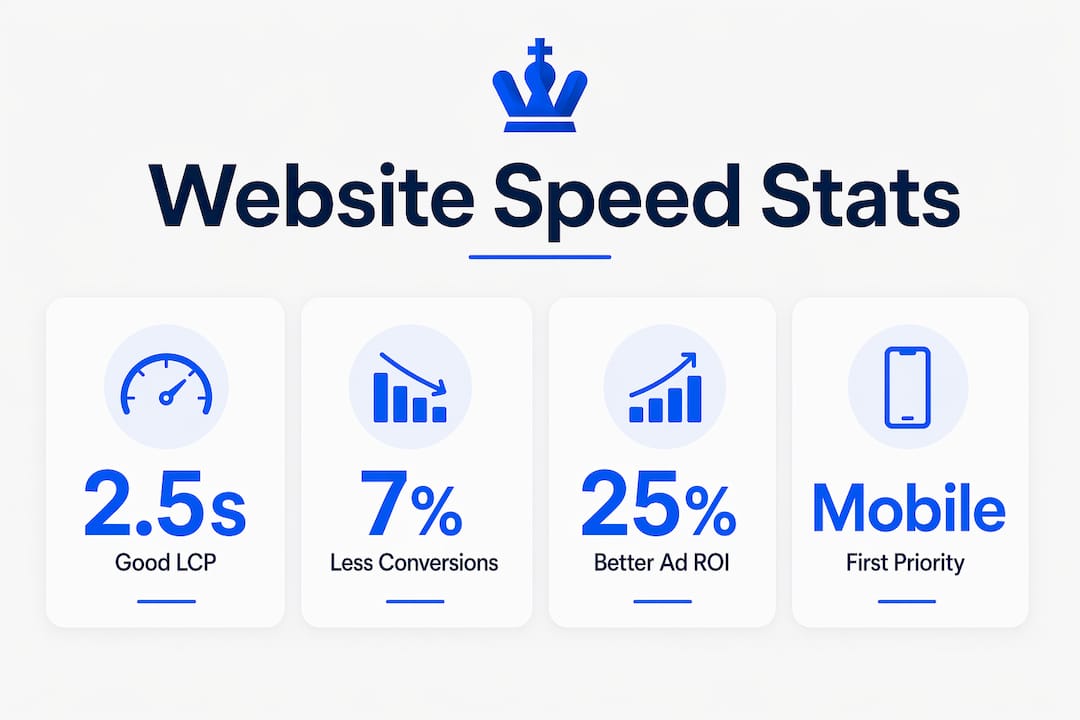
Website speed is the performance metric that determines how fast your webpage loads and becomes usable for visitors, directly controlling your revenue, search rankings, and customer trust. For small and medium-sized business owners, this is not a technical detail to hand off to a developer and forget. Every one-second delay in page load time reduces conversions by up to 7% and drops customer satisfaction by 16%. Sites loading under 2 seconds convert at 2.4 times the rate of sites taking 5 seconds or longer. That gap is the difference between a thriving business and one bleeding customers to a faster competitor.
Why website speed is important for user experience
Speed shapes how users feel about your business before they read a single word. Users form trust judgments in less than 0.05 seconds, and slow-loading sites register as unprofessional. Think of it like a physical storefront: a slow site is the equivalent of a locked door with the lights off. Visitors leave before they ever see what you offer.
The behavioral consequences are measurable and severe:
- Bounce rate spikes. Slow mobile experiences increase bounce rates by over 100%. Mobile users are less patient, often on slower networks, and quick to leave.
- Session length drops. Users who stay on a slow site spend less time browsing, view fewer pages, and engage less with your content or offers.
- Trust erodes. Speed dominates perception more than design quality. A polished site that loads slowly still signals “amateur” to visitors.
- Lead generation suffers. Contact forms, quote requests, and phone calls all decrease when users abandon before reaching your conversion points.
Many SMB owners invest heavily in design and content while ignoring load time. That is a costly mistake. A beautifully designed site that takes 6 seconds to load will underperform a plain site that loads in 1.8 seconds every single time.
Pro Tip: Test your site on a real mobile device using a 4G connection, not just your office Wi-Fi. That is the experience most of your customers actually have.

How does website speed affect SEO rankings?
Google treats page speed as a direct ranking factor, and the stakes have risen significantly with mobile-first indexing. Sites passing Core Web Vitals see up to 70% more organic traffic than sites that fail these benchmarks. Core Web Vitals are Google’s three primary speed and stability metrics: Largest Contentful Paint (LCP), Interaction to Next Paint (INP), and Cumulative Layout Shift (CLS). Passing all three is now a baseline requirement for competitive search visibility.
Slow page speed also wastes crawl budget, meaning Google’s bots spend less time indexing your site. For an SMB with a blog, a service catalog, or new product pages, this is a real problem. Pages that are not crawled are not ranked. You could publish excellent content every week and still see no organic traffic gain if your site loads too slowly for Google to index it efficiently.
The SEO impact extends beyond Google’s traditional search results. AI-powered search tools like ChatGPT and Perplexity are now a growing source of discovery for consumers. AI bots may skip slow or error-prone sites entirely, reducing your chances of appearing in AI-generated answers. Speed is no longer just an SEO factor. It is an AI visibility factor.
| Speed Metric | SEO Impact |
|---|---|
| LCP under 2.5 seconds | Passes Google’s “Good” threshold; supports higher rankings |
| INP under 200ms | Signals responsive, interactive pages to Google |
| CLS under 0.1 | Prevents layout instability penalties in rankings |
| Page load over 5 seconds | Crawl budget waste; lower indexing frequency |
Pro Tip: Use Google Search Console’s Core Web Vitals report to see exactly which pages are failing and by how much. Fix the highest-traffic pages first for the fastest SEO gains.
Does website speed directly impact conversions and ad ROI?
Speed and revenue are directly connected, and the numbers are specific enough to build a business case around. A 100ms improvement in load time lifts sales by approximately 1.23%. That sounds small until you calculate it against your annual revenue. For a business generating $500,000 per year online, a 500ms improvement could add over $6,000 in revenue without a single new marketing dollar spent.
The connection to paid advertising is equally direct. Google Ads rewards fast landing pages with up to 25% better return on ad spend, 15% lower cost per click, and 2x higher conversion rates. Landing page experience is a core component of Google’s Quality Score. A slow landing page means you pay more per click and convert fewer visitors. That is a double loss on every dollar of ad spend.
Here is how speed compares across key business metrics:
| Site Load Time | Conversion Rate | Bounce Rate | Ad Quality Score |
|---|---|---|---|
| Under 2 seconds | High (2.4x baseline) | Low | Strong |
| 2–4 seconds | Moderate | Moderate | Average |
| 5+ seconds | Low | High (100%+ spike) | Weak |
For SMBs running Google Ads or Meta campaigns, this matters enormously. You can improve your landing page conversion rate without changing a word of copy, simply by cutting load time. Speed is one of the highest-leverage improvements available to any business running paid traffic.
Additional business impacts worth tracking:
- Lower customer acquisition cost. Faster sites convert more visitors from the same ad spend, reducing cost per lead.
- Higher return on ad spend. Better Quality Scores mean lower CPC, stretching every advertising dollar further.
- Stronger email and social ROI. Visitors arriving from email campaigns or social posts are just as sensitive to load time as paid traffic.
How fast should your website load in 2026?
Industry benchmarks target load times under 2.5 seconds for desktop and under 3 seconds for mobile. Sites slower than 3 seconds experience sharp bounce rate increases that compound over time. These are not aspirational targets. They are the minimum thresholds for competitive performance in most industries.
Google’s Core Web Vitals define three specific measurements every SMB should know:
- Largest Contentful Paint (LCP): Measures how long it takes for the main content block to appear. Target: under 2.5 seconds.
- Interaction to Next Paint (INP): Measures how quickly your page responds to user clicks or taps. Target: under 200 milliseconds.
- Cumulative Layout Shift (CLS): Measures visual stability, meaning how much the page jumps around as it loads. Target: under 0.1.
These three metrics are the foundation of Google’s page experience signals. Failing any one of them can suppress your rankings even if your content is excellent. Use Google PageSpeed Insights, GTmetrix, or Lighthouse to measure all three on both desktop and mobile versions of your site.
Continuous measurement matters as much as the initial fix. A site that passes Core Web Vitals today can fail after a plugin update, a new image-heavy blog post, or a third-party script addition. Build speed checks into your monthly website maintenance routine the same way you review your revenue numbers.
What are the best ways to improve website speed?
Image compression and server optimization deliver the biggest and most cost-effective speed improvements for most SMBs. Before spending on front-end polish, fix the foundation. A slow server will undermine every other optimization you make.
Start with these priorities:
- Compress images. Use tools like TinyPNG or ShortPixel to reduce image file sizes without visible quality loss. Images are the single largest contributor to slow load times on most business websites.
- Upgrade your hosting. Shared hosting plans are often the hidden bottleneck. Moving to a managed WordPress host or a VPS can cut load times dramatically.
- Enable browser caching. Caching stores static files locally on a visitor’s device so repeat visits load faster. Most caching plugins for WordPress, like WP Rocket or W3 Total Cache, handle this automatically.
- Minimize JavaScript and CSS. Unused scripts and stylesheets add load time. Audit and remove anything your site does not actively need.
- Use a content delivery network (CDN). A CDN like Cloudflare distributes your site’s files across global servers, reducing load time for visitors regardless of their location.
Speed should be treated as a core product feature, not a one-time technical fix. Every new page, blog post, or design update is an opportunity to introduce a performance regression. Assign someone on your team to run a speed check after every major site change.
Pro Tip: Run your site through Google PageSpeed Insights before and after any major update. Screenshot the scores. Tracking changes over time gives you a clear picture of whether your site is getting faster or slower.
For deeper guidance on improving SMB website performance, King Digital Marketing Agency has published practical resources built specifically for business owners, not developers.
Key takeaways
Website speed is a direct revenue driver: faster sites convert more visitors, rank higher in search results, and lower the cost of every paid advertising campaign.
| Point | Details |
|---|---|
| Speed drives conversions | A one-second delay cuts conversions by up to 7%; sub-2-second sites convert 2.4x better. |
| Core Web Vitals affect rankings | Passing LCP, INP, and CLS benchmarks can increase organic traffic by up to 70%. |
| Paid ads cost less on fast sites | Google Ads rewards fast landing pages with 15% lower CPC and 2x higher conversion rates. |
| Mobile speed is non-negotiable | Slow mobile experiences more than double bounce rates, costing leads and revenue. |
| Speed requires ongoing monitoring | New content and plugin updates can introduce regressions; check speed monthly. |
Speed is the most underestimated growth lever i see
After working with SMBs across industries, I can tell you that website speed is the most consistently overlooked factor in digital marketing. Business owners spend months refining their brand messaging, redesigning their homepage, and testing ad copy. Then they send that traffic to a site that takes 6 seconds to load on mobile and wonder why their cost per lead keeps climbing.
Speed affects every channel simultaneously. It affects your SEO rankings, your Google Ads Quality Score, your email campaign ROI, and your social media traffic. Fixing it once creates compounding returns across all of them. I have seen SMBs cut their cost per acquisition by 20% or more simply by moving to faster hosting and compressing their images. No new content. No new ads. Just a faster site.
The mindset shift I encourage every client to make is this: treat speed like a revenue metric, not a technical checkbox. Continuous speed monitoring is as important as tracking your monthly sales numbers. If your site slows down after a new plugin or a large image upload, you want to catch that immediately, not three months later when your rankings have already dropped.
Track your Core Web Vitals scores monthly. Set a performance budget. Make speed part of every website decision you make. The businesses that do this consistently outperform competitors who treat their website as a static asset rather than a living growth tool.
— Bernadette
How King Digital Marketing Agency helps smbs build faster, higher-ranking websites
If your site is slow, you are losing customers, paying more for ads, and ranking below competitors who have solved this problem. King Digital Marketing Agency builds SEO-friendly website designs that are engineered for speed from the ground up, not patched after the fact. Every site we build passes Core Web Vitals benchmarks and is optimized for both mobile and desktop performance.
Our team combines technical performance optimization with local SEO strategy, so your faster site also ranks higher in Albuquerque search results and drives more qualified leads. We also offer web design built for SMBs that balances visual credibility with the performance your business needs to compete. If you are ready to turn your website into a genuine growth asset, let’s talk.
FAQ
What is a good website load time for a small business?
Industry benchmarks target under 2.5 seconds for desktop and under 3 seconds for mobile. Sites slower than 3 seconds see sharp increases in bounce rates and lower search rankings.
How does page speed affect google rankings?
Google uses Core Web Vitals, including LCP, INP, and CLS, as direct ranking inputs. Sites that pass these benchmarks earn up to 70% more organic traffic than those that fail them.
Can a slow website hurt my google ads performance?
Yes. Google’s Quality Score weighs landing page experience heavily, and slow pages receive lower scores. Fast landing pages earn up to 25% better return on ad spend and 15% lower cost per click.
What is the fastest way to speed up my website?
Image compression and server upgrades deliver the biggest gains for most SMBs. Fix hosting performance before addressing front-end elements like scripts or fonts.
Does website speed affect AI search visibility?
Yes. AI bots like ChatGPT may skip slow or error-prone sites entirely, reducing your chances of appearing in AI-generated search answers. Speed now influences both traditional and AI-driven discovery.
Recommended
- Website Performance Improvement Tips for SMB Success
- Web Design for SMBs: What You Need to Know
- Why Is Web Design Important for Your Business?
- Why Update Website Content: SMB Guide for 2026
