Stop Guessing: The Ultimate Guide to Tracking Marketing Campaigns
Tracking marketing campaigns means measuring exactly where your website traffic, leads, and sales come from – so you stop wasting money on what doesn’t work.
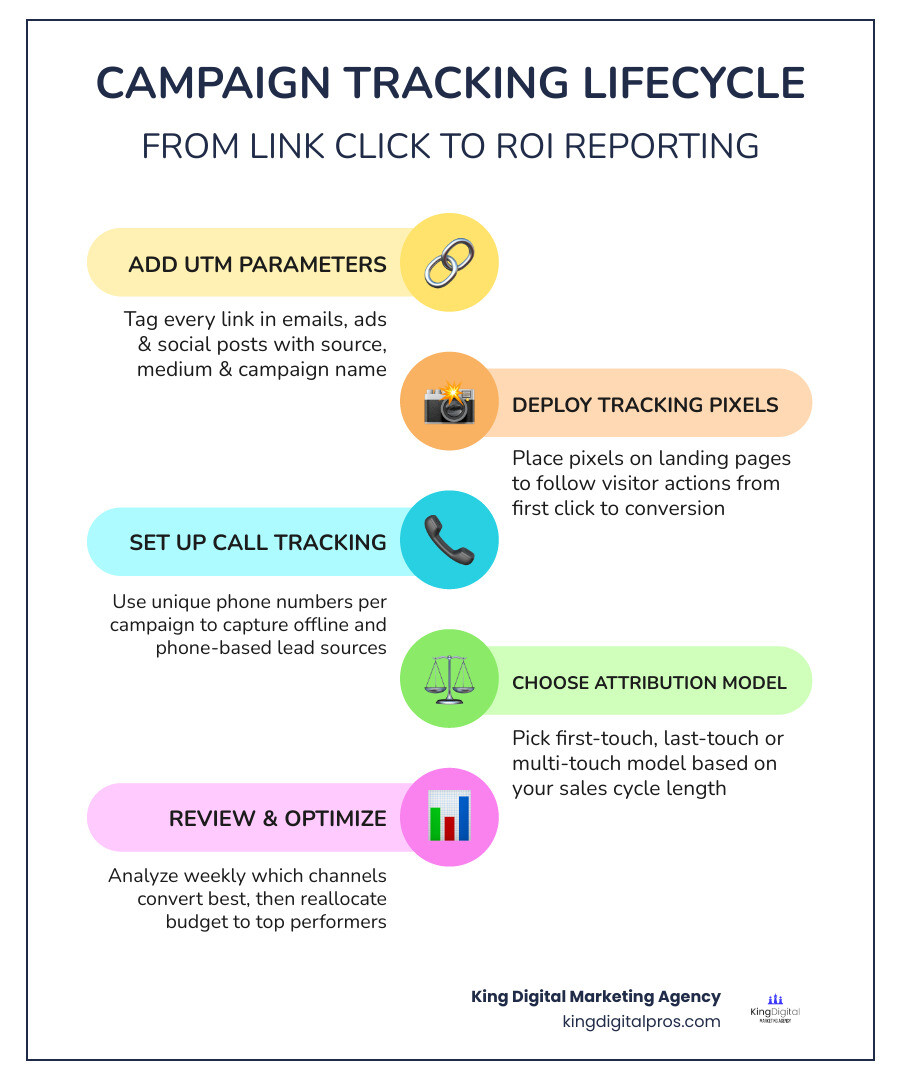
Here’s how to do it at a glance:
- Add UTM parameters to every link in your emails, ads, and social posts
- Use tracking pixels on landing pages to follow the customer journey
- Set up call tracking for phone-based leads from offline or digital ads
- Choose an attribution model (first-touch, last-touch, or multi-touch) that fits your business
- Review your analytics platform weekly to compare campaign performance and shift budget accordingly
You’re spending money on ads, emails, and social media. But do you actually know which one is bringing in customers?
Most small business owners don’t. They see a spike in website visits or a few new leads and assume a campaign worked. But assumption isn’t strategy – and it’s an expensive habit.
The reality is that without proper tracking, you’re flying blind. Invalid clicks and bot traffic alone quietly consume 20-30% of the average performance marketing budget. That’s money gone before a real customer ever sees your ad.
And it gets more frustrating: even legitimate traffic can be misread. Emails, for example, almost always show up as “direct traffic” in standard analytics tools – making it nearly impossible to know if your newsletter campaign actually drove results.
The good news? Campaign tracking isn’t as complicated as it sounds. With the right methods and tools, you can see exactly what’s working – down to the specific ad, email, or social post that converted a visitor into a paying customer.
I’m Bernadette King, founder of King Digital Marketing Agency, and helping small businesses and franchise owners track marketing campaigns with precision is at the core of everything I do. Over years of running conversion-driven campaigns for local businesses, I’ve seen how the right tracking setup transforms guesswork into confident, ROI-backed decisions – and I’m sharing everything that works in this guide.
Quick look at Track marketing campaigns:
Why You Must Track Marketing Campaigns in 2026
In July 2026, marketing is faster, more competitive, and more crowded than ever before. Whether you are running a local bakery in Albuquerque, a boutique hotel in Santa Fe, or a plumbing service in Rio Rancho, your audience is constantly bombarded with messages. If you don’t actively track marketing campaigns, you are essentially throwing your hard-earned budget into a black hole.
Campaign tracking is the structured process of logging, measuring, and analyzing specific marketing activities to see how they drive traffic, leads, and sales. It bridges the gap between what you spend and what you earn. Without it, you cannot accurately calculate your marketing return on investment (ROI).
According to industry data, over 54% of marketers have the primary goal of increasing sales leads generated. However, achieving this goal requires knowing exactly where your high-quality leads originate. If you are running multiple local promotions simultaneously across Google, Facebook, and local directories, how do you know which one is performing?
By setting up a robust campaign tracking system, you protect your data integrity. Clean, accurate data is the foundation of any successful strategy. When you understand your metrics, you can confidently execute marketing budget optimization to scale top-performing channels and cut underperforming ones. For a deeper look at how local SMBs can leverage data, check out our analytics digital marketing guide.
Core Methods for Tracking Marketing Campaigns
To build a reliable tracking engine, you need to understand the tools at your disposal. Modern marketers use a mix of tracking technologies depending on the channel, user journey, and privacy requirements. Here are the core methods:
- Tracking Pixels: These are tiny, invisible 1×1 images embedded in HTML emails or on website pages. When a user opens an email or visits a page, the pixel loads from a tracking server, recording the interaction. Pixels are highly effective for tracking email open rates and measuring conversions from paid ad networks.
- Cookies: Cookies are small text files stored in a user’s browser. While third-party cookies are being phased out due to privacy regulations, first-party cookies remain essential for remembering user preferences and tracking multi-session behavior on your own website.
- Server-Side Tracking: Because ad blockers and browser privacy updates (like iOS changes) can block browser-based pixels and cookies, server-side tracking has become the gold standard. It routes tracking data directly from your server to your analytics platform, bypassing browser-side restrictions entirely for superior accuracy.
- Call Tracking: For local service businesses in places like Corrales, Los Alamos, and Taos, phone calls are often the primary source of leads. Call tracking software dynamically swaps the phone number displayed on your website based on how the visitor found you. This allows you to attribute a phone call back to a specific Google search ad, local map listing, or offline billboard.
Using a dedicated lead tracker allows you to consolidate these data sources into a single source of truth. Advanced platforms like the TrackOg AI Platform leverage artificial intelligence to analyze billions of clicks, achieving up to 98.6% attribution accuracy while cutting down manual reporting work by 60%. Similarly, platforms like Campaign Management with Trackier help businesses manage all their creative assets, target specific traffic channels, and protect their budgets from fraudulent clicks.
How to Track Marketing Campaigns Across Channels
Every marketing channel requires a slightly different approach to tracking. To ensure you aren’t leaving gaps in your data, here is how to tackle the primary channels:
- Email Tracking: Standard email marketing platforms automatically track open and click rates using tracking pixels. However, to see what subscribers do after they click a link and land on your website, you must append tracking parameters to your URLs. This prevents email traffic from being miscategorized as direct traffic in your analytics dashboard.
- SMS Tracking: Text message marketing has an incredibly high engagement rate, with statistics showing that a whopping 98% of text messages sent are read. Because of SMS character limits, you should use trackable, shortened links to direct recipients to your landing pages, allowing you to monitor their post-click behavior.
- Paid Advertising: Platforms like Google Ads and Facebook Ads provide tracking templates and dynamic parameters. By placing their native tracking pixels on your conversion confirmation pages, you can attribute purchases, sign-ups, and form submissions directly to specific ad creatives and keywords.
- Social Media Tracking: For organic social posts, use unique tracking links for each platform. This helps you compare your organic reach and conversion performance on Instagram, LinkedIn, and Facebook side-by-side.
For real-world examples of how businesses utilize these setups to measure success, you can explore various Campaign Tracking Use Cases.
| Marketing Channel | Primary Tracking Method | Key Metric to Watch | Best Practice |
|---|---|---|---|
| Tracking Pixels & UTM Links | Click-Through Rate (CTR) | Segment lists to send tailored content. | |
| SMS | Shortened Trackable URLs | Post-Click Conversion Rate | Keep messages under 160 characters. |
| Paid Ads | Native Pixels & Server-Side | Cost Per Acquisition (CPA) | Use dynamic placeholders for ad names. |
| Social Media | Platform-Specific UTMs | Engagement & Referral Traffic | Test posting times weekly. |
| Offline (Print/TV) | Call Tracking & QR Codes | Lead Volume | Use unique phone numbers per ad. |
How to Set Up Campaign Tracking URLs and UTM Parameters
The backbone of digital campaign tracking is the UTM (Urchin Tracking Module) parameter. UTM parameters are simple tags appended to the end of a URL. When a user clicks a link with these tags, your analytics tool reads the parameters and logs the campaign details.
A standard tracked URL looks like this:
https://yourwebsite.com/landing-page/?utm_source=google&utm_medium=cpc&utm_campaign=spring_sale&utm_content=red_banner
By using a reliable Marketing Link Tracker, you can easily generate these links for free, organize them by campaign, and even use custom branded domains (such as go.yourbrand.com) to build user trust and improve click-through rates.
Best Practices to Track Marketing Campaigns
To keep your analytics reports clean and actionable, you must establish strict rules for link building. Even minor inconsistencies in UTM tagging can distort your reporting and lead to misguided budget decisions.
- Enforce Consistent Naming Conventions: Decide on a standard structure for your tags. For example, always use lowercase letters because analytics platforms treat
googleandGoogleas two entirely different traffic sources. - Use Separators Wisely: Use hyphens or underscores instead of spaces. Spaces in URLs turn into
%20, making your links messy and harder to read. - Tag Everything: Do not limit tracking to paid ads. Tag links in your email signatures, partner guest posts, and social media profiles.
- Audit Your Setup Regularly: Use a governed link management tool like the CampaignTrackly URL Builder to enforce casing rules, prevent duplicate entries, and automate metadata management across your team.
The Five Standard UTM Parameters
- utm_source: Identifies the platform or advertiser sending the traffic (e.g.,
google,newsletter,facebook). - utm_medium: Identifies the marketing channel or medium (e.g.,
cpc,email,organic_social). - utm_campaign: Identifies the specific product promotion or overarching campaign (e.g.,
spring_clearance,black_friday_2026). - utm_term: Used primarily for paid search to track the specific keyword that triggered the ad.
- utm_content: Used to differentiate similar content or links within the same ad or email (e.g.,
sidebar_link,cta_button_blue).
Attribution Models: First-Touch vs. Last-Touch
When a customer converts, which marketing effort gets the credit? In a typical buyer’s journey, a user might first discover your business through a Google search, return a week later via a Facebook retargeting ad, open an email newsletter, and finally make a purchase by navigating directly to your site.
To make sense of this journey, marketers use attribution models:
- First-Touch Attribution: This model gives 100% of the conversion credit to the very first channel the user interacted with. It is highly useful for brand awareness campaigns because it highlights which channels are best at introducing new prospects to your brand.
- Last-Touch Attribution: This model gives 100% of the credit to the final interaction before the conversion. While it is the easiest model to set up and track, it completely ignores the preceding touchpoints that helped nurture the lead.
- Multi-Touch Attribution: This model distributes conversion credit across multiple touchpoints in the customer journey. For example, a linear model gives equal credit to every interaction, while a position-based model might give 40% credit to the first and last interactions and split the remaining 20% among the middle touchpoints.
Choosing the right attribution model prevents you from scaling the wrong traffic sources and pausing channels that are actively building your conversion pipeline.
Key Metrics and Measuring Marketing ROI
Tracking campaigns is only useful if you know which numbers to watch. To evaluate performance accurately, local businesses should focus on both high-level and granular metrics.
- Conversion Rate: The percentage of website visitors who complete a desired action, such as filling out a contact form, calling your business, or making a purchase. Understanding your digital marketing conversion rate is critical to identifying bottlenecks in your sales funnel.
- Customer Acquisition Cost (CAC): The total marketing spend divided by the number of new customers acquired during a specific campaign.
- Return on Investment (ROI): The ultimate measure of campaign success. You can calculate this by subtracting your marketing costs from your generated revenue, dividing by the marketing cost, and multiplying by 100. For step-by-step guidance, explore our guide on how to measure marketing ROI or check out our list of top marketing metrics for SMBs.
By utilizing advanced analytics dashboards like Trackier’s Marketing Analytics, you can monitor these metrics in real-time, set up automated budget capping to prevent overspending, and drill down into performance data by geography or device.
Common Mistakes to Avoid in Campaign Tracking
Even experienced marketing teams can fall into common tracking traps. Here are the biggest mistakes to watch out for:
- Ignoring Ad Fraud and Bot Traffic: As mentioned, invalid clicks and bots consume a massive chunk of performance budgets. If you do not use active fraud detection to block these clicks in real-time, your conversion data will be heavily skewed.
- Inconsistent Tagging: Letting team members manually build URLs without templates leads to duplicate campaign listings (e.g.,
spring-salevs.Spring_Sale) and broken reporting in GA4. - Data Silos: Keeping your website analytics, CRM data, and email metrics separate makes it impossible to see the complete customer journey. Ensure your tracking tools integrate seamlessly.
- Reactive Optimization: Waiting until the end of a month-long campaign to check your reports is a recipe for wasted budget. Set up real-time alerts to catch underperforming ads early and implement conversion funnel optimization continuously.
Frequently Asked Questions about Campaign Tracking
What is the most accurate way to track marketing campaigns?
The most accurate method is combining server-side tracking with first-party data and standardized UTM parameters. This hybrid approach ensures that browser privacy settings do not block your tracking signals, giving you a complete and compliant view of your traffic.
Why does standard referral tracking fail for email campaigns?
Standard analytics tools look at the “referrer” header sent by browsers. When a user clicks a link inside a desktop email client (like Outlook or Apple Mail) or a secure mobile app, no referrer data is passed. As a result, the analytics platform categorizes the visit as “direct traffic,” masking the success of your email marketing.
How do you track offline marketing campaigns like billboards or print ads?
You can track offline campaigns by using unique, trackable entry points. These include custom QR codes that lead to landing pages with pre-built UTM parameters, memorable vanity URLs (e.g., yoursite.com/deal) that redirect to tracked pages, and unique call tracking phone numbers assigned to specific offline ad placements.
Conclusion
Stop guessing where your leads are coming from. By implementing a consistent campaign tracking framework, you can protect your marketing budget, confidently optimize your campaigns, and dramatically increase your ROI.
At King Digital Marketing Agency, we specialize in helping local businesses across Albuquerque, Rio Rancho, Santa Fe, Corrales, and Taos dominate their local markets. Our unique selling point is our expert management of Google Business Profiles and map listings, ensuring your business stands out exactly where local customers are searching.
Ready to eliminate the guesswork and start scaling your business with clean, accurate data? Explore our professional lead tracking services today, and let us help you build a high-performing, trackable marketing engine.
