Why Every Business Owner Needs a Marketing ROI Calculator
A marketing ROI calculator is one of the most powerful tools a business owner can use to find out if their marketing spend is actually working. Here’s the quick answer you need:
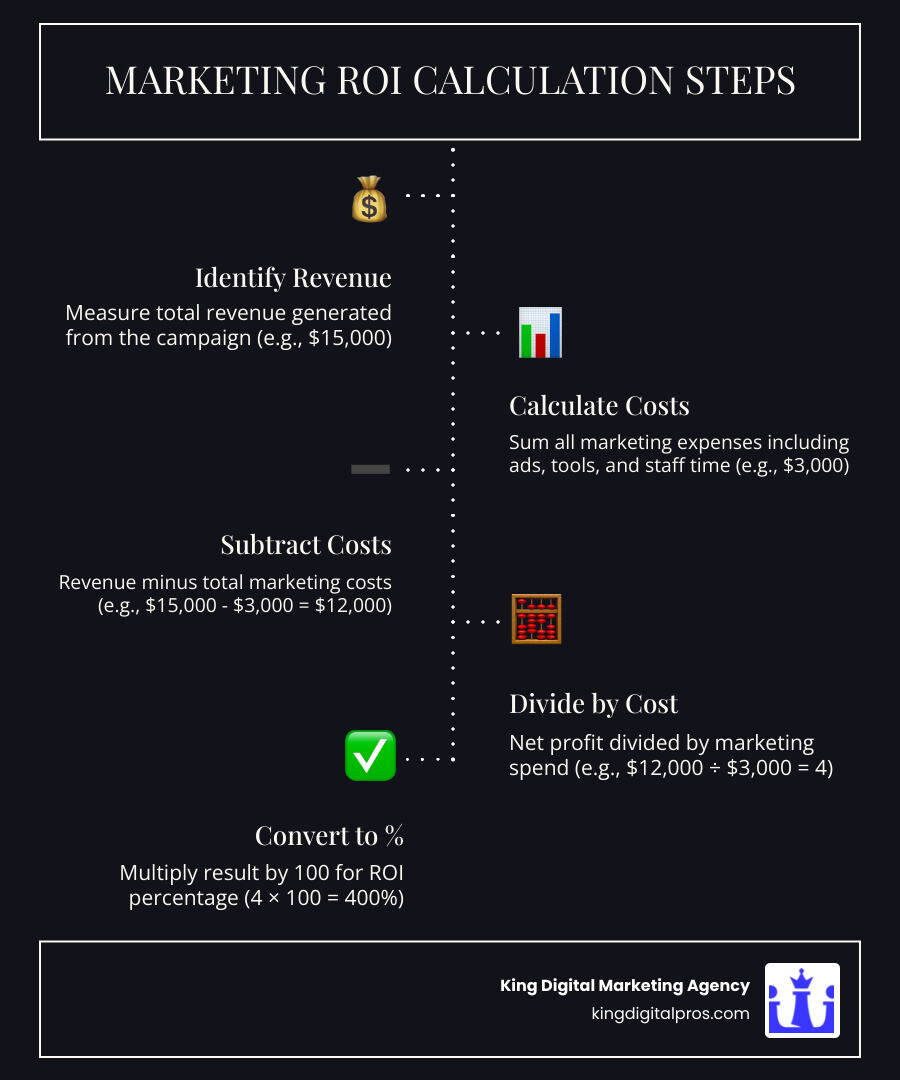
How to Calculate Marketing ROI:
| Step | Action | Formula |
|---|---|---|
| 1 | Identify revenue from campaign | e.g., $15,000 |
| 2 | Identify total marketing cost | e.g., $3,000 |
| 3 | Subtract cost from revenue | $15,000 – $3,000 = $12,000 |
| 4 | Divide by marketing cost | $12,000 ÷ $3,000 = 4 |
| 5 | Multiply by 100 | 400% ROI |
Quick Benchmarks:
- 100% (2:1) – Minimum acceptable return
- 500% (5:1) – Good marketing ROI
- 1,000% (10:1) – Exceptional return
Too many small business owners are guessing whether their marketing is working. They’re spending money on ads, SEO, and social media — but have no clear picture of what’s coming back. In fact, 44% of marketers aren’t measuring the ROI of their content efforts at all.
That’s a serious problem. Without measuring return, there’s no way to know which channels to grow — and which ones to cut.
The good news? You don’t need a finance degree to figure this out. The formula is simple, and once you understand it, every marketing decision gets easier and smarter.
I’m Bernadette King, founder of King Digital Marketing Agency, where I’ve spent years helping local businesses and franchise owners build ROI-focused marketing strategies — including building out a dedicated marketing ROI calculator to take the guesswork out of measuring campaign performance. In this guide, I’ll walk you through everything you need to know to calculate, benchmark, and improve your marketing ROI the right way.
Marketing roi calculator word list:
The Standard Formula and How a Marketing ROI Calculator Works
At its core, ROI (Return on Investment) is a performance metric used to evaluate the efficiency of an investment. In marketing, we use it to see if the dollars we put into a campaign are bringing back more dollars in profit.
The standard formula used by any reliable marketing roi calculator is:
ROI = (Net Profit / Cost of Investment) x 100
To get your “Net Profit,” you take the total revenue generated by your marketing efforts and subtract the costs involved. According to Investopedia: Understanding Return on Investment (ROI), this provides a clear percentage that allows you to compare different investments on an even playing field.
When we look at how to measure marketing ROI, we have to be honest about our numbers. If a campaign brings in $10,000 in sales but costs $5,000 to run, your ROI isn’t just “good”—it’s a 100% return. If you can repeat that, you’ve essentially found a way to double your money.

Essential Inputs for Your Marketing ROI Calculator
To get an accurate result, you can’t just look at your ad spend. A “fully loaded” ROI calculation includes several key inputs:
- Ad Spend: The direct cost paid to platforms like Google or Facebook.
- Creative Production: The cost of graphic design, video editing, or copywriting.
- Agency Fees: If you hire a team like ours to manage your Google Business Profile or PPC, these fees must be included.
- Software Subscriptions: Tools for email marketing, CRM, or analytics.
- Staff Time: The estimated cost of the hours your internal team spends on the project.
Why Every Business Needs a Marketing ROI Calculator
Using a marketing roi calculator isn’t just about looking at the past; it’s about planning the future. When you have hard data, you can justify your budget to stakeholders or your own bank account. It allows for objective channel comparison—maybe your social media looks “busy,” but your email marketing is actually paying the bills.
By using tools to calculate ROI, you move from “gut feeling” marketing to data-driven growth. It helps you allocate resources where they have the most impact, ensuring you aren’t over-investing in losing channels while underfunding your winners.
ROI vs. ROAS: Understanding the Key Differences
In our strategy sessions with business owners from Albuquerque to Santa Fe, we often hear ROI and ROAS used interchangeably. However, they tell very different stories.
| Metric | Focus | Formula | What it tells you |
|---|---|---|---|
| ROAS (Return on Ad Spend) | Direct Revenue | Revenue / Ad Spend | How efficient your ads are. |
| ROI (Return on Investment) | Total Profitability | (Revenue – Total Cost) / Total Cost | If the business is actually making money. |
While an advertising ROI calculator might show a high ROAS, your actual ROI could be low if your creative costs or agency fees are high. As noted by Forbes: Why ROAS Is Not The Same As ROI, ROAS is a measure of efficiency, while ROI is a measure of business health.
Calculating Return on Ad Spend
ROAS is great for a “quick check” on specific ad campaigns. If you spend $1,000 on Google Ads and generate $4,000 in revenue, your ROAS is 4:1. This is a fantastic metric for the person managing your ads to track daily performance, but it doesn’t account for the cost of the products sold or the electricity in your office.
Moving Beyond Media Efficiency
To truly understand your success, you must move toward “fully loaded” costs. This means including overhead allocation and creative production. If you only look at media efficiency, you might think a campaign is a hero when it’s actually a zero after all expenses are paid. We dive deeper into this in the ROI report on unpacking return on investment.
Industry Benchmarks: What is a “Good” Return in 2026?
As of May 2026, the landscape of digital marketing has become more competitive, but the fundamental benchmarks remain steady. A 5:1 ratio (500%) is generally considered a strong goal for most marketing campaigns. If you are hitting 10:1 (1,000%), you are in the exceptional category—this usually happens when you’ve perfectly optimized your local visibility or have a highly loyal customer base.
A 2:1 (100%) ratio is often the minimum acceptable return. Why? Because after you pay for your cost of goods and business overhead, a 2:1 marketing return might only leave you at a break-even point. You can calculate your success with our marketing ROI calculator to see where you land on this scale.

Channel-Specific ROI Expectations
Not all channels are created equal. Here are the average benchmarks we see in 2026:
- Email Marketing: Boasts an incredible average ROI of 3,800%. This is because the cost of sending an email is negligible compared to the high conversion rate of a “warm” audience.
- SEO (Search Engine Optimization): Typically sees a 275% to 500% ROI. While it takes longer to kick in, the long-term value is massive because you aren’t paying for every click.
- Content Marketing: Averages around 200%. It’s a long game that builds trust and supports all other channels.
For a deeper dive into these numbers, check out our email marketing ROI calculator guide.
Factors Influencing Your Benchmarks
Your “good” ROI might look different from a neighbor’s. High-margin businesses (like software or consulting) can often afford a lower ROI because their costs are low. However, a local retail shop with thin margins might need a 6:1 or 7:1 return just to stay profitable. Your business stage also matters—if you’re a new shop in Rio Rancho or Corrales, you might accept a lower ROI initially just to build brand awareness and “buy” market share.
Advanced Metrics: Factoring in CLV and Attribution
If you only calculate ROI based on the first purchase a customer makes, you are likely undervaluing your marketing. This is where Customer Lifetime Value (CLV) comes in.
The Role of Customer Lifetime Value (CLV)
Imagine you spend $50 to acquire a customer who buys a $40 product. On paper, that’s a negative ROI. But if that customer returns five times a year for the next three years, that $50 investment has actually generated hundreds of dollars in profit.
Factoring in retention rates and repeat purchases allows you to be more aggressive with your marketing budget. When you know a customer is worth $1,000 over their lifetime, spending $100 to get them in the door is a no-brainer. We explore this “no-PhD required” math in our guide on calculating ROI for marketing activities.
Solving the Attribution Puzzle
Attribution is the process of identifying which marketing touchpoint led to a sale. Was it the Google Map listing? The Facebook ad? The email newsletter? In 2026, most customers interact with a brand 7 to 10 times before buying.
A challenge is “organic growth subtraction.” If your business was already growing at 5% year-over-year without any extra marketing, you should subtract that 5% from your campaign results to see the true impact of your new efforts. This is especially important for increasing digital marketing ROI for Albuquerque SMBs, where local reputation often drives a baseline of “accidental” sales.
Common Challenges in Measuring Marketing Profitability
Calculating ROI isn’t always easy. Data silos—where your sales data is in one place and your marketing data is in another—can make it nearly impossible to see the full picture. Disorganized tracking is the number one “ROI killer” we see.
According to our research on the importance of data integrity, if your data is messy, your ROI calculation will be wrong. You might be overestimating your success or, even worse, cutting a campaign that is actually working behind the scenes.
Overcoming Data Fragmentation
To fix this, you need a “source of truth.” This usually involves:
- CRM Integration: Connecting your sales software directly to your marketing platforms.
- UTM Parameters: Using special codes on your links so you know exactly which ad or email a visitor came from.
- Conversion Tracking: Setting up “goals” in your analytics so you can see when a click turns into a phone call or a lead.
Our tools marketing ROI calculator works best when you have these clean data points ready to go.
Accounting for Non-Financial Wins
Not every win shows up in the bank account immediately. “Soft” metrics like social media engagement, brand sentiment, and search engine rankings are “leading indicators.” They tell you that a financial win is coming soon. For example, customers who interact with reviews are twice as likely to convert. Even if they don’t buy today, that interaction is a valuable step in the right direction.
Frequently Asked Questions about Marketing ROI
What is a good marketing ROI ratio?
A 5:1 ratio (500%) is the gold standard for a “good” return. This means for every $1 you spend, you get $5 back in revenue. A 10:1 ratio is exceptional, while a 2:1 ratio is generally considered the minimum to cover costs and stay afloat.
Should I include employee salaries in my ROI calculation?
For a “fully loaded” ROI, yes. If your marketing manager spends 50% of their time on a specific campaign, 50% of their salary for that period should be counted as a cost. However, many businesses also track “Media ROI” (which only looks at ad spend) to see how the platforms themselves are performing.
How do I calculate ROI for brand awareness campaigns?
Brand awareness is tricky because it doesn’t always lead to a direct sale today. Instead, use “proxy metrics.” Look for increases in brand search volume (people typing your business name into Google), direct website traffic, and improvements in your Google Business Profile map rankings.
Conclusion
At King Digital Marketing Agency, we believe that marketing should never be a “black hole” where money disappears. Whether you are in Albuquerque, Santa Fe, or Taos, your marketing should be a measurable engine for growth. By focusing on expert management of your Google Business Profile and local map listings, we help ensure your business is found by the right people at the right time.
Don’t let another month go by wondering if your marketing is paying off. Use a marketing roi calculator to get the clarity you need to grow with confidence. Ready to see your real numbers? Calculate your success with our marketing ROI calculator today and let’s start building a strategy that actually moves the needle.
