TL;DR:
- An effective CTA system includes concise, outcome-focused button text, reassuring microcopy, aligned landing page headlines, and distinct visual contrast.
- Matching platform-specific CTA options to funnel stages and testing variables like copy and placement individually enhances conversion rates and minimizes waste.
A call to action (CTA) is a verb-led prompt that directs your audience toward one specific next step in your marketing funnel, making it the single most decisive element in any conversion-focused campaign. Whether you are running Google Ads, publishing a landing page, or posting on Meta, every CTA you write either moves a prospect forward or lets them drift away. The difference between a button that converts and one that gets ignored is rarely the color. It is the system behind it. This article breaks down explaining call-to-action strategies from the ground up, covering the components, platform rules, copywriting mechanics, testing discipline, and the pitfalls that quietly kill conversion rates.
What components make up an effective call-to-action system?
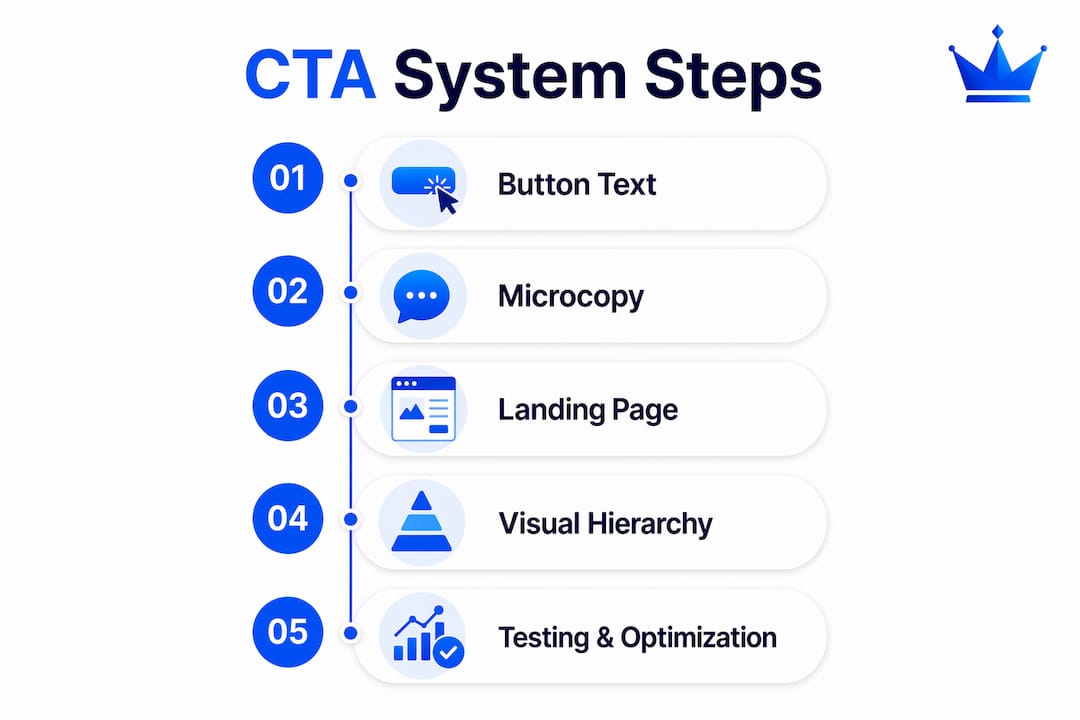
A CTA is not just a button. It is a complete conversion system built from four interlocking parts: the button text itself, the microcopy that precedes it, the landing page experience that follows it, and the visual hierarchy that frames it. Miss any one of these and you introduce friction that costs you clicks.
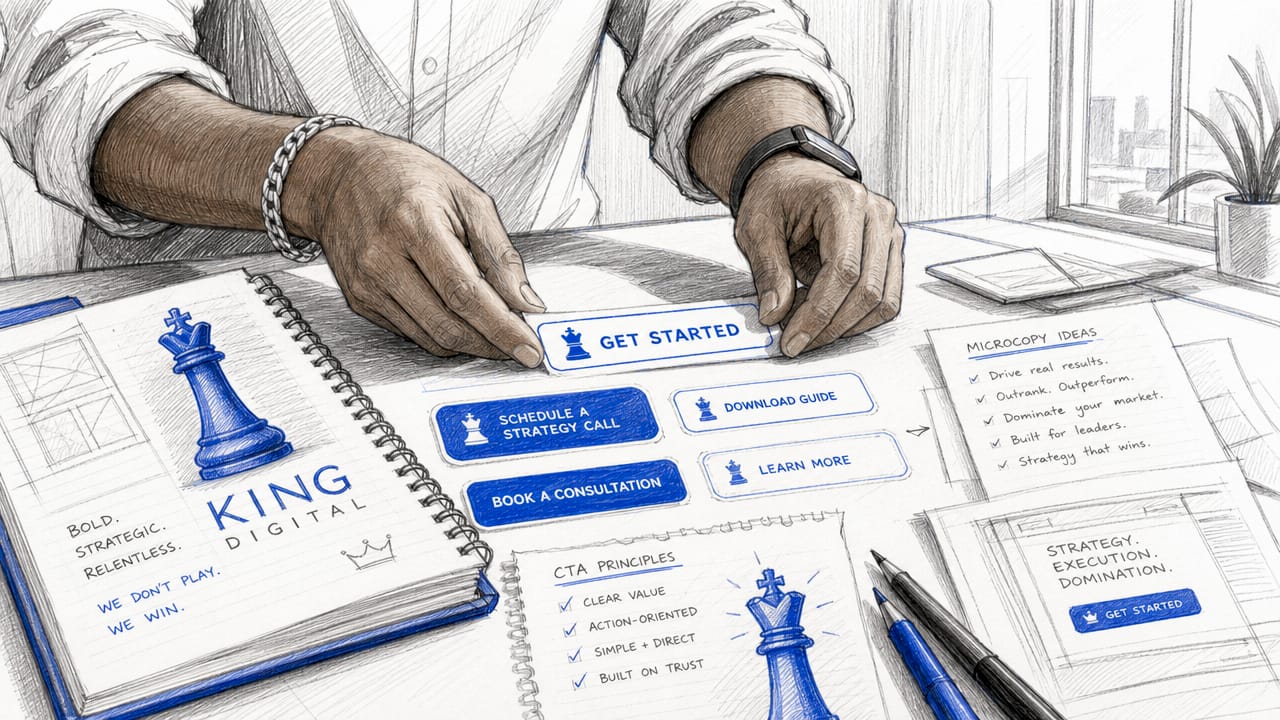
Button text must be concise and verb-led. Words like “Start,” “Get,” “Download,” and “Book” set clear expectations. Generic labels like “Submit” or “Click Here” create ambiguity because they describe the mechanical act, not the outcome. CTAs succeed by removing ambiguity, and specific verbs reduce the mental load a visitor carries at the moment of decision.
Preceding microcopy is the short line of text that appears just above or below the button. Its job is to remove the last objection standing between your visitor and the click. A line like “No credit card required” or “Cancel anytime” addresses the fear of commitment before it becomes a reason to leave. This is not decoration. It is a conversion lever.
Post-click confirmation is where most marketers drop the ball. The landing page headline must echo the verb and promise in your CTA. If your button says “Get My Free Audit,” the H1 on the next page should confirm “Your Free Audit Starts Here” or something equally direct. Mismatches create a perceived disconnect that triggers bounce. Practitioners treat the CTA as a promise contract where the button verb must be immediately fulfilled on the landing page.
Visual anchoring means your CTA button must stand apart from surrounding content through contrast, white space, and size. A button that blends into the page is invisible. A button that competes with three other equally prominent buttons creates choice overload.
- Button text: verb-led, 2 to 5 words, outcome-focused
- Microcopy: one reassurance line addressing the primary objection
- Landing page H1: echoes the CTA verb to confirm the promise
- Visual contrast: button color and size distinct from surrounding elements
Pro Tip: Write your landing page H1 before you finalize your CTA button text. If they do not echo each other naturally, rewrite both until they do.
How do different platforms shape CTA choices?
Structured ad platforms like Meta, Google Ads, and TikTok do not let you write freeform CTA buttons. They provide predefined lists, and your job is to select the option that most closely matches your campaign objective. Mismatching a CTA to your objective confuses the platform’s algorithm and slows down the learning phase, which directly reduces performance.
Here is how funnel stage maps to platform CTA selection:
| Funnel stage | Goal | Recommended CTA verbs |
|---|---|---|
| TOFU (awareness) | Reach and engagement | “Learn More,” “Watch More,” “See Menu” |
| MOFU (consideration) | Traffic and lead generation | “Download,” “Sign Up,” “Get Quote” |
| BOFU (conversion) | Purchase or booking | “Buy Now,” “Book Now,” “Get Started” |
Running a “Buy Now” CTA on a cold awareness campaign sends the wrong signal to Meta’s algorithm and to your audience. A cold prospect who has never heard of your brand is not ready to buy. Pushing them to that decision point too early increases your cost per click and tanks your relevance score. Match the verb to where the visitor actually sits in their decision journey.
TikTok’s CTA button set skews toward action-forward verbs like “Shop Now” and “Download” because its audience expects immediacy. Google Ads search campaigns reward specificity because users are already in intent mode. A search ad for “emergency plumber Albuquerque” should use “Call Now” or “Book Today,” not “Learn More.”
Pro Tip: Before launching a new campaign, review the top three performing ads in your category using Meta’s Ad Library or Google’s Ads Transparency Center. Note which CTA verbs appear most frequently among high-engagement ads. Those are your starting hypotheses.
What copywriting strategies make CTAs convert?
The mechanics of CTA copy come down to specificity, length, and ownership. Two to five words averaging 3.4 words in CTA button text produce the highest conversion rates. This means longer labels consistently underperform, not because brevity is a rule, but because short, specific verbs carry more clarity per word than longer explanations.
First-person pronouns shift the psychological ownership of the action from the brand to the visitor. “Start My Free Trial” outperforms “Start Your Free Trial” because the visitor mentally claims the outcome. First-person pronoun usage in CTA copy creates ownership and has demonstrated measurable lift in click-through rates. This is a small change with a disproportionate impact.
Personalization takes this further. Personalized CTAs convert 202% better than default static CTAs. That number reflects the compounding effect of matching your CTA to the visitor’s intent, referral source, and lifecycle stage. A returning visitor who already downloaded your guide should not see the same “Download Now” button as a first-time visitor. Show them “Get the Advanced Guide” or “Book a Strategy Call” instead.
Here are the most common CTA copy mistakes to avoid:
- Vague verbs: “Click Here” and “Submit” describe mechanics, not outcomes. Replace them with outcome-oriented verbs.
- Competing CTAs: Two equally prominent buttons on the same page split attention and reduce total conversions.
- Exclamation marks: They read as pressure, not enthusiasm, and can undermine trust at the decision point.
- Accessibility failures: Low contrast between button text and background color excludes users with visual impairments and violates WCAG guidelines.
- Ignoring microcopy: A reassurance line like “No credit card required” can lift conversions by 3 to 7%. Skipping it leaves that lift on the table.
Pro Tip: Test a first-person variant of your current CTA button text before testing anything else. Change “Get Your Free Quote” to “Get My Free Quote” and measure the difference over two weeks. It is one of the fastest, lowest-effort tests you can run.
For a deeper look at how these principles connect to your full conversion funnel, the landing page optimization guide from King Digital Marketing Agency covers post-click experience in detail.
How to A/B test CTAs without wasting your budget
Testing CTAs produces reliable data only when you change one variable at a time. A/B testing CTAs should isolate variables such as verb, urgency, or microcopy individually to accurately identify improvements and reduce noise. Running a test that changes the button color, the verb, and the microcopy simultaneously tells you that something worked, but not what.
A practical testing sequence for most businesses looks like this:
- Test verb specificity first. Replace a generic verb with a specific, outcome-oriented one. “Get Started” becomes “Get My Free Audit.” This is the highest-impact change you can make.
- Test microcopy next. Add a reassurance line below the button. Measure whether “No commitment required” or “Join 1,200 businesses already growing” lifts conversions more.
- Test urgency framing. Add a time-bound element like “Book before Friday” or “Limited spots available” and measure the lift against your control.
- Test first-person pronouns. Swap “your” for “my” in the button label and measure click-through rate changes.
- Test visual placement last. Move the CTA above the fold or below a testimonial block and compare performance.
Button color tests often produce noise rather than signal. More impactful changes come from copy specificity and reassurance messaging. This does not mean color is irrelevant. It means color should be tested after you have exhausted copy and placement variables, not before.
Combine your quantitative test data with qualitative tools. Hotjar heatmaps show where users click and where they stop scrolling. Microsoft Clarity session recordings reveal hesitation patterns near CTA buttons. These tools tell you why a test result happened, not just that it did.
Pro Tip: Use the PXL prioritization framework when deciding which CTA test to run next. Score each test idea on potential impact, ease of implementation, and existing evidence. Run the highest-scoring test first, not the easiest one.
Common CTA pitfalls that quietly kill conversions
The most damaging CTA mistakes are not obvious. They do not trigger error messages or analytics alerts. They just quietly reduce your conversion rate week after week.
Multiple CTAs at equal visual weight dilute user focus and harm conversion. One primary CTA should dominate the page, with any secondary options visually demoted to text links or lower positions. Think of your page as a conversation. You would not ask someone three equally urgent questions at the same time and expect a clear answer.
Placement matters more than most marketers acknowledge. Above-the-fold CTAs work well for simple, low-commitment offers where the value is immediately obvious. Below-the-fold CTAs perform better for complex offers that require explanation before the visitor is ready to act. Placing a “Book a Consultation” button at the top of a page before you have explained what the consultation includes is like asking for a signature before showing the contract.
Here are the nuanced tactics worth adding to your CTA practice:
- Honor the promise immediately. The landing page must fulfill what the CTA button promised. Any delay or mismatch reads as a broken contract and increases bounce rate.
- Demote secondary CTAs visually. If you need a secondary option, make it a text link in a smaller font, not a competing button.
- Test accessibility actively. Run your CTA buttons through a contrast checker like WebAIM’s Contrast Checker. A button that fails WCAG AA standards is invisible to a meaningful portion of your audience.
- Break copy consistency deliberately when justified. If your brand voice is formal but your audience responds to casual language, test a conversational CTA variant. The data matters more than the style guide.
Pro Tip: Audit every page on your site that has more than one CTA button. Ask whether each secondary button is genuinely necessary or whether it is diluting the primary action. Remove or demote anything that competes for attention without adding conversion value.
For more on boosting conversion rates across your full digital presence, King Digital Marketing Agency has documented 20 tested strategies worth reviewing alongside your CTA work.
Key takeaways
Effective CTA strategy is a system of aligned components, not a single button choice, and every element from verb selection to landing page confirmation determines whether a visitor converts or bounces.
| Point | Details |
|---|---|
| CTA as a system | Button text, microcopy, landing page alignment, and visual hierarchy all work together to drive conversions. |
| Platform-native selection | Match CTA verbs to funnel stage and platform algorithm requirements to avoid wasted ad spend. |
| Copy specificity wins | Two to five words averaging 3.4 words, with first-person pronouns and outcome-oriented verbs, outperform generic labels. |
| Test one variable at a time | Isolate verb, microcopy, or urgency in each test to produce clean, actionable data. |
| One primary CTA per page | Multiple competing CTAs dilute focus; demote secondary options to text links to protect conversion rate. |
What I have learned from years of watching CTAs succeed and fail
I have reviewed hundreds of landing pages and ad campaigns for businesses across Albuquerque and beyond, and the pattern is consistent. Marketers who treat CTAs as isolated design decisions consistently underperform compared to those who treat them as the final step in a carefully constructed argument.
The most common blind spot I see is the disconnect between the ad CTA and the landing page. A business runs a Meta campaign with “Get a Free Quote” as the button, and the landing page headline reads “Welcome to Our Services.” That mismatch is not a minor inconsistency. It is a broken promise that tells the visitor they landed in the wrong place.
The second blind spot is over-investing in button color testing before testing copy. Color matters, but it is the last variable you should test, not the first. I have seen businesses spend months testing red versus green buttons while their vague, passive CTA copy sat untouched. Fix the words first. The color conversation can wait.
What actually compounds over time is a disciplined testing workflow where you document every test, record the result, and build a library of what your specific audience responds to. That library becomes your unfair advantage. No competitor can replicate it because it is built from your data, your audience, and your offers.
— Bernadette
How King Digital Marketing Agency can help you put this into practice
King Digital Marketing Agency works with small and medium-sized businesses in Albuquerque and beyond to build digital marketing systems where every element, including CTAs, is tested, aligned, and optimized for real results. If your current campaigns are generating traffic but not conversions, the problem is almost always in the details of your CTA system, your landing page experience, or both.
Our local marketing SEO services are built to attract qualified local traffic and convert it. Our web design services focus specifically on building credibility and improving lead generation, which means every page we build is designed with CTA effectiveness at its core. And our paid advertising programs are structured around funnel-stage CTA alignment so your ad spend works harder from day one.
FAQ
What is a call to action in marketing?
A call to action is a verb-led prompt that directs a user toward one specific next step in a marketing funnel, such as “Book Now,” “Get My Free Quote,” or “Download the Guide.” Its purpose is to remove ambiguity and guide the visitor toward a conversion.
How many words should a CTA button have?
CTA button text performs best at two to five words, with an average of 3.4 words producing the highest conversion rates. Longer labels tend to underperform because they reduce clarity at the moment of decision.
Do personalized CTAs really outperform static ones?
Personalized CTAs convert 202% better than default static CTAs by matching the prompt to the visitor’s intent, referral source, or lifecycle stage. A returning visitor and a first-time visitor should rarely see the same CTA.
What should I test first in a CTA optimization program?
Test verb specificity before anything else. Replacing a generic verb like “Submit” with an outcome-oriented verb like “Get My Free Audit” produces the highest-impact lift with the least implementation effort.
Why do multiple CTAs on one page hurt conversions?
Multiple CTAs at equal visual weight create choice overload and dilute the user’s focus at the decision point. One primary CTA should dominate, with any secondary options reduced to text links or lower-priority positions on the page.
Recommended
- Boost conversion rates: 20 Sky-High Strategies
- Conversion Rate Optimization Best Practices: The Secret Sauce for More Sales | King Digital Marketing Agency
- Conversion Funnel Optimisation: The #1 Playbook 2025
- B2B CRO Secrets: How to Skyrocket Your Conversion Rates | King Digital Marketing Agency
