Why Landing Page Optimisation Decides Whether Visitors Stay or Leave
Landing page optimisation is the process of improving key elements on a web page — like headlines, calls to action, images, and forms — to turn more visitors into leads or customers.
Here’s a quick overview of what it involves:
| Element | What Gets Optimised |
|---|---|
| Headline | Clarity, relevance, and impact |
| Call to Action (CTA) | Copy, color, placement, and urgency |
| Page Design | Layout, whitespace, and visual hierarchy |
| Trust Signals | Testimonials, reviews, and logos |
| Page Speed | Load time, image size, mobile performance |
| Copy | Tone, length, and audience alignment |
| Forms | Number of fields, friction, and clarity |
The goal is simple: get more of the right people to take action.
But here’s the problem most local business owners face. You’re spending money on ads or SEO to drive traffic — and the visitors arrive, look around for a few seconds, and leave. Not because your business isn’t good. Because your landing page didn’t give them a reason to stay.
Over 50% of visitors abandon a site if it takes more than 3 seconds to load. And the average landing page conversion rate sits at just 5.89% — meaning most pages convert fewer than 6 out of every 100 visitors. That’s a lot of wasted opportunity.
The good news? Small, strategic changes can make a measurable difference. A/B testing a cleaner page layout has been shown to drive a 28% increase in conversions — with further gains when those improvements are applied across multiple pages.
Landing page optimisation isn’t about guessing. It’s about testing, learning, and improving — continuously.
I’m Bernadette King, founder of King Digital Marketing Agency, where I’ve spent years helping franchise owners and local businesses turn underperforming pages into conversion engines through strategic landing page optimisation and data-driven content marketing. In this guide, I’ll walk you through everything you need to know — from the fundamentals to the technical details — so you can start getting more from the traffic you’re already working hard to earn.
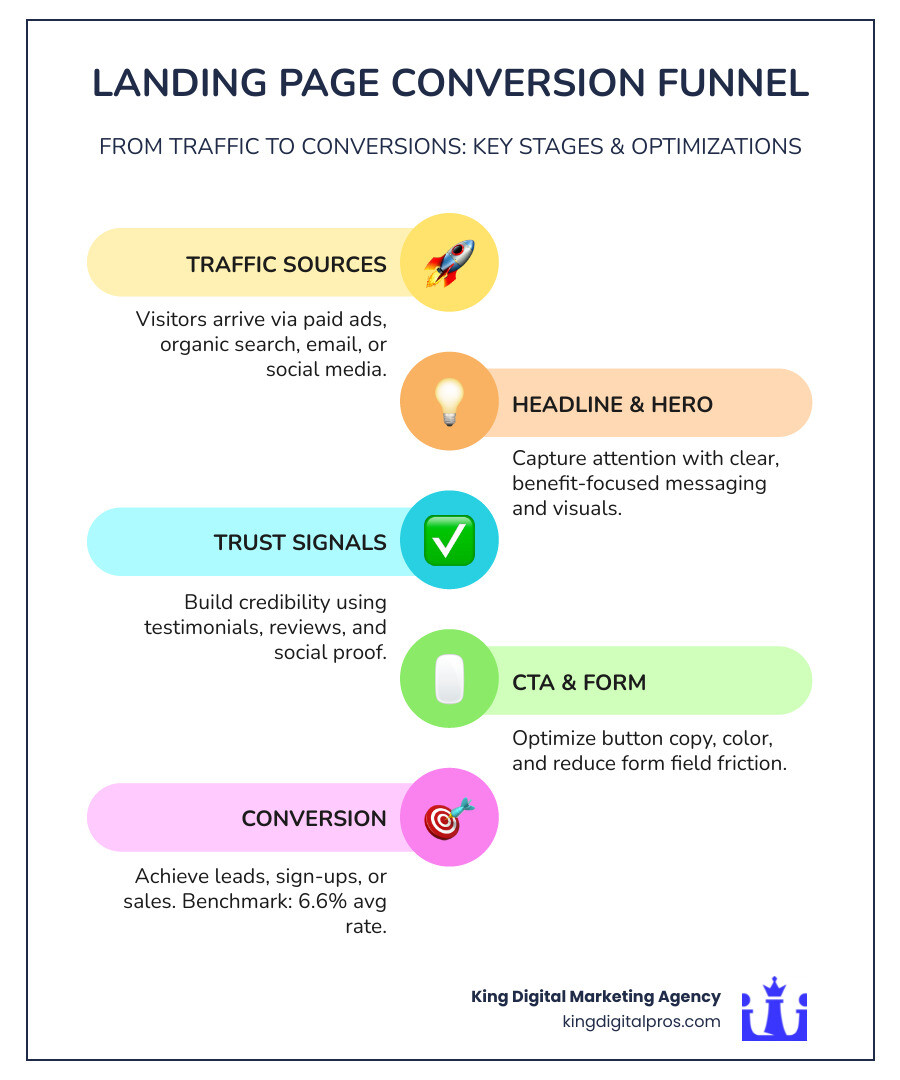
Quick look at landing page optimisation:
The Fundamentals of Landing Page Optimisation
To truly master landing page optimisation, we first need to understand exactly what a landing page is—and what it isn’t. In digital marketing, a landing page is a standalone web page, created specifically for a marketing or advertising campaign. It’s where a visitor “lands” after they click on a link in an email, or ads from Google, Bing, YouTube, Facebook, Instagram, or similar places on the web.
Unlike homepages, which typically have many goals and encourage exploration, landing pages are designed with a single focus, known as a Call to Action (CTA). This simplicity is what makes them the best option for increasing the digital marketing conversion rate of your campaigns.
LPO vs. CRO: What’s the Difference?
You might have heard the term Conversion Rate Optimisation (CRO) used interchangeably with LPO. While they are related, they aren’t the same thing. Think of CRO as the umbrella term for the entire process of improving your website’s ability to turn visitors into customers. Landing page optimisation is a specific subset of CRO that focuses exclusively on those entry-point pages.
While a Conversion Optimization Complete Guide would cover your entire site structure, LPO is laser-focused on the user’s first impression and the immediate action you want them to take.
Understanding Your Audience and Their Journey
Success in LPO starts with empathy. We need to know who the target audience is and where they are in their buyer journey. Are they just learning about a problem (Top of Funnel – TOFU), comparing solutions (Middle of Funnel – MOFU), or ready to buy (Bottom of Funnel – BOFU)?
Your value proposition—the primary reason a prospect should buy from you—must be crystal clear. If a visitor from Albuquerque or Santa Fe lands on your page, they should immediately understand how you solve their specific pain point.
Why Landing Page Optimisation is Critical for ROI
If you are paying for traffic through Google Ads or social media, every click costs you money. If those clicks don’t convert, you’re essentially pouring your marketing budget down the drain. This is why approximately 90% of companies consider conversion rate optimization to be important or even crucial to their overall digital marketing strategy.
By focusing on LPO, we can achieve:
- Lower Customer Acquisition Costs (CAC): When more people convert, the cost of acquiring each customer drops.
- Improved Ad Efficiency: Google and other platforms reward highly relevant landing pages with better Quality Scores, which can lead to a 24% reduction in cost-per-click.
- Better Lead Quality: A well-optimized page filters out the “window shoppers” and attracts people truly interested in your services.
- Revenue Growth: Even a small increase in your conversion rate can lead to a massive jump in total revenue over time.
According to the Unbounce conversion benchmark report, the median conversion rate across all industries is 6.6%. If your current pages are below that, there is significant room for growth.
Essential Elements of a High-Converting Page
Creating a high-converting page is part art and part science. There are certain elements that every successful page must have to guide the visitor toward the finish line.
Headline Clarity and the “Above the Fold” Rule
The “fold” is the point on the screen where a user has to start scrolling. Your most important information—the headline, the value proposition, and the CTA—should be placed “above the fold.” Research shows that 80% of visitors will see your headline, but only 20% will read much further. Your headline needs to be punchy, relevant, and descriptive.
Hero Shots and Visuals
A “hero shot” is the primary visual on your page. It should be a high-quality image or video that shows your product or service in action. Avoid cheesy stock photos; using real photos of your team or your work in places like Rio Rancho or Los Alamos can increase sign-ups by as much as 35%.
Short-Form vs. Long-Form Landing Pages
Deciding how much content to include depends on what you are asking the visitor to do.
| Page Type | Best For | Characteristics |
|---|---|---|
| Short-Form | Newsletter sign-ups, free downloads, simple offers | Minimal text, one clear goal, high speed |
| Long-Form | High-ticket services, complex products, B2B sales | Detailed benefits, multiple trust signals, FAQ sections |
While short pages are great for quick wins, long-form sales pages have the potential to generate up to 220% more leads for complex offerings.
Trust Indicators and Social Proof
People buy from those they trust. Trust indicators like security badges, partner logos, and professional certifications are essential. Social proof—such as testimonials and reviews—is even more powerful. However, be careful: some data suggests there is only a 1% difference in conversion between pages that add social proof and those that don’t if the social proof feels fake or irrelevant. Use real names, photos, and specific results to make it count.
Visual Hierarchy and Directional Cues
Your design should lead the eye. Use designing for conversion techniques like directional cues (arrows or photos of people looking toward the form) to guide visitors. Whitespace is also your friend; it prevents the page from feeling cluttered and keeps the focus on your primary message.
Optimizing Calls to Action (CTAs)
The CTA is the most important button on your page. To optimize it:
- Use Contrasting Colors: Your button should “pop” against the background.
- Action-Oriented Copy: Instead of “Submit,” try “Get My Free Quote” or “Start My Trial.”
- Reduce Friction: Don’t ask for a phone number or address if you only need an email.
- Personalization: Personalized CTAs can convert significantly better than generic ones.
Technical Performance and SEO Integration
A beautiful landing page is useless if no one sees it or if it takes forever to load. Technical performance is the backbone of landing page optimisation.
The Need for Speed
We live in an era of instant gratification. Research proves that 50% of visitors leave a site if it takes more than 3 seconds to load. In fact, a 0-2 second load time is the “sweet spot” for the highest conversion rates. Every second of delay can cost you 7% in conversions.
To improve speed, we recommend:
- Image Compression: Use tools for optimizing your images for the web to reduce file sizes without losing quality.
- Browser Caching: This allows repeat visitors to load your page faster.
- Lighthouse & PageSpeed Insights: Use Google’s Lighthouse tool or PageSpeed Insights to identify technical bottlenecks.
Mobile-Friendliness
With the majority of web traffic now coming from mobile devices, your landing page must be responsive. This means it should look and function perfectly on everything from an iPhone in Taos to a tablet in Edgewood. A mobile-first approach ensures that buttons are easy to tap and text is easy to read on small screens.
Driving Organic Traffic Through SEO
While many landing pages are built for paid ads, they can also be powerful tools for organic search. By following an SEO-Friendly Website Design Structure, you can attract “free” traffic from Google.
Key SEO steps include:
- Keyword Research: Use tools like Ubersuggest to find terms your local customers are searching for.
- Meta Tags: Ensure your title tags and meta descriptions are optimized for both search engines and human clicks.
- Internal Linking: Connecting your landing page to other relevant parts of your site helps Google understand its importance.
- Long-Form Content: For organic ranking, longer content often performs better as it provides more value and context to search engines.
Working with a Website Designer and SEO expert ensures that your page is built to convert while also being discoverable.
Data-Driven Testing and Continuous Iteration
The biggest mistake you can make is “setting and forgetting” your landing page. Landing page optimisation is an ongoing process of testing and refinement.
A/B Testing and Multivariate Testing
A/B testing involves creating two versions of a page (Version A and Version B) and splitting your traffic between them to see which performs better. You might test:
- Headlines
- CTA button colors
- Hero images
- Form lengths
Multivariate testing is more complex, testing multiple elements at once, but it requires much higher traffic volumes to get accurate results.
Gathering User Insights
To know what to test, you need to understand how people use your page.
- Heatmaps: These show you where people are clicking and how far they are scrolling.
- Session Replays: Watch real-time recordings of visitors navigating your page to see where they get stuck.
- The Five Second Test: Show your page to someone for five seconds and ask them what it’s about. If they can’t tell you, your message isn’t clear enough. Use the Five Second Test tool to crowdsource this feedback.
- Analytics: Use LeadsRx or Google Analytics to track your KPIs and ask, “Is Your Website Converting?“
Common Mistakes in Landing Page Optimisation
Even pros make mistakes. Here are the most common pitfalls to avoid:
- Visual Clutter: Too many images or blocks of text distract the user. Minimizing distractions can boost conversions by 10%.
- Multiple Offers: A landing page should have one goal. Offering three different things confuses the visitor.
- Slow Loading: As mentioned, [a 0-2 second load time has the highest conversion rate](https://www.portent.com/blog/analytics/research-site-speed-hurting-everyones-revenue.htm#:~:text=Website%20conversion%20rates%20drop%20by,(between%20seconds%200%2D9).
- Generic Stock Photos: People can spot a “fake” office photo from a mile away. Real images can lead to a 35% increase in sign-ups.
- Broken Links: Nothing kills trust faster than a button that doesn’t work.
Frequently Asked Questions about Landing Page Optimization
What is a good conversion rate for a landing page?
While the median conversion rate is 6.6%, “good” is relative to your industry and your specific goals. Some high-performing pages in niche industries can see rates as high as 20% or more. The best benchmark is your own past performance—always aim to beat your previous month’s numbers.
How does LPO differ from general website optimization?
General website optimization looks at the whole user experience across many pages. LPO is campaign-specific. It focuses on a single objective and a specific traffic source. This is a key part of any Funnel Marketing Strategy, ensuring that the transition from ad to page is seamless.
Which tools are best for identifying landing page problems?
We recommend a combination of Google Analytics for high-level data and specialized landing page optimization tools like Hotjar or Crazy Egg for behavioral data (heatmaps and recordings). A thorough Conversion Funnel Analysis will help you see exactly where visitors are dropping off.
Conclusion
At King Digital Marketing Agency, we know that for local businesses in Albuquerque, Rio Rancho, and across New Mexico, every lead counts. You don’t just need more traffic; you need traffic that turns into paying customers.
Landing page optimisation is the bridge between a click and a sale. By focusing on clear messaging, technical performance, and continuous data-driven testing, we help our clients dominate their local map listings and grow their revenue.
Ready to stop wasting your ad spend and start converting more visitors? Explore our Conversion Optimization Services today and let’s build a landing page that actually works for your business.
