Your Brand’s Reputation Is Being Shaped Right Now – Are You Watching?
The right online reputation monitoring tool can mean the difference between catching a crisis early and watching it spiral out of control. Here are the top options to compare:
| Tool | Best For | Key Strength | Starting Price |
|---|---|---|---|
| Prestige Shield | SMBs & agencies | Dual web + X/Twitter monitoring | $49/month |
| Reptor | Multi-channel brands | 22 channels incl. AI search | Contact for pricing |
| Wisseo | Solo operators | AI threat detection & removal drafts | Contact for pricing |
| Monity | Marketing teams | Automated web & forum auditing | Contact for pricing |
| Sprout Social | Enterprises | Full social listening stack | $249/month/user |
| Birdeye | Multi-location | Review aggregation & local SEO | $299/location/month |
| Brand24 | Growing businesses | Real-time mentions & sentiment | $149/month |
Think about this: 81% of consumers research a brand online before making a purchase. Every review, mention, and comment shapes what they find. Yet most local businesses have no system in place to track any of it.
One bad review, left unanswered for a week, can quietly tank your star rating. One misleading article, ranking on page one, can cost you customers you never even knew you lost. And you won’t know either happened unless you’re actively watching.
That’s exactly what reputation monitoring tools are built to solve. They scan the web – review sites, social media, news outlets, AI search engines, forums – and bring everything back to one place so you can act fast.
I’m Bernadette King, founder of King Digital Marketing Agency, and I’ve spent years helping franchise owners and local businesses use online reputation monitoring tool strategies to protect their brands and turn customer feedback into a competitive advantage. In this guide, I’m breaking down the best tools available in 2026 so you can find the right fit without wasting time or money.
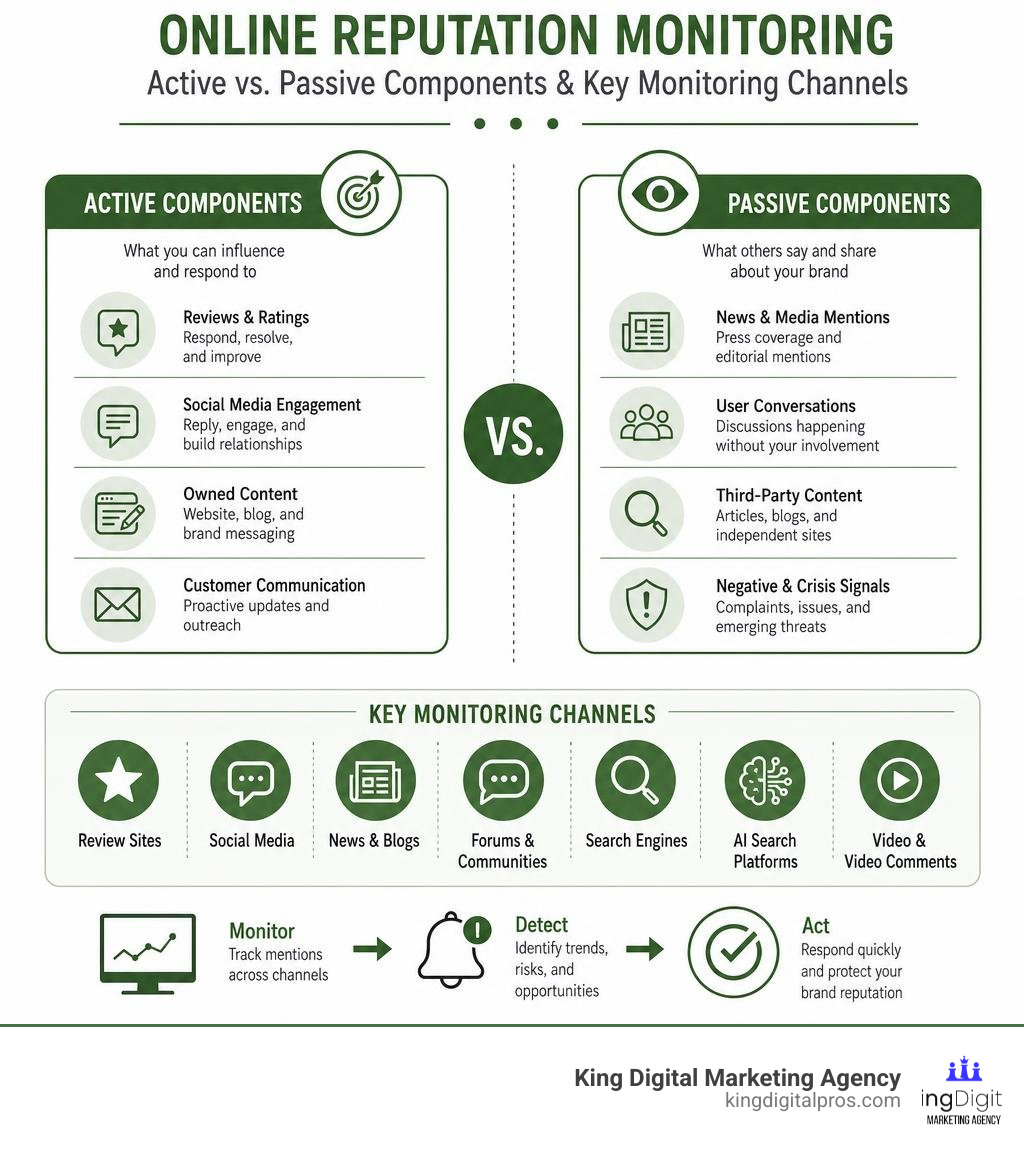
Online reputation monitoring tool terminology:
What is an Online Reputation Monitoring Tool and How Does It Work?
At its core, an online reputation monitoring tool is an automated platform designed to track what people are saying about your business across the digital universe. Instead of manually searching Google, scrolling through social media feeds, and logging into dozens of review platforms every morning, these tools do the heavy lifting for you. They act as your brand’s digital bodyguard, constantly scanning the web for mentions of your business name, key personnel, products, and even your competitors.
To understand how these platforms work, we must look at the core engine running under the hood. When you implement a comprehensive system, as detailed in our Reputation Management Systems Complete Guide, the software utilizes three primary mechanisms to protect your brand:
- Review Aggregation: The software connects directly to major review platforms (like Google Business Profile, Facebook, and Yelp) to pull all your customer feedback into a single, centralized dashboard.
- Sentiment Analysis: Using natural language processing (NLP), the tool automatically analyzes the tone of every mention or review. It classifies the sentiment as positive, neutral, or negative. This helps you immediately prioritize negative feedback that requires urgent attention before it escalates.
- Real-Time Alerts: The moment a negative mention or low star rating is detected, the platform triggers an instant notification. This allows your team to respond within minutes, turning a potentially damaging situation into a demonstration of excellent customer service.
Advanced platforms, such as Reptor – AI-Powered Reputation Monitoring, take this a step further by monitoring non-traditional channels, ensuring that your business is protected not just on standard search engines but across the entire digital ecosystem.
How an Online Reputation Monitoring Tool Tracks Brand Mentions
Tracking brand mentions is far more complex than running a basic Google Alert. Modern tools use a combination of web scraping, social listening, and direct API integrations to capture conversations that do not directly tag your official brand accounts.
For instance, if someone complains about your service on Reddit or discusses your product in a popular industry forum, standard notifications won’t catch it. However, a specialized tool will scan these public forums, blog posts, and news sites in real time.
By utilizing advanced API integrations, such as those highlighted in the Social Media Monitoring Features & Brand Monitoring | Octolens feature set, businesses can monitor developer forums, GitHub, Hacker News, and public Slack channels. This level of tracking ensures you see the full picture of your brand’s digital footprint, allowing you to engage with your audience where they naturally hang out.
How an Online Reputation Monitoring Tool Manages Customer Reviews
Review management is where an online reputation monitoring tool directly impacts your bottom line. It is a well-known industry fact that 32% of shoppers will walk away from a brand after just one bad experience. Conversely, businesses that actively manage their reviews see substantial rewards. In fact, average rating increases of 0.4 to 0.6 stars (e.g., moving from a 4.2 to a 4.6) have been widely observed after implementing centralized reputation management systems.
These tools streamline two critical processes:
- Review Generation: Instead of begging customers for feedback, the software automates the process. It integrates with your point-of-sale (POS) system or CRM to send automated email or SMS review requests immediately after a transaction. This simple automation can generate 15% to 20% more customer reviews consistently.
- Automated & Guided Responses: Many platforms now feature AI-powered reply assistants that draft professional, context-aware responses to reviews. This ensures you maintain a high response rate, which is a major local SEO ranking factor.
By maintaining an active, highly-rated profile, you send strong trust signals to search engine algorithms. To dive deeper into why this matters for local search visibility, read our guide on Why Online Business Reviews Matter for SMBs in 2026.
Essential Capabilities of Modern Reputation Software
When comparing different software options, it is easy to get overwhelmed by feature lists. However, a truly effective reputation tool must possess a core set of modern capabilities to handle the speed of today’s internet.
First, multichannel support is non-negotiable. Your customers aren’t just on Google; they are talking on social media, writing blog posts, and discussing your business on niche forums.
Second, automated workflows are essential for keeping your team aligned. If you operate multiple locations across New Mexico – whether in Albuquerque, Rio Rancho, or Santa Fe – your regional managers need to receive alerts only for their specific locations, while corporate leadership retains global visibility.
To help you decide between a simple, platform-specific tool (like a basic Google-only responder) and a comprehensive reputation platform, we have outlined the key differences below:
| Feature | Platform-Specific Tools | Comprehensive Reputation Software |
|---|---|---|
| Channel Coverage | Limited to one or two networks (e.g., only Google or only Facebook) | 15+ channels including blogs, forums, and news |
| Sentiment Analysis | None or very basic keyword matching | Advanced AI-powered sentiment and emotion mapping |
| Alert Speed | Delayed or batched email notifications | Real-time push alerts and Slack/CRM integrations |
| Review Generation | Manual or basic email templates | Automated multi-channel SMS & email campaigns |
| Competitive Benchmarking | Rare or heavily restricted | Side-by-side share of voice and rating comparisons |
| Workflow Management | Single user access | Multi-location user roles and assignment rules |
The Best AI-Powered Reputation Monitoring Software in 2026
Artificial intelligence has completely transformed the reputation management landscape. In 2026, we are no longer just tracking keywords; we are analyzing the deep context of digital conversations. AI-powered tools can filter out the “noise” (like unrelated search results that happen to share your brand name) and surface the exact posts that require your attention.
Furthermore, machine learning algorithms can now predict potential PR crises by detecting sudden spikes in negative sentiment volume. For an in-depth look at how these technologies are shaping the market this year, check out The Ultimate Guide to Software Reputation Management in 2026.
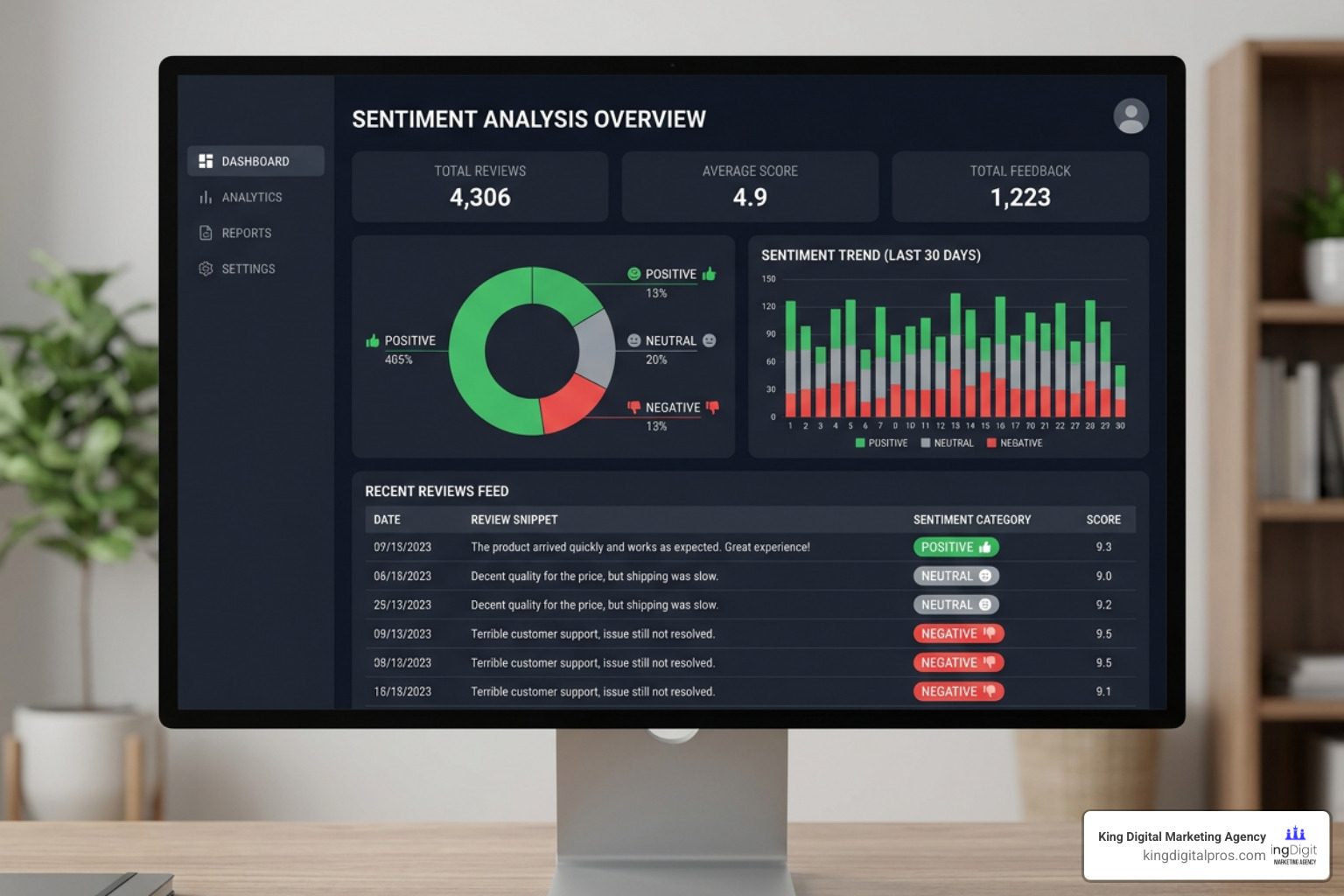
Let’s take a closer look at the leading specialized tools changing the game this year.
Prestige Shield: Dual-Source Brand Intelligence
For businesses looking for comprehensive web coverage without the enterprise price tag, Prestige Shield – AI-Powered Brand Monitoring & Reputation Management offers an incredibly smart approach. While many traditional tools rely solely on restrictive social media APIs, Prestige Shield uses dual-source intelligence.
It combines advanced web scraping via Firecrawl to scan the entire web in real time, alongside Grok X Search to pull live social signals directly from X (formerly Twitter). This ensures you catch press coverage, blog mentions, and viral social posts simultaneously. It also includes 26 built-in AI tools to help you draft rapid response strategies and crisis playbooks on the fly.
Reptor: Multi-Channel Search and AI Monitoring
If you want to know exactly what the internet says about your business across every conceivable corner, Reptor – AI-Powered Reputation Monitoring is a powerhouse. Reptor monitors an impressive 22 channels from a single dashboard.
What makes Reptor unique in 2026 is its focus on modern search behaviors. A rapidly growing share of consumers now ask AI platforms like ChatGPT, Gemini, and Perplexity for business recommendations instead of using traditional search engines. Reptor tracks these AI search engines daily, alongside Google autocomplete suggestions, Wikipedia edits, and even podcast audio mentions, scoring the sentiment of every result on a precise 0-1 scale.
Wisseo: AI-Generated Threat Detection
For business owners who want protection without needing to become reputation experts, Your brand’s online reputation, under control – AI watches for you is the ideal solution. Wisseo is built for simplicity and proactive defense.
Once you input your brand name and target country, Wisseo’s AI scans Google, news outlets, and the web daily. If a negative mention or threat is detected, the tool doesn’t just alert you – it analyzes the risk and automatically generates prioritized action plans, including AI-generated removal drafts that you can use to request the removal of defamatory or policy-violating content from third-party sites.
Monity: Automated Web and Forum Auditing
For teams that need to monitor highly specific web pages, forums, and review sites, Brand reputation & mentions monitoring – Monity provides surgical precision. Monity allows you to track specific web sources and receive real-time alerts whenever changes occur.
This is particularly useful for tracking forum threads or review pages that do not have public APIs. Monity can even capture content behind logins or pagination. When a change is detected, Monity provides detailed visual comparisons – such as HTML diffs, screenshots, and visual sliders – so you can see exactly what was added or deleted before your team even opens the page.
How to Choose the Right Software for Your Business
Selecting the perfect online reputation monitoring tool depends heavily on your business model, the size of your team, and your specific growth goals. A local retail shop in Albuquerque has vastly different needs than a multi-location franchise spread across Rio Rancho, Santa Fe, and Los Alamos.
To choose without breaking the bank, keep these three factors in mind:
- Scalability and Multi-Location Support: If you manage multiple branches, you need a system that can keep local managers aligned while giving corporate leaders a bird’s-eye view. Platforms like those discussed in Reputation Management Tools for Multi-Location Brands | Alchemer excel at organizing feedback by location, ensuring that reviews for your Taos office don’t get mixed up with feedback for your Grants location.
- Integration Capabilities: Your reputation tool shouldn’t live on an isolated island. Ensure the software you choose integrates seamlessly with your existing tech stack, whether that’s your CRM, POS system, or team communication tools like Slack and email.
- Core Goals vs. Feature Bloat: Are you trying to clean up search results, or are you focused on generating hundreds of new Google reviews? If your primary goal is clean-up and crisis prevention, prioritize tools with strong web-scraping and alert systems. If you want to build trust and local search authority, focus on review marketing and automated request features.
For a step-by-step framework on setting up your monitoring strategy without getting overwhelmed, read our guide on How to Master Brand Reputation Monitoring Without Losing Your Mind.
Frequently Asked Questions About Reputation Monitoring
What is the difference between active and passive reputation management?
Active reputation management involves the strategic actions your business takes to build and shape its image. This includes public relations campaigns, active customer service, and review generation strategies.
Passive reputation management involves monitoring the channels you do not directly control – such as public feedback, forum discussions, social media chatter, and search engine results – to understand how the public perceives your brand when you aren’t in the room.
How does AI improve online reputation tracking?
AI dramatically improves tracking by automating sentiment scoring, which classifies mentions as positive, neutral, or negative with high contextual accuracy. It also filters out the “noise” (false positives) so your team only focuses on relevant alerts. Additionally, generative AI can instantly draft highly professional review responses and crisis communication templates, saving your team hours of manual work.
How much do reputation monitoring tools typically cost?
Pricing varies widely based on features and scale. Basic mention monitoring tools can start as low as $49 to $99 per month. Mid-tier reputation platforms that include automated review generation and CRM integrations typically range from $150 to $300 per month. Enterprise-grade, multi-location platforms can cost $500 to several thousand dollars per month depending on the number of locations and volume of data tracked.
Conclusion
Protecting your brand’s digital presence is no longer a luxury – it is an absolute necessity for survival and growth. Whether you are a local business in Albuquerque, Santa Fe, or Rio Rancho, what people see when they search for your name directly determines whether they choose you or walk away to a competitor.
Implementing the right online reputation monitoring tool gives you the power to listen to your customers, catch crises before they spread, and highlight your team’s hard work through glowing online reviews.
At King Digital Marketing Agency, we specialize in helping local businesses optimize their Google Business Profiles and manage their map listings to maximize local visibility. We can help you implement automated review systems that build trust and attract more local customers effortlessly.
Ready to take control of your digital presence and stand out in local search? Explore our professional Review Management Services today, and let’s build a reputation that drives real business growth.
