TL;DR:
- Most small and medium-sized Albuquerque businesses waste time chasing low-quality leads instead of focusing on high-value prospects.
- Effective lead generation relies on defining your ideal customer, aligning sales and marketing, and nurturing qualified leads through consistent, value-driven communication.
Most business owners believe that more leads automatically means more revenue. It’s one of the most persistent myths in marketing, and it quietly drains budgets, exhausts sales teams, and produces disappointing results. The truth is, fifty highly qualified leads will outperform five hundred random contacts every single time. For small and medium-sized businesses in Albuquerque, understanding the difference between lead volume and lead quality isn’t just a nice-to-know concept. It’s the foundation of a growth strategy that actually works.
Table of Contents
- What is lead generation and why does it matter?
- Inbound vs outbound lead generation: A side-by-side comparison
- Lead qualification: How to prioritize quality over quantity
- Lead nurturing: Turning interest into ready-to-buy customers
- Why most lead generation advice misses the mark for local SMBs
- Accelerate your lead generation with local expertise
- Frequently asked questions
Key Takeaways
| Point | Details |
|---|---|
| Quality beats quantity | Targeting and nurturing the right leads results in more sales than chasing every contact. |
| Mix approaches | A blend of inbound and outbound methods is most effective for Albuquerque SMBs. |
| Prioritize and qualify | Scoring leads and aligning your team prevents wasted time and missed sales. |
| Follow up fast | Rapid response to new leads dramatically boosts conversion rates. |
| Local context matters | Customize your strategies for the Albuquerque market to see the best results. |
What is lead generation and why does it matter?
Lead generation is the process of attracting potential customers and capturing their interest so your sales team can follow up. Simple enough. But what most guides leave out is the part that separates thriving local businesses from struggling ones: the quality filter.
A lead isn’t just anyone who fills out a form or calls your number. A qualified lead is someone who fits your ideal customer profile (ICP), meaning they have a real need for what you offer, the budget to pay for it, and the authority to make a buying decision. When you chase lead volume without defining your ICP first, you flood your pipeline with the wrong people.
Here’s why that matters for Albuquerque SMBs specifically. Your team is small. You don’t have a 20-person sales floor or unlimited follow-up capacity. Every hour spent chasing a low-quality lead is an hour not spent closing a high-value one.
“Avoid volume over quality; define your ICP first, align sales and marketing on what qualifies as a lead, and nurture leads 7-14 days before moving on.” — Ultimate Guide to Lead Generation
The three elements of a strong lead generation foundation:
- Define your ICP. Know who your best customers are by industry, size, location, pain point, and budget. In Albuquerque, that might mean targeting construction firms in the North Valley or medical practices near UNM.
- Align sales and marketing. Both teams need to agree on what makes a lead ready for sales outreach. Misalignment here is one of the most common causes of wasted marketing spend.
- Build a nurture sequence. Most people who show interest won’t buy on day one. A structured follow-up plan keeps your business top of mind over time.
Explore our proven lead generation strategies to see how this plays out in practice for local businesses.
Pro Tip: Start by interviewing your three best current customers. Ask what made them choose you and what almost stopped them. Their answers will define your ICP better than any spreadsheet.
Inbound vs outbound lead generation: A side-by-side comparison
With a clear understanding of lead generation’s importance, let’s see how different strategies stack up so you can make informed decisions.
There are two broad categories of lead generation, and they work very differently. Inbound methods bring leads to you over time. Outbound methods involve you reaching out first. Neither is inherently better. The right choice depends on your timeline, budget, and team capacity.
Inbound vs. outbound methodologies each carry distinct trade-offs: inbound relies on content, SEO, and social media to attract leads with lower ongoing effort, while outbound through cold email, calls, and LinkedIn requires more hands-on work but delivers faster results.
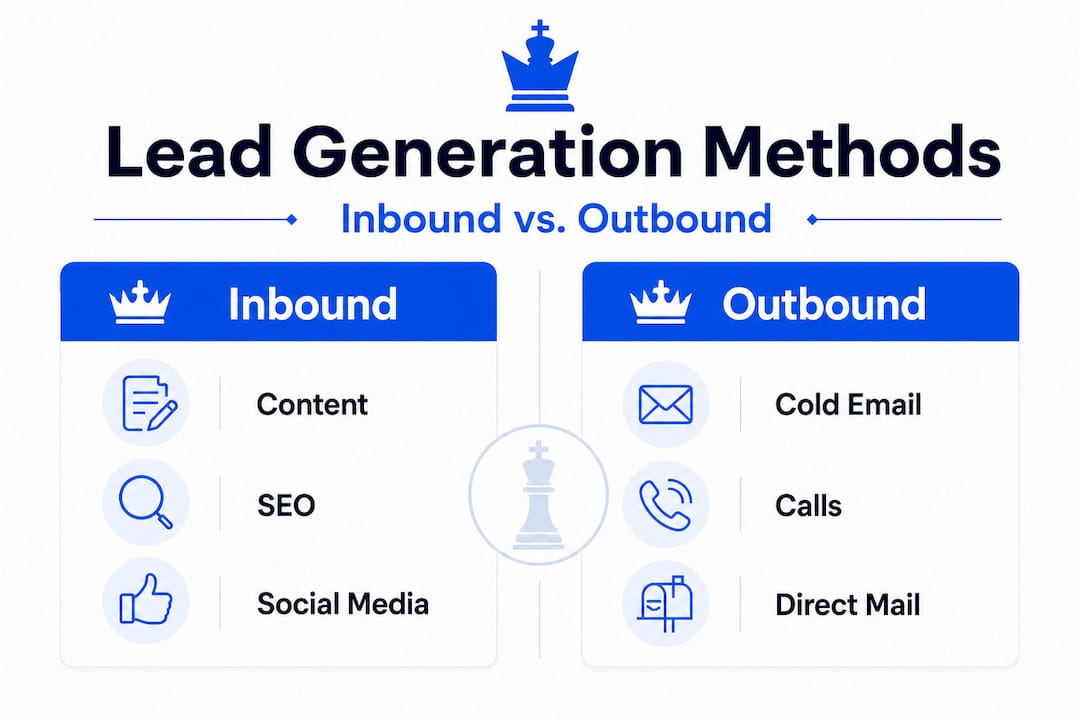
| Method | Type | Time to Results | Effort Level | Best For |
|---|---|---|---|---|
| SEO and content | Inbound | 3-6 months | Low (once built) | Long-term visibility |
| Social media organic | Inbound | 1-3 months | Medium | Brand building |
| Google Ads | Outbound | Days | High | Quick lead flow |
| Cold email campaigns | Outbound | 1-2 weeks | High | B2B prospecting |
| LinkedIn outreach | Outbound | 1-3 weeks | High | Professional services |
| Local SEO / Google Business | Inbound | 1-3 months | Low to medium | Local foot traffic |
Inbound lead generation: The long game
Inbound is like planting a garden. You put in the work early, water it consistently, and eventually it produces without constant manual effort. A well-optimized blog post about “best HVAC services in Albuquerque” can generate leads for years without any additional spend.
The downside is patience. If you need leads this week, inbound alone won’t save you. But if you invest in it now, you’ll reduce your cost per lead dramatically over time.
Outbound lead generation: The sprint
Outbound is faster but more labor intensive. A targeted cold email sequence to 200 Albuquerque-area property managers can generate responses within days. The challenge is that response rates are typically low, ranging from 1-5%, and prospects can feel interrupted rather than helped.

Smart SMBs blend both. Use outbound to create early cash flow while inbound builds momentum. Then, as your inbound channels mature, you can dial back outbound spending.
Use our Albuquerque strategies guide as a reference when planning your mix, and check out our SEO checklist for small businesses to strengthen your inbound foundation.
Where Albuquerque SMBs often go wrong: They pick one method, run it for 30 days, see mixed results, and abandon it entirely. Consistency beats perfection here. Commit to a 90-day test before drawing conclusions.
Lead qualification: How to prioritize quality over quantity
Seeing how inbound and outbound methods work, you’ll next need a smart way to decide which leads deserve your attention.
Not every lead is worth your time. That’s not harsh; it’s strategic. Lead scoring is the practice of assigning value to leads based on their behavior and attributes, so you know exactly who to call first and who needs more warming up.
Lead scoring is essential to prioritize prospects most likely to convert. AI tools can help automate the process, but they miss real-world context, like whether a company just went through layoffs or a key decision-maker recently changed roles. Human judgment still matters.
Two terms you’ll hear often are Marketing-Qualified Leads (MQLs) and Sales-Qualified Leads (SQLs). An MQL is someone who has shown enough interest to be worth marketing to further. An SQL is someone your sales team has verified as ready for a direct conversation. The handoff between these two stages is where most SMBs leak revenue.
“The MQL-to-SQL disconnect, caused by poor alignment between marketing and sales, is one of the leading causes of wasted lead generation budgets.”
How to build a simple qualification process:
- Define your minimum criteria. What does a lead need to have before you reach out? For a commercial cleaning company in Albuquerque, it might be a business with at least 5,000 square feet of office space within a 20-mile radius.
- Assign point values to actions. Visiting your pricing page: 10 points. Downloading a case study: 15 points. Requesting a consultation: 50 points. Prospects who hit a threshold get prioritized.
- Segment by score. High scorers go to sales immediately. Mid-range leads enter a nurture sequence. Low scorers get added to a long-term list for occasional re-engagement.
- Review and adjust monthly. Track which scored leads actually converted. That feedback loop makes your scoring model sharper over time.
- Flag disqualifiers early. If a lead is outside your service area or looking for something you don’t offer, release them fast. Every hour you spend on a wrong-fit lead costs you a right-fit one.
Pro Tip: Use a simple CRM, even a free one, to tag and score leads consistently. Inconsistent tracking is one of the biggest barriers Albuquerque SMBs face when trying to scale.
Our lead scoring services page walks through advanced scoring frameworks, and you can also explore inbound lead scoring strategies specifically for businesses growing through content and SEO. For a broader view, check our lead management tactics guide.
Lead nurturing: Turning interest into ready-to-buy customers
Once you’re prioritizing the right leads, it’s time to focus on nurturing, because interest needs to be guided into action.
Think of lead nurturing like a conversation, not a sales pitch. A prospect who downloads your free guide on local SEO isn’t ready to sign a contract today. But they’re telling you something: they’re interested in growing their visibility. Nurturing means you stay in that conversation, providing value, building trust, and showing up consistently until they’re ready to move forward.
Speed-to-lead is critical for conversion. Research consistently shows that following up within the first hour of a lead expressing interest dramatically outperforms slower responses. Waiting 24 hours or more can cut your conversion rate by more than half.
A simple 3-stage nurturing sequence for Albuquerque SMBs:
- Stage 1: Immediate response (Day 1). Send a personalized email within 60 minutes of the lead’s action. Acknowledge what they did and offer one helpful resource. No sales pitch yet.
- Stage 2: Education and trust-building (Days 2-7). Send 2-3 follow-up messages spaced across the week. Each one should address a common question or objection. Think case studies, short videos, or links to relevant articles. Keep it about them, not about you.
- Stage 3: Soft ask (Days 8-14). By now, you’ve delivered real value. A warm lead who has engaged with your content is ready for a conversation. Make a clear, low-pressure invitation, like a free 20-minute consultation or a quick strategy call.
| Stage | Timeline | Goal | Action |
|---|---|---|---|
| Immediate response | Day 1 | Acknowledge interest | Personalized email or call |
| Education sequence | Days 2-7 | Build trust | Value-focused content |
| Soft conversion ask | Days 8-14 | Invite to next step | Consultation or demo offer |
Tracking engagement matters as much as the sequence itself. Which emails are being opened? Which links are being clicked? A lead who opens every email but never responds might need a different approach, maybe a phone call or a direct mail piece. A lead who clicks your pricing page three times in one week is practically raising their hand.
Pro Tip: Set up simple email tracking through your CRM or email tool. When a lead clicks your pricing page or consultation link, trigger an immediate personal follow-up from your sales rep. That timing is gold.
Explore our lead nurturing tactics and our lead management programs for ready-to-use frameworks built for businesses exactly like yours.
Why most lead generation advice misses the mark for local SMBs
While the practical steps above set the foundation, it’s worth recognizing the unique realities for Albuquerque business owners.
Here’s something I’ve observed working with SMBs in this market: most of the lead generation advice circulating online was written by and for companies with large teams, big budgets, and national audiences. It assumes you can afford a dedicated SDR team, run A/B tests for six months, and invest in enterprise marketing software. Most Albuquerque business owners can’t, and shouldn’t have to.
The uncomfortable truth is that many fancy lead generation frameworks are actually distractions. The business owner who spends three weeks setting up a complex multi-channel drip campaign might have been better served picking up the phone and calling their top 20 prospects directly. Relationships still drive sales in this city. Albuquerque is a relationship-first market. People buy from who they trust, and trust is built through consistent personal interaction more than automated email sequences.
That doesn’t mean technology is useless. It means technology should support your relationships, not replace them. Use automation to handle the repetitive follow-ups so you free up time for the conversations that actually close deals.
The other thing most guides ignore is the local buyer psychology specific to markets like Albuquerque. Buyers here are loyal once they trust you, but they’re also skeptical of impersonal, corporate-feeling outreach. A cold email that looks like it was sent to 10,000 people will land in trash faster here than almost anywhere. Personalization isn’t optional. It’s the price of entry.
Instead of chasing every new shiny tactic, focus on three things: knowing your ICP deeply, following up faster than your competition, and delivering genuine value before you ever ask for the sale. Those three priorities, executed consistently, will outperform any complex funnel system.
We built our Albuquerque-specific lead strategies resource specifically because we got tired of watching local businesses waste money on generic advice that wasn’t built for this market.
Accelerate your lead generation with local expertise
You’ve got the framework now. You understand what separates quality leads from noise, how to choose the right mix of inbound and outbound, and how to nurture prospects into paying customers. The next question is execution, and that’s where most SMBs stall.
At King Digital, we specialize in helping Albuquerque business owners build lead generation systems that are strategic, locally grounded, and designed to deliver real ROI. Whether you need a stronger local SEO presence, a paid ad campaign that targets the right neighborhoods, or a lead scoring system your sales team will actually use, we build it with you, not for some generic national audience. Our in-house team knows this market, and we work as a true partner in your growth. Ready to stop chasing volume and start attracting the right customers? Let’s start a conversation.
Frequently asked questions
What is the difference between inbound and outbound lead generation?
Inbound lead generation attracts potential customers through content, SEO, and social media, while outbound involves proactively reaching out through cold emails, calls, or LinkedIn messages.
How fast should I follow up with new leads?
Following up within the first hour is ideal, since speed-to-lead is critical and delays beyond 24 hours significantly lower your conversion rate.
Why don’t all leads convert to sales?
Many leads lack the right fit or readiness; in fact, 87% of MQLs fail to become SQLs when there’s no proper qualification process in place.
How long should I nurture a lead before giving up?
Most effective nurturing sequences run 7-14 days, after which unresponsive leads can be deprioritized without guilt and revisited in a long-term re-engagement list.
Recommended
- How SEO Drives Lead Generation for Albuquerque Businesses
- Get More Local Leads: Albuquerque Business Guide
- Top content marketing tips to elevate Albuquerque SMB leads
- Social media marketing tips to boost Albuquerque SMBs
