TL;DR:
- Properly optimized SEO attracts high-intent local prospects continuously, unlike costly paid ads.
- Matching content to search intent, especially transactional and local, significantly increases qualified leads.
- Focusing on local SEO tactics and tracking actual conversions turns rankings into measurable business results.
Most Albuquerque business owners treat SEO like a billboard: get seen, get clicks, done. But that mindset leaves real money on the table. SEO, when built with intention, is one of the most reliable lead generation engines you can run. Unlike paid ads that stop the moment your budget runs dry, a well-optimized site keeps pulling in qualified prospects around the clock. This article breaks down exactly how SEO fuels lead generation for local businesses, why the leads it produces are worth more than most other sources, and the specific steps you can take right now to start capturing them.
Table of Contents
- Why SEO is essential for lead generation
- How search intent powers qualified lead generation
- Core SEO strategies to drive more local leads
- Integrating SEO with your marketing funnel for maximum leads
- What most Albuquerque businesses get wrong about SEO and leads
- Power up your Albuquerque lead generation with expert help
- Frequently asked questions
Key Takeaways
| Point | Details |
|---|---|
| SEO delivers qualified leads | Strategic SEO attracts high-intent searchers who are ready to become your next customers. |
| Search intent matters | Matching your website content to what local customers search for drives better leads. |
| Local strategies win | Optimizing for Albuquerque-specific keywords and reviews increases inbound leads. |
| Measure leads, not just traffic | Track calls, forms, and bookings to see the real value SEO provides your business. |
| Integrate SEO in your funnel | Applying SEO at every stage of your marketing funnel maximizes the number of qualified leads. |
Why SEO is essential for lead generation
With that new mindset, let’s clarify why SEO sits at the heart of sustainable lead generation.
Traditional outbound marketing pushes your message at people who may or may not want it. Cold calls, direct mail, and display ads interrupt. SEO, on the other hand, pulls people in at the exact moment they are already searching for what you offer. That difference in timing is everything. A person typing “HVAC repair Albuquerque” into Google is not browsing casually. They have a problem and they want it solved today. That is the power of SEO as inbound marketing: it positions your business directly in front of buyers who are already motivated.
The numbers back this up. SEO leads close at 14.6% compared to just 1.7% for outbound methods. That is nearly nine times the conversion rate. When you factor in the cost difference, the case for SEO becomes impossible to ignore.
Here is what makes SEO-driven leads stand out:
- Higher intent: Searchers are actively looking for your service, not stumbling across it.
- Lower cost over time: Unlike paid ads, organic rankings compound. You invest once and benefit repeatedly.
- Measurable results: Every click, call, and form fill can be traced back to specific keywords and pages.
- Compounding returns: The longer your SEO is active, the stronger your authority grows, and the more leads you attract.
Pro Tip: Do not chase every keyword. Focus your energy on high-value, high-intent keywords specific to your services and your Albuquerque location. Ranking for “best plumber in Albuquerque” is worth far more than ranking for “what is a plumber.”
For more on building a lead pipeline through search, explore these local lead generation strategies designed specifically for SMBs in our market.
How search intent powers qualified lead generation
Now that we’ve seen the value of SEO for lead quality, let’s explore how understanding search intent helps you capture the right customers.
Search intent is the reason behind a query. When someone types something into Google, they have a goal. Your job is to match your content to that goal so precisely that they choose you. There are four main types of intent:
- Informational: “How do I fix a leaky faucet?” (learning mode)
- Navigational: “King Digital Albuquerque” (looking for a specific business)
- Transactional: “hire a plumber in Albuquerque” (ready to buy)
- Local: “plumber near me” (wants a nearby solution fast)
For lead generation, transactional and local intent queries are gold. Aligning content with search intent consistently drives higher conversion rates because visitors land on pages built to meet their exact need.
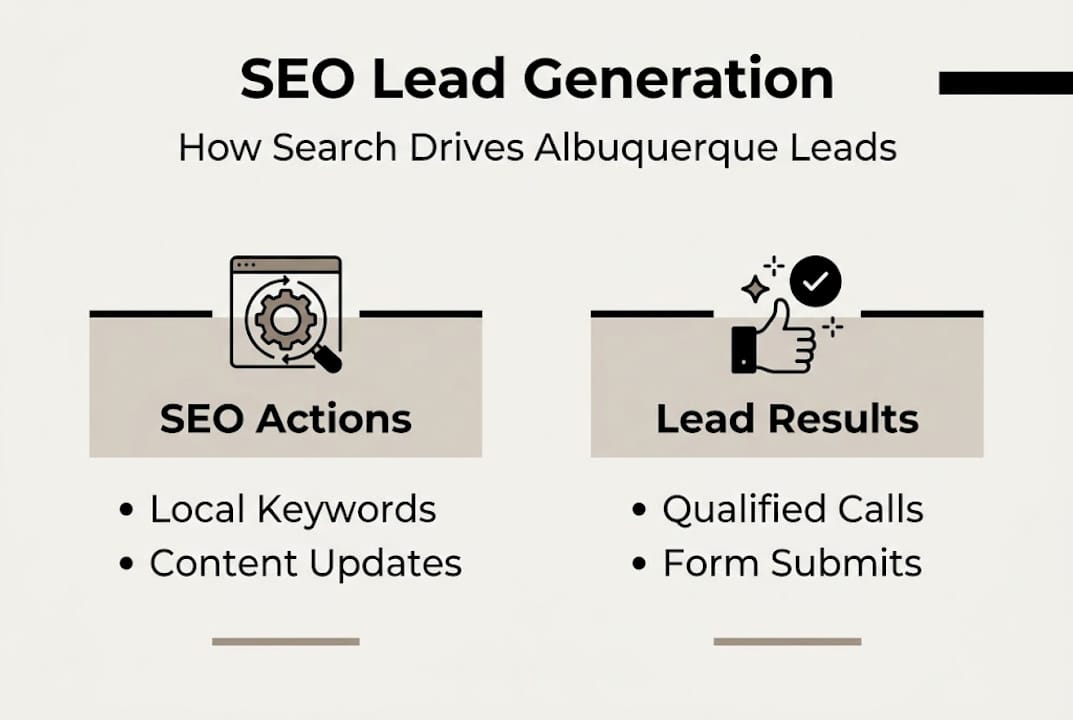
Here is a quick look at how query types translate to lead value:
| Search Query | Intent Type | Lead Value |
|---|---|---|
| “emergency plumber Albuquerque” | Transactional/Local | Very High |
| “best SEO agency near me” | Local | High |
| “how to improve my Google ranking” | Informational | Medium |
| “King Digital reviews” | Navigational | High |
| “what is local SEO” | Informational | Low |
To map intent to your content effectively, follow these steps:
- List your core services. Write down every service you offer and the problem it solves.
- Research how people search for each. Use tools like Google’s autocomplete or keyword planners to find real queries.
- Create dedicated pages for high-intent terms. Each service should have its own page targeting a specific transactional or local keyword.
- Match your page content to the intent. A transactional page needs a clear call to action, pricing info, and trust signals. An informational page needs answers and links to your services.
- Track which pages generate actual leads. Use form tracking and call tracking to see what is working.
Building a solid local marketing strategy around intent mapping is one of the fastest ways to improve lead quality without increasing your ad spend. Understanding user intent in SEO is a skill that pays off every single month.
Core SEO strategies to drive more local leads
Once you grasp intent, applying targeted local SEO techniques will amplify your lead generation engine.

Local SEO is not the same as general SEO. It is specifically designed to help businesses rank in their geographic area, which means the leads it generates are people who can actually walk through your door or call you today. Optimizing for local keywords and “near me” searches significantly increases local lead volume, and the tactics are more accessible than most business owners realize.
Here are the core strategies that move the needle:
- Google Business Profile optimization: Keep your profile complete, accurate, and active. Post updates, respond to reviews, and add photos regularly.
- On-page SEO: Include your city name and service keywords naturally in your page titles, headers, and content.
- Local backlinks: Earn links from Albuquerque-based directories, chambers of commerce, and local news sites. These tell Google you are a trusted local authority.
- Citation management: Make sure your business name, address, and phone number are consistent across every online directory.
- Service area pages: If you serve multiple neighborhoods, create individual pages targeting each area.
Now, let’s compare local SEO to traditional SEO so you can see where to focus your energy:
| Factor | Local SEO | Traditional SEO |
|---|---|---|
| Target audience | Nearby customers ready to buy | Broad, national, or global audience |
| Lead quality | Very high (location-specific intent) | Varies widely |
| Timeline to results | 3 to 6 months | 6 to 12+ months |
| Key tools | Google Business Profile, citations | Backlinks, content, technical SEO |
| Best for | Service businesses, brick-and-mortar | E-commerce, national brands |
Pro Tip: Customer reviews are a dual-purpose asset. They boost your review management for SEO rankings AND serve as social proof that converts visitors into leads. Ask every satisfied customer to leave a review on Google.
For a broader view of how these tactics fit together, see our guide on local marketing SEO and how Albuquerque businesses are using it to grow local leads consistently.
Integrating SEO with your marketing funnel for maximum leads
Finally, let’s see how you can weave SEO throughout your marketing efforts for even greater lead results.
SEO is not just a top-of-funnel tool. It supports every stage of the buyer journey, from the moment someone first hears about a problem to the moment they pick up the phone and call you. Understanding this changes how you build your content and your website.
Here is how to apply SEO at each funnel stage:
- Awareness: Create blog posts and guides targeting informational keywords. Someone searching “why is my AC not cooling” finds your HVAC blog, learns you exist, and bookmarks your site.
- Interest: Develop comparison and “best of” content. “Best HVAC companies in Albuquerque” pages capture people who are now actively evaluating options.
- Decision: Optimize your service pages with reviews, case studies, and clear calls to action. These pages should target transactional keywords and make it easy to contact you.
- Action: Make sure your contact forms, phone numbers, and booking tools are front and center. Fast-loading, mobile-friendly pages reduce drop-off at this critical stage.
“SEO influences up to 57% of B2B lead acquisition at critical funnel stages, making it one of the highest-impact channels for driving qualified prospects through to conversion.”
The key is tracking. You need to know which funnel stage each page serves and whether it is moving people forward. Optimizing your marketing funnel with SEO data gives you a clear picture of where leads are coming from and where they are dropping off. Pair that with the insights from SEO for the marketing funnel and you have a system that continuously improves.
Strategic alignment between your SEO and your funnel is what separates businesses that get occasional leads from those that generate them consistently.
What most Albuquerque businesses get wrong about SEO and leads
To wrap up, here’s an honest take on what truly makes SEO effective for lead generation in Albuquerque.
I see it constantly. A business owner invests in SEO, watches their rankings climb, and then wonders why their phone is not ringing more. The problem is not the SEO. The problem is what they are measuring.
Rankings and traffic are not leads. They are indicators. Chasing a number-one ranking for a keyword that does not attract buyers is a waste of your budget and your time. The businesses that win with SEO are the ones that connect every optimization effort directly to a business outcome: form fills, phone calls, booked appointments.
Shift your focus from “how do I rank higher” to “how do I turn more searchers into customers.” That means auditing which pages actually generate contact, not just visits. It means tracking calls from organic search separately from paid. It means building content that answers the question and then makes it effortless to take the next step.
Pro Tip: Set up conversion goals in Google Analytics tied to your SEO pages. If a page gets traffic but zero conversions, it needs a better call to action, not more keywords.
For a deeper look at this approach, our expert marketing insights page breaks down how we apply this thinking to real Albuquerque businesses.
Power up your Albuquerque lead generation with expert help
Ready to make SEO your best lead source? Here’s how to get expert support to amplify your results.
SEO is a proven driver of qualified leads, but doing it right requires strategy, consistency, and local expertise. At King Digital, we work exclusively with Albuquerque SMBs to build SEO systems that generate real business results, not just rankings.
Whether you want to master search ranking, integrate SEO and web design for a seamless lead-capturing experience, or follow our Albuquerque SEO ranking guide to benchmark your current performance, we have the tools and the team to help. Let’s build a lead generation engine that works for your business every single day.
Frequently asked questions
How long does it take to see lead generation results from SEO?
For most SMBs, meaningful SEO results begin appearing within 3 to 6 months, though timelines vary based on your competition level and how aggressively you implement changes.
What SEO strategies deliver the best leads for Albuquerque businesses?
Optimizing your Google Business Profile, targeting local keywords, and actively managing reviews are the top lead-driving tactics, as local SEO and review management consistently rank as leading strategies for SMB growth.
What’s the difference between SEO traffic and SEO leads?
SEO traffic counts all visitors arriving from search engines, while SEO leads are the subset who take a meaningful action like calling or submitting a form. Not all traffic becomes leads without deliberate conversion steps in place.
Can SEO work alongside paid advertising for more leads?
Absolutely. Combining SEO with PPC creates greater overall visibility and typically boosts total lead volume beyond what either channel achieves alone.
How do I know if my SEO is actually driving leads?
Set up call tracking, monitor form submissions, and use analytics tools linked to SEO pages to connect organic search activity directly to real lead outcomes.
Recommended
- Lead generation guide: proven strategies for Albuquerque SMBs
- Albuquerque SEO: Get Found, Get Customers, Get Results | King Digital Marketing Agency
- Boost leads in Albuquerque: on-page SEO best practices
- Digital marketing for Albuquerque SMBs: grow local leads
