Struggling to attract local customers online while competitors dominate search results? Most Albuquerque small business owners face this frustrating challenge daily. The solution lies in strategic website content optimization tailored specifically for local SEO. This guide walks you through proven, actionable steps to transform your website into a lead-generating powerhouse. You’ll discover how to integrate local keywords naturally, structure service pages for maximum impact, leverage technical optimizations, and measure real results. By implementing these strategies, you’ll position your business prominently in local searches and convert more visitors into paying customers throughout 2026 and beyond.
Table of Contents
- Understanding Your Local SEO Goals And Prerequisites
- Step-By-Step Website Content Optimization Process For Local SEO
- Technical And Mobile Optimization Essentials
- Tracking Results And Avoiding Common Pitfalls
- Enhance Your Local SEO With Expert Digital Marketing Support
- Frequently Asked Questions
Key takeaways
| Point | Details |
|---|---|
| Local searches drive conversions | 46% of Google searches seek local information, making optimization critical for visibility |
| Content quality beats quantity | Optimized content increases organic traffic by 30-50% while avoiding keyword stuffing penalties |
| Mobile optimization is mandatory | Mobile-friendly sites see 20-30% higher traffic as Google prioritizes mobile-first indexing |
| Schema markup boosts visibility | Structured data helps search engines understand your business and display rich snippets |
| Regular updates maintain rankings | Quarterly content refreshes keep your site relevant to evolving local search trends |
Understanding your local SEO goals and prerequisites
Before diving into content optimization tactics, you need crystal-clear objectives aligned with your business growth targets. Are you aiming to increase phone calls, foot traffic, or online inquiries? Each goal requires different content approaches and measurement strategies.
Start by researching what your Albuquerque customers actually search for when they need your services. This means understanding their pain points, questions, and the specific language they use. A plumber might discover locals search “emergency water heater repair Nob Hill” rather than generic plumbing terms. This insight shapes every content decision you make.
Several foundational elements must be in place before optimization delivers results. You need thorough local keyword research identifying neighborhood-specific terms and service combinations. Your business should have consistent local citation building across directories to establish credibility. Without these prerequisites, even perfectly optimized content struggles to rank.
Google evaluates local rankings through three primary factors: relevance, distance, and prominence. Relevance measures how well your content matches search intent. Distance considers proximity between the searcher and your business location. Prominence reflects your overall online authority through reviews, links, and citations. Your content optimization must address all three dimensions simultaneously.
The opportunity is massive. Nearly 80% of local mobile searches result in a conversion, yet many businesses leave this potential untapped. Set realistic benchmarks for improvement. A 25% increase in organic traffic within six months is achievable with consistent optimization. Track baseline metrics now so you can measure progress accurately as you implement changes.
Consider these essential preparation steps:
- Audit your current website content for local relevance and keyword gaps
- Document your target service areas and neighborhoods within Albuquerque
- Identify top competitors and analyze their content strategies
- Establish baseline metrics including current traffic, rankings, and conversion rates
- Create a content calendar for regular updates and new page creation
Step-by-step website content optimization process for local SEO
Now you’re ready to transform your website content into a local SEO powerhouse. Follow these proven steps systematically for maximum impact.
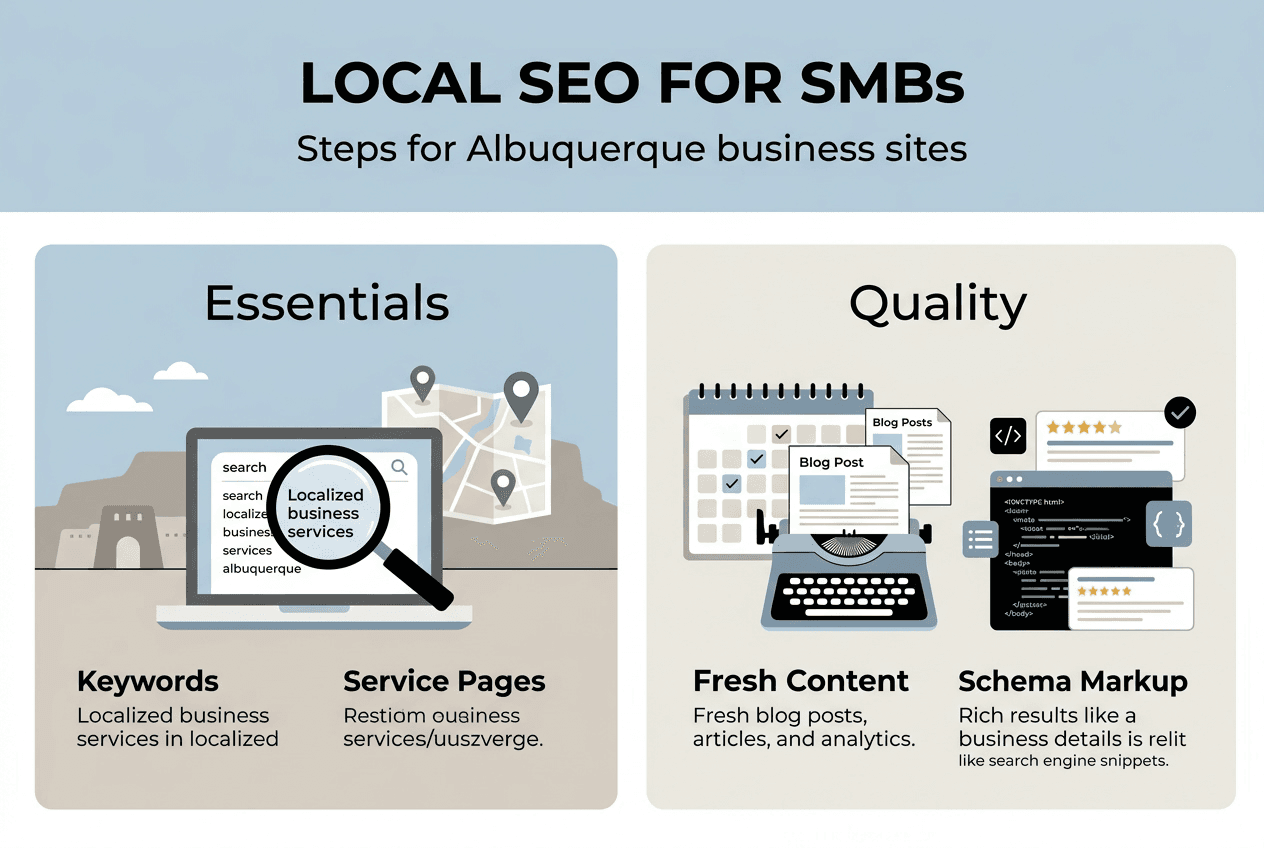
Step 1: Integrate geo-targeted keywords naturally throughout your content
Incorporate location-specific terms in page titles, H1 headings, subheadings, body text, and meta descriptions. Instead of “Best HVAC Services,” use “Best HVAC Services in Downtown Albuquerque.” Place primary keywords in the first 100 words of each page. Weave secondary keywords naturally into subsequent paragraphs without forcing them. Your content should read smoothly while signaling clear geographic relevance to search engines.
Step 2: Create dedicated service-area pages for multiple neighborhoods
Develop unique pages targeting specific Albuquerque areas like Nob Hill, Old Town, Uptown, or the Northeast Heights. Each page needs original content describing how your services address that neighborhood’s specific needs. Include local landmarks, community details, and testimonials from customers in that area. This strategy expands your ranking potential across multiple location searches simultaneously.

Step 3: Implement schema markup to enhance search engine understanding
Add LocalBusiness schema to your homepage with complete NAP information (name, address, phone). Use Service schema on service pages to define offerings clearly. Include AggregateRating schema to display star ratings in search results. These structured data types help Google comprehend your business details and display enhanced snippets that improve click-through rates significantly.
Step 4: Optimize all on-page elements for local relevance
Craft compelling meta titles under 60 characters including your primary keyword and location. Write meta descriptions between 150-160 characters that encourage clicks while incorporating local terms. Structure URLs with location identifiers like “/services/plumbing-albuquerque-nm/”. Add descriptive alt text to images mentioning both service and location. These elements collectively strengthen local ranking signals.
Step 5: Maintain high content quality while avoiding keyword stuffing
Prioritize answering user questions and solving problems over keyword density. Write comprehensive paragraphs that demonstrate expertise and build trust. Use variations and synonyms naturally rather than repeating exact phrases. Local keyword integration can improve local search visibility by 20-30% in months when done properly, but overuse triggers penalties that destroy rankings.
Step 6: Regularly update and audit content for continued relevance
Review pages quarterly to refresh statistics, examples, and recommendations. Add new sections addressing emerging customer questions or service updates. Remove outdated information that could confuse visitors or damage credibility. Fresh content signals active business management to both search engines and potential customers.
Pro Tip: Create a simple spreadsheet tracking which pages target which neighborhoods and keywords. This prevents accidental keyword cannibalization where multiple pages compete for the same search terms.
The impact of proper optimization is substantial. Optimized content increases organic traffic by 30-50% and conversion rates by 15-25% according to comprehensive case studies. These improvements translate directly to more leads and revenue for your Albuquerque business.
Consider this comparison of optimization approaches:
| Optimization Level | Traffic Impact | Ranking Improvement | Lead Generation |
|---|---|---|---|
| Basic (keywords only) | 10-15% increase | Minimal movement | Low conversion |
| Intermediate (keywords + structure) | 25-35% increase | Moderate improvement | Steady leads |
| Advanced (full optimization) | 40-60% increase | Significant gains | High-quality leads |
Implementing these steps systematically through resources like crafting local content guides and local SEO tips ensures you build sustainable visibility. The optimize local search guide provides additional frameworks for maximizing these efforts across your entire digital presence.
Technical and mobile optimization essentials
Content quality alone won’t secure top local rankings. Technical performance and mobile optimization form the foundation supporting your content strategy. Google’s mobile-first indexing means your site’s mobile version determines rankings for all devices, making mobile optimization absolutely critical.
Mobile users behave differently than desktop visitors. They want instant answers, clear calls to action, and fast loading times. A sluggish mobile site frustrates potential customers who quickly bounce to competitors. Mobile-optimized websites see 20-30% higher mobile traffic and better conversions compared to non-optimized alternatives.
Consider how mobile and technical factors impact local search performance:
| Factor | Mobile-Optimized Site | Non-Optimized Site |
|---|---|---|
| Page Load Speed | Under 3 seconds | Over 5 seconds |
| Mobile Traffic | 20-30% higher | Baseline |
| Bounce Rate | 35-45% | 60-75% |
| Local Ranking | Top 3-10 positions | Page 2 or lower |
| Conversion Rate | 3-5% | 1-2% |
Implement these technical best practices immediately:
- Compress images to reduce file sizes without sacrificing quality
- Enable browser caching to speed up repeat visits
- Minimize CSS and JavaScript files to decrease load times
- Install an SSL certificate for secure HTTPS connections
- Design intuitive navigation with clear menu structures
- Use responsive design that adapts seamlessly to all screen sizes
- Ensure buttons and links are easily tappable on small screens
Google uses relevance, distance, and prominence as primary local ranking factors, and technical performance directly influences prominence. Fast, secure, mobile-friendly sites earn better rankings and more backlinks naturally. They also provide superior user experiences that encourage longer visits and more conversions.
Structured data becomes even more powerful when combined with excellent mobile performance. Rich snippets displaying ratings, hours, and services capture attention in mobile search results where screen space is limited. This combination of technical excellence and enhanced visibility creates a competitive advantage most local businesses overlook.
Pro Tip: Use Google’s Mobile-Friendly Test and PageSpeed Insights tools monthly to identify specific technical issues. Address the highest-impact problems first, focusing on elements that directly affect user experience and ranking signals.
Regular technical audits prevent small issues from becoming major problems. Check for broken links, duplicate content, missing alt tags, and slow-loading pages. The optimize local search guide provides comprehensive checklists for ongoing maintenance. Pair technical optimization with Google Maps optimization and local SEO best practices for complete local dominance.
Tracking results and avoiding common pitfalls
Optimization without measurement is guesswork. You need concrete data showing which strategies work and which need adjustment. Tracking the right metrics transforms optimization from a one-time project into a continuous improvement system that compounds results over time.
Focus on these essential metrics:
- Organic traffic from local searches to key landing pages
- Keyword rankings for priority local search terms
- Conversion rates from organic visitors to leads or sales
- Click-through rates from search results to your website
- Time on page and bounce rates indicating content engagement
- Phone calls, form submissions, and direction requests generated
Google Analytics and Google Search Console provide most of this data free. Set up goals tracking specific actions like form submissions or phone clicks. Create custom reports filtering for local traffic sources. Monitor Search Console for ranking changes, indexing issues, and search queries driving traffic. Review these reports weekly initially, then monthly once patterns emerge.
Many Albuquerque businesses sabotage their own efforts through common mistakes. Many businesses neglect local optimization, with 60% having not optimized for local search despite the massive opportunity. Don’t join this majority leaving money on the table.
Keyword stuffing remains the most damaging error. Cramming keywords unnaturally into content triggers Google penalties that tank rankings overnight. Avoid keyword stuffing; prioritize creating natural, user-focused content that genuinely helps readers. Write for humans first, search engines second.
Other critical pitfalls include:
- Neglecting mobile optimization despite mobile-first indexing
- Creating thin, duplicate content across service area pages
- Ignoring page speed and technical performance issues
- Failing to update content as business offerings evolve
- Overlooking the importance of consistent NAP information
- Focusing solely on rankings instead of conversions and ROI
Pro Tip: Refresh your highest-traffic pages every quarter with updated statistics, new examples, and expanded sections. This signals freshness to Google while providing more value to returning visitors. Add diverse content formats like videos, infographics, or customer stories to maintain engagement.
“Local SEO delivers leads at a fraction of paid advertising costs while building long-term organic visibility. The initial investment in optimization pays dividends for years through sustained rankings and traffic.”
The cost-effectiveness of local SEO compared to paid ads becomes obvious over time. While PPC requires continuous spending, organic rankings from proper optimization generate free traffic indefinitely. A well-optimized page ranking in the top three positions can deliver hundreds of qualified leads monthly without ongoing ad spend.
Continuous improvement through resources like local SEO tips and local keyword research keeps your strategy current as algorithms and user behavior evolve. Stay informed about local search trends and adjust your approach accordingly.
Enhance your local SEO with expert digital marketing support
Implementing these optimization strategies requires time, expertise, and consistent execution. Many Albuquerque business owners recognize the value but lack bandwidth to handle optimization alongside daily operations. That’s where specialized support accelerates results.
King Digital offers tailored digital marketing solutions for small businesses throughout the Albuquerque region. Our team combines local market knowledge with technical SEO expertise to optimize your website content for maximum local visibility. We handle everything from keyword research and content creation to technical audits and ongoing optimization.
Working with experienced professionals means faster implementation and better results. We stay current with algorithm updates and local search trends so you can focus on running your business. Our local SEO tips guide and SEO website design services ensure your entire digital presence works together cohesively. Partner with us to transform your website into a consistent lead generation engine that outperforms competitors and drives sustainable growth.
Frequently asked questions
What are the most effective keywords for local SEO in Albuquerque?
The most effective keywords combine your services with specific Albuquerque neighborhood names like Nob Hill, Old Town, or Northeast Heights. Include “near me” phrases and service descriptors that match how locals actually search. Blend these naturally throughout your content using local keyword research to identify high-value opportunities.
How often should I update my website content for optimal local SEO?
Review and refresh your content at least quarterly to maintain relevance with evolving local trends and search intent. Update service pages immediately when your offerings change and add new location-specific content as you expand into additional neighborhoods. Regular updates signal active management to Google while providing fresh value to visitors. Follow local SEO tips guide recommendations for maintaining optimization momentum.
What is schema markup and why is it important for local businesses?
Schema markup is structured data code that helps search engines understand your business details like services, hours, location, and ratings. It enhances your visibility in search results with rich snippets that display additional information and improve click-through rates. For local businesses, LocalBusiness and Service schema types are essential for maximizing search presence. Learn implementation strategies through the local search optimization guide.
How can I avoid keyword stuffing while optimizing my content?
Focus on writing for your audience first, integrating keywords naturally where they fit contextually within helpful, informative sentences. Use synonyms and related phrases to diversify keyword usage without repeating exact terms excessively. If a sentence feels awkward or forced with a keyword, rewrite it to flow naturally. Quality content that genuinely helps readers always outperforms keyword-stuffed pages. The crafting local content guide provides frameworks for balancing optimization with readability.
Recommended
- Optimize local search: Ultimate Guide 2025
- Albuquerque SEO: Get Found, Get Customers, Get Results | King Digital Marketing Agency
- Albuquerque Website Development Services: Top 2025
- Local SEO Best Practices 2025: Essential for Small Business
Article generated by BabyLoveGrowth
