Local SEO Best Practices 2025: Essential for Small Business
Why Local SEO Best Practices Matter for Your Small Business
Local SEO best practices are the key to appearing in search results when nearby customers need your products or services. The stakes are high: nearly 46% of all Google searches have local intent, and roughly 80% of local mobile searches lead to a conversion. When someone searches “plumber near me” or “best coffee shop in Albuquerque,” they are ready to act.
Yet many small businesses are invisible online while their competitors dominate Google Maps. This isn’t luck; it’s the result of a systematic strategy. To win, you need to focus on what works:
- Optimizing your Google Business Profile
- Maintaining consistent Name, Address, and Phone (NAP) data
- Creating location-specific website content
- Earning and responding to customer reviews
- Using LocalBusiness schema markup
- Building local citations and backlinks
- Ensuring your website is mobile-friendly and fast
The difference between appearing in the coveted local pack-the top three map results-and being buried on page two is the consistent implementation of these proven tactics.
I’m Bernadette King, founder of King Digital Marketing Agency. I’ve spent years helping businesses transform their local visibility with strategies that drive real revenue. This guide strips away the jargon to give you actionable steps for results.
Mastering Your Digital Storefront: Google Business Profile Optimization
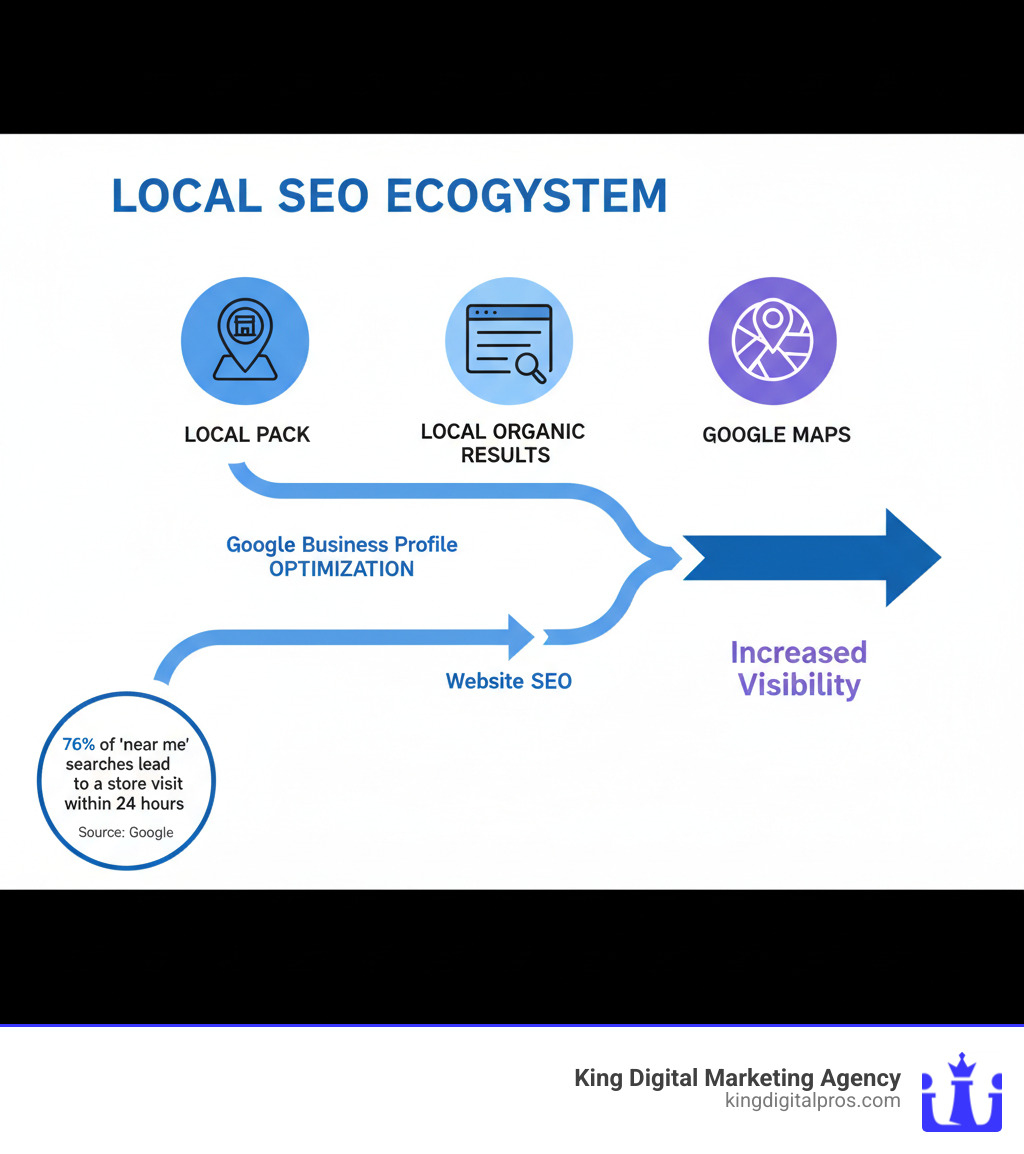
Your Google Business Profile (GBP) is your digital storefront and often a customer’s first impression. It directly influences whether you appear in the Local Pack-the three business listings with a map at the top of search results. With Google holding over 92% of the search market, according to Forbes Advisor, an optimized GBP is your gateway to local customers.
Claiming and verifying your profile is step one. Surprisingly, only 56% of local businesses have claimed their GBP, giving you an immediate advantage. Once claimed, ensure your business name is exactly as it appears on your physical signage-no keyword stuffing like “Joe’s Pizza Best Pizza in Albuquerque,” which can lead to suspension.
NAP consistency is crucial. Your Name, Address, and Phone number must be identical everywhere online, from your GBP to your website and all directories. Even minor differences like “Street” vs. “St.” can harm your rankings.
Your business categories tell Google what you do. Choose a primary category that is specific and accurate, as it carries the most weight. For example, a family law attorney should choose “Family Law Attorney,” not just “Lawyer.” You can add secondary categories for other services. For more details, see our guide on Business Profile Optimization.
Photos and videos are vital. Businesses with photos get 42% more direction requests and 35% more website clicks. Upload high-quality images of your storefront, team, and products. Use Google Posts for promotions, events, and news to keep your profile fresh.
The Q&A feature is an underused tool. Customers can ask questions directly on your profile. Monitor and answer them promptly. You can also proactively add common questions and answers to provide helpful, keyword-rich content.
Essential local SEO best practices for your profile
To maximize your GBP’s impact, follow these key practices:
- Complete every section: The more information Google has, the better it can match you to searches. Fill out your business description, services, products, and attributes.
- Keep hours accurate: Update your hours of operation immediately for any changes, especially for holidays. Inaccurate hours frustrate customers.
- Use service attributes: Check boxes for features like “Wheelchair accessible,” “Free Wi-Fi,” or “Online appointments.” These attributes, as noted in Google’s guidelines for representing your business, help customers find businesses that meet their specific needs.
- Add product listings: If you sell products, add them directly to your GBP with photos, descriptions, and prices to let customers browse before visiting your site.

Finally, always follow Google’s official guidelines to avoid penalties. Common violations include keyword stuffing business names, using virtual offices, and creating duplicate listings. Honesty and accuracy are key to long-term visibility.
Building a Strong Foundation: On-Page Local SEO Best Practices
While your Google Business Profile is the handshake, your website is the conversation. A well-optimized site is a critical local SEO best practice that supports your entire online presence.
First, technical performance is non-negotiable. Google uses mobile-first indexing, meaning it prioritizes your mobile site for ranking. Since most local customers search on the go, your site must be flawless on their phones. Page speed is equally important; slow-loading sites are abandoned quickly, and Google confirms speed is a direct ranking factor. Ensure your site has clear navigation and a logical structure. For more on this, see our guide on How to Create an SEO Friendly Website Design Structure.
Leveraging Location-Specific Keywords and Landing Pages
To connect with local customers, you must use the language they use. People in Santa Fe don’t just search for “plumber”; they search for “plumber Santa Fe.” These location-specific keywords have incredibly high intent.
Your first step is research to understand how people in your service areas search. Think beyond city names to include neighborhoods, landmarks, and “near me” queries. Our Local Keyword Research Complete Guide can walk you through this process.
Once you have your keywords, create dedicated location pages. If you serve both Albuquerque and Rio Rancho, each city needs its own unique page. Don’t just swap city names on a template-Google penalizes thin content. Each page should offer substantial, unique information relevant to that specific area. For example, discuss how your services address the unique needs of older homes in one neighborhood versus new construction in another. Also, embed a Google Map on each location page to reinforce your local presence.
Integrate these local keywords naturally into your title tags, meta descriptions, headings, body content, and image alt text. The goal is to create helpful content that organically includes the phrases your customers are searching for.
Using Schema Markup to Stand Out
Schema markup is code you add to your website to help search engines understand your content. As defined by Schema.org, it’s a shared vocabulary for search engines. It’s like giving Google an instruction manual for your business information.
Correctly implemented schema can make you eligible for rich snippets-improved search results that show star ratings, hours, or prices. These stand out and earn more clicks.
For local businesses, the LocalBusiness schema type is essential. It provides search engines with standardized information. Key details to include are:
- Business name, phone number, and full address
- Website URL and logo
- Daily hours of operation
- Geo coordinates (latitude and longitude)
- Review schema for ratings
- Price range
Tools like Google’s Structured Data Markup Helper can generate this code, and you can validate it with the Rich Results Test. According to Moz’s research on local search ranking factors, structured data is increasingly important for local visibility. Implementing schema is a powerful way to communicate directly with Google and improve your chances of being featured when someone in Tijeras or Sandia Park searches for your services.
Expanding Your Local Footprint: Off-Page Signals and Reputation
What happens off your website is just as important as what’s on it. Google evaluates off-page signals-mentions, links, and reviews from other sites-to gauge your authority and trustworthiness. When the local Chamber of Commerce links to you or customers leave glowing reviews, Google takes notice. This external validation is what lifts good local SEO best practices into dominant rankings. To learn more, see our guide on how to Improve Google Local Ranking.
Building Local Citations and Relevant Backlinks
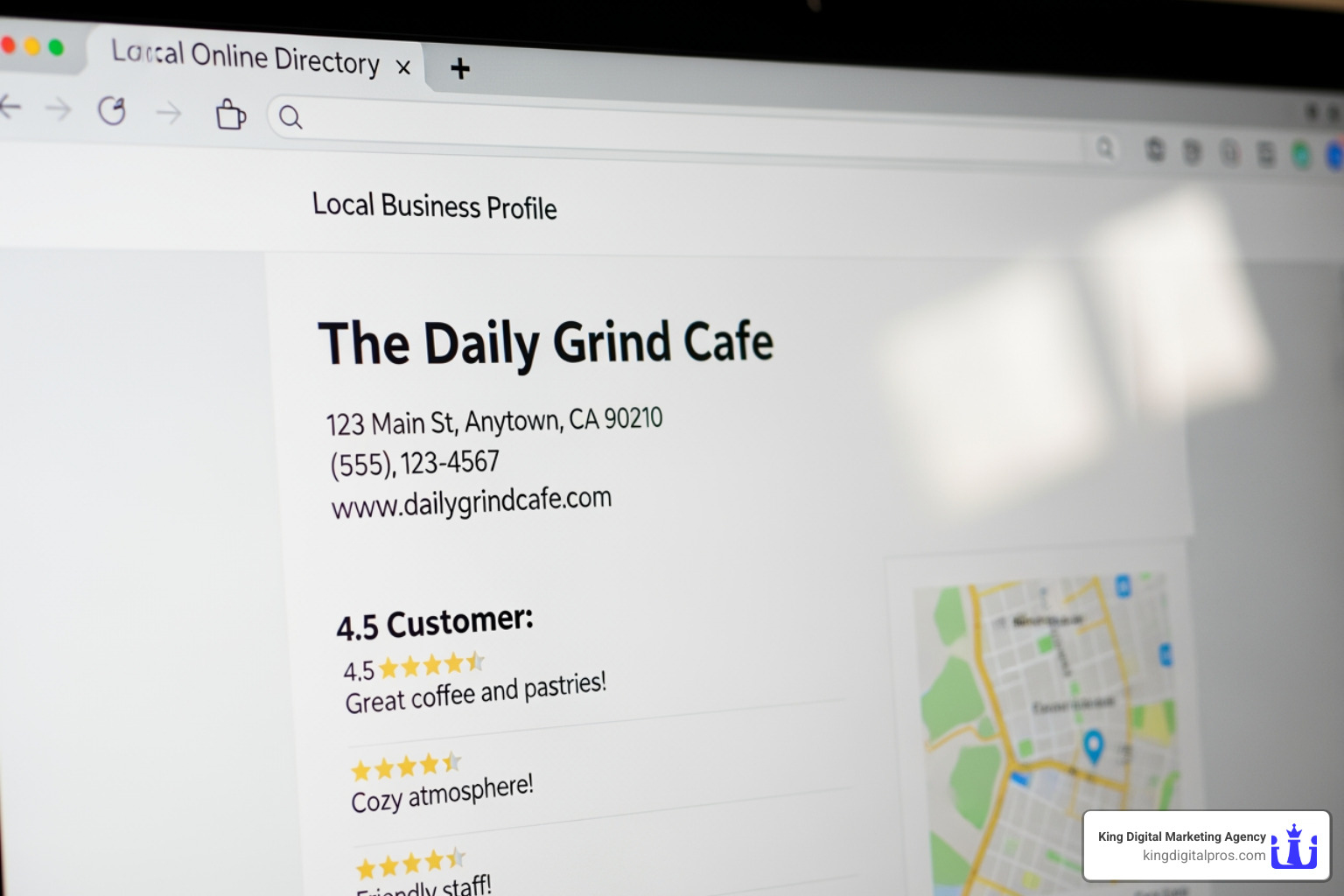
Local citations are online mentions of your business’s Name, Address, and Phone number (NAP). They appear in directories and social profiles, reinforcing your legitimacy. NAP consistency is non-negotiable; your information must be identical everywhere. Even small variations can confuse search engines and hurt your rankings.
Start by ensuring your data is correct with major data aggregators, which feed hundreds of smaller directories. Beyond general directories like Yelp, focus on niche directories for your industry (e.g., legal directories for lawyers, dining guides for restaurants).
Local link building involves earning backlinks from relevant, authoritative local sources. Link signals are a top factor for local pack rankings, acting as votes of confidence. Here are effective ways to build local links:
- Sponsor local events in areas like Santa Fe or the East Mountains to get a link from the event website.
- Join your local Chamber of Commerce for a highly trusted backlink.
- Pitch stories to local news about your community involvement or unique services.
- Partner with complementary local businesses for reciprocal mentions and links.
- Write guest posts for local blogs to establish expertise and earn a backlink.
A link from a respected local source is far more valuable than dozens of irrelevant links from elsewhere.
The role of reviews in local SEO best practices
Online reviews are one of the most powerful local SEO signals. An incredible 95% of customers read reviews before making a purchase. Your online reputation directly impacts both your ranking and your conversion rate.
Google considers review quantity, velocity (recency), and diversity across platforms. Ten recent reviews often carry more weight than fifty old ones. One of the most effective local SEO best practices is to make it easy for happy customers to leave feedback. Ask them directly, send a follow-up email with a link, or use QR codes on receipts. According to BrightLocal’s consumer review survey, 76% of customers who are asked to leave a review will do so.
Crucially, you must respond to all reviews-positive and negative. Google has confirmed that owner responses strengthen your local presence. When you receive a negative review, respond professionally and empathetically. Acknowledge the issue and offer to resolve it offline. A thoughtful response shows potential customers that you care and take accountability. For more strategies, our Google Business Listing Help guide offers a complete walkthrough. Finally, showcase your best testimonials on your website as powerful social proof.
Frequently Asked Questions about Local SEO
As we help businesses across Albuquerque and New Mexico, we hear the same questions about local SEO best practices. Here are the answers to the most common ones.
How does local SEO differ from standard SEO?
Standard SEO casts a wide net to attract a national or global audience, while local SEO targets customers in your immediate geographic area. The key differences are:
- Geographic Focus: Local SEO uses location-specific keywords (e.g., “running shoes Santa Fe”) instead of broad terms (“best running shoes”).
- Ranking Signals: Local search algorithms heavily weigh proximity, relevance, and prominence (your local reputation from reviews and citations).
- Key Asset: Your Google Business Profile is often more important than your website for ranking in the Local Pack, a feature unique to local search.
- Search Results: Local searches often trigger the Local Pack (a map with three businesses), which standard SEO results do not have.
How long does it take to see results from local SEO?
The timeline depends on your starting point and market competition, but here’s a general guide:
- Initial Improvements (1-2 months): You may see more GBP views and start appearing for some local searches. These early wins come from foundational work like optimizing your GBP and fixing NAP inconsistencies.
- Significant Results (3-6 months): With consistent effort, you can expect to appear regularly in the Local Pack, leading to more calls and customers.
Local SEO is an ongoing process, not a one-time project. Google’s algorithms change constantly-thousands of times a year, per Search Engine Journal-and your competitors are always working to improve. Consistent effort creates a cumulative effect, like compound interest for your visibility.
What are the essential features of local SEO software?
While free tools like Google Analytics are useful, specialized local SEO software can amplify your efforts. Look for these essential features:
- Rank Tracking: Monitors your position in both the Map Pack and organic results, ideally with grid-based tracking to show rankings from different points in your service area.
- Citation Management: Finds and fixes inconsistent NAP information across online directories, often automatically.
- Review Management: Alerts you to new reviews and allows you to respond from a single dashboard.
- GBP Management: Lets you schedule posts, manage photos, and update information across multiple locations from one place.
- Reporting and Analytics: Consolidates data from multiple sources into clear reports to track ROI and guide your strategy.
Grow Your Business with Local SEO
You now have the roadmap to dominate local search. From optimizing your Google Business Profile to building a strong website and earning a stellar reputation, these are the local SEO best practices that drive real-world results.
Local SEO is like tending a garden, not building a fence. The businesses that win are those who implement these strategies with patience and persistence. While your competitors are still figuring out the basics, you can be ranking in the Local Pack, fielding calls from customers who found you on their phone just minutes earlier.
At King Digital Marketing Agency, we specialize in optimizing Google Business Profiles and managing map listings for businesses throughout New Mexico, from Albuquerque to Santa Fe. We know the local landscape and how to make your business visible within it.
Your potential customers are searching right now. The question isn’t whether local SEO works-it’s whether you’re ready to implement it. Research from outlets like Search Engine Land and BrightLocal consistently shows that businesses appearing in the Local Pack receive the vast majority of clicks and customers.
Ready to stop being invisible? Start growing your small business with a better digital marketing strategy today. Let’s put your business on the map and turn local searches into loyal customers.
