TL;DR:
- Google prioritizes user satisfaction and intent fulfillment over bounce rate or dwell time.
- Improving page speed, mobile usability, and clear content enhances local SEO results.
- Focus on outcome-based metrics like calls and bookings rather than vanity engagement indicators.
Most Albuquerque business owners have heard that a high bounce rate tanks their Google rankings. It sounds logical, so they obsess over that number. But here is the truth: bounce rate and dwell time are not direct ranking signals Google uses. Chasing the wrong metrics wastes time and money. What Google actually rewards is whether your site satisfies what someone was searching for. In this article, we break down how user experience (UX) genuinely affects your local search rankings, clear up the myths that keep Albuquerque businesses stuck, and give you a practical roadmap to start winning more visibility and leads. If you’re too busy managing your business to implement this roadmap, King Digital Marketing Agency provides this service. We are proud to offer month-to-month SEO services with no contract.
Table of Contents
- What is user experience and why does it matter for SEO?
- How user experience influences search rankings
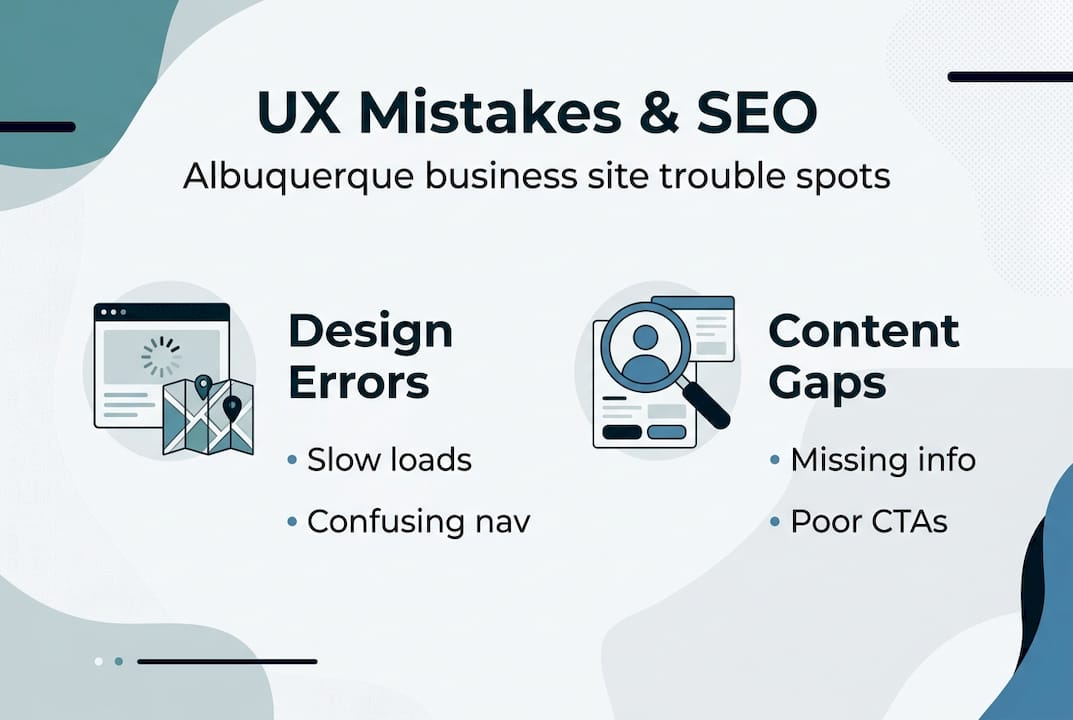
- Common UX mistakes that hurt your local SEO
- Step-by-step: Improving user experience for better SEO in Albuquerque
- Why common SEO advice can hold your Albuquerque business back
- Take your Albuquerque SEO further with expert help
- Frequently asked questions
Key Takeaways
| Point | Details |
|---|---|
| Prioritize user intent | Design your website to answer real customer questions and needs, not just to please search engines. |
| Focus on Core Web Vitals | Improving site speed, mobile-friendliness, and stability can directly boost your SEO rankings. |
| Avoid common UX traps | Fixing confusing navigation and slow loading times quickly improves both user satisfaction and your search visibility. |
| Measure what matters | Track intent satisfaction and conversions over bounce rate or dwell time for a more accurate SEO health check. |
| Apply changes for local impact | Regular UX improvements can help your Albuquerque business stand out and win more local customers. |
What is user experience and why does it matter for SEO?
User experience is simply how easy and satisfying it is for someone to use your website. It covers everything from how fast your pages load, to whether visitors can find your phone number without squinting, to whether your content actually answers their question. For a local service business in Albuquerque, that might mean a plumbing company’s site that loads in under two seconds and shows a clear “Call Now” button above the fold.
Here is where many business owners get confused. They believe that if someone leaves their site quickly, Google penalizes them. That is not how it works. Google does not rank sites based on bounce rate or time-on-page pulled directly from your analytics. What Google cares about is whether the user got what they came for.
Think of it this way: if someone searches “emergency plumber Albuquerque” and clicks your site, finds your number immediately, and calls you, they leave your site fast. A short visit, but a completely satisfied user. That is a win for everyone, including your SEO.
So what does UX actually influence from an SEO standpoint?
- Page speed: Slow pages frustrate visitors and directly affect Core Web Vitals scores, which are real ranking factors.
- Mobile usability: Google indexes your mobile site first. If it is clunky on a phone, you lose ground.
- Content clarity: Does each page answer the specific question a local visitor is asking? Generic content rarely satisfies local search intent.
- Navigation: Can someone get from your homepage to a service page in one or two clicks?
“The goal of every page on your site should be to fulfill one clear user need. When you build around that, SEO follows naturally.” That is a principle we apply every time we evaluate the website design and SEO connection for our Albuquerque clients.
Pro Tip: Before you tweak any design element, ask yourself: what does a person searching this keyword actually need to do or find on this page? Build the page around that goal, not around what looks impressive.
When an Albuquerque med spa updated their site to load faster, added clear service descriptions, and made their booking button easy to find on mobile, organic traffic grew noticeably within weeks. The content did not change. The user experience did.
How user experience influences search rankings
Understanding the mechanism here changes everything. When someone searches on Google, they click a result. If they quickly leave and click a competitor’s result instead, that behavior may signal to Google’s systems that the first result did not satisfy the intent. This concept is sometimes called NavBoost, an internal Google system that factors in click satisfaction patterns.
Engagement signals like dwell time operate indirectly through user satisfaction, not through raw analytics data. Core Web Vitals, on the other hand, are direct ranking factors. That distinction matters enormously for where you focus your energy.
| UX factor | SEO impact | Priority level |
|---|---|---|
| Core Web Vitals (speed, responsiveness, stability) | Direct ranking factor | High |
| Mobile-friendly design | Direct ranking factor | High |
| Clear navigation and site structure | Indirect via intent satisfaction | High |
| Content relevance and clarity | Indirect via intent satisfaction | High |
| Calls to action and conversion paths | Indirect via engagement quality | Medium |
Here is a practical sequence for thinking about UX and rankings:
- A local customer in Albuquerque searches for your service.
- Your listing appears and they click through.
- They either find what they need quickly, or they leave.
- If they leave without satisfaction, that pattern accumulates and can reduce your visibility over time.
- If they stay, convert, or find their answer, your page builds authority for that intent.
The good news is that improving your site to improve search ranking does not require a full rebuild. Start with Core Web Vitals. Google Search Console gives you a free report showing exactly where your site falls short on speed, interactivity, and visual stability.
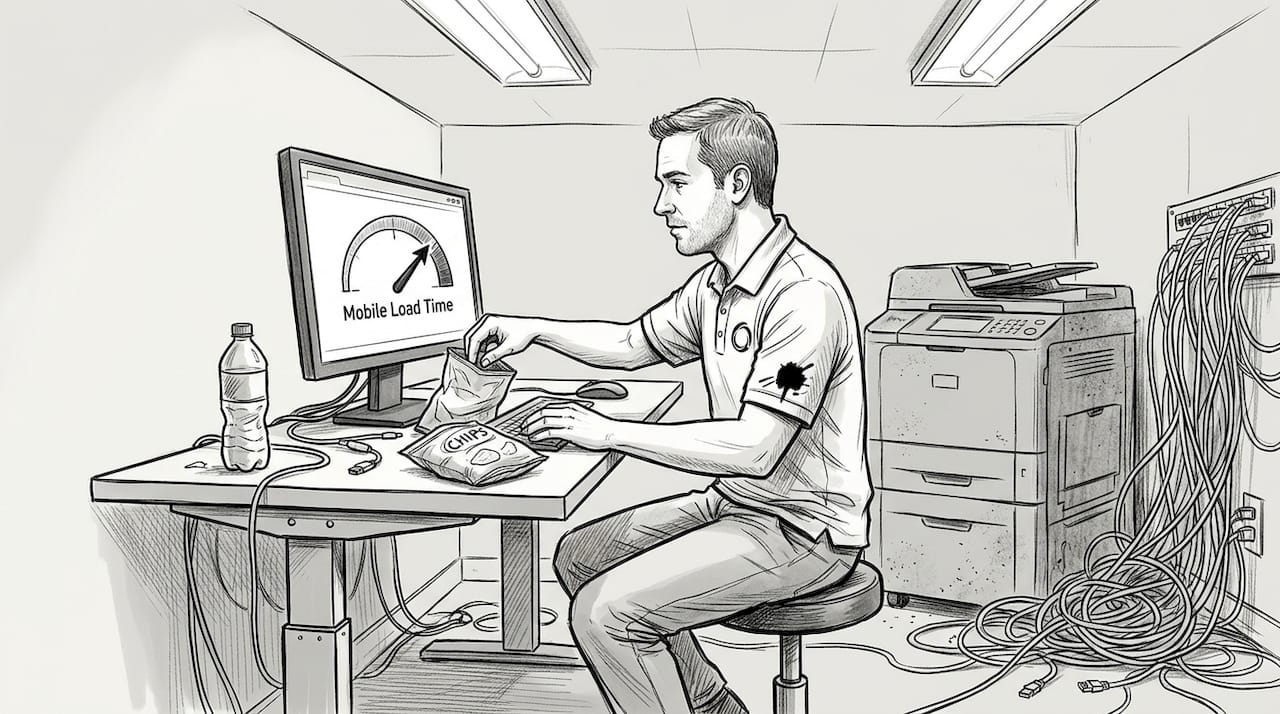
One Albuquerque HVAC company we reviewed had a 6-second load time on mobile. After compressing images and reducing unnecessary scripts, they dropped to under 2.5 seconds. Their local pack visibility improved within the following month.
For businesses ready to go deeper, integrating SEO with web design from the start produces far stronger results than retrofitting SEO onto a poorly built site.
Common UX mistakes that hurt your local SEO
Most Albuquerque businesses are not losing rankings because of bad content. They are losing because of fixable UX problems that drive visitors away before they ever read a word.
User intent satisfaction matters far more than the engagement numbers most people watch. Yet the mistakes below consistently undermine it.
| Bad local homepage | Good local homepage |
|---|---|
| No address or service area visible | City and service area clearly stated |
| Generic stock photos with no local context | Real photos of your team or location |
| Slow load time over 4 seconds | Loads in under 2.5 seconds |
| Phone number buried in the footer | Clickable phone number in the header |
| No clear next step for the visitor | Clear call to action above the fold |
Here are the most common UX mistakes we see on Albuquerque business websites:
- Slow mobile performance: Most local searches happen on phones. If your site takes more than 3 seconds to load on mobile, you are losing people before they see anything.
- Confusing navigation: Menus with too many options or vague labels like “Solutions” instead of “Plumbing Services” leave visitors guessing.
- Generic landing pages: A restaurant in Albuquerque’s Old Town should not have the same homepage messaging as a national chain. Local specificity builds trust and relevance.
- No clear contact path: If calling or booking requires more than two clicks, most mobile visitors will leave.
- Walls of text: Dense paragraphs with no headings, bullets, or white space overwhelm visitors and reduce the chance they find their answer.
These issues are not just conversion killers. Check whether your site is fixing conversion killers that silently erode both leads and rankings.
Pro Tip: Grab your phone right now and visit your own website as if you are a first-time customer. Can you find your phone number in under five seconds? Can you tell exactly what you offer and where you serve? If not, your visitors cannot either.
For a deeper look at structure, reviewing SEO-friendly site structure tips or website best practices for Albuquerque businesses gives you a solid checklist to work from.
Step-by-step: Improving user experience for better SEO in Albuquerque
Now that you understand what hurts and why, here is how to fix it. This process works whether you have a simple five-page site or a larger service catalog.
- Run a Core Web Vitals audit. Go to Google Search Console and check the Core Web Vitals report. Note which pages fail and what specific issue is flagged. Google’s focus on intent satisfaction and technical performance means this step is non-negotiable.
- Fix speed issues first. Compress images using a free tool like Squoosh. Remove unused plugins or scripts. Consider a faster hosting plan if your server response time is slow.
- Simplify your navigation. Limit your main menu to five or six clearly labeled items. Each should describe a service or action, not a vague category.
- Localize your content. Add Albuquerque-specific language to your homepage, service pages, and meta descriptions. Mention neighborhoods, landmarks, or local context where it fits naturally.
- Make your calls to action obvious. Every key page needs one clear next step: call, book, get a quote. Put it where visitors see it without scrolling.
- Gather real feedback. Ask a few local customers to navigate your site while you watch. Their confusion points will tell you more than any analytics report.
- Track the right metrics. Instead of watching bounce rate, monitor goal completions, phone call clicks, and form submissions. These reflect real intent satisfaction.
Useful tools for this process:
- Google Search Console (Core Web Vitals and mobile usability reports)
- PageSpeed Insights (free speed and performance analysis)
- Hotjar or Microsoft Clarity (free session recordings and heatmaps)
- Google Analytics 4 (conversion and event tracking)
For businesses ready to build this the right way from the start, the SEO-friendly web design guide walks through everything in detail. And do not overlook review management for local SEO, since positive reviews reinforce the trust signals Google looks for in local results.
Why common SEO advice can hold your Albuquerque business back
Here is something most SEO articles will not tell you. A lot of the standard advice floating around, the kind that tells you to reduce your bounce rate or increase time on page, points you at the wrong target entirely. We have seen Albuquerque businesses spend months trying to lower a bounce rate that was actually healthy because their pages were doing exactly what they were supposed to do: giving users a fast answer and prompting a phone call.
Real SEO progress comes from asking a harder question. Did that visitor get what they came for? A satisfied visitor who leaves in 30 seconds is worth more than a confused visitor who stays for five minutes reading the wrong page.
The businesses that win local search in Albuquerque are the ones who design every page around a specific customer need. They stop chasing vanity metrics and start measuring outcomes: calls, bookings, form fills. That shift in thinking, backed by the right website design that impacts SEO, is what separates consistent local leaders from businesses that plateau.
Focus on your customer first. The rankings follow.
Take your Albuquerque SEO further with expert help
Applying everything in this article takes time, and the technical details can get complicated fast. That is exactly where having the right partner makes a real difference.
At King Digital, we help Albuquerque small and medium businesses improve both their user experience and their search visibility through a strategy that connects the two. Our local SEO services are built around what actually moves rankings in this market. Our website design services are crafted to perform, not just look good. And because we understand how web design helps SEO, everything we build works together to bring you more qualified local leads. Reach out today and let’s take a real look at where your site stands.
Frequently asked questions
Does bounce rate affect my Google rankings?
Bounce rate is not a direct ranking factor for Google, but a high bounce rate may signal deeper UX problems that hurt SEO indirectly.
What are Core Web Vitals and why are they important for SEO?
Core Web Vitals are direct ranking factors that measure your site’s speed, responsiveness, and visual stability, rewarding sites that deliver a smooth, fast experience.
How quickly can UX improvements impact my search rankings?
You may see ranking improvements within a few weeks to a few months after major user experience upgrades, though timing varies depending on your site’s current state and local competition.
Do small local businesses in Albuquerque really need to focus on user experience?
Absolutely. Better user experience keeps local customers on your site longer, increases conversions, and encourages positive reviews, all of which strengthen your local SEO standing.
Recommended
- Albuquerque SEO: Get Found, Get Customers, Get Results | King Digital Marketing Agency
- Boost leads in Albuquerque: on-page SEO best practices
- SEO ranking factors: Local Albuquerque guide for SMBs
- How SEO Drives Lead Generation for Albuquerque Businesses
