Your Business Reputation Is Either Working For You or Against You
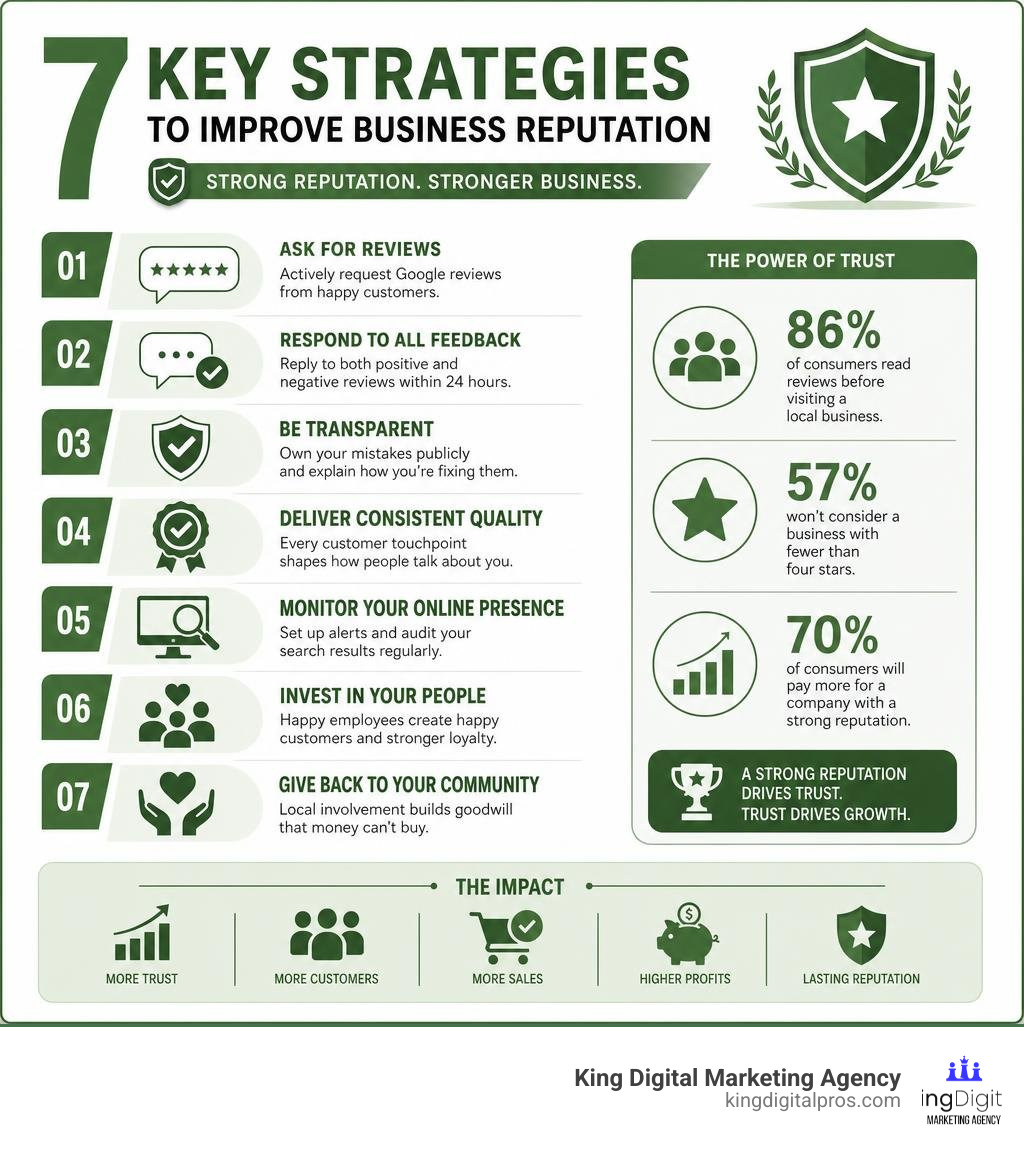
If you want to improve business reputation, here are the most effective steps to take:
- Ask for reviews – Actively request Google reviews from happy customers after every positive interaction.
- Respond to all feedback – Reply to both positive and negative reviews within 24 hours.
- Be transparent – Own your mistakes publicly and explain how you’re fixing them.
- Deliver consistent quality – Every customer touchpoint shapes how people talk about you.
- Monitor your online presence – Set up Google Alerts and audit your search results regularly.
- Invest in your people – Happy employees create happy customers, which builds a stronger reputation.
- Give back to your community – Local involvement builds goodwill that money can’t buy.
Think about the last time you tried a new restaurant, hired a contractor, or bought something from an unfamiliar store. Chances are, you checked the reviews first.
Your customers do the same thing – every single time.
86% of consumers read reviews before visiting a local business. And 57% won’t even consider a business with fewer than four stars. That means your reputation isn’t just a soft, feel-good metric. It’s a revenue driver. It directly controls how many people walk through your door – real or virtual.
Here’s the uncomfortable truth: your reputation is being built right now, whether you’re managing it or not. Every review left unanswered, every complaint ignored, every inconsistent experience – it all compounds over time. As one reputation strategist put it, a business reputation is “the compound interest of a thousand small decisions made visible to the public.”
The good news? You can take control of it – starting today.
I’m Bernadette King, founder of King Digital Marketing Agency, and after years of helping franchise owners and local businesses transform their digital presence, I know that the fastest way to improve business reputation is to stop leaving it to chance and start treating it like the strategic asset it is. In this guide, I’ll walk you through exactly how to do that – step by step, without the jargon.
Improve business reputation terms simplified:
What is Business Reputation and Why It Matters for Growth
At its core, your business reputation is the collective perception of your brand held by customers, employees, partners, and the general public. It is not what you claim to be in your corporate brochures; it is what people actually say about you when you are not in the room. This perception directly shapes your brand equity – the commercial value derived from consumer perception of your brand name rather than from the product or service itself.
When you actively manage and improve your standing, you build a reservoir of goodwill that serves as a protective cushion during challenging times. A robust, positive reputation works around the clock to drive customer acquisition. When prospects search for services in Albuquerque or Rio Rancho, a glittering online footprint does the heavy lifting of pre-selling your brand before a human ever speaks to them.
Furthermore, reputation is the ultimate driver of customer retention. People stick with brands they trust. When you consistently deliver on your brand promise, you eliminate the friction that causes customer churn. Trust building is not a one-time marketing campaign; it is a continuous operational standard that translates directly into long-term enterprise value. For more insights on how this plays out on a local scale, explore our comprehensive guide on local business reputation.
The Direct Link Between Trust and Revenue
The relationship between public perception and your bottom line is highly quantifiable. A strong digital presence directly boosts website conversion rates and accelerates purchase decisions. In our digital-first economy, the path to purchase is paved with online reviews.
Consider these critical benchmarks:
- The Trust Factor: 91% of consumers aged 18 to 34 trust online reviews as much as personal recommendations from friends and family.
- The Star Threshold: 57% of consumers will only buy from a business that has four or more stars. If your business sits at 3.8 stars, you are invisible to more than half of your potential market.
- The Volume Requirement: Consumers read an average of 10 reviews online before they feel they can trust a local business.
When your star rating climbs, your customer acquisition costs plummet. A positive reputation acts as a natural sales funnel, turning cold searchers into warm leads. For a deeper analysis of how modern consumer perception impacts revenue streams, take a look at this strategic Business Online Reputation Guide.
Key Factors That Shape Your Corporate Image
Your corporate image is not a monolith; it is a complex puzzle assembled from multiple internal and external pieces. While marketing can influence perception, the reality of your operations will always dictate your long-term reputation.
To understand where your business stands, we must look at the key drivers that shape public opinion:
| Internal Reputation Drivers | External Reputation Drivers |
|---|---|
| Employee treatment & workplace safety | Customer service quality & responsiveness |
| Product or service quality assurance | Online reviews, ratings, & forum discussions |
| Financial performance & transparency | Media coverage & public relations |
| Corporate Social Responsibility (CSR) | Community involvement & local partnerships |
| Customer data privacy & security standards | Word-of-mouth referrals & social media chatter |
If any of these areas are neglected, the entire structure can collapse. For example, a business can offer a stellar product, but if its customer service is slow or defensive, its public rating will suffer. Conversely, excellent customer service can often rescue a business from a minor product defect if the issue is resolved with speed and empathy.
The Role of Employee Treatment and Company Culture
One of the most frequently overlooked aspects of building a positive public image is what happens inside your own walls. Your employees are your first line of defense and your most influential brand advocates. In the age of social media and employer-review platforms, internal company culture is highly visible to the public. Unhappy employees can quickly undo years of expensive marketing with a single viral post or a series of negative workplace reviews.
On the flip side, treating your team well creates a powerful ripple effect. When employees feel valued, they naturally provide better customer service, resulting in happier clients who leave glowing reviews.
- The CSR Advantage: 77% of consumers prefer to purchase from companies with active corporate social responsibility (CSR) initiatives.
- The Talent Magnet: 55% of employees state they would accept a lower salary to work for a socially responsible company.
By cultivating a healthy, transparent corporate culture, you build an army of authentic spokespeople. To learn how to integrate internal culture into your broader brand strategy, explore this blueprint on building a long-term reputation strategy.
How to Monitor and Measure Your Online Standing
You cannot improve what you do not measure. To build a highly effective reputation strategy, you must first perform a comprehensive reputation audit. This means taking an objective, hard look at what appears when someone types your business name into a search engine.
Monitoring your online standing requires tracking three distinct layers:
- Search Engine Results Pages (SERPs): What articles, profiles, and links rank on the first page of Google?
- Review Platforms: What is your average star rating and review volume on Google, Yelp, and industry-specific directories?
- Social Media & Forums: What are people saying about you on platforms like Reddit, Facebook, and Instagram?
By actively tracking brand mentions and utilizing sentiment analysis – which categorizes online commentary as positive, negative, or neutral – you can identify emerging issues before they spiral into full-blown crises.
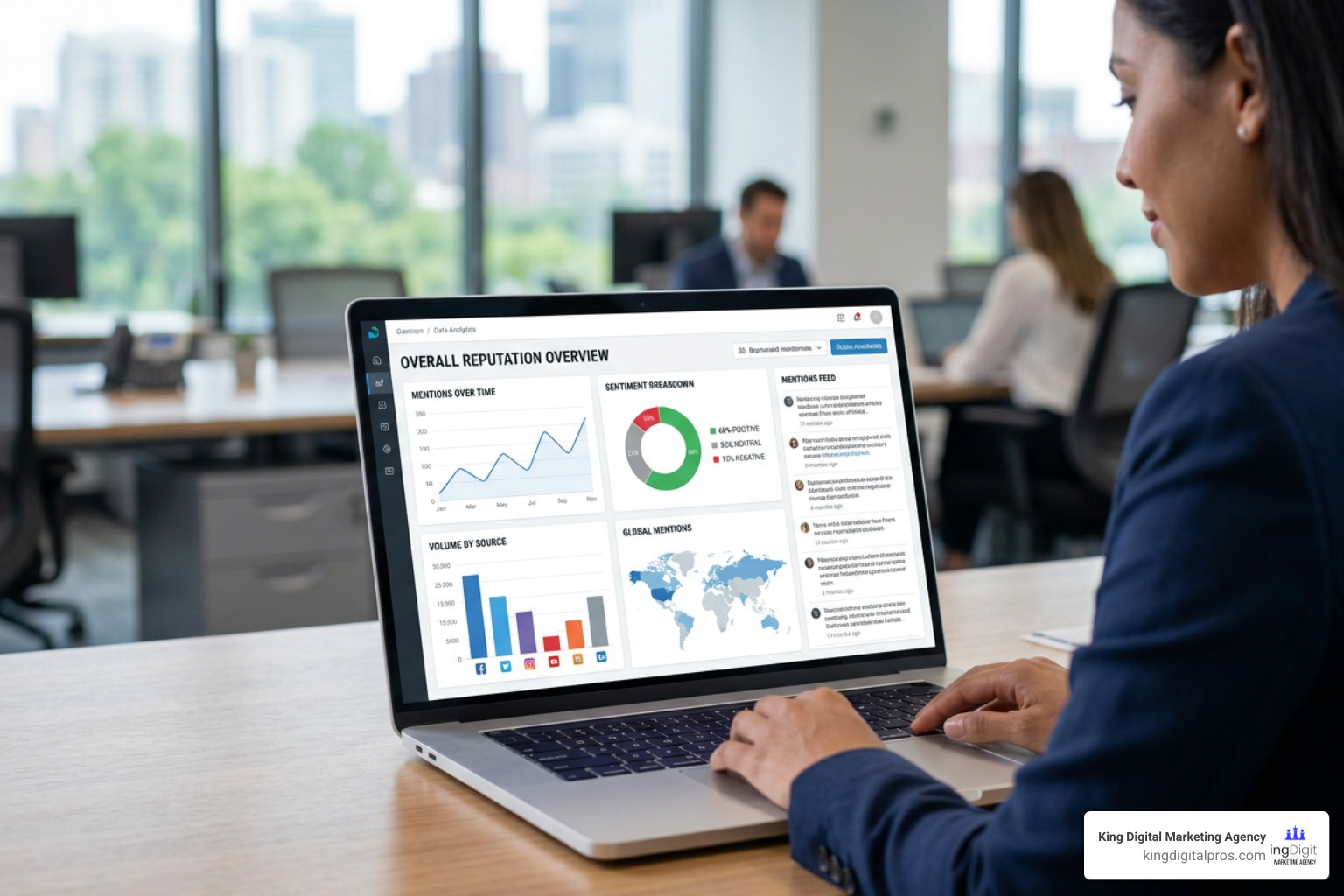
To keep your finger on the pulse of your brand without getting overwhelmed, read our guide on how to master brand reputation monitoring.
Essential Tools and Channels to Track
To build a reliable monitoring system, we recommend using a combination of automated tools and manual check-ins:
- Google Alerts: Set up free alerts for your business name, key executives, and specific product lines. Include high-intent search modifiers like “your business name + scam” or “your business name + reviews” to catch negative content early.
- Review Sites: Regularly monitor Google Business Profile, Yelp, and industry-specific platforms.
- Community Forums: Keep an eye on local discussions. For example, if you operate in New Mexico, watch local subreddits and community forums in Albuquerque, Santa Fe, and Los Alamos to see what residents are saying.
- Social Listening Software: Use tools to track hashtags and direct brand mentions across social channels.
For a deeper dive into the tools and methodologies that are shaping the industry, see this Online Reputation Management Guide.
Actionable Steps to Improve Business Reputation
Improving your reputation requires a proactive, multi-faceted approach. You cannot simply wait for negative search results or poor reviews to disappear; you must actively crowd them out with high-quality, positive assets.
- Build Owned Assets: Create and optimize robust profiles on high-authority platforms like LinkedIn, YouTube, and local chamber directories, such as the Los Alamos Chamber of Commerce.
- Implement SEO Suppression: If you have an unfair or outdated negative article ranking on the first page of Google, you can use ethical search engine optimization to push it down. By publishing high-quality, keyword-optimized content on your own website, you can outrank negative search results and bury them on page two, which receives less than 1% of all search clicks.
- Demonstrate Transparency: When things go wrong, explain what happened, what you are doing to fix it, and provide a clear timeline for resolution.
- Get Involved Locally: Build real-world goodwill by participating in community events, sponsoring youth sports leagues, or partnering with local business associations. For instance, businesses in historic areas can look to resources like Doing Business in Corrales to find local alignment and networking opportunities.
If your brand’s search results need a thorough cleaning, check out our step-by-step playbook to clean up internet reputation.
Leverage Customer Feedback to Improve Business Reputation
The most reliable way to improve business reputation is to build a steady stream of authentic, positive customer reviews. This provides search engines with the fresh user-generated content they crave while offering prospective buyers the social proof they need to trust your brand.
To maximize your review generation efforts:
- Ask at the Right Moment: Request feedback immediately after delivering a successful service or product.
- Reduce Friction: Send a direct, clickable link to your Google Business Profile via email or text message.
- Highlight Your Reviews: Showcase your favorite customer testimonials on your website and social channels.
To learn how to turn customer feedback into a powerful marketing asset, read our guide on how to harness reviews to boost your business reputation online.
Empower Employees to Improve Business Reputation Internally
To ensure your external reputation matches your internal reality, you must equip your team with the training and guidelines they need to succeed.
- Establish a Brand Voice: Define how your business communicates across all channels – whether it is professional, warm, or slightly humorous.
- Provide Customer Service Training: Teach your team how to handle difficult customer interactions with empathy and calm professionalism.
- Maintain Service Consistency: Ensure that whether a customer visits your physical location in Santa Fe or calls your support line in Rio Rancho, they receive the exact same high standard of care.
For a complete look at how to build these internal systems, check out our reputation management systems guide.
How to Handle Negative Feedback and Reviews
No matter how perfectly you run your business, you will eventually receive a negative review or face public criticism. How you respond to that feedback is the ultimate test of your brand’s integrity.
- Speed Matters: 42% of consumers who complain on social media expect a response within an hour.
- Apologize Sincerly: 39% of customers who leave negative reviews do so because they simply want the business to apologize and acknowledge their experience.
- Stay Professional: Your response is not just for the unhappy customer – it is a public performance for every prospective customer who reads it in the future.
To explore the deeper psychology of review management and how it impacts your long-term business growth, read Beyond the Stars: Understanding Review Management.
A Step-by-Step Response Protocol
When a negative review lands on your profile, do not panic or lash out. Instead, follow this structured, battle-tested protocol:
- Take a Deep Breath: Never reply when you are feeling angry or defensive.
- Acknowledge and Empathize: Validate the customer’s feelings without immediately accepting legal liability. A simple “I am so sorry to hear that your experience did not meet our high standards” goes a long way.
- Move the Conversation Offline: Provide a direct phone number or email address to resolve the issue privately. Say: “We would love to make this right. Please contact our manager directly at feedback@kingdigitalpros.com so we can investigate this for you.”
- Fix the Root Cause: Use the feedback to improve your internal operations.
- Request an Update: Once you have successfully resolved the customer’s issue offline, politely ask if they would be open to updating or removing their original review.
For a comprehensive, systems-first approach to dealing with severe reputational challenges and search engine cleanups, consult this Online Reputation Repair Playbook.
Frequently Asked Questions About Business Reputation
How can small businesses build a positive reputation with limited resources?
Building a great reputation does not require a massive corporate budget. If you are a small business operating in places like Tijeras, Edgewood, or Grants, you can leverage your local agility to outshine larger competitors.
- Get Involved Locally: Join local organizations like the Taos County Economic Development or attend networking events to build face-to-face trust.
- Apply for Local Grants: Look for local growth opportunities, such as the New Mexico creative business development grants, which can help fund your marketing and community initiatives.
- The Reverse Review Method: If you run a service business, train your dispatchers to ask for Google reviews from callers who received helpful, free advice over the phone – even if they did not book a job. Providing genuine value upfront is an incredibly powerful way to earn five-star reviews.
What are the costs and trade-offs of reputation management?
Reputation management is an investment of either time or money, and businesses typically choose one of three paths:
- The DIY Route (Low Cost, High Time): Using free tools like Google Alerts and manually replying to reviews. This is great for new startups, but it becomes difficult to scale as your business grows.
- Software Solutions ($30 to $500+/month): Utilizing automated review generation and monitoring platforms. This saves time but still requires internal staff to manage and respond to alerts.
- Professional Agency Services ($1,000 to $5,000+/month): Outsourcing your entire reputation strategy, local SEO, and review management to experts. This path offers the highest return on investment for established businesses, freeing up your time to focus entirely on running your operations.
Can a business remove negative Google reviews?
You cannot directly delete a review simply because it is negative or unfair. However, you can successfully remove a review if it clearly violates Google’s Terms of Service (such as containing hate speech, harassment, fake accounts, or conflicts of interest from competitors).
If a negative review is legitimate, your best course of action is to respond professionally, resolve the customer’s concern, and focus on generating a high volume of positive reviews to naturally dilute the impact of that single negative rating.
Conclusion
In our highly connected digital landscape, your reputation is your most valuable business asset. It can either serve as a powerful engine that drives new customer acquisition, or as a quiet tax that drains your revenue, limits your hiring, and holds your business back from its true growth potential.
At King Digital Marketing Agency, we specialize in helping local businesses in Albuquerque, Rio Rancho, Santa Fe, and the surrounding New Mexico communities take complete control of their online presence. Through expert Google Business Profile optimization, strategic map listing management, and proactive review generation, we ensure that when local customers search for your services, they see a trusted, five-star brand that stands out from the competition.
Do not let a few unanswered reviews or an outdated search result dictate the future of your business. Let us do the heavy lifting of building, protecting, and scaling your brand online.
Ready to transform your online standing? Partner with King Digital for Expert Review Management Services today, and let’s build a reputation that does the selling for you.
