TL;DR:
- Step by step lead generation is a systematic process that guides prospects through five stages: Attract, Capture, Qualify, Nurture, and Convert. Small to medium-sized businesses can measure and scale this process using tools like HubSpot, Salesforce, and Google Lead Forms. Success depends on having a documented system, clear qualification criteria, and fast response times to maximize conversion rates.
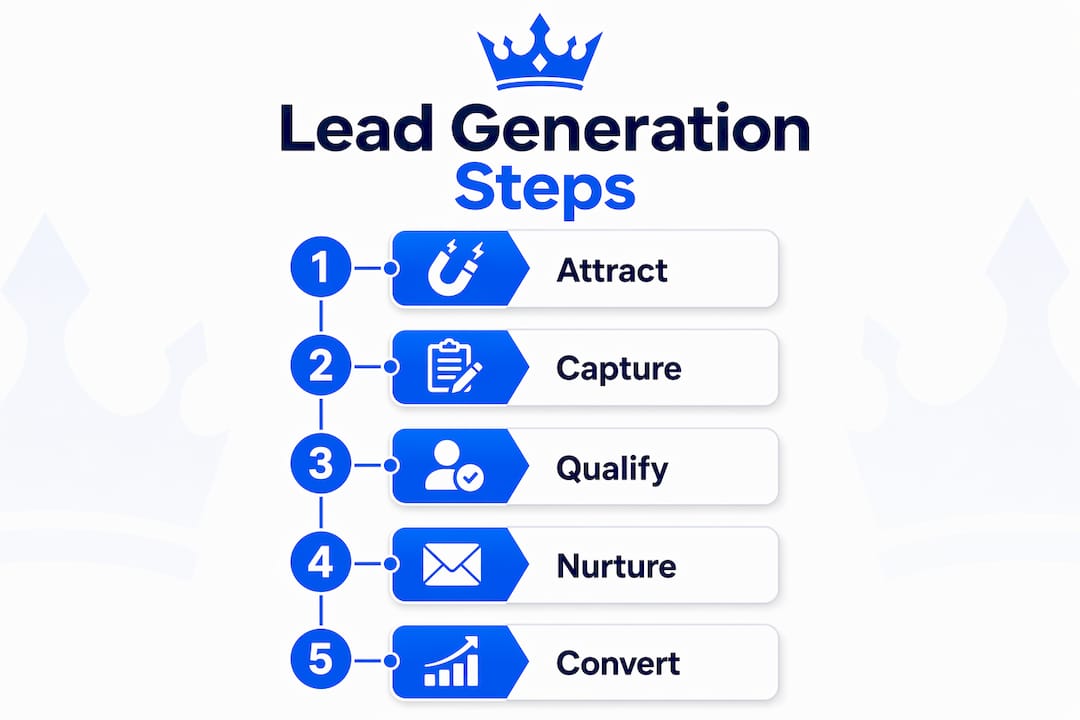
Step by step lead generation is a systematic funnel process that transforms strangers into qualified prospects through five repeatable stages: Attract, Capture, Qualify, Nurture, and Convert. Tools like HubSpot, Salesforce, and Google Lead Forms make this process measurable and scalable for small to medium-sized businesses. The difference between SMBs that grow predictably and those that chase random leads comes down to one thing: a documented system. This guide walks you through every stage of that system, the right tools for each step, and the mistakes that quietly kill conversion rates before a prospect ever talks to sales.
What are the essential stages of step by step lead generation?
The lead generation funnel is a repeatable process that moves prospects from first awareness to a buying decision. HubSpot and Salesforce both map this to the TOFU, MOFU, and BOFU framework, which stands for top, middle, and bottom of funnel. Each stage has a distinct goal, and skipping one breaks the chain.
| Stage | Funnel Position | Primary Goal | Key Activities |
|---|---|---|---|
| Attract | TOFU | Drive targeted traffic | SEO, paid ads, social content |
| Capture | TOFU/MOFU | Collect contact information | Forms, landing pages, lead magnets |
| Qualify | MOFU | Identify sales-ready leads | Lead scoring, progressive profiling |
| Nurture | MOFU | Build trust and intent | Email sequences, retargeting |
| Convert | BOFU | Close the sale | Sales calls, demos, proposals |
Every stage builds on the one before it. Attract without Capture wastes traffic. Capture without Qualify wastes your sales team’s time. Qualify without Nurture loses warm leads to competitors. The stages are not optional. They are the architecture of a working lead generation process.
What tools and tactics work best at each lead generation step?
The right tool at the wrong stage costs you leads. Here is what works at each phase of the lead generation process for SMBs.
Attract phase: content and paid traffic
Organic lead tactics like SEO-driven blog content and Google Business Profile optimization pull in prospects who are already searching for your solution. Paid channels like Google Ads and Meta ads accelerate reach when organic takes time to build. Content marketing tied to specific funnel stages, as outlined in this 2026 content guide, keeps your attract efforts aligned with what buyers actually need to hear at each step.
Capture phase: forms, ctas, and landing pages
Your website is your highest-leverage capture tool. Salesforce advises SMBs to use clear calls to action, simple forms, and automated workflows to reduce the manual burden of lead follow-up. Fewer form fields mean more completions. Strategic CTA design directly influences how many visitors convert into leads on your site.

Google Lead Form ads add another capture layer directly inside search results. Using the “More qualified” option in Google Lead Forms reduces lead volume by 15–25% but improves conversion quality significantly. That trade-off is worth it if your sales team is small and cannot handle high volumes of unqualified inquiries.
Qualify and nurture phase: scoring and automation
- HubSpot CRM: Assigns lead scores based on behavior signals like page visits, email opens, and form submissions
- ActiveCampaign: Automates email nurture sequences triggered by lead actions
- Calendly: Reduces friction at the handoff stage by letting qualified leads book directly
- Google Analytics 4: Tracks which traffic sources produce the highest-quality leads
Lead scoring services help you define the exact threshold where a Marketing Qualified Lead (MQL) becomes a Sales Qualified Lead (SQL). Without that threshold, your sales team wastes time on leads that are not ready.
Pro Tip: Start your nurture sequences with three to five targeted emails before any sales outreach. Email nurture sequences of this length maintain MQL engagement until conversion conditions are met, according to HubSpot.
How to build a lead generation system step by step
Adobe’s 9-step framework and Systemology’s 7-step model both confirm the same sequence. Here is a practical build order for SMBs.
- Define your Ideal Customer Profile (ICP). Identify the specific business size, industry, location, and pain points your offer solves. Without a clear ICP, every other step targets the wrong people.
- Set explicit lead definitions. Agree with your sales team on what makes someone an MQL versus an SQL before you build anything. HubSpot clarifies these definitions rely on behavior and intent signals, not just demographics.
- Build a compelling lead magnet. A free checklist, local market report, or short audit gives prospects a reason to share their contact information. The magnet must solve a specific problem your ICP faces right now.
- Drive targeted traffic. Use SEO, Google Ads, or social media to send the right people to your landing page. Match your traffic source to your ICP’s behavior. Local SMBs in Albuquerque, for example, often see strong returns from Google Business Profile and local search ads.
- Capture leads with low-friction forms. Ask for name, email, and one qualifying question on the first form. Progressive profiling lets you collect more data later through nurture sequences without losing volume at the capture stage.
- Score and qualify automatically. Set up your CRM to score leads based on actions taken after capture. Leads who open three emails and visit your pricing page score higher than those who downloaded one asset and went silent.
- Run automated nurture sequences. Send three to five targeted emails over two to three weeks. Each email should address a specific objection or question your ICP has at that stage of their decision.
- Respond fast. Contacting a lead within 5 minutes increases your odds of qualifying them by 21 times compared to waiting 30 minutes or more. Set a response SLA and enforce it.
- Execute a clean sales handoff. Pass only SQL-qualified leads to your sales team with full context: lead source, score, emails opened, and pages visited. This removes guesswork and shortens the sales cycle.
| Step | Action | Output |
|---|---|---|
| ICP Definition | Profile your best existing customers | Targeting criteria document |
| Lead Magnet | Create a specific, valuable free offer | Landing page asset |
| Traffic | Run SEO and paid campaigns | Qualified visitors |
| Capture | Short form with one qualifying question | Contact database entries |
| Nurture | Automated email sequence | Warmed MQLs |
| Handoff | CRM alert with lead score and history | Sales-ready SQLs |
Pro Tip: Design your funnel backward. Successful funnels are built from the conversion point outward, so every piece of content flows into a single, consistent offer and a low-friction form.
What common mistakes kill SMB lead generation results?
Most SMBs do not fail at generating leads because of bad products. They fail because of process gaps that are entirely fixable.
- Overloaded forms: Asking for phone, company, budget, and timeline on a first-touch form causes abandonment. Limit initial forms to two or three fields.
- Mismatched content: Sending a product demo invitation to someone who just downloaded a beginner’s guide is a premature sales ask. Funnel content must match the buyer’s current stage to build trust gradually.
- Slow lead response: The average business takes over 40 hours to respond to a new lead. That delay costs conversions. Speed-to-lead requires staffing and routing SLAs, not just software automation.
- Blurred MQL and SQL definitions: When marketing and sales disagree on what a “qualified lead” means, sales ignores marketing’s leads and marketing blames sales for poor follow-through. Clear qualification thresholds agreed upon by both teams prevent this friction.
- No nurture sequence: Sending one email after a download and then going silent loses the majority of leads who were interested but not yet ready to buy. A structured sequence keeps your brand present until the timing is right.
- Skipping lead source tracking: If you do not know which channel produces your best leads, you cannot allocate budget wisely. Tag every lead source in your CRM from day one.
Fixing these gaps does not require a large budget. It requires discipline and a documented process your whole team follows.
How can smbs measure and optimize their lead generation efforts?
Measurement is what separates a lead generation system from a lead generation guess. Track these metrics at every funnel stage.
| Metric | What It Measures | Impact Level |
|---|---|---|
| Traffic-to-lead rate | Capture effectiveness of landing pages | High |
| Lead-to-MQL rate | Quality of initial targeting and magnet | High |
| MQL-to-SQL rate | Accuracy of qualification thresholds | Critical |
| Speed-to-lead | Response time from capture to first contact | Critical |
| Cost per lead by source | ROI across paid, organic, and referral channels | High |
| Close rate by lead source | Revenue quality of each acquisition channel | High |
Your CRM, whether HubSpot, Salesforce, or a simpler tool like Zoho CRM, should generate weekly reports on these numbers. A drop in your MQL-to-SQL rate signals a qualification problem. A spike in cost per lead from a specific channel signals a targeting problem. The data tells you exactly where to fix the system, so you are not guessing.
Review your lead management process quarterly. Markets shift, buyer behavior changes, and what worked in Q1 may underperform by Q3. Build optimization into your calendar, not just your intentions.
Key takeaways
Effective lead generation for SMBs requires a documented system that moves prospects through five defined stages, supported by the right tools, clear qualification criteria, and fast response protocols.
| Point | Details |
|---|---|
| Build a five-stage funnel | Attract, Capture, Qualify, Nurture, and Convert are all required for a working system. |
| Define MQL and SQL clearly | Agree on qualification thresholds with sales before launching any campaign. |
| Respond within 5 minutes | Contacting leads fast increases qualification odds by 21 times versus delayed outreach. |
| Use progressive profiling | Start with short forms and collect more data through nurture sequences to protect volume. |
| Measure every funnel stage | Track traffic-to-lead, MQL-to-SQL, and speed-to-lead rates weekly to find and fix gaps. |
What i’ve learned after years of watching smbs generate leads
Most business owners I work with come to us chasing leads. They want more volume. More traffic. More ad spend. What they actually need is a system that converts the leads they already have.
The single biggest shift I see when SMBs start winning at lead generation is when they stop treating it as a marketing activity and start treating it as an operational one. Speed-to-lead is not a marketing metric. It is an operations metric. If your team takes 48 hours to call a new lead, no amount of ad spend fixes that.
The other thing I push hard on is content alignment. I have seen businesses spend thousands on blog content that attracts the wrong buyer or speaks to someone who is already past that stage. A first-time visitor does not want a pricing page. They want proof you understand their problem. Match the message to the moment, and your nurture sequences do the heavy lifting.
My honest advice: start small, document everything, and automate one stage at a time. You do not need a perfect system on day one. You need a working one that you can improve every quarter. The businesses that build lead generation into their operations, not just their marketing calendar, are the ones that grow without chaos.
— Bernadette
How King Digital Marketing Agency helps smbs build real lead generation systems
If you have read this far, you already know that effective lead generation is not a single tactic. It is a system. King Digital Marketing Agency builds those systems for small and medium-sized businesses that are ready to grow with intention.
From local SEO and paid advertising to CRM setup and conversion optimization, King Digital Marketing Agency handles the full lead generation process so you can focus on closing. Our team works exclusively with SMBs, which means our strategies are built for your budget, your team size, and your market. Whether you are starting from scratch or fixing a funnel that is leaking leads, we can help. Visit our digital marketing services page to see how we build lead generation systems that produce measurable results for businesses like yours.
FAQ
What is step by step lead generation?
Step by step lead generation is a structured process that moves potential customers through five stages: Attract, Capture, Qualify, Nurture, and Convert. Each stage has specific tools and goals that build toward a sales-ready prospect.
How many steps does a lead generation process need?
A complete lead generation process requires at least five stages to function reliably. Adobe’s framework uses nine steps, while Systemology’s model uses seven, but both cover the same core sequence from ICP definition to sales handoff.
What is the difference between an MQL and an SQL?
A Marketing Qualified Lead (MQL) has shown interest through behavior like downloading content or visiting key pages. A Sales Qualified Lead (SQL) has met a defined threshold of intent and is ready for direct sales contact, as clarified by HubSpot’s lead scoring guidelines.
How fast should you respond to a new lead?
Responding within 5 minutes of lead capture increases your odds of qualifying that lead by 21 times compared to waiting 30 minutes or more. Most businesses average over 40 hours, which is why speed-to-lead is one of the highest-impact fixes available to SMBs.
What is the best lead generation tool for small businesses?
HubSpot CRM is widely used by SMBs for its free tier, lead scoring features, and email automation. Salesforce suits businesses ready to scale with more complex workflows. Google Lead Forms work well for paid search campaigns where qualification controls matter.
Recommended
- How to Boost Organic Leads for Your SMB in 2026
- Lead generation calculator 2025: Predictable Growth
- Lead generation guide: proven strategies for Albuquerque SMBs
- Lead generation explained: How SMBs in Albuquerque drive growth
