TL;DR:
- Many SMB websites appear fine but are invisible to Google due to technical and architectural issues.
- SEO audits identify critical problems like broken links, missing structured data, and slow site speed impacting ranking.
- Successful SEO requires actionable plans, tailored to local market and business goals, beyond just the audit report.
Most Albuquerque small business owners assume their website is working fine because it looks good. But looks have almost nothing to do with search visibility. 70% of SMB sites are effectively invisible to Google due to technical and architectural failures that go unnoticed without a proper audit. These aren’t obscure issues reserved for large enterprise sites. They’re common, fixable problems hiding inside everyday business websites, quietly draining traffic and leads every single day. An SEO audit is the tool that exposes them.
Table of Contents
- Understanding SEO audits: Definition and purpose
- Key areas analyzed during an SEO audit
- Typical SEO audit findings: Lessons from Albuquerque businesses
- Actionable steps after an SEO audit: Maximizing gains
- The uncomfortable truth: Most SEO audits are only half the solution
- Ready to elevate your Albuquerque business with a tailored SEO audit?
- Frequently asked questions
Key Takeaways
| Point | Details |
|---|---|
| SEO audits reveal hidden gaps | Most SMB sites have invisible technical flaws that audits uncover and fix. |
| Local context is crucial | Tailoring audit fixes for Albuquerque’s market delivers maximum search visibility. |
| Action beats analysis | Applying audit findings promptly leads to measurable gains in website traffic and leads. |
| Prioritize structured data | Missing structured data is a common and costly mistake proven in recent audit studies. |
Understanding SEO audits: Definition and purpose
Now that we’ve outlined the challenge, let’s clarify what an SEO audit really involves.
An SEO audit is a structured evaluation of your website’s ability to rank in search engines. Think of it like a health checkup for your site. A doctor doesn’t guess what’s wrong. They run tests, review results, and build a treatment plan. An SEO audit does the same thing for your online presence. It examines every layer of your website to find what’s working, what’s broken, and what’s holding you back in search results.
For small and medium-sized businesses, audits are especially valuable. You don’t have a massive team monitoring your site around the clock. Problems can sit undetected for months, even years. Architecture failures cost SMBs significant traffic and visibility before anyone realizes something is wrong.
A quality SEO audit typically uncovers issues in these core areas:
- Technical errors: Broken links, crawl blocks, slow load times, and mobile usability failures
- On-page problems: Missing or duplicate title tags, weak meta descriptions, and unoptimized headings
- Content gaps: Pages that don’t target relevant keywords or fail to answer user intent
- Local SEO weaknesses: Inconsistent business listings, missing Google Business Profile data, and absent location signals
- Structured data errors: Missing schema markup that prevents rich results in search
The goal isn’t to generate a 50-page report full of technical noise. The goal is to surface the specific issues costing your business real traffic and real leads. Review our local SEO checklist to see what a strong foundation looks like before your audit begins.
Pro Tip: When reviewing an audit, ask your provider to rank findings by business impact, not just technical severity. A missing title tag on your homepage costs far more than a broken link on a blog post from 2019.
The best audits are actionable. They don’t just tell you what’s wrong. They tell you what to fix first, why it matters, and what improvement you can realistically expect.
Key areas analyzed during an SEO audit
With a clear understanding of an SEO audit’s purpose, let’s break down what gets analyzed during the process.

A thorough SEO audit covers multiple layers of your website. Each layer affects how Google finds, reads, and ranks your pages. Miss one, and you’re leaving visibility on the table.
1. Technical SEO
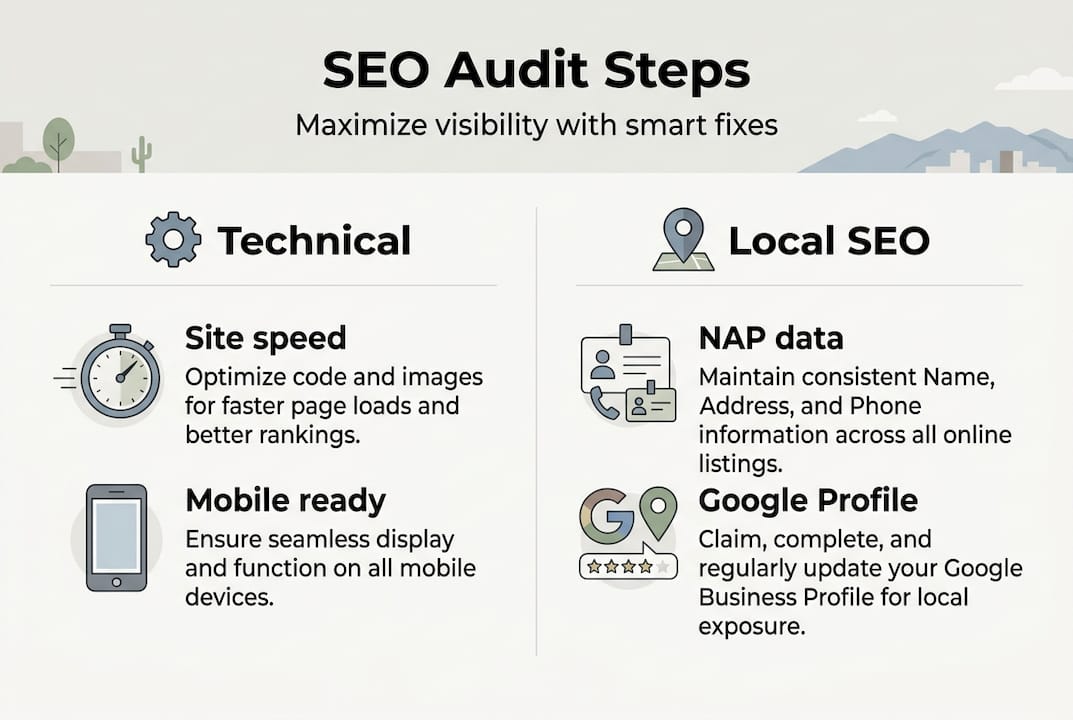
This covers site speed, mobile responsiveness, HTTPS security, and Core Web Vitals. Google uses these signals to determine whether your site delivers a good user experience. A slow, clunky site on mobile is a red flag for both users and search engines.
2. On-page factors
Title tags, headings (H1, H2, H3), meta descriptions, and keyword placement all fall here. These elements tell Google what each page is about. When they’re missing or generic, your pages compete poorly in search results.
3. Site architecture
How your pages link to each other matters. A logical, crawlable SEO website structure helps Google understand your site’s hierarchy and distribute ranking power across your pages.
4. Local signals
For Albuquerque businesses, this is critical. Your Google Business Profile, local citations, NAP (Name, Address, Phone) consistency, and customer reviews all influence how you appear in local search results.
Here’s a quick look at common audit findings and their real business impact:
| Audit finding | Business impact |
|---|---|
| Poor or missing title tags | Loss of 50 to 100 visits per page per month |
| Core Web Vitals failures | Lower rankings, higher bounce rates |
| Missing structured data | No rich results, reduced click-through rates |
| Inconsistent local citations | Confused search engines, lost local rankings |
| Broken internal links | Blocked crawl paths, wasted ranking potential |
The data is clear. 70% of SMB sites are invisible to Google because of these exact failures. Understanding how website design and SEO success connect is the first step toward fixing them strategically.
Typical SEO audit findings: Lessons from Albuquerque businesses
Knowing what’s examined, here’s what real audits in Albuquerque reveal about SMB websites.
When we look at audit data from small business sites, the patterns are striking. The same issues appear again and again, regardless of industry or website age. And the consequences are real, measurable losses in traffic, leads, and revenue.
“The most alarming finding across 30 SMB audits wasn’t one catastrophic error. It was the sheer frequency of the same preventable mistakes, compounding silently over time.”
Missing structured data was found in 26 out of 30 SMB sites audited. Structured data (also called schema markup) is code that helps Google understand your content and display it as rich results, like star ratings, FAQs, or business hours, directly in search. Without it, you’re invisible in those enhanced search features.
Here’s a breakdown of common audit issues and their estimated traffic impact:
| Issue | Estimated monthly visits lost |
|---|---|
| Missing or poor title tags | 50 to 100 per affected page |
| No structured data / schema | Rich result exclusion, 20 to 30% CTR drop |
| Core Web Vitals failure (LCP over 3.5s) | 15 to 25% ranking suppression |
| Duplicate content across pages | Keyword cannibalization, split authority |
| No local landing pages | Lost neighborhood and city-level search traffic |
For Albuquerque SMBs, the local signals category is especially painful. Many businesses have inconsistent NAP data across directories, outdated Google Business Profiles, or no location-specific content at all. These gaps make it hard for Google to trust your relevance for local searches.
The fix often starts with content optimization for SMBs and a clear understanding of the local SEO ranking factors that matter most in your market.
Key issues we see most often in Albuquerque SMB audits:
- Title tags that are either missing, duplicated, or stuffed with irrelevant keywords
- No mobile optimization, despite most local searches happening on phones
- Google Business Profiles that are incomplete or unverified
- Zero schema markup across the entire site
- Pages with thin content that fails to answer what local customers are actually searching for
Each of these is fixable. But you can’t fix what you haven’t found.
Actionable steps after an SEO audit: Maximizing gains
Once you’ve received your audit results, here’s how to turn them into real gains.
An audit without action is just a document. The real value comes from what you do next. Here’s a practical sequence for turning audit findings into measurable improvements.
-
Sort findings by impact, not volume. A 40-item audit report can feel overwhelming. Start by identifying the three to five issues with the highest traffic impact. Usually, these are title tag problems, Core Web Vitals failures, and missing local signals.
-
Fix technical blockers first. If Google can’t crawl or index your pages, nothing else matters. Address crawl errors, broken redirects, and mobile usability issues before touching content.
-
Optimize your highest-traffic pages. Don’t spread effort evenly. Focus on the pages that already get some traffic. Improving their title tags, headings, and content structure often produces fast ranking gains.
-
Localize your content and signals. Add location-specific language to your key pages. Ensure your Google Business Profile is complete and consistent with your website. This is especially important for Albuquerque businesses competing in neighborhood-level searches.
-
Implement structured data. Even basic schema markup (business type, address, reviews) can unlock rich results and improve click-through rates significantly.
Core Web Vitals failures with LCP scores between 3.5 and 5 seconds on mobile are a top visibility killer. If your site loads slowly on a phone, you’re losing rankings before a potential customer ever sees your business name.
Pro Tip: Prioritize fixes that unblock visibility first. A fast, crawlable, locally optimized site will outperform a beautifully designed but technically broken one every time.
Review local SEO best practices to align your post-audit improvements with what Google rewards in 2026. And if budget is a concern, our guide to affordable SEO for small business shows you how to prioritize smartly without overspending.
The uncomfortable truth: Most SEO audits are only half the solution
Here’s something most SEO providers won’t tell you. An audit report is not a strategy. It’s a starting point.
We’ve seen Albuquerque business owners receive detailed, technically accurate audits and then do nothing with them because the findings weren’t translated into a clear, prioritized action plan. The audit identified the problem. But without local context, business goals, and a realistic roadmap, it just sat in someone’s inbox.
Generic SEO advice doesn’t account for Albuquerque’s specific competitive landscape, your industry’s search behavior, or your business’s capacity to implement changes. A restaurant in Nob Hill has different needs than a contractor in Rio Rancho, even if their audit findings look similar on paper.
The businesses that win are the ones that treat an audit as the beginning of a conversation, not the end of a project. They work with someone who understands digital marketing for SMBs at a local level and can turn findings into a tailored, executable plan. That’s the difference between knowing what’s wrong and actually fixing it.
Ready to elevate your Albuquerque business with a tailored SEO audit?
If you’re ready to go beyond simple audits, here’s how to get support tailored for your Albuquerque business.
At King Digital, we don’t hand you a report and walk away. We build a clear, prioritized action plan based on your specific site, your market, and your goals.
Our local marketing SEO services are designed specifically for Albuquerque SMBs who want real visibility, not just a checklist. Start with our SEO checklist for SMBs to benchmark where you stand today. Then explore the Albuquerque SEO ranking factors that matter most in your market. When you’re ready to move forward, we’re here to make it happen.
Frequently asked questions
What makes an SEO audit different from a regular website review?
An SEO audit uses advanced technical checks to detect issues impacting search visibility, such as architecture failures costing SMBs organic visits, not just surface-level design flaws. A regular website review focuses on appearance and functionality, while an SEO audit focuses on how search engines find and rank your pages.
How often should Albuquerque businesses conduct an SEO audit?
Most SMBs benefit from a full SEO audit every 6 to 12 months or after any major website changes, such as a redesign or platform migration. Regular audits help you catch new issues before they compound into larger visibility losses.
What is the biggest SEO issue found in audits of local business sites?
Architecture failures and missing structured data in 26 out of 30 SMB sites are the most frequent findings, making 70% of local business websites nearly invisible on Google. These issues are common but highly fixable with the right guidance.
Can I fix audit findings on my own, or do I need a pro?
Some issues, like updating title tags or compressing images for faster load times, can be handled in-house with basic guidance. However, technical fixes like structured data implementation, crawl error resolution, and strategic content improvements typically deliver better results with expert support.
Recommended
- Boost leads in Albuquerque: on-page SEO best practices
- SEO checklist for small businesses: boost local visibility
- Albuquerque SEO: Get Found, Get Customers, Get Results | King Digital Marketing Agency
- SEO ranking factors: Local Albuquerque guide for SMBs
