
How Does Location-Based Advertising Work? (Quick Answer)
How does location based advertising work is a question every local business owner should understand — because the answer could change how you attract customers forever.
Here’s the short version:
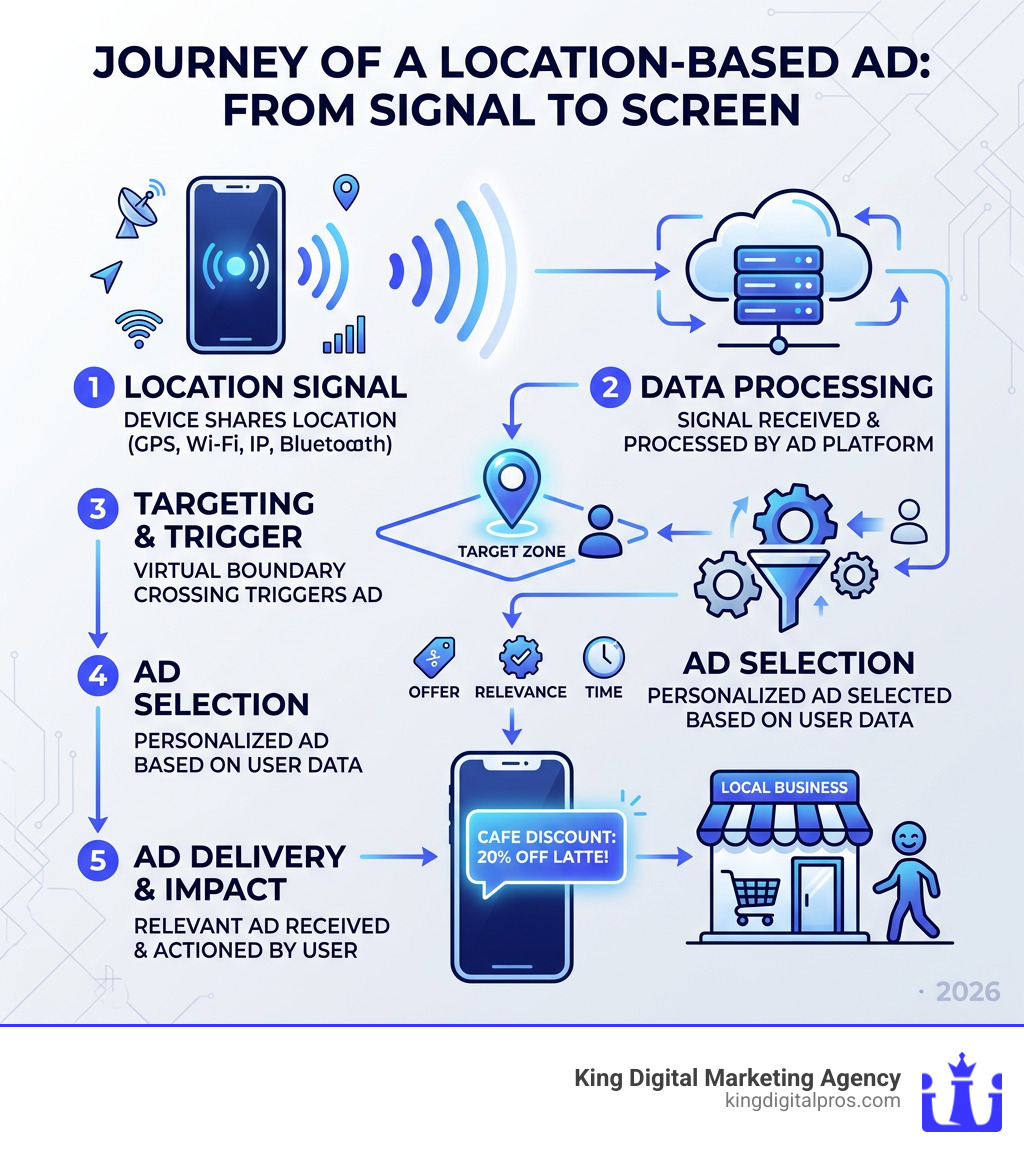
- Your device shares its location via GPS, Wi-Fi, IP address, or Bluetooth.
- A virtual boundary or location rule is set by an advertiser (e.g., within 1 mile of a store).
- When you enter that zone, an ad is triggered and delivered to your device.
- The ad is personalized based on where you are, what’s nearby, and sometimes the time of day.
- You see a relevant offer — a discount, a reminder, a push notification — at exactly the right moment.
That’s it. Location data in. Relevant ad out.
Imagine walking past a coffee shop and your phone buzzes with a “20% off your next latte” notification. You weren’t planning to stop — but now you are. That’s location-based advertising doing exactly what it’s designed to do: reach the right person, in the right place, at the right time.
This isn’t guesswork. It’s precision marketing powered by the device already in your pocket.
For local businesses, this matters enormously. 61% of local searches result in a purchase within 24 hours. And nearly 90% of marketers report that using location-based marketing directly boosted their sales. The technology is no longer reserved for big brands with massive budgets — it’s accessible, measurable, and increasingly essential.
I’m Bernadette King, founder of King Digital Marketing Agency, and I’ve spent years helping local businesses and franchise owners use strategies like location-based advertising to turn online visibility into real-world foot traffic and revenue. In this guide, I’ll break down exactly how does location based advertising work — from the tech behind the targeting to the tactics that drive results — so you can make smarter decisions for your business.
Terms related to how does location based advertising work:
- Key features of place-based advertising for multi-location businesses
- Location marketing
- Place-based advertising platform multiple locations campaign management
What is Location-Based Advertising and How Does It Differ from Traditional Methods?
Traditional advertising is like casting a massive net into the Rio Grande and hoping you catch a specific type of trout. You buy a billboard on I-25 or a radio spot in Albuquerque, and you hope the right person sees it at the right time. It’s broad, it’s static, and honestly, it’s often ignored.
Location-based advertising (LBA) is the digital upgrade. Instead of a wide net, it’s a precision lure. It uses real-time geographical data to deliver messages that are contextually relevant to where a user is standing right now.
The biggest difference lies in relevance and personalization. According to McKinsey, 71% of consumers expect personalized experiences from brands. While a traditional TV ad might show a generic commercial for a national chain, location-based ads can highlight a specific deal at the Santa Fe or Los Alamos branch of that same business.
This creates a “magic” moment for the consumer. When an ad acknowledges their local environment—like mentioning a local event or the current weather in Rio Rancho—engagement rates skyrocket. In fact, research shows that location-based marketing can boost conversions by up to 27%. To see how this transition from broad to local is happening in other mediums, check out our guide on local-tv-global-impact-the-magic-of-geo-targeted-ads.
How Does Location Based Advertising Work?
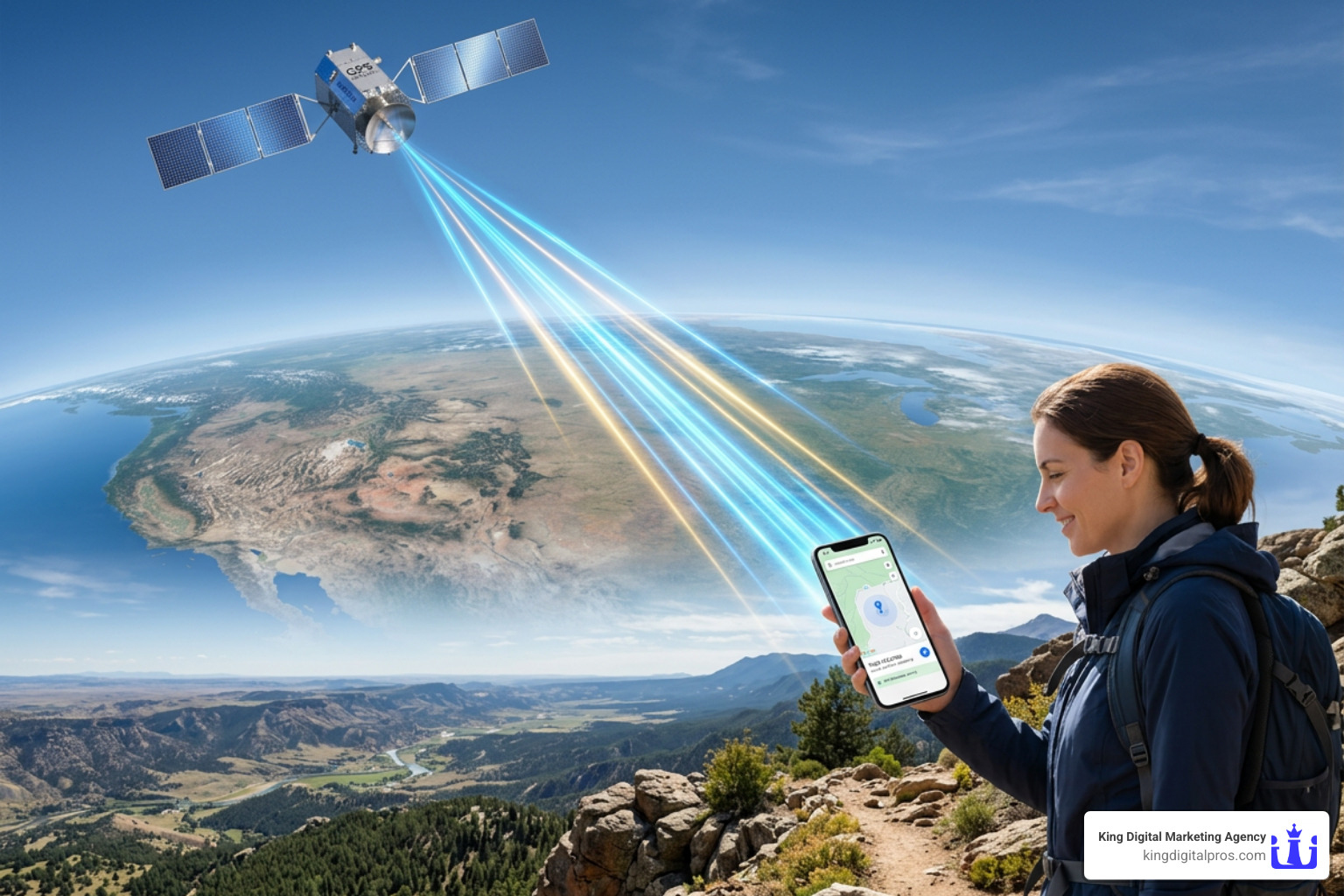
At its core, understanding how does location based advertising work requires looking at the invisible signals our devices send out every second. Your smartphone is essentially a beacon that communicates with satellites, cell towers, and routers to pin down your coordinates.
When we set up a campaign for a client, we define a “target area.” This could be a 5-mile radius around a storefront in Taos or a specific street corner in Grants. The advertising platform (like Google Ads or Meta) then monitors for users whose device signals match those coordinates. When a match occurs, the system serves the ad through a mobile app, a website, or a social media feed.
To dive deeper into the mobile side of this tech, see our breakdown of targeted-mobile-advertising.
The Role of GPS and IP Addresses in How Location Based Advertising Works
The “how” depends largely on the source of the data. Different technologies offer different levels of “Lat/Long” (latitude and longitude) accuracy.
- GPS (Global Positioning System): This is the gold standard for accuracy. By using a network of satellites to triangulate a device’s position, GPS can pinpoint a user within a few meters. This is what powers high-precision “blue dot” navigation and hyper-local ads.
- IP Addresses: Every internet connection has an IP address. While useful for broad targeting (knowing a user is in Albuquerque vs. Santa Fe), it’s less precise for “street-level” marketing. It’s often used for desktop users or broad regional campaigns.
| Technology | Accuracy | Range | Best Use Case |
|---|---|---|---|
| GPS | 5–20 Meters | Global | Outdoor hyper-local targeting |
| Wi-Fi | 10–50 Meters | Building/Block | Urban areas and indoor malls |
| IP Address | City/Zip Level | Regional | Broad brand awareness |
| Beacons | 1–3 Meters | Room/Aisle | In-store product promotions |
Proximity Tech: Beacons and Wi-Fi in How Location Based Advertising Works
When you move indoors—say, into a large shopping center in Rio Rancho—GPS signals can get weak. This is where proximity technology takes over.
- Beacons: These are small Bluetooth Low Energy (BLE) devices placed physically inside a location. They send out a signal that a smartphone can detect if it has the right app installed. This allows for “micro-location” targeting. Imagine walking into a hardware store and getting a notification for the exact aisle where the air filters are on sale.
- Wi-Fi Marketing: Many businesses offer free Wi-Fi. When a user connects (or even just has Wi-Fi enabled), the router can identify the device’s proximity. This is a great way to engage customers who are already on-site.
These tactics fall under the umbrella of place-based advertising, which focuses on reaching people in specific physical environments.
Core Strategies: Geofencing, Geotargeting, and Geo-Conquesting
Once you have the tech in place, you need a strategy. Marketers use different “fences” to capture attention. To get a foundational understanding, you can read our geofencing-marketing-meaning-guide.
Geofencing vs. Geotargeting
While people often use these terms interchangeably, they function differently in how does location based advertising work.
- Geofencing: This creates a virtual “boundary” around a specific point. It is dynamic and trigger-based. When someone crosses that line, boom—the ad is delivered. It’s perfect for immediate action, like driving someone into a store they are currently walking past. Curious about the investment required? We’ve broken down the geofencing-advertising-cost for you.
- Geotargeting: This is usually broader. It targets users based on their location but often includes other factors like interests or demographics. For example, you might target “people in Santa Fe who are interested in hiking.” It’s less about a specific “fence” and more about a geographic audience.
For a more exhaustive look, check out our geofencing-marketing-complete-guide.
Geo-Conquesting and Event-Based Targeting
One of our favorite “aggressive” tactics is Geo-Conquesting. This involves drawing a geofence around your competitor’s location. If a customer is at a rival shop in Albuquerque, you can serve them an ad with a better offer to lure them away.
A famous example is Burger King’s “Whopper Detour” campaign. They geofenced McDonald’s locations and offered a 1-cent Whopper to anyone who opened the BK app within 600 feet of a Golden Arches. It resulted in 3.2 million app downloads and a massive 37:1 ROI.
Event-Based Targeting works similarly but focuses on a time and place—like a festival in Taos or a conference in Los Alamos. You can reach a highly concentrated group of potential customers exactly where they are gathered. There are 7-game-changing-benefits-of-geofence-marketing-for-your-business that make these strategies worth the effort.
Privacy, Consent, and the Evolving Regulatory Landscape
We can’t talk about how does location based advertising work without addressing the elephant in the room: privacy.
Modern advertising is built on consent. Regulations like the General Data Protection Regulation (GDPR) and California Consumer Privacy Act (CCPA) have changed the game. Advertisers cannot simply track you without permission.
Most location data is collected through “opt-in” prompts on mobile apps. You’ve likely seen the popup: “Allow this app to access your location?”
To maintain trust, we always recommend:
- Transparency: Tell users why you need their location.
- Value Exchange: Give them something in return (like a discount).
- Anonymization: Use aggregated data so you aren’t tracking “John Doe,” but rather “a user interested in coffee.”
If you’re a marketing agency looking to offer these services, our whitelabel-geofencing-marketing-software-guide explains how to handle these technicalities at scale.
Measuring Success: Foot Traffic and Attribution
The real “magic” of location-based ads is that they bridge the gap between the digital and physical worlds. In traditional marketing, it’s hard to know if a billboard actually caused someone to walk into your store. With LBA, we use Foot Traffic Attribution.
By matching the device ID that saw an ad with the device ID that later entered the store (detected via GPS or Wi-Fi), we can calculate a direct “Store Visit” metric.
Key KPIs we track include:
- Walk-in Rate: The percentage of people who saw the ad and then visited the location.
- Cost Per Visit (CPV): How much you paid in ads for every person who walked through the door.
- ROAS (Return on Ad Spend): Comparing the revenue generated from those visits to the cost of the campaign.
For a deeper dive into how these metrics transform your strategy, read geofencing-demystified-how-location-based-marketing-can-transform-your-digital-strategy.
Frequently Asked Questions about Location-Based Ads
Is location-based advertising considered “creepy” by users?
It can be if done poorly. Research shows that 55% of people find immediate, unprompted location tracking “creepy.” However, when there is a clear value exchange—like a discount for a shop you are already near—consumers are much more accepting. The key is to be helpful, not haunting.
Does location targeting work on both iOS and Android devices?
Yes, but the implementation differs. Android devices often share more background data, while Apple’s App Tracking Transparency (ATT) requires explicit permission for every app. However, location services are a core feature of both operating systems, making LBA viable for nearly all smartphone users.
How small can a geofence radius actually be?
Technically, you can set a geofence as small as a few meters (especially with beacons). However, for GPS-based geofencing, we usually recommend a minimum radius of 200-500 feet in urban areas like Albuquerque to account for signal drift and ensure the system has time to trigger the ad.
Conclusion
Understanding how does location based advertising work is the first step toward dominating your local market. Whether you are a small boutique in Corrales or a large franchise with locations across Santa Fe and Albuquerque, the ability to reach customers based on their physical proximity is a game-changer.
At King Digital Marketing Agency, we specialize in making your business “findable.” While geofencing and LBA are powerful tools, they work best when paired with a rock-solid local foundation. We help businesses optimize their Google Business Profiles and manage their map listings to ensure that when a customer is nearby and looking for what you offer, you are the first thing they see.
Ready to turn those digital pins into real-world customers? Explore our geofencing-marketing services today and let’s put your business on the map—literally.