TL;DR:
- Effective local SEO budgeting starts with a thorough audit that reveals business strengths and weaknesses.
- Budget should be connected to measurable goals, such as customer lifetime value and specific local search targets.
- The 70/20/10 allocation model prioritizes Google Business Profile management, technical SEO, and link building for best results.
Local SEO budget planning is the process of allocating funds across specific search optimization activities to increase your business’s visibility in local search results. For Albuquerque business owners, getting this right separates businesses that consistently appear in Google’s Map Pack from those that stay invisible to nearby customers. The local SEO budget planning steps covered here follow a proven framework: audit your current position, set measurable goals, apply a structured allocation model, and build a phased 12-month plan. Done correctly, budgeting for local SEO is not an expense. It is a calculated investment in customer acquisition.
What foundational assessments do you need before setting your local SEO budget?
A budget built without a baseline is just guessing. Before you allocate a single dollar, you need a clear picture of where your business stands in local search today.
Start with a foundational SEO audit of your website and your Google Business Profile. The audit reveals broken pages, missing schema markup, slow load times, and incomplete profile information. These are the issues that silently drain your visibility before any budget is spent.
The 7-step SEO budget planning process begins with exactly this kind of audit, followed by competitive analysis and operational model selection. That sequence matters because your audit findings directly shape how much you need to spend and where.
For Albuquerque businesses, competitive benchmarking is especially useful. Search your primary service keywords in Google Maps and note which businesses consistently appear. Look at their review counts, photo volume, and posting frequency. That gap between their profile and yours is a budget signal.
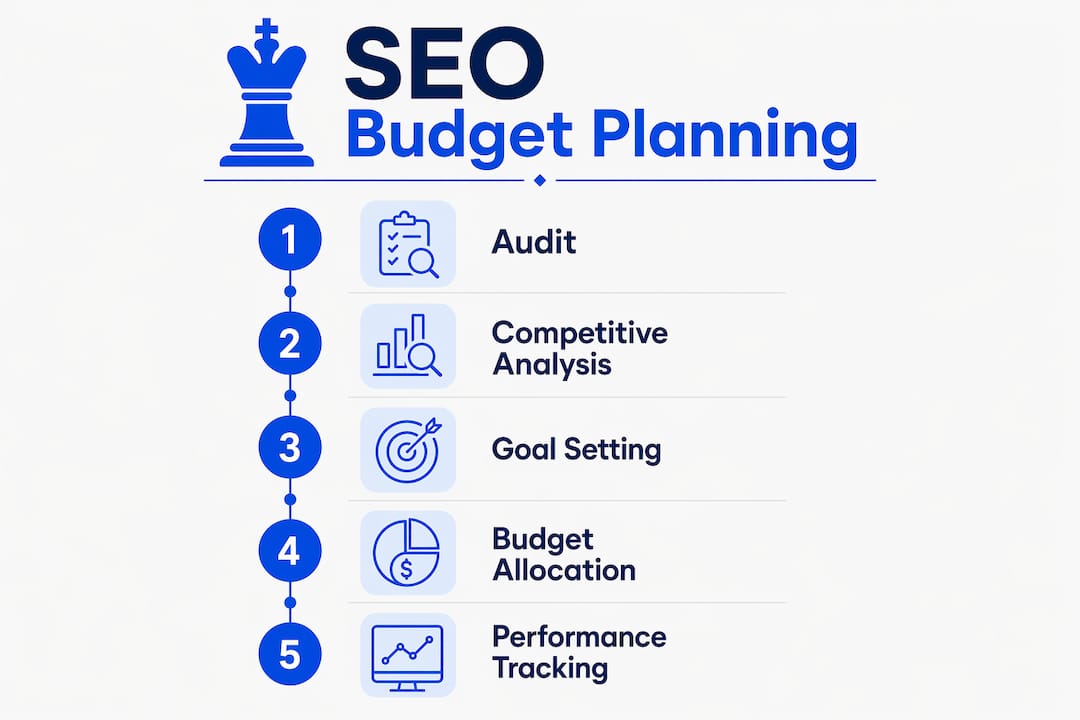
The audit also forces a realistic answer to the DIY versus outsourcing question. Budget tiers vary widely: DIY approaches typically run $0–$100 per month, freelancers run $200–$400 per month, and full-service agencies run $1,500–$5,000 or more per month. Your internal capacity, time, and growth goals determine which tier fits.
Key pre-budget checklist:
- Audit your Google Business Profile for completeness, photo count, and recent posts
- Run a technical site audit to identify crawl errors, page speed issues, and missing schema
- Review your current local keyword rankings and Map Pack appearances
- Assess competitor profiles in your Albuquerque service area
- Honestly evaluate your team’s capacity to execute SEO tasks in-house
Pro Tip: Use Google Search Console and Google Business Profile Insights as your free starting point. Both tools show you exactly where you are losing clicks and impressions before you spend anything.
How do you define measurable goals and connect budget to business outcomes?
The most common local SEO budgeting mistake is setting a dollar amount before setting a goal. Your budget should be a function of what you want to achieve, not the other way around.
Start with specific, measurable business outcomes. “More website traffic” is not a goal. “Generate 30 qualified leads per month from local search within 6 months” is a goal. That specificity lets you calculate what the investment is worth.
Customer lifetime value (LTV) is the most reliable tool for justifying your SEO budget. If a new customer is worth $3,000 to your business over their lifetime, then a $1,500 monthly SEO retainer that generates even two new clients per month produces a clear return. Most local business owners who approach budgeting this way stop seeing SEO as a cost and start treating it as a revenue driver.
“Successful local SEO budgeting links investment to customer lifetime value, making a $1,500–$2,500 monthly SEO retainer a sensible business decision when you compare it to expected revenue per new client.”
Align your goals with your marketing funnel. Awareness-stage goals (ranking for broad local terms) require different activities than conversion-stage goals (optimizing your Google Business Profile for calls and direction requests). Budget allocation shifts depending on which stage needs the most attention.
Build your goals into quarterly phases. Quarter one focuses on fixing foundational issues. Quarter two shifts toward content creation and profile activity. Quarters three and four focus on scaling what is working. This phased structure keeps your spending purposeful and your expectations realistic.
Goal-setting framework for local SEO:
- Define lead volume targets by month and quarter
- Calculate your customer LTV to set a logical budget ceiling
- Identify which funnel stage (awareness, consideration, conversion) needs the most investment
- Set ranking targets for your top 5 local keywords in Albuquerque
- Establish a review acquisition goal tied to your Google Business Profile
What are the recommended budget allocation models for local SEO?
The 70/20/10 allocation model is the most effective framework for local SEO budgeting. It directs 70% of your budget to Google Business Profile management and hyper-local content, 20% to technical SEO, and 10% to link building. This split reflects where local search rankings are actually won.
| Budget Category | Allocation | Core Activities |
|---|---|---|
| GBP and local content | 70% | Weekly posts, 20–30 photos, service descriptions, Q&A responses |
| Technical SEO | 20% | Schema markup, site speed, mobile optimization, crawl fixes |
| Link building | 10% | Local citations, community outreach, quality directory listings |

The 70% GBP and content focus is not arbitrary. Businesses with photos on their Google Business Profile receive 42% more driving direction requests. That single data point explains why GBP management deserves the largest share of your budget. An active, photo-rich profile with regular posts signals credibility to both Google and potential customers.
Technical SEO at 20% covers the infrastructure your content depends on. Schema markup helps Google understand your business type, location, and services. Page speed directly affects both rankings and conversion rates. These fixes are typically one-time or quarterly investments, so the 20% allocation front-loads early in your plan and decreases over time.
Link building at 10% focuses on quality, not volume. For Albuquerque businesses, this means citations in local directories, mentions from neighborhood organizations, and outreach to complementary local businesses. Automated directory submissions waste budget. Manual, relevant outreach builds the kind of authority that moves rankings.
Pro Tip: Avoid spending budget on low-impact automated citation blasts. One well-placed mention from an Albuquerque Chamber of Commerce page or a local news site carries more weight than 50 generic directory listings.
The scope of work matters more than the price tag. A budget that covers active GBP management, technical schema implementation, and review responsiveness will outperform a larger budget spent on passive or automated tasks.
How do you build a phased 12-month local SEO budget plan?
A phased annual budget plan aligns your spending with where your business actually is in its SEO development. Trying to scale content before fixing technical issues is like painting a house with a cracked foundation. The phases prevent that mistake.
Phase 1: Months 1–3 (Foundation)
- Complete your technical SEO audit and fix critical errors
- Fully optimize your Google Business Profile with photos, services, and descriptions
- Conduct local keyword research for your top Albuquerque service areas
- Set up Google Search Console and Google Business Profile Insights tracking
- Establish your baseline rankings for target keywords
Phase 2: Months 4–6 (Content and Engagement)
- Publish location-specific service pages targeting Albuquerque neighborhoods
- Begin a consistent weekly GBP posting schedule
- Launch a review acquisition process for satisfied customers
- Build your first round of local citations and directory listings
- Review ranking progress against your Phase 1 baseline
Phase 3: Months 7–12 (Scale and Amplify)
- Expand content to cover related local search topics and FAQs
- Increase link building outreach to local organizations and media
- Analyze which GBP post types and content formats drive the most engagement
- Adjust budget allocation based on performance data
- Plan the following year’s budget using 12 months of actual performance data
Albuquerque’s market has seasonal patterns worth noting. Service businesses tied to construction, landscaping, or HVAC see search volume spikes in spring and summer. Retail and restaurant businesses peak around the holidays. Align your content and GBP activity calendar with those patterns to capture demand when it is highest.
Monthly local SEO services in typical metro areas run from $500 to $5,000 depending on competition, site health, and number of locations. Albuquerque sits in a mid-competition range for most service categories, which means a well-structured budget of $1,000–$2,500 per month is realistic for most small businesses aiming for Map Pack visibility.
Track your key performance metrics monthly: Map Pack appearances, website sessions from organic search, Google Business Profile calls, and direction requests. Review your full budget allocation quarterly and adjust based on what the data shows.
Key Takeaways
Effective local SEO budgeting starts with a clear audit, connects every dollar to a measurable business goal, and follows a structured allocation model to maximize return on investment.
| Point | Details |
|---|---|
| Audit before budgeting | Complete a technical and GBP audit before setting any dollar amounts. |
| Link budget to LTV | Use customer lifetime value to justify and size your monthly SEO investment. |
| Apply the 70/20/10 model | Allocate 70% to GBP and content, 20% to technical SEO, and 10% to link building. |
| Phase your 12-month plan | Start with technical fixes, then build content, then scale in quarters three and four. |
| Track and adjust quarterly | Review Map Pack appearances, calls, and organic sessions every quarter to reallocate budget. |
What I’ve learned about local SEO budgeting that most guides skip
Most local SEO budget guides spend a lot of time on numbers and almost no time on mindset. The business owners I see get the best results are the ones who stop asking “How little can I spend?” and start asking “What is a new customer worth to me?”
That shift changes everything. When you know a new client is worth $4,000 over two years, a $1,500 monthly SEO investment looks completely different. It is not a marketing expense. It is a customer acquisition system with a measurable cost per lead.
The other thing I see consistently: business owners underestimate the value of an active Google Business Profile. Posting once a week, responding to every review, and keeping your photos current are not optional extras. They are the core of what drives Map Pack rankings for local businesses in Albuquerque. You can have a technically perfect website and still lose to a competitor whose GBP is more active.
My honest advice on the in-house versus agency question: be realistic about your time. DIY local SEO is possible, but it requires consistent weekly effort. If you cannot commit to that, a mid-tier agency investment will almost always outperform a neglected DIY approach. The local SEO best practices that move rankings require discipline and consistency, not just knowledge.
Start with the audit. Set a goal tied to revenue. Apply the 70/20/10 model. Review the numbers every quarter. That process works. I have seen it work for Albuquerque businesses across every service category.
— Bernadette
How King Digital Marketing Agency supports your local SEO budget plan
Knowing the steps is one thing. Executing them consistently while running a business is another challenge entirely. King Digital Marketing Agency works with Albuquerque small businesses to build and manage local SEO plans that connect directly to lead generation and revenue goals.

From SEO-friendly website design that builds the technical foundation your budget depends on, to active Google Business Profile management and local content creation, King Digital Marketing Agency handles the execution so you can focus on your customers. The team brings in-house expertise and personalized attention that larger agencies simply do not offer. If you want a clear plan for your local search visibility in Albuquerque, King Digital Marketing Agency is ready to build it with you.
FAQ
What is a realistic monthly local SEO budget for a small business?
Monthly local SEO services typically run from $500 to $5,000 depending on competition level, site health, and number of locations. Most Albuquerque small businesses see strong results in the $1,000–$2,500 range.
How do I know if my local SEO budget is working?
Track Map Pack appearances, Google Business Profile calls, direction requests, and organic website sessions monthly. Quarterly reviews of these metrics show whether your budget allocation is producing results.
What is the 70/20/10 local SEO budget model?
The 70/20/10 model allocates 70% of your budget to Google Business Profile management and local content, 20% to technical SEO, and 10% to link building. This split prioritizes the activities that most directly influence local search rankings.
Should I do local SEO myself or hire an agency?
DIY local SEO costs $0–$100 per month but requires consistent weekly effort. A full-service agency runs $1,500–$5,000 per month and handles execution for you. The right choice depends on your available time, growth goals, and customer lifetime value.
How long does it take to see results from local SEO investment?
Most local businesses see measurable ranking improvements within 3–6 months of consistent SEO activity. A phased 12-month plan builds momentum gradually, with the strongest results typically appearing in months 7–12.
Recommended
- Website content optimization steps for Albuquerque SMBs
- SEO trends that will drive Albuquerque small business growth
- Boost leads in Albuquerque: on-page SEO best practices
