Why Choosing the Right Review Software Can Make or Break Your Business
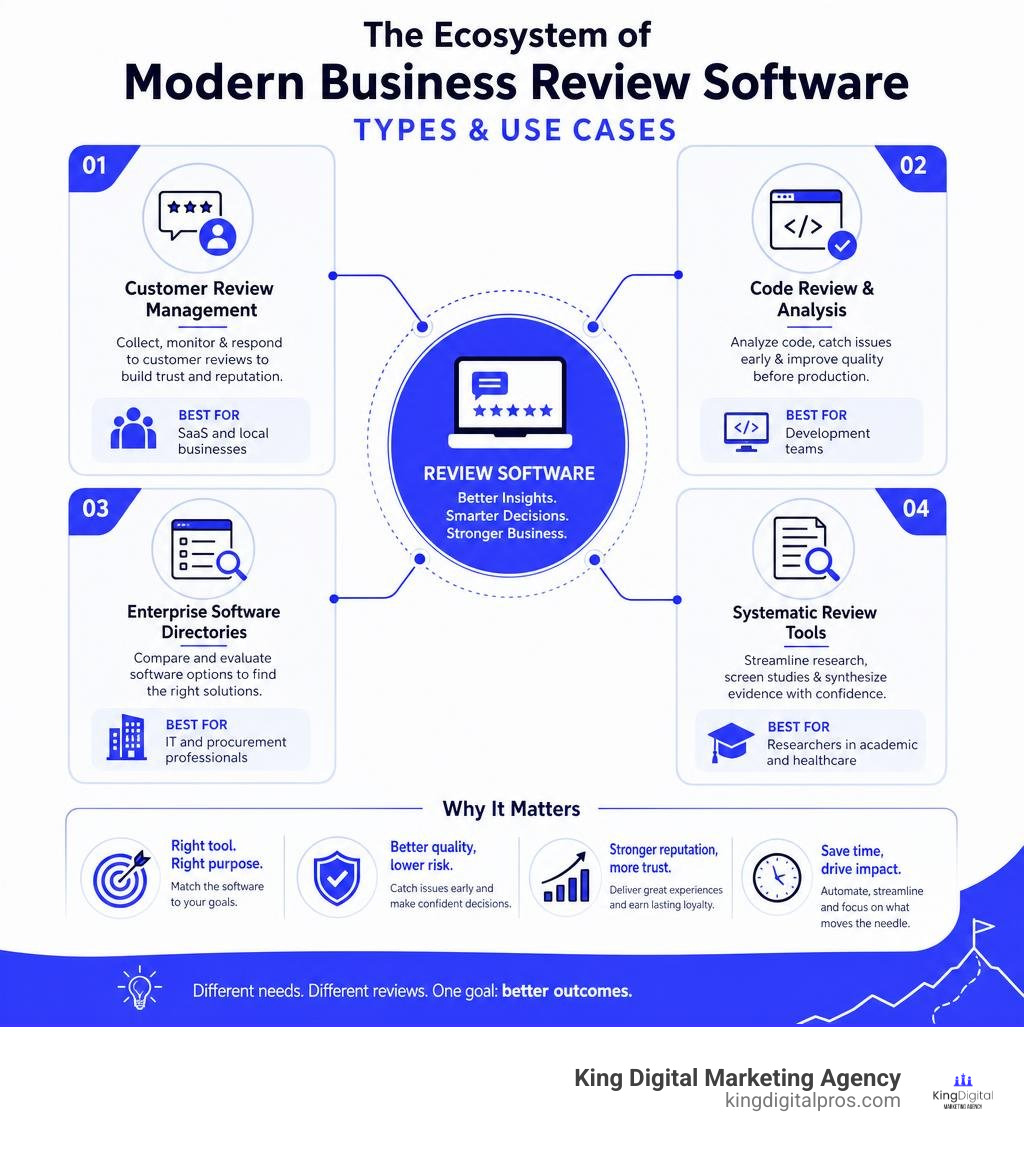
The term review software covers a surprisingly wide range of tools – and picking the wrong one wastes time and money. Here’s a quick look at the main categories to help you find what fits your needs:
| Type | Best For | Examples |
|---|---|---|
| Customer review management | SaaS and local businesses building online reputation | G2, Capterra, Revly |
| Code review and analysis | Dev teams catching bugs before production | MicroReview, Sigilix, Review.ai |
| Enterprise software directories | IT buyers comparing vendor options | SoftwareReviews, TrustRadius |
| Systematic review tools | Academic and healthcare researchers | Covidence |
Not all review tools do the same thing. A developer tool that scores pull requests won’t help you collect customer feedback on G2. And a reputation management platform won’t catch a hardcoded API key before it ships to production.
The stakes are real on both sides. According to industry data, a bug caught in code review costs around $100 to fix – but that same bug in production can cost $1,000 or more. On the customer reputation side, B2B buyers routinely sort reviews by lowest star rating first to see how responsive a vendor really is.
Knowing which type of review software you actually need is step one.
I’m Bernadette King, founder of King Digital Marketing Agency, where I’ve spent years helping businesses build credibility and visibility online – including navigating the messy, high-stakes world of review software and reputation management. In the sections below, I’ll break down every major category so you can make a confident, ROI-focused decision.
Must-know review software terms:
Understanding the Core Types of Review Software
When people talk about review software, they are often referring to vastly different tools depending on their department. An executive in marketing thinks of star ratings and testimonials, while a lead developer thinks of automated GitHub checks and static analysis. Meanwhile, an academic researcher or scientific lab lead thinks of literature synthesis or protocol verification.
To choose the right option, you first need to recognize how these distinct ecosystems operate and where The Ultimate Guide to Feedback and Reviews Management Software can help guide your strategic decisions.
Customer Experience and Feedback Review Software
Customer experience tools are engineered to collect, manage, and amplify public sentiment. For B2B SaaS companies and digital brands, platforms like G2, Capterra, and TrustRadius serve as the primary research hubs for software buyers. G2 alone hosts over 3,539,900 verified reviews, while Capterra features more than 2.5 million reviews.
Managing customer feedback across these platforms manually leads to missed replies and lost social proof. Modern customer feedback tools use smart routing and sentiment screening to streamline this process:
- Pre-Ask Sentiment Screening: Before inviting a user to post publicly, the software gauges customer satisfaction. Satisfied users are guided toward public platforms, while unhappy users are directed to internal support.
- Smart Review Links: These dynamic links direct happy customers to specific target platforms (like G2 or Capterra) where your public profile needs the most lift.
- Unified Feedback Dashboards: Dedicated systems like the Revly review management platform aggregate reviews from marketplace directories, app stores, and plugin hubs into a single dashboard.
By capturing positive customer sentiment and resolving issues before they hit public forums, customer review platforms help turn user experience into a revenue engine.
Developer Code Review Software and Static Analysis
On the engineering side, review software takes the form of automated pull request (PR) analysis, static application security testing (SAST), and AI logic checking. Traditional manual code reviews consume senior developer time – often up to 4.5 hours per week per engineer – and human reviewers still miss between 25% and 60% of code defects.
Modern automated code review systems accelerate the engineering lifecycle while blocking vulnerabilities:
- Quantitative Risk Scoring: Tools evaluate every pull request on a 0-100 scale based on complexity, churn, and security exposure.
- Automated Secret Detection: Real-time scanning stops API keys, database credentials, and personal data from being committed to public or private branches.
- Merge Blocking Gates: Engineering managers can set rules (such as blocking any PR with a risk score over 70) to ensure high-risk changes undergo manual scrutiny before merging.
- Seamless SCM Integration: Platforms like MicroReview automated code analysis integrate directly with GitHub and GitLab workflows without requiring YAML configurations.
By pairing automated scans with developer workflows, engineering teams reduce code review cycle times by 30% to 50% while preventing costly bugs in production environments.
Niche Academic and Scientific Review Systems
Beyond customer reviews and source code analysis lies specialized scientific and academic review tooling. Research teams conducting literature synthesis rely on platforms like Covidence to screen thousands of study citations, extract data, and assess bias. Using dedicated systematic review tools reduces total time spent per study review by an average of 35%, saving roughly 71 hours per project.
Government and scientific institutions also utilize administrative security reviews and domain reviews before publishing open-source software or deploying scientific models:
- Administrative Security Reviews: These checks scan code repositories to strip out sensitive data, internal server paths, and credentials before public release.
- Domain Reviews: Subject-matter experts review software algorithms against peer-reviewed literature and real-world scientific data sets to confirm mathematical accuracy.
- Institutional Capability Reviews: Facilities such as Los Alamos National Laboratory capability reviews in New Mexico use structured evaluation frameworks to assess complex scientific software pipelines and operational standards.
AI vs. Human Judgment in Software Reviews

The integration of artificial intelligence has reshaped the review process across both software engineering and online reputation management. However, relying entirely on AI automation without human context can create new challenges.
In software engineering, AI-driven engines like Review.ai code reviews achieve an issue detection rate exceeding 90%. They analyze logic, performance bottlenecks (like N+1 database queries), and security risks in seconds. By providing instant feedback, AI engines save individual developers 5 or more hours per week by reducing context switching.
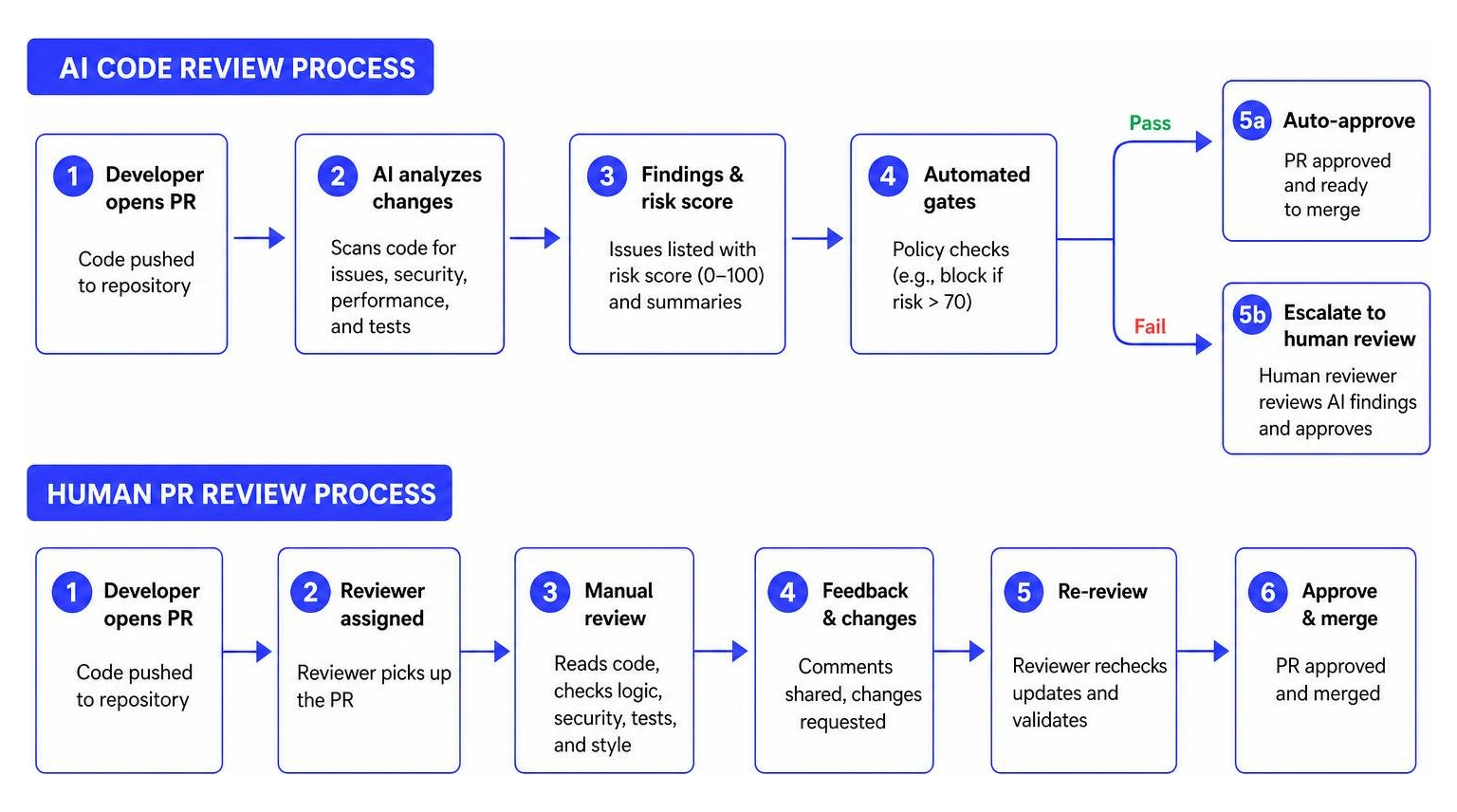
Despite these gains, AI models can sometimes generate noisy comments or miss high-level architectural context. This is why platforms like the Sigilix evidence-first PR reviewer run parallel specialist reviewers (covering logic, security, performance, and testing) and verify every finding against working code execution before posting inline comments.
Understanding how AI complements human judgment is key to picking the right software stack, as outlined in Demystifying the Magic: How Online Review Management Systems Keep Your Reputation Squeaky Clean.
| Feature / Metric | Traditional Human Code Review | AI-Powered Automated Review |
|---|---|---|
| Defect Detection Rate | Catches 25% – 60% of bugs | Catches up to 90%+ of static/logic issues |
| Feedback Speed | Hours to days (dependent on team availability) | Instant (seconds after PR creation) |
| Review Cycle Reduction | Baseline manual timeline | 30% – 50% faster PR cycles |
| Contextual Awareness | High understanding of business logic & strategy | High speed on patterns; requires human verification |
| Developer Time Saved | Low (heavy manual overhead) | 5+ hours saved per developer per week |
Similarly, in customer reputation management, AI drafting assistants can turn brief customer quotes into detailed review copy. However, explicit customer approval must remain part of the process. Automated tools should streamline feedback collection without faking engagement or posting unapproved content.
Managing B2B User Reviews and Online Reputation

For B2B software companies and service providers, maintaining a strong public review presence is essential. Prospects frequently evaluate directory listings on platforms like G2, Capterra, and TrustRadius before requesting a sales demo or starting a free trial.
To build authority without wasting resources, review management requires a proactive strategy rather than passive waiting. You can explore proven workflows in our guide on how to Stop Chasing Customers with These Top Review Generation Tools.
Here are proven best practices for managing public reviews and building brand authority:
- Centralize Multi-Platform Live Sync: Connect all directory listing profiles (G2, Capterra, App Store, Google Business Profile) to a single dashboard so your team never misses a new submission.
- Implement Pre-Ask Sentiment Filtering: Intercept negative customer experiences early by providing a direct path to internal support, allowing team members to address concerns before public reviews are posted.
- Promptly Address Critical Reviews: When negative feedback occurs, respond professionally. Address specific issues directly, demonstrate accountability, and invite the user to resolve the matter offline.
- Transform Testimonials into Social Proof: Convert positive feedback from customer surveys, emails, and support tickets into verified public reviews using guided drafting prompts.
- Monitor Competitor Directories: Track competitor review profiles to spot market trends, identify feature gaps, and highlight your brand’s unique strengths in sales conversations.
Evaluating Pricing Models and ROI for Review Tools
When selecting review software, evaluating pricing structures against measurable operational gains is essential for securing budget approval.
In developer tools, software pricing generally follows one of two models:
- Per-Seat Pricing: Charges a fixed monthly fee per active developer (e.g., $24/seat/month). While simple for small teams, per-seat plans become expensive as engineering organizations grow, often discouraging wider adoption.
- Per-Repository Pricing: Charges a flat rate per active code repository (e.g., MicroReview’s $19/repo/month plan). This flat-rate model allows every team member to participate in code reviews without per-user fees, delivering significant cost savings for growing engineering teams.
For instance, a team of 10 developers working across 3 active repositories on a flat $19/repo plan pays $57/month, compared to $240/month on a per-seat alternative – saving over $2,100 per year.
On the organizational ROI side, catching code defects early yields substantial financial savings. A defect caught during code review costs roughly $100 to remediate, whereas that same defect reaching production can exceed $1,000 in fix costs, server downtime, and security mitigation.
Similarly, in academic and clinical research environments, utilizing software like Covidence saves an average of 71 hours per review cycle, allowing research teams to complete evidence synthesis faster and cut labor costs.
To streamline your internal review strategy without overcomplicating workflows, review The Lazy Person’s Guide to Automated Review Management.
Frequently Asked Questions About Business Review Software
What is the main difference between per-seat and per-repo pricing models?
Per-seat pricing charges your organization based on the number of individual users or developers access the software each month. Per-repo (per-repository) pricing charges a flat rate based on the number of active software projects or code repositories being monitored, regardless of how many team members access the platform. Per-repo models generally offer lower total costs for growing engineering teams.
How do automated tools prevent sensitive data and secrets from leaking into repositories?
Automated code review systems use static analysis and pattern matching to scan code diffs in real time before pull requests are merged. They identify hardcoded API keys, database credentials, passwords, and private tokens. Security tools operate with diff-only repository access, ensuring code is scanned securely without retaining data or using client source code to train external AI models.
How can SaaS businesses systematically collect verified reviews across multiple directories?
SaaS companies can automate review generation by embedding smart review requests into key points in the customer lifecycle, such as after onboarding or following positive support interactions. Using sentiment screening routes satisfied customers directly to target review platforms (like G2 or Capterra) while directing dissatisfied users to internal support teams to address issues privately.
Conclusion
Whether you are an engineering manager seeking to eliminate code vulnerabilities, a research lead synthesizing clinical data, or a business owner building market presence, selecting the right review software directly impacts operational speed and public reputation.
At King Digital Marketing Agency, we specialize in helping businesses build online authority, optimize search visibility, and convert customer feedback into brand growth. From managing local search listings across Albuquerque, Santa Fe, and surrounding New Mexico markets to establishing verified social proof, structured review systems are essential for long-term growth.
Ready to elevate your online authority and streamline customer feedback management? Discover dedicated review management services to transform your online authority and take control of your reputation today.
