
Conversion Funnel Analysis: Conquer with 5-Steps
Why Your Business is Losing Money Without Conversion Funnel Analysis
Conversion funnel analysis is the systematic process of tracking how visitors move through your website-from first contact to final purchase-so you can identify exactly where potential customers drop off and fix those leaks to boost sales.
In short, it’s about tracking the customer journey (Awareness to Interest to Desire to Action) to find out why over 70% of carts are abandoned. By fixing these drop-off points, businesses can improve conversion rates by up to 35%, turning existing traffic into customers without more ad spend. The first step is mapping your funnel and setting up tracking in a tool like Google Analytics 4.
Think of your website as a physical store. You wouldn’t ignore customers leaving empty-handed, yet online, only about 4.6% of visitors to a typical e-commerce site actually make a purchase. The solution isn’t always more traffic; it’s plugging the leaks in your existing funnel.
For local businesses, every click and ad costs money. Funnel analysis stops you from pouring water into a leaky bucket, whether the leak is a confusing checkout form or unclear shipping costs. The difference between struggling and thriving businesses is what happens after someone lands on your site.
I’m Bernadette King, founder of King Digital Marketing Agency. I’ve seen how conversion funnel analysis transforms websites into revenue generators. My approach uses practical, ROI-driven strategies to help local business owners turn more browsers into buyers.
Let’s walk through how to analyze your funnel, spot the leaks, and fix them.
Understanding the Conversion Funnel: Your Business’s Roadmap to Revenue
Picture this: customers visit your site, browse, and add items to their cart, but only a fraction buy. Where do the rest go? Conversion funnel analysis reveals the exact moments people lose interest, so you can fix the problems and boost revenue. It’s about making data-driven decisions to stop your sales funnel from leaking money.
What is a Conversion Funnel?
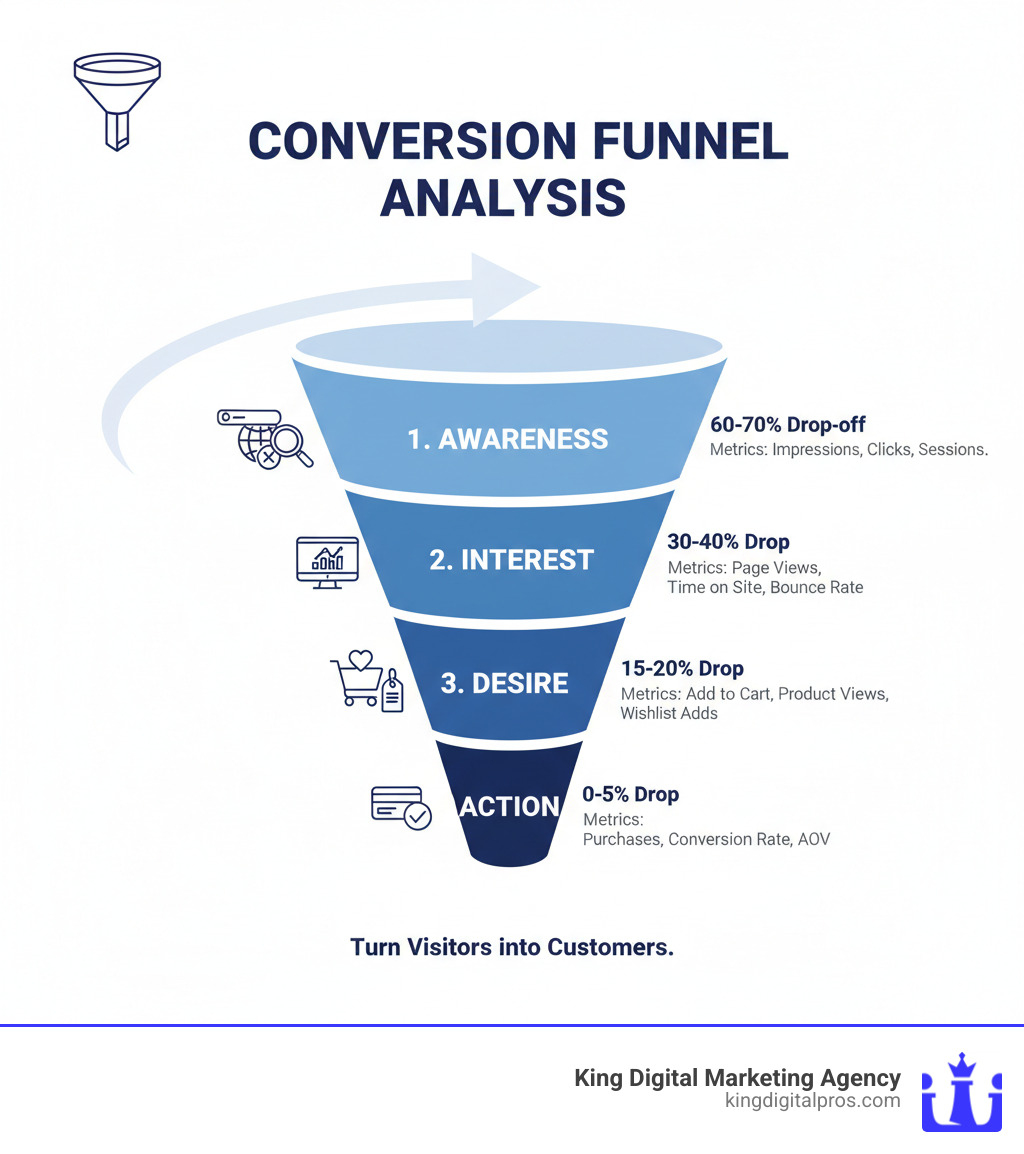
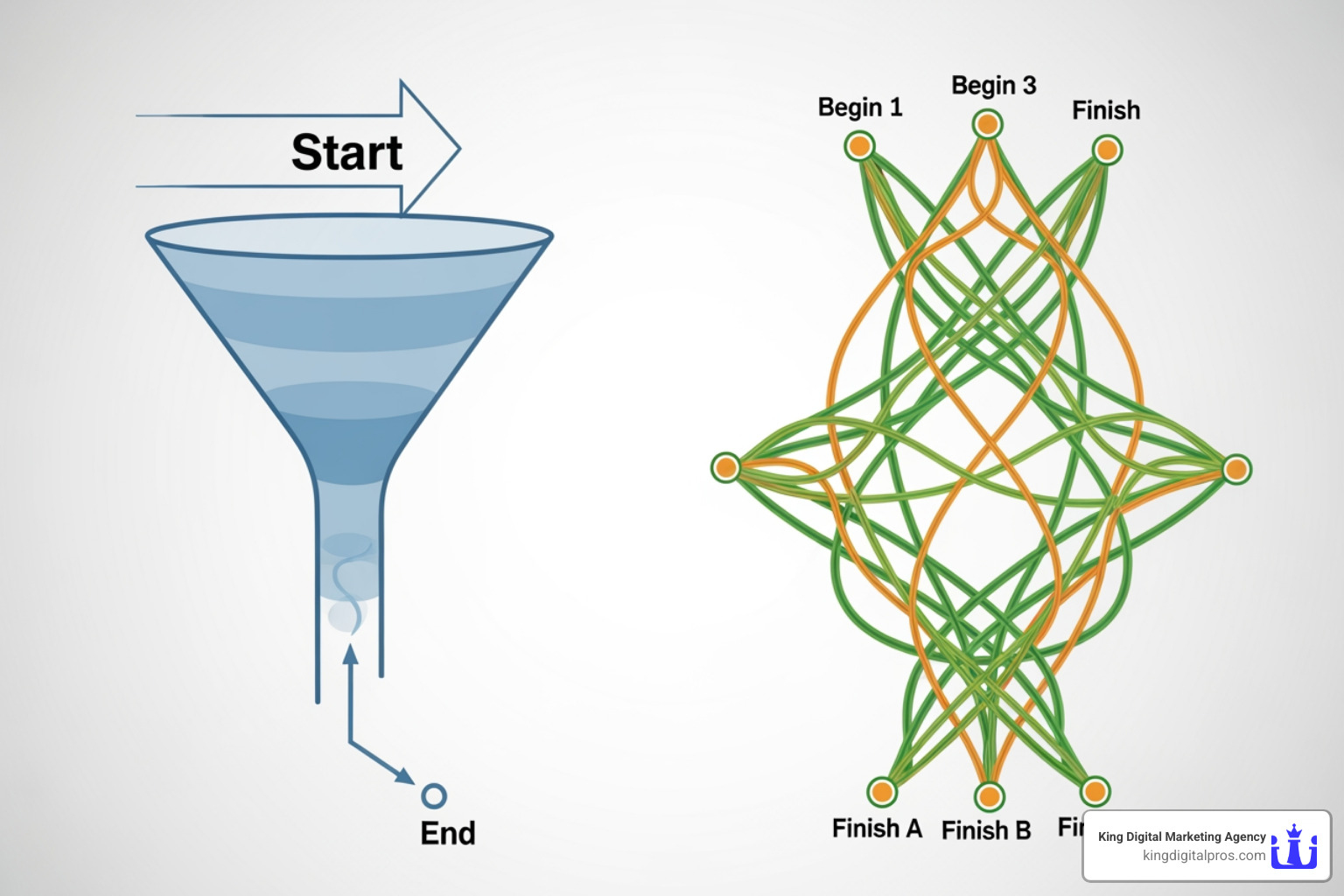
A conversion funnel is the path a visitor takes to become a customer. It’s named for its shape: many people enter the top, but fewer make it through each stage. The classic framework is the AIDA model:
- Awareness: A person finds your business through search, ads, or social media.
- Interest: They explore your site, reading content or viewing products.
- Desire: Browsing turns into serious consideration. They might compare options or add items to a cart.
- Action: They complete the goal-a purchase, form submission, or phone call.
A fifth stage, Re-engagement, focuses on turning one-time buyers into repeat customers. It’s also important to track micro-conversions (small steps like a newsletter signup) and macro-conversions (the ultimate goal, like a sale).
The Key Benefits of Funnel Analysis
Analyzing your funnel is one of the most powerful ways to grow without increasing ad spend. Key benefits include:
- Identifying leaks: Pinpoint the exact steps where customers drop off.
- Improving user experience: Fix friction points like confusing forms or unclear product info.
- Boosting conversion rates: Systematic optimization can improve conversions by up to 35%, meaning more sales from your existing traffic. Learn more about maximizing your Digital Marketing Conversion Rate.
- Aligning marketing and product: Ensure your website delivers on your marketing promises.
- Maximizing ROI: Get more value from every dollar spent on traffic.
You also gain deep insights into customer behavior that can inform your entire business strategy. For technical context, Google’s guide to conversion funnels is a helpful resource.
Funnel vs. Customer Journey: What’s the Difference?
People often confuse “conversion funnel” and “customer journey,” but they serve different purposes. The customer journey is the complete story of every interaction with your brand, online and off. It’s a holistic view of the entire relationship. The conversion funnel is a focused path to a specific goal, like a purchase. It tracks the direct steps to that one action.
| Feature | Conversion Funnel | Customer Journey Map |
|---|---|---|
| Goal | Maximize one specific conversion (purchase, signup) | Understand the complete customer experience |
| Scope | Linear path focused on a single conversion event | Holistic view of all touchpoints, online and offline |
| Output | Drop-off rates, conversion percentages, bottlenecks | Customer emotions, pain points, overall experience insights |
Both are valuable, but funnel analysis provides the most immediate, actionable insights for increasing sales.
The 5-Step Process for Effective Conversion Funnel Analysis
Our approach to conversion funnel analysis is a practical roadmap that turns data into real improvements for your New Mexico business. It’s a five-step process to diagnose issues, run tests, and make targeted repairs.

Step 1: Map Your Funnel Stages and Set Up Tracking
First, we define the specific steps your customers take. This path is unique to your business. For a local service company in Grants, it might be: Website Visit to Services Page to Contact Form to Phone Call to Appointment. For an e-commerce shop in Taos, it could be: Homepage to Product Page to Add to Cart to Checkout to Purchase. Once we’ve mapped your funnel, we use Google Analytics 4 (GA4) to set up event-based tracking for each critical action. Accurate tracking is the foundation for all data-driven decisions.
Step 2: Identify the Biggest Leaks (Drop-Off Points)
With tracking in place, the data reveals where customers abandon their journey. We look for the largest drop-offs. For example, what percentage of shoppers add items to their cart but never start checkout? These are your leaks. We focus on the steps that deviate most from credible benchmarks or your own historical performance. Industry research consistently finds cart abandonment rates around 69-71%; if yours suddenly climbs to 85%, that’s a clear red flag to investigate. Likewise, abrupt declines in start-checkout or payment completion without a clear change in traffic mix warrant deeper analysis. Faster, smoother experiences are proven to improve progression through these steps. This step tells us where the problem is.
Step 3: Dig Into the ‘Why’ with Qualitative Data
Numbers show where people leave, but not why. To understand the ‘why,’ we use qualitative tools:
- Session recordings let us watch anonymous user sessions to see where they struggle, hesitate, or get confused.
- Heatmaps show where users click and scroll, revealing if your calls-to-action are being ignored.
- User feedback surveys can directly ask visitors why they didn’t complete a purchase, uncovering issues like unclear shipping costs.
We also look for on-page friction, like long forms or missing information, and technical issues like slow mobile loading speeds or broken links. A smooth site is crucial, which is why we build Services: SEO Friendly Website Design that works on all devices. Combining quantitative and qualitative data gives us the full picture.
Step 4: The Role of User Segmentation in Conversion Funnel Analysis
Not all visitors are the same. User segmentation breaks down your traffic into meaningful groups to reveal hidden opportunities. We analyze segments by:
- Traffic source: Visitors from a Google search for ’emergency plumber Albuquerque’ behave differently than those from a Facebook ad.
- Device type: If mobile users convert at a lower rate than desktop users, we know to optimize the mobile experience.
- New vs. returning visitors: Low conversion for new visitors might indicate a lack of trust signals.
- Geographic location: Do visitors from Santa Fe convert better than those from Los Alamos? This can inform local ad targeting.
Segmentation turns a vague problem like ‘low conversion rate’ into a specific, solvable challenge, helping us Attract More Customers more effectively.
Step 5: Prioritize, Hypothesize, and Prepare to Test
With a list of potential fixes, we prioritize using the PIE framework: Potential impact, Importance to business goals, and Ease of implementation. High-impact, low-effort changes go to the top of the list. Next, we form a specific hypothesis. For example: “By removing the ‘company name’ field from our contact form, we will increase submissions by 15% because it reduces friction for residential customers.” This isn’t a guess; it’s a testable statement. We then use A/B testing to validate the hypothesis, comparing the old version against the new one with real users. This scientific approach ensures we make changes based on evidence, not opinions.
From Leak to Lock: Optimizing Every Funnel Stage
After your conversion funnel analysis identifies the leaks, it’s time to optimize. This involves making user-centric improvements, A/B testing them, and committing to continuous improvement. For a deep dive, see our guide on Conversion Funnel Optimisation Best Practices.
Top-of-Funnel (TOFU) Optimization: Awareness & Interest
At the top of the funnel (TOFU), the goal is to attract the right people and build credibility. For local businesses in communities like Albuquerque or Santa Fe, this means:
- Local SEO: Optimize your Google Business Profile and create location-specific content so you’re found in local searches.
- Content Marketing: Blog posts that solve local problems (e.g., ‘HVAC Tips for New Mexico’s Climate’) position you as an expert.
- Landing Page Clarity: Your landing pages must have a clear value proposition that immediately answers ‘What’s in it for me?’
- Building Trust: Showcase testimonials and local reviews. According to Nielsen research, 83% of consumers trust recommendations from people they know.
- Social Media Engagement: Be an approachable presence in your community’s digital spaces, sharing helpful tips and local content.
Middle-of-Funnel (MOFU) Optimization: Desire
In the middle of the funnel (MOFU), prospects are comparing options. Your goal is to turn their interest into desire by demonstrating value:
- Show, Don’t Tell: Use case studies and portfolios with before-and-after photos to prove you deliver results.
- Nurture Leads: Use email sequences to answer common questions and build confidence in prospects who aren’t ready to buy. This is a key part of our Online Sales Lead Management Ultimate Guide.
- Differentiate Yourself: Clearly explain your unique selling points, whether it’s faster service or specialized local expertise.
- Offer Expertise: Host webinars or local workshops to let prospects experience your knowledge firsthand.
- Use Retargeting: Gently remind visitors who left your site with well-timed ads for the service or product they viewed.
Bottom-of-Funnel (BOFU) Optimization: Action
At the bottom of the funnel (BOFU), you must make it incredibly easy for a prospect to convert.
- Simplify Processes: Remove every unnecessary field from your contact forms and every extra click from your checkout. Over 70% of online shoppers abandon carts, often due to complexity.
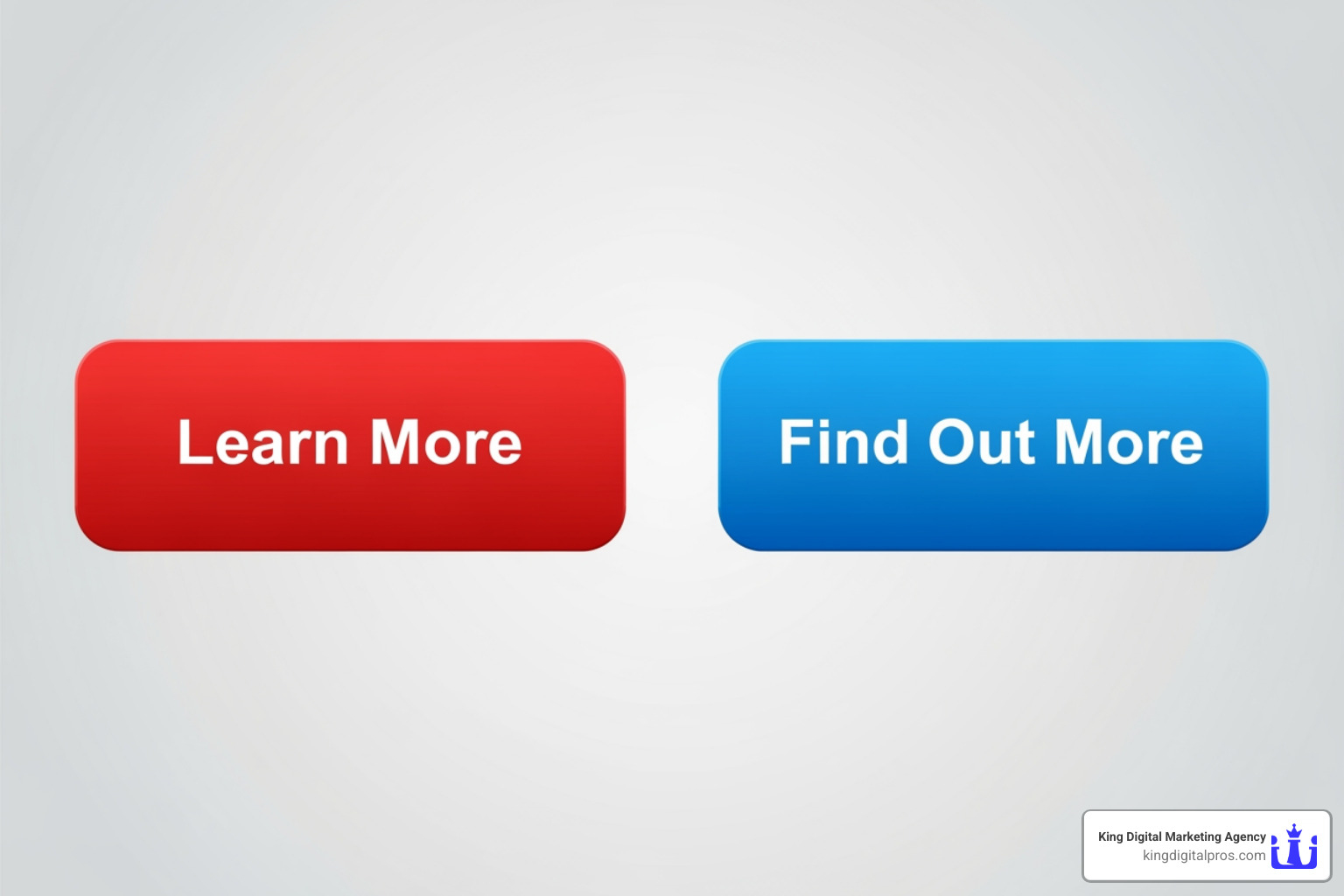
- Use Clear Calls-to-Action (CTAs): Buttons should state the exact outcome, like ‘Book Your Free Consultation’ instead of a vague ‘Submit.’
- Create Urgency: Use honest scarcity, such as ‘Only 3 slots left this week,’ to encourage immediate action.
- Overcome Anxiety: Display trust signals like guarantees, business licenses, and return policies prominently. Make your phone number easy to find.
- Recover Abandonments: Use automated emails to follow up with users who started but didn’t complete a purchase or form submission.
If you’re asking ‘Is Your Website Converting?,’ the BOFU stage is often where the biggest wins are found.
Essential Tools and Metrics for Ongoing Success
Conversion funnel analysis isn’t a one-time project; it’s an ongoing process of tending to your business’s growth. With the right tools and metrics, this work becomes manageable and highly rewarding.
Crucial Tools for Your Analysis Toolkit
Your analytics toolkit is your diagnostic equipment for your funnel.
- Web Analytics Platforms: Tools like Google Analytics 4 are the foundation, tracking every visitor interaction with an event-based model.
- Heatmap & Session Recording Tools: These let you see your site through your customers’ eyes, revealing where they click, scroll, and get frustrated.
- A/B Testing Platforms: These tools allow you to test changes (like a new headline or button color) with real users to get concrete data on what works best.
- User Feedback Tools: Sometimes, the easiest way to find a problem is to ask. Surveys can uncover issues you’d never spot in the data alone.
Key Metrics for Your Conversion Funnel Analysis
These numbers are the vital signs of your funnel’s health.
- Conversion Rate: The headline number. The percentage of visitors who complete your main goal (e.g., make a purchase, fill out a form).
- Drop-Off Rate Per Stage: The percentage of users who leave at each specific step of the funnel. This tells you exactly where to focus.
- Average Order Value (AOV): The average amount spent per order. Increasing AOV is a powerful way to boost revenue from the same number of customers.
- Customer Lifetime Value (LTV): The total revenue a customer is predicted to generate over their entire relationship with your business. Our guide on How to Calculate Lead Value explains this further.
- Cost Per Acquisition (CPA): How much you spend to gain one new customer. Improving your conversion rate directly lowers your CPA.
Best Practices for Continuous Funnel Optimization
Successful businesses treat optimization as an ongoing practice.
- Conduct Regular Reviews: Check your funnel analytics on a consistent schedule (weekly for high-traffic sites, monthly or quarterly for others).
- A/B Test Everything: Don’t make changes based on gut feelings. Test headlines, buttons, forms, and layouts to see what actually improves performance.
- Listen to User Feedback: Customer service inquiries and social media comments are goldmines of information about friction points in your funnel.
- Consider External Factors: Always interpret your data in context. Did a holiday, local event, or economic news affect your numbers? Seasonality also plays a big role for many New Mexico businesses.
Frequently Asked Questions about Conversion Funnel Analysis
What are the typical stages of a conversion funnel?
The typical funnel follows the AIDA model: Awareness (customer finds you), Interest (they explore your site), Desire (they consider buying), and Action (they make a purchase or contact you). The specific steps vary by business. For an e-commerce store in Taos, it might be Visit to View Product to Add to Cart to Purchase. For an HVAC company in Rio Rancho, it could be Website Visit to Service Page to Request Quote to Appointment. We customize the funnel stages to match your specific business goals.
What is a good conversion rate for a funnel?
There’s no single magic number. A ‘good’ rate varies widely by industry, price point, and traffic source. While a general e-commerce benchmark is 2-3%, it’s not a useful comparison for every business. The most important benchmark is your own historical performance. The goal is continuous improvement-doing better this month than you did last month. That’s how sustainable growth happens.
How often should I analyze my conversion funnels?
This depends on your website traffic. High-traffic sites should conduct reviews weekly or bi-weekly. Most local New Mexico businesses with more moderate traffic will find monthly or quarterly reviews more practical, as this allows enough data to accumulate. However, you should always analyze your funnel after major events like a website redesign, a new marketing campaign, or a sudden, unexplained change in conversions. Treat it like car maintenance: perform regular check-ups, but investigate any warning lights immediately.
Conquer Your Conversions with Expert Analysis
By now, you see that conversion funnel analysis is about building a system that guides customers from curiosity to commitment. When you map the journey, find the drop-off points, and test solutions, your website transforms from a maze into a profitable pathway. The businesses that thrive in New Mexico aren’t just the ones with the most traffic; they’re the ones that make the most of every single visitor.
At King Digital Marketing Agency, we dig deep into your data to turn insights into action and visitors into loyal customers. We help local businesses turn their websites into powerful revenue-generating assets.
Ready to stop watching customers slip away? Our Services: Conversion Optimization team is here to build a funnel that works as hard as you do. Let’s conquer your conversions together.