What Is Copywriting for SaaS and Why Does It Matter?
SaaS copywriting is the art and science of crafting persuasive written copy across websites, onboarding flows, email funnels, and digital campaigns to turn casual traffic into loyal, recurring subscribers. Unlike traditional retail products or one-off digital downloads, software operates on a recurring subscription model. Every word written must not only inspire an initial trial or demo signup, but also reinforce product adoption, mitigate customer acquisition cost (CAC), and protect long-term monthly recurring revenue (MRR) by reducing churn.
Navigating this space requires addressing multi-stakeholder buying committees. In a B2B environment, an internal team champion might evaluate your tool for daily usability, but a department head or CFO holds the purchasing power. Your copy must satisfy both personas – validating technical capability for the user while proving clear operational return on investment for the executive signing the check.
Achieving this level of conversion is notoriously challenging. Across digital marketing, the median conversion rate for standard landing pages across industries sits around 6.6%. Yet, SaaS landing pages convert at a median of just 3.8% – roughly 42% below the wider industry baseline. Because switching software introduces friction, migration anxieties, and workflow disruption, generic copywriting services often fall flat without SaaS-specific positioning strategies.
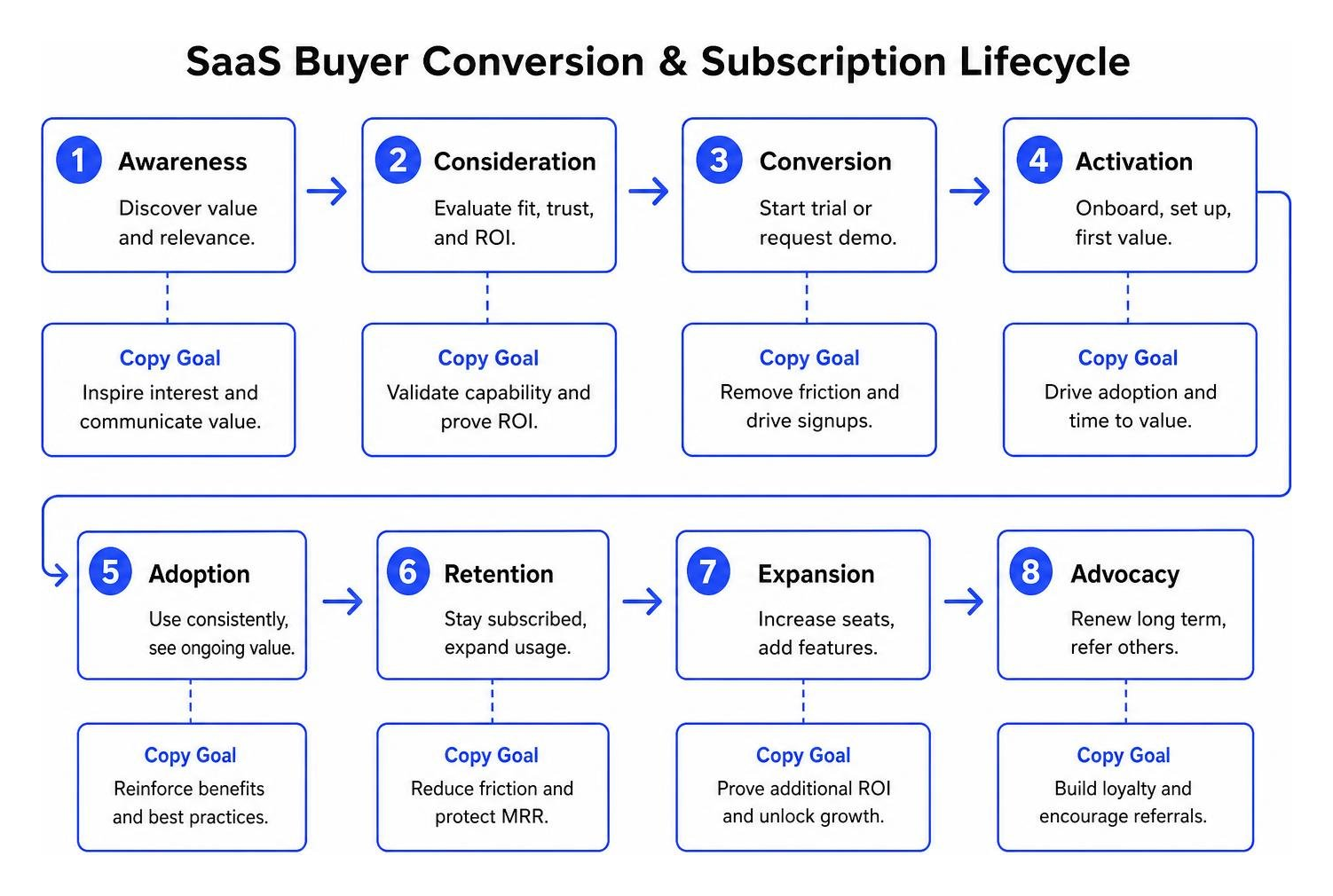
SaaS Copywriting vs. General and Content Writing
It is easy to confuse copywriting with content writing, but treating them as interchangeable is an expensive mistake in the tech sector.
- Content Writing is built for education, domain authority, organic search footprint, and long-term brand equity. It includes deep guides, industry reports, and thought leadership pieces. For a complete look at high-level editorial frameworks, explore mastering the art of b2b content.
- General Copywriting often leans heavily on emotional brand narratives, lifestyle imagery, and clever wordplay suited for fast, impulse consumer decisions.
- SaaS Copywriting focuses directly on immediate user action, measurable pipeline conversion, and technical translation. It bridges complex engineering architecture into clear, frictionless user workflows.
A SaaS copywriter acts as a conversion strategist and user-experience architect. The work focuses on identifying why software users get stuck, addressing migration doubts, and crafting precise messaging that compels immediate signups or demo bookings.
Core Fundamentals of High-Converting B2B and B2C Software Messaging
High-converting software messaging rests on clarity, speed, and strategic alignment with your go-to-market (GTM) motion:
- GTM Motion Alignment: Product-led growth (PLG) messaging emphasizes self-serve ease, fast time-to-value, and zero-risk entry points (e.g., “Set up your workspace in 2 minutes”). Conversely, sales-led growth (SLG) copy targets operational efficiency, security, enterprise governance, and scheduled sales conversations.
- Emotive Simplicity and Active Voice: Software purchases solve stressful everyday frustrations. Ditch passive, corporate phrasing like “Workflows can be accelerated by our engine” in favor of crisp, active statements: “Automate your daily standup reports in one click.”
- Strict Readability Thresholds: An analysis of over 464 million visits by Unbounce revealed that top-converting landing pages strictly limit difficult, three-syllable+ vocabulary to between 50 and 140 words per page. Clear language consistently beats clever jargon.
For a deeper dive into conversion architectures, see The Ultimate B2B SaaS Copywriting Guide to Maximize Conversion.
Essential Strategies for High-Converting SaaS Copy
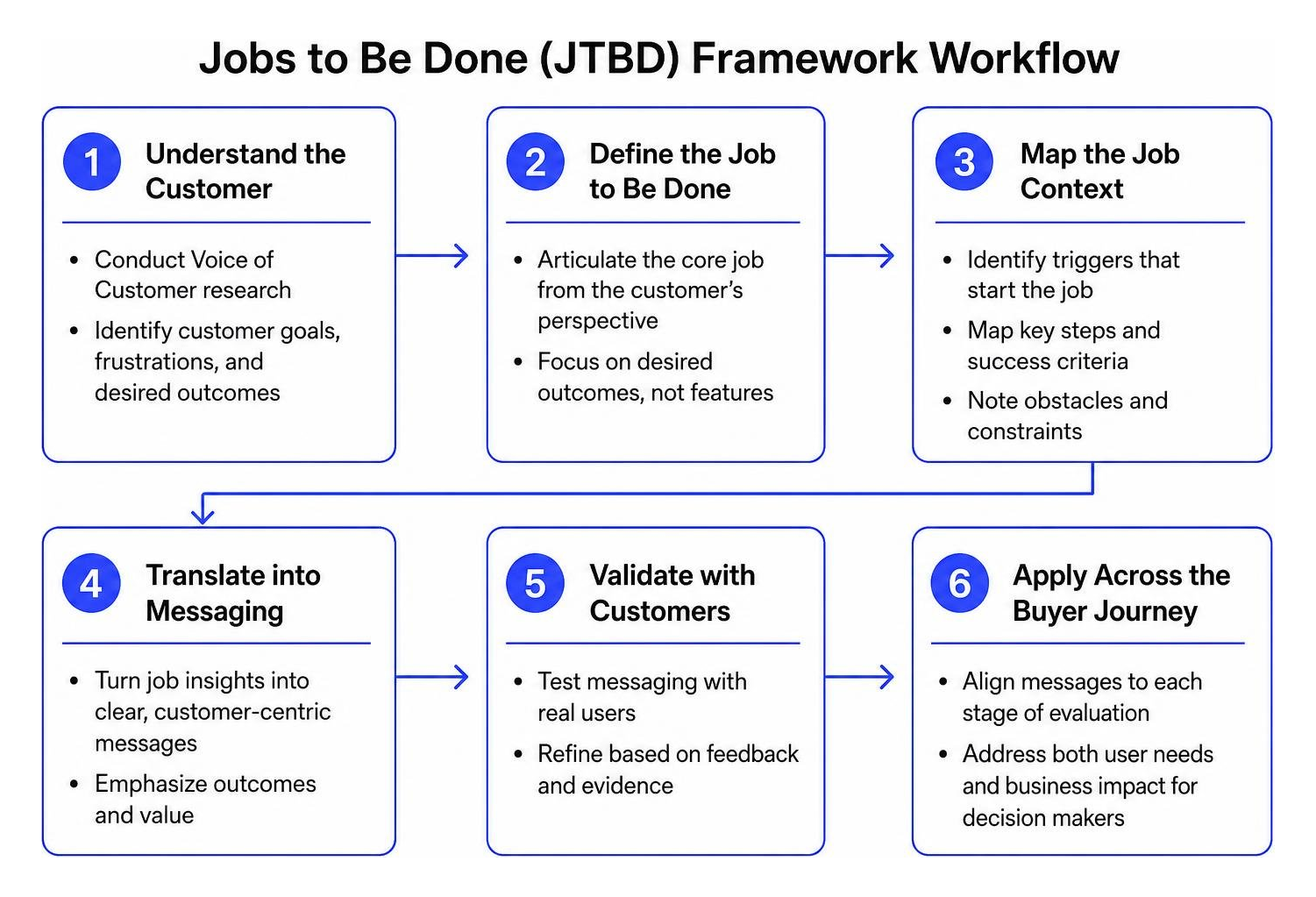
Writing copy that converts requires proven messaging frameworks rather than guesswork. When SaaS websites sound identical to their competitors, it is usually because they rely on internal feature checklists instead of customer-grounded frameworks.
Customer Research and Jobs to Be Done (JTBD) Frameworks
The most impactful copy you write will rarely come from your own head – it comes straight from the mouths of your customers. Voice of Customer (VoC) research transforms customer sentiment into high-converting headlines.
To build a reliable VoC databank:
- Analyze Review Portals: Mine sites like G2 and Capterra for 3- and 4-star reviews. These reviews highlight the exact tipping points that made buyers switch, as well as the friction points holding them back.
- Review Support Logs and Sales Transcripts: Identify common user objections, confusing onboarding moments, and recurring questions.
- Run Targeted JTBD Customer Interviews: The Jobs to Be Done framework views purchases through a functional lens: users do not buy software; they “hire” it to make progress in a specific situation.
Use this foundational JTBD prompt during customer discovery:
“When I am [painful situation/trigger], help me [perform this job], so I can achieve [desired operational outcome].”
When you understand the situational trigger that caused a team to abandon spreadsheets, your copy reflects genuine empathy.
Balancing Features and Tangible Outcomes with the “So What?” Test
A common copywriting myth asserts that SaaS copywriters should ignore technical features and write only about high-level emotional benefits. In software, this is counterproductive. Technical buyers, IT leaders, and power users actively scan pages for core capabilities, architectural requirements, and native integrations.
The secret lies in contextualizing features within user outcomes using the “So What?” Test. Read every product claim and ask “So what?” until you reach a concrete, measurable workflow outcome.
| Technical Feature | The “So What?” Drilldown | Outcome-Led Messaging Angle |
|---|---|---|
| Automated CI/CD test coverage reporting | Tells developers where code fails before deployment | Ship production-ready code 40% faster without manual testing bottlenecks |
| Granular role-based access control (RBAC) | Restricts sensitive data views by team permissions | Onboard external contractors securely in minutes without exposing sensitive code repos |
| Real-time bi-directional CRM syncing | Keeps pipeline fields updated across sales tools | Eliminate 5 hours of manual data entry weekly and never miss a follow-up |
When communicating with specialized audiences, precision matters. Review How to Write a SaaS Landing Page That Converts Technical Buyers to master feature-to-outcome mapping.
Leveraging Neuroresponse Social Proof and Objection Handling
Proof is not decorative; it is the structural backbone of software conversion. Psychological research indicates that human decision-making processes proof in three distinct stages: recognition, relief, and reasoning.
- Outcome-Focused Testimonials: Avoid generic praise like “Great tool, highly recommend!” Instead, display quotes highlighting specific numbers and named titles: “We cut client onboarding from 7 days down to 4 hours in our first month.” – VP of Operations.
- Authentic Review Ranges: Data from Northwestern University’s Spiegel Research Center demonstrates that displaying reviews lifts purchase likelihood by up to 270%. Interestingly, authentic review ratings between 4.0 and 4.7 convert higher than a perfect 5.0, as flawless scores often trigger user skepticism.
- Pre-CTA Risk-Reduction Microcopy: Address friction points right where users make decisions. Place simple reassurances near your buttons, such as “No credit card required,” “Takes 2 minutes to set up,” or “Cancel anytime.”
To see how these principles apply across retention and nurture campaigns, review our guide to elevate your email game.
Step-by-Step Anatomy of a High-Converting SaaS Landing Page
A high-performing SaaS landing page functions like a well-structured conversion funnel. Each content block must earn the visitor’s attention for the next section, guiding them toward a single conversion goal.
Crafting the Above-the-Fold Hero Section and the 5-Second Test
The hero section above the fold carries the heaviest conversion weight. According to research from the Nielsen Norman Group, web visitors form a judgment and often leave within 10 to 20 seconds if value is not immediately evident.
Your hero layout needs four core components:
- The H1 Promise Hook: A clear statement declaring what the product achieves for a specific audience.
- The Agitation Subheadline: One or two sentences explaining how the product delivers that outcome while eliminating existing friction.
- The Frictionless Primary CTA: A prominent, action-oriented button paired with reassuring microcopy.
- Instant Visual Validation: An annotated screenshot, interactive sandbox, or product GIF displaying the UI in action.
The 5-Second Test: Show your hero section to someone outside your company for five seconds, then hide it. If they cannot clearly explain what your product does and who it is built for, simplify the headline.
To explore modular page structures in greater detail, study the frameworks in How to write landing page copy for SaaS and the breakdown provided in Anatomy of a High-Converting Landing Page.
Structuring How-It-Works Modules and Frictionless CTAs
Once your hero section captures initial attention, guide visitors through your operational details without overwhelming them:
- The Three-Step “How It Works” Section: Abstract complex multi-tier architectures into three simple front-end actions (e.g., 1. Connect your repo, 2. Run automated scan, 3. Review instant PR suggestions).
- Personalized, Action-Driven CTAs: Data from HubSpot shows that personalized calls-to-action convert 202% better than generic default labels like “Submit” or “Click Here.” Use descriptive, benefit-driven text like “Claim Your Free Workspace” or “Book a 15-Minute Demo.”
- Direct Objection Handling Blocks: Address core concerns – such as security compliance (SOC 2), data migration timelines, and native integration stacks – directly before your final CTA button.
Modern Techniques: AI Workflows, GEO, and Career Foundations
Modern SaaS copywriters balance high-converting frameworks with emerging AI workflows and evolving search paradigms.
| Dimension | Generic AI Copywriting Output | Human-Led & AI-Assisted SaaS Copy |
|---|---|---|
| Messaging Focus | Feature lists, passive buzzwords (“seamless”, “all-in-one”) | Concrete customer outcomes, JTBD frameworks |
| Buyer Nuance | Generic corporate tone, vague claims | Segmented for PLG vs. SLG and buyer roles |
| Proof & Credibility | Generic hypothetical scenarios | Primary data points, genuine quotes, verified metrics |
| Search Engine Strategy | Standard keyword stuffing | Extractable answer chunks optimized for GEO engines |
Integrating AI Tools and GEO in Copywriting for SaaS
Generative AI platforms can speed up research and initial drafting, but generic prompts often generate vague, buzzword-laden copy.
To get the most out of AI assistance:
- Draft Section-by-Section: Rather than generating an entire landing page at once, prompt the model on one modular section at a time.
- Few-Shot Voice Training: Feed the model a 120- to 150-word sample of approved brand copy to maintain consistent tone and cadence.
- Generative Engine Optimization (GEO): As AI-driven search engines and answer engines synthesize web content, structure key definitions and value propositions in self-contained, extractable modules supported by primary statistics.
For additional perspectives on incorporating automation into content production, check out why content writing technology is the new secret sauce for techies.
How Beginners Can Build a Portfolio in Copywriting for SaaS
With over 35,000 SaaS copywriter-related job listings appearing regularly on platforms like LinkedIn, demand for specialized talent remains high. Breaking into the tech space as a beginner requires practical samples:
- Conduct Before-and-After Audits: Select an early-stage SaaS product with confusing copy, rewrite their hero section and onboarding emails, and document your strategic rationale.
- Build Speculative Case Studies: Draft modular conversion copy for mock software tools across different niches, demonstrating clear feature-to-outcome mapping.
- Master SaaS Business Metrics: Learn how your copy directly impacts core metrics like CAC, MRR, trial-to-paid velocity, and churn reduction.
Frequently Asked Questions About SaaS Copywriting
How Do You Balance Features and Benefits in SaaS Website Copy?
Lead with the primary outcome in the section header, then immediately support it with the specific feature mechanism. Use the formula: [Feature capability] so that you can [Achieve desired outcome without manual friction].
What Is the Difference Between PLG and SLG Copywriting?
Product-led growth (PLG) copy targets end users, emphasizing immediate software utility, self-serve onboarding, and low-friction entry points (e.g., “Start free trial”). Sales-led growth (SLG) copy addresses executive buyers and buying committees, focusing on enterprise governance, security, ROI calculations, and sales demos.
How Can SaaS Copywriters Optimize for AI Search Engines (GEO)?
Structure content in clear, self-contained modular blocks. Lead with direct answers, cite verifiable industry benchmarks, incorporate structured schema data, and establish consistent topical entity relationships across your website.
Driving Measurable Software Growth Through Strategic Copy
Clear, persuasive SaaS copywriting turns complex software into straightforward business solutions. When you replace vague buzzwords with customer-researched outcomes, back up claims with verified social proof, and remove conversion friction, you build a sustainable foundation for ongoing user growth.
At King Digital, we help businesses across Albuquerque NM, Rio Rancho NM, East Mountains NM, Santa Fe NM, and beyond strengthen their digital messaging and online visibility. Whether you need to optimize local map listings, sharpen your brand narrative, or execute targeted conversion campaigns, explore our complete digital marketing services/copywriting solutions to turn more visitors into long-term customers.
