TL;DR:
- Local search intent optimization aligns website content and profiles with what nearby customers search for to improve visibility. It combines traditional SEO with AI-focused strategies like schema markup and content clusters to enhance local rankings and AI citations. Regular tracking and updating are essential to maintain and grow local authority in Albuquerque.
Local search intent optimization is the practice of aligning your website content, Google Business Profile, and technical signals to match exactly what nearby customers type when they are ready to buy. For Albuquerque business owners, this is not a nice-to-have. It is the difference between showing up when someone searches “HVAC repair near me” and being invisible while a competitor takes the call. 30% of all searches now involve AI assistance, which means your local presence must satisfy both traditional Google ranking factors and the newer demands of AI-powered results. The industry term for the AI side of this equation is Generative Engine Optimization, or GEO. Mastering both gives your Albuquerque business a real edge.
How does local search intent impact marketing strategies for Albuquerque businesses?
Local search intent is not a single category. It is a blend of three intent types that overlap in almost every local query.
Informational intent drives searches like “how much does a roof repair cost in Albuquerque.” The searcher is not ready to buy yet. They want education. Commercial intent shows up in queries like “best plumber in Albuquerque.” The searcher is comparing options. Transactional intent drives “emergency plumber open now near me.” That person has their credit card ready.
Most local queries carry all three signals at once. A search for “Albuquerque Italian restaurant with outdoor seating” blends geographic, commercial, and informational intent simultaneously. Hybrid intent scoring assigns a percentage mix to each intent component so you can structure content that satisfies all three. A restaurant page, for example, might need 50% commercial content (menu, pricing, reservations), 30% informational content (neighborhood guide, parking tips), and 20% transactional content (a clear booking button).
Understanding this mix changes how you write every page on your site. Generic service pages that just list what you do will not rank for local queries. Pages that answer real Albuquerque customer questions, include neighborhood references, and guide visitors toward a clear next step will.
- “Near me” queries signal high transactional intent and require your Google Business Profile to be fully claimed and accurate.
- Neighborhood-specific queries like “Old Town Albuquerque dentist” reward businesses with location pages built around those exact terms.
- Comparison queries like “best vs cheapest” signal commercial intent and call for content that addresses value, not just price.
- Question-based queries like “is it safe to…” signal informational intent and are best answered with FAQ sections using plain language.
Matching your content format to the dominant intent in each query type is the core skill in local intent marketing.
What foundational tools does your Albuquerque business need first?
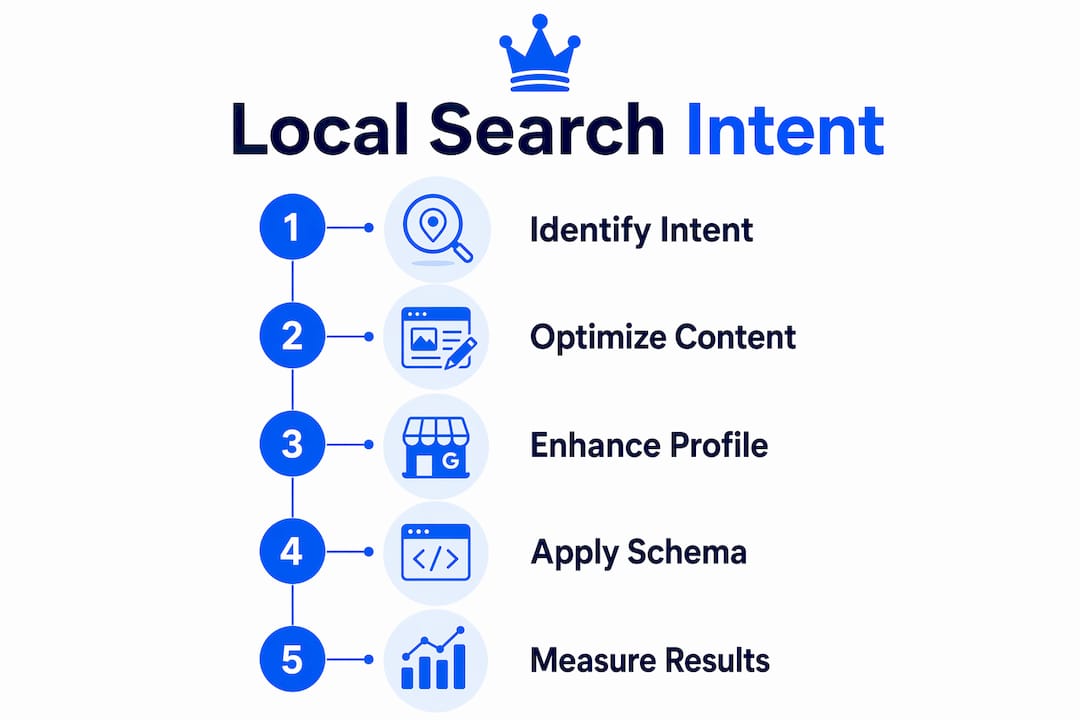
Before any content strategy works, your technical foundation must be solid. Think of it as the plumbing behind the walls. Nobody sees it, but everything breaks without it.

A fully optimized Google Business Profile with accurate hours, photos, and customer reviews is the single most important asset for local pack visibility. Your profile must list your Albuquerque address exactly as it appears everywhere else online. That consistency is called NAP, which stands for Name, Address, and Phone number. NAP consistency across listings and directories is a primary ranking factor. One mismatched address across Yelp, your website, and your GBP can suppress your rankings.
Your website must load fast and display correctly on mobile. Google indexes the mobile version of your site first. A slow, broken mobile experience kills your rankings before your content even gets evaluated. Use the small business SEO checklist from King Digital Marketing Agency to audit your technical baseline before building content on top of it.
LocalBusiness schema markup tells both Google and AI assistants exactly who you are, where you are, and what you offer. Adding your address, hours, and service details in structured data format significantly boosts AI visibility. This is not optional in 2026. AI search tools pull structured data first when generating local answers.
| Foundation Element | Why It Matters | Priority |
|---|---|---|
| Google Business Profile | Drives local pack and map visibility | Critical |
| NAP consistency | Prevents ranking suppression across directories | Critical |
| LocalBusiness schema | Feeds AI assistants accurate business data | High |
| Mobile-friendly site | Required for Google mobile-first indexing | High |
| Local keyword research | Identifies hybrid intent terms to target | High |
Which strategies effectively build local search authority in Albuquerque?
Once your foundation is set, the real work begins. These steps move you from “listed” to “trusted” in Google’s eyes and in AI-generated answers.
-
Build content clusters around Albuquerque neighborhoods. A single service page is weak. A cluster of pages covering your service plus specific neighborhoods (Nob Hill, Downtown, Rio Rancho) builds topical authority that directory listings cannot match. Each cluster page should answer a question a real Albuquerque customer would ask. This proves to Google that you are an active community resource, not just a listing.
-
Add localized keywords to meta titles, H1 tags, and the first paragraph of every page. “Albuquerque” and neighborhood names belong in your page titles. Generic titles like “Our Services” waste the most valuable on-page real estate you have. Use the local search optimization guide from King Digital Marketing Agency to map keywords to specific pages.
-
Create FAQ sections with real customer questions and mark them up with FAQPage schema. FAQ pages with FAQPage schema signal AI assistants directly about your question-and-answer content. When a customer asks an AI tool “who fixes AC units in Albuquerque,” your FAQ answer can be pulled verbatim. This is GEO in practice.
-
Collect and manage customer reviews consistently. Reviews are a trust signal for both Google and AI systems. A business with 200 reviews averaging 4.7 stars outranks a competitor with 20 reviews in almost every local query. Respond to every review, positive or negative. Responses show engagement and add keyword-rich content to your profile.
-
Earn backlinks from authoritative Albuquerque sources. Links from the Albuquerque Journal, local chambers of commerce, or neighborhood association websites carry far more local ranking weight than generic directory links. One strong local backlink beats ten low-quality national ones.
-
Create content that AI systems will cite. Write clear, direct answers to local questions. Use structured data. Keep sentences short. AI tools favor content that is easy to extract and quote. Think of your FAQ answers as press releases written for robots.
-
Track your rankings and AI citations, then iterate. Data tells you what is working. Without tracking, you are guessing.
Pro Tip: Build a dedicated “Albuquerque Resources” page that links to local events, neighborhood guides, and community organizations. This earns natural backlinks and signals genuine local relevance to both Google and AI crawlers.
How can Albuquerque businesses measure and refine their local SEO efforts?
Measurement is where most local businesses fall short. They set up a Google Business Profile, write a few pages, and then wait. Waiting is not a strategy.
- Monitor Google Business Profile insights weekly. GBP shows you how many people called, requested directions, or visited your website from your profile. A drop in these numbers signals a problem with your profile or a new competitor in your area.
- Track AI search visibility with Promptwatch. Tracking AI citations with Promptwatch lets you see when and how AI tools reference your business. This data tells you which pages are performing in AI-generated answers and which need improvement.
- Analyze competitor citation patterns. Search for your main service category in Albuquerque using AI tools like Perplexity or ChatGPT. See which businesses get cited. Read their cited pages. Identify the content gaps you can fill.
- Audit your NAP consistency quarterly. Business information changes. Phone numbers get updated. Hours shift. A quarterly audit of your listings across Google, Yelp, Apple Maps, and Bing Places catches inconsistencies before they suppress your rankings.
- Avoid thin, generic location pages. A page that just says “We serve Albuquerque” with no unique content is worse than no page at all. Google treats it as low-quality content. Every location page must answer a specific local question or serve a specific neighborhood need.
Pro Tip: Set a monthly calendar reminder to check your top five GBP competitors. If a competitor suddenly gains 50 new reviews or adds new photos, they are actively working their profile. You should be too.
Key Takeaways
Mastering local search intent optimization requires combining a complete Google Business Profile, consistent NAP data, LocalBusiness schema, neighborhood content clusters, and AI citation tracking into one unified approach.
| Point | Details |
|---|---|
| Google Business Profile is foundational | A complete, accurate GBP with photos and reviews drives local pack visibility above all other factors. |
| Schema markup feeds AI search | LocalBusiness and FAQPage schema tell AI assistants exactly what your business does and where. |
| Content clusters beat single pages | Neighborhood-specific clusters build topical authority that generic service pages cannot achieve. |
| NAP consistency prevents ranking loss | Mismatched business data across directories actively suppresses your local search rankings. |
| Track AI citations, not just rankings | Promptwatch and similar tools reveal whether AI systems are citing your business in local answers. |
What I have learned about local intent after years in Albuquerque SEO
The biggest mistake I see Albuquerque business owners make is treating local SEO as a one-time setup task. They claim their GBP, add their address to the website, and consider the job done. That approach worked in 2018. It does not work now.
What actually moves the needle is thinking like a community resource, not a business listing. When I work with clients on multi-location SEO, the businesses that win are the ones publishing content that genuinely helps Albuquerque residents. A plumbing company that writes about “what to do when a pipe bursts in an adobe home” is not just doing SEO. It is building the kind of topical authority that makes Google and AI tools trust it as the local expert.
GEO is the part most businesses are ignoring right now. A unified strategy integrating traditional local SEO and GEO is no longer optional. When someone asks an AI assistant for a recommendation in Albuquerque, the businesses that get cited are the ones with structured data, clear FAQ answers, and consistent information across every platform. That is not luck. That is preparation.
My honest advice: invest in tracking before you invest in more content. You need to know what is already working before you add more pages to the pile.
— Bernadette
King Digital Marketing Agency helps Albuquerque businesses get found first
Albuquerque business owners who want to compete in both Google search and AI-generated results need more than a basic SEO setup. They need a plan that covers GBP optimization, schema markup, content clusters, and ongoing tracking.
King Digital Marketing Agency specializes in exactly this kind of work for small and medium-sized businesses across Albuquerque. The team handles everything from technical SEO and local marketing SEO to content strategy and AI citation tracking. Every plan is built around your specific business, your neighborhood, and your customers. If you are ready to stop guessing and start seeing real results in local search, contact King Digital Marketing Agency for a personalized consultation.
FAQ
What is local search intent optimization?
Local search intent optimization is the process of aligning your website content, Google Business Profile, and schema markup to match what nearby customers search for when they are ready to act. It combines traditional local SEO with GEO to capture both Google and AI-generated search results.
How does Google Business Profile affect local rankings?
A fully optimized Google Business Profile with accurate information, photos, and customer reviews is the primary driver of local pack visibility. Incomplete or inconsistent profiles are actively penalized in local search results.
What is FAQPage schema and why does it matter?
FAQPage schema is structured data markup that labels your question-and-answer content for search engines and AI tools. FAQ pages marked with this schema allow AI assistants to extract and cite your answers directly in local search responses.
How do I track whether AI tools are citing my business?
Tools like Promptwatch monitor AI search results and flag when your business is cited in AI-generated answers. Setting up this tracking lets you identify which pages perform well and which need stronger content or schema markup.
How often should I audit my local SEO performance?
Review your Google Business Profile insights weekly, audit NAP consistency across directories quarterly, and check AI citation data monthly. Regular monitoring catches problems early and shows you where to focus your content efforts next.
Recommended
- Google Business Profile Optimization Albuquerque | King Digital Marketing Agency
- Website content optimization steps for Albuquerque SMBs
- Albuquerque local SEO: Dominate Your Market in 2025
- Boost leads in Albuquerque: on-page SEO best practices
