TL;DR:
- Nearly half of all Google searches carry local intent, making local keywords essential for small businesses. Targeting hyper-local phrases and placing them strategically improves visibility, reduces costs, and boosts conversions by attracting high-intent nearby customers. Frequent updates of local keyword strategies are necessary due to the rapid volatility of local search results and evolving customer language.
Local keywords are geographically specific search terms that connect your business to nearby customers who are ready to buy. Understanding why focus on local keywords matters starts with one fact: 46% of all Google searches carry local intent. That is nearly half of every search happening on Google right now. For small and medium-sized businesses, ignoring local keyword targeting means handing those searches directly to competitors who show up when it counts most.
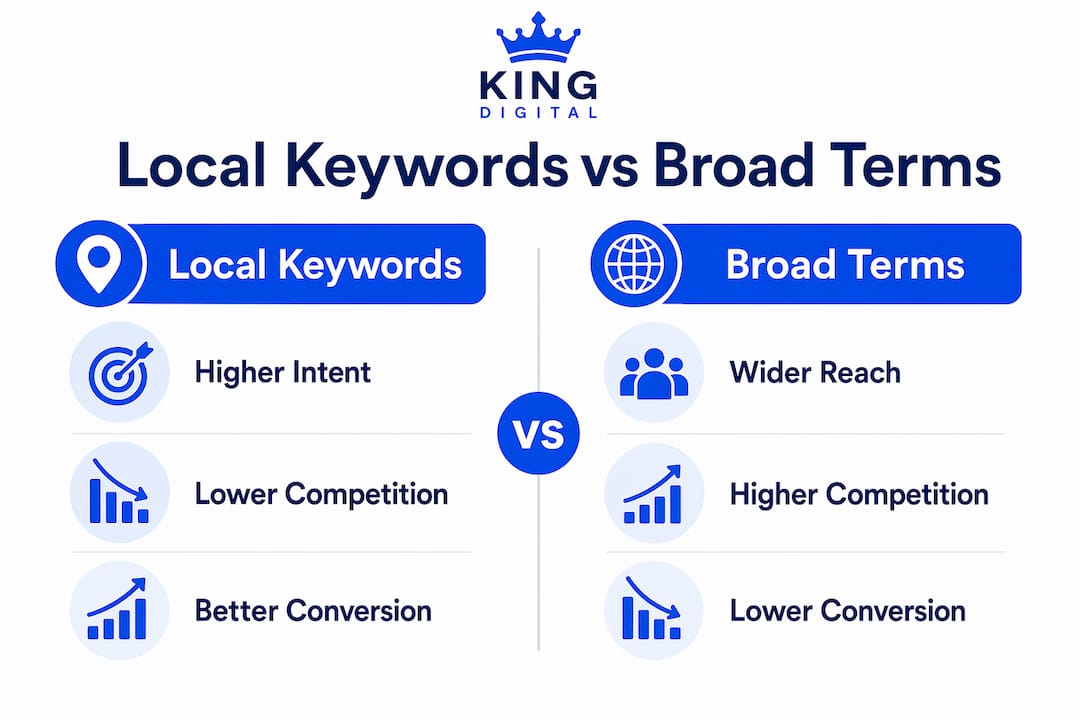
Why focus on local keywords for your business?
Local keywords differ from general SEO terms in one critical way: they signal geographic intent. A general keyword like “plumber” tells Google almost nothing about where the searcher is. A local keyword like “emergency plumber in Albuquerque” or “plumber near Rio Rancho” tells Google exactly who should appear in the results.
Google interprets local intent through three ranking factors: Relevance, Distance, and Prominence. Relevance and Prominence are the two factors your business can directly control. That means the words you use in your website content, your Google Business Profile, and your listings directly influence whether you appear in the local pack.
Local keywords typically fall into these categories:
- City or region modifiers: “dentist in Albuquerque,” “roofing contractor Santa Fe”
- Neighborhood-specific phrases: “coffee shop Nob Hill,” “gym near Downtown Albuquerque”
- “Near me” queries: “auto repair near me,” “urgent care near me”
- Service plus location: “HVAC installation New Mexico,” “dog groomer Rio Rancho”
Each of these phrase types targets a searcher who already knows where they are and what they need. That combination of location awareness and purchase intent is what makes local keywords so valuable compared to broad, national terms.
How local keywords improve visibility and conversion rates
The business case for local keyword targeting is direct and measurable. Local SEO leads cost an average of $32, which is 2–5 times more cost-effective than paid Google Ads in competitive U.S. markets. That gap in cost per lead is significant for any business watching its marketing budget.
Beyond cost, local keywords attract higher-intent customers. Someone searching “best Italian restaurant Albuquerque tonight” is not browsing. They are deciding. That behavioral difference shows up in conversion data: “near me” and voice search queries convert at nearly 4.7%, compared to 1.3% for branded city queries. Higher conversion rates mean more calls, more foot traffic, and more online bookings from the same volume of traffic.

The importance of local SEO also compounds over time. Unlike paid ads that stop the moment your budget runs out, a well-optimized local keyword presence keeps generating leads month after month. For a small business owner in Albuquerque, that sustained visibility is the difference between a slow month and a full calendar.
How to find the right local keywords for your market
Effective local keyword research combines data from tools with knowledge only you have about your community. No keyword tool knows that locals call a neighborhood “the Heights” instead of its official name, or that customers search “swamp cooler repair” instead of “evaporative cooler service.” Aligning your language with how customers actually search closes the gap between what your business says and what your customers type.
Here is a practical process for building your local keyword list:
- Start with Google Search Console. Filter your existing search queries by location to see which geographic terms already bring traffic to your site. This reveals real demand with zero guesswork.
- Use Google Business Profile Insights. The search queries section shows exactly what phrases triggered your profile to appear. These are high-value local terms you may not have considered.
- Research with keyword tools. Tools like Google Keyword Planner and Semrush allow you to filter by city or region. Look for terms with clear local intent, manageable competition, and consistent monthly volume.
- Add neighborhood and colloquial terms. Think about how longtime residents describe your area. Add those phrases to your list alongside the standard city-name modifiers.
- Target long-tail, hyper-local phrases. Targeting 50 to 200 well-researched hyper-local keywords produces higher total lead volume than chasing one broad, high-competition keyword. Cumulative volume across many specific phrases beats a single generic term every time.
Pro Tip: Ask your front desk staff or customer service team what phrases customers use when they call or walk in. Those exact words are your best local keyword leads, and no tool will surface them for you.
For a deeper dive into building your list, the local keyword research guide at King Digital Marketing Agency walks through this process with real Albuquerque examples.
Best practices for placing local keywords on your website and listings
Knowing your keywords is only half the work. Placing them correctly is what moves the needle on your local search rankings.
Apply local keywords in these specific locations on your website:
- Title tags and meta descriptions: Include your primary city and service in every page title. “Albuquerque HVAC Repair | Your Company Name” outperforms a generic title every time.
- H1 and H2 headings: Use location-specific phrases in your main headings. Google reads these as strong relevance signals.
- URL structure: A URL like
/albuquerque-roof-repairreinforces geographic targeting at the technical level. - Body content: Mention your city, neighborhood, and service area naturally throughout your page copy. Forced repetition hurts; natural use helps.
- Location-specific landing pages: If you serve multiple areas, create a dedicated page for each one. A page titled “Plumbing Services in Rio Rancho” ranks for Rio Rancho searches far better than a generic services page.
Your Google Business Profile deserves equal attention. Well-optimized Google Business Profiles with relevant categories, updated photos, and accurate hours directly boost local search ranking and customer trust. Write your business description using your primary local keywords. Choose the most specific categories available. Keep your name, address, and phone number identical across every listing online. Inconsistent NAP data confuses Google and suppresses your local rankings.
Pro Tip: Create a simple spreadsheet that tracks your NAP data across every directory where your business is listed: Google, Yelp, Apple Maps, Bing Places, and any industry-specific directories. Check it quarterly and correct any discrepancies immediately.
Local SEO best practices also extend to your blog and social media. A post titled “5 Signs Your Albuquerque Home Needs a New Roof Before Winter” targets local searchers while building topical authority. That combination of geographic and subject relevance is exactly what local search strategies reward.
Key Takeaways
Local keyword targeting is the most cost-effective way for small businesses to attract nearby, high-intent customers and generate consistent leads from organic search.
| Point | Details |
|---|---|
| Local intent is massive | 46% of Google searches carry local intent, making geographic targeting non-negotiable for local businesses. |
| Lower cost per lead | Local SEO leads average $32, which is 2–5 times cheaper than paid ads in competitive markets. |
| “Near me” queries convert best | Voice and near-me searches convert at 4.7%, far above the 1.3% rate for standard branded city queries. |
| Volume beats one broad term | Targeting 50–200 hyper-local keywords produces more total leads than competing for a single high-volume phrase. |
| Placement drives results | Local keywords must appear in title tags, headings, URLs, Google Business Profile descriptions, and location pages to work. |
What I’ve learned about local keywords that most guides skip
Local SERPs are far more volatile than most business owners realize. Local search results reshuffle 2 to 3 times faster than national results because Google factors in user location, time of day, and device type. That means your ranking at 9 a.m. on a Tuesday can look completely different from your ranking at 7 p.m. on a Friday. Monthly rank reports are almost useless for local SEO. You need zip-code-level tracking, and you need it frequently.
The other thing I see businesses consistently underestimate is the power of cumulative volume. Everyone wants to rank for “Albuquerque plumber.” That keyword is competitive and expensive to chase. But ranking for 80 neighborhood-specific and service-specific phrases adds up to far more traffic and far more leads. The math is simple, but the patience required to build that kind of keyword portfolio is where most businesses give up too soon.
The language gap is real too. I have worked with businesses that used technical industry terms on every page of their website while their customers were typing plain, everyday phrases into Google. Aligning your website language with local colloquialisms is not just an SEO tactic. It is a trust signal. When a customer reads your page and it sounds like how they actually talk, they stay longer and convert more often.
My honest advice: treat local keyword research as a living process, not a one-time project. Update your keyword list every quarter. Track your rankings by zip code. And never stop listening to how your actual customers describe what they need.
— Bernadette
How King Digital Marketing Agency helps you win local search
King Digital Marketing Agency works with local businesses across Albuquerque and the surrounding region to build local keyword strategies that produce real leads, not just rankings. The team handles everything from initial keyword research to on-page placement, Google Business Profile optimization, and location page creation.
If you are ready to stop guessing which keywords actually bring customers through your door, the local marketing SEO service at King Digital Marketing Agency gives you a clear, data-backed plan built for your specific market. The agency also offers a practical local search optimization guide for businesses that want to understand the full picture before committing to a service. Reach out to King Digital Marketing Agency and find out exactly where your local keyword gaps are costing you customers.
FAQ
Why focus on local keywords instead of broad terms?
Local keywords target searchers with geographic intent who are ready to act. They face less competition and produce higher conversion rates than broad national terms.
What percentage of Google searches have local intent?
46% of all Google searches include a local intent component. That makes local keyword targeting critical for any business serving a specific geographic area.
How much do local SEO leads cost compared to paid ads?
The average local SEO lead costs about $32, which is 2–5 times cheaper than paid Google Ads in competitive U.S. markets.
What are the best places to use local keywords on a website?
Place local keywords in your title tags, H1 and H2 headings, URL slugs, body content, meta descriptions, and Google Business Profile description for maximum impact.
How often should I update my local keyword strategy?
Update your local keyword list at least quarterly. Local SERPs reshuffle rapidly due to personalization factors, so monthly rank reports are not sufficient for tracking local performance accurately.
Recommended
- Local keyword research: Power Up in 2025!
- Optimize local search: Ultimate Guide 2025
- Understanding Local Search Ranking for Business Growth
- Top Mistakes in Local SEO: 2026 Fix-It Guide
