What Is Content Writing Technology (And Why Techies Need to Know It)
Content writing technology sits at the crossroads of writing craft, SEO strategy, and digital tools – and it’s quietly reshaping how tech businesses communicate online.
Here’s a quick breakdown of what it covers:
- Technical writing – documentation, user manuals, API references, and guides that help users do something
- Technical content writing – SEO-driven blogs, tutorials, and educational articles that help businesses get found and grow
- Content writing technology tools – AI writers, content optimizers, SERP intelligence platforms, and help authoring systems that power both
These three areas overlap more than most people realize, and understanding how they fit together is the first step to using them effectively.
Think about it this way. A potential customer searches Google for a solution your product solves. If your content isn’t there – clear, accurate, and optimized – a competitor’s is. That’s the gap content writing technology is designed to close.
The good news? You don’t need to be a professional writer to benefit from it. According to Google’s own guidance for aspiring technical writers, people from backgrounds as varied as software engineering, journalism, law, and teaching have all built successful careers in this space. The tools and frameworks available today make quality content more accessible than ever.
I’m Bernadette King, founder of King Digital Marketing Agency, and I’ve spent years helping businesses turn complex ideas into compelling, search-optimized content that actually drives growth – which means content writing technology is something I work with every single day. In this guide, I’ll walk you through everything you need to know, from the basics to the tools that are changing the game.
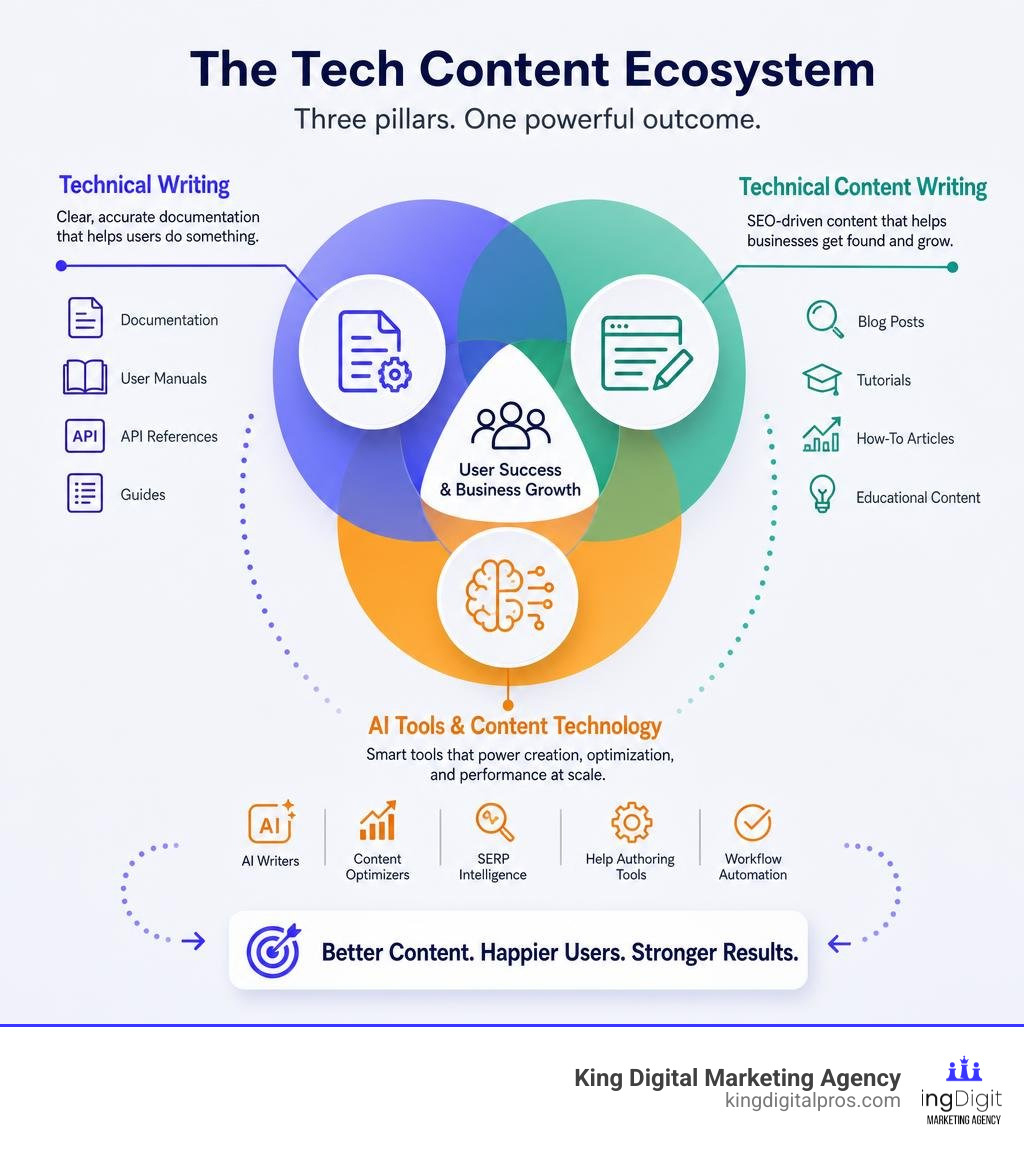
Common content writing technology vocab:
Technical Writing vs. Technical Content Writing: The Key Differences
To truly understand how content writing technology drives results, we must first clear up a very common point of confusion: the difference between technical writing and technical content writing.
While both require a deep grasp of complex tech, they serve entirely different masters and live in different parts of the customer journey.
| Feature | Technical Writing | Technical Content Writing |
|---|---|---|
| Primary Goal | Task enablement (helping users perform a specific task) | Audience engagement, lead generation, and brand awareness |
| Primary Audience | Existing users, developers, administrators, and customers | Potential customers, industry professionals, and decision-makers |
| Tone & Style | Objective, highly structured, and matter-of-fact | Educational, engaging, and conversational |
| SEO Focus | Minimal (primarily focused on internal search/indexing) | Critical (designed to rank on Google and capture organic traffic) |
| Typical Assets | API references, user manuals, release notes, system docs | Deep-dive blog posts, tutorials, white papers, case studies |
| Lifecycle Stage | Post-purchase / Implementation | Pre-purchase / Discovery / Consideration |
Technical writing is fundamentally product-focused. It aims to simplify the incredibly complex so that a developer or end-user can execute a workflow without getting stuck.
On the flip side, technical content writing is audience-oriented. It takes those same complex technical realities and packages them into educational, search-optimized marketing assets. Both are essential, and they work hand-in-hand to build trust and authority. If you want to dive deeper into how professional writing services construct these strategies, explore our comprehensive guide on Content Writing Services.
What Do Technical Writers Actually Produce?
Technical writers are the architects of clarity. They sit down with software engineers, product managers, and UX designers to map out exactly how a system works, translating raw code and architectural diagrams into structured, actionable resources.
The core output of a technical writer typically includes:
- API References: Detailed documentation of endpoints, request/response payloads, and authentication methods that developers need to integrate software.
- User Manuals & Quick-Start Guides: Step-by-step instructions that help non-technical users set up hardware or navigate a new software platform.
- Process Manuals & Standard Operating Procedures (SOPs): Internal documents that keep engineering and operations teams aligned on safety, compliance, and deployment protocols.
- Technical Reports & White Papers: In-depth explanations of a technology’s underlying architecture, performance benchmarks, or security standards.
- Troubleshooting & Knowledge Base Articles: Self-service support documents designed to resolve common user errors and reduce support ticket volume.
The Rise of Technical Content Writing
In June 2026, the modern buyer’s journey is almost entirely self-directed. Before a software architect or IT director ever speaks to a sales representative, they spend hours researching solutions online. This shift has fueled the explosive rise of technical content writing.
By producing high-quality, educational content that tackles real-world developer pain points, tech companies can build brand awareness and establish market authority early in the sales cycle. For example, a company selling database optimization tools might publish a deep-dive tutorial on solving query latency in PostgreSQL. While this tutorial is highly technical, its ultimate goal is marketing: to position the company as a trusted expert so that when the reader is ready to buy, they choose the brand that already solved their problem for free.
To learn more about how to structure these high-impact marketing assets, check out our handbook on Mastering the Art of B2B Content.
The Core Skills and Career Paths in Tech Documentation

Whether you are looking to hire a writer or transition into the field yourself, it is important to know that tech documentation is no longer just about writing grammatically correct sentences. It requires a unique blend of analytical thinking, code comprehension, and empathetic communication.
To succeed in this space, writers must master:
- Code Comprehension: You do not need to be a senior developer, but you must be able to read code samples, understand basic syntax (such as Python, JavaScript, or C++), and explain how a code snippet works in plain English.
- Audience Analysis: A great writer knows how to adapt their tone. Explaining an API to a seasoned developer requires a very different approach than explaining a cloud migration strategy to a non-technical project manager.
- Active Listening & SME Collaboration: Tech writers must interview Subject Matter Experts (SMEs) – engineers who are often incredibly busy. Asking the right questions and quickly synthesizing their answers is a superpower.
- Information Architecture: Organizing complex documentation so that it is easily searchable and logically structured is just as important as the writing itself.
For those looking to build these foundational skills in New Mexico, the University of New Mexico offers an excellent Technical Writing Course that covers these exact methodologies.
What It Takes to Write for Tech Giants Like Google
Tech giants like Google look for a very specific type of writer. Google’s technical writers are rare hybrids who bridge the communication gap between engineers, product managers, and global users. Interestingly, Google does not require a specific educational path. Their writing teams are incredibly diverse, featuring former software engineers, journalists, physicists, lawyers, and teachers.
To excel at this level, writers must be comfortable diving deep into complex programming products like Google Cloud, Android, and TensorFlow. They do not just write text; they build code samples, design diagrams, script educational videos, and curate interactive slides. If you are looking to build a career in the local tech hub, you can keep an eye out for regional opportunities via the Best Content Jobs in Albuquerque, NM 2026 on Built In.
Transitioning Into the Field Without Professional Experience
One of the most inspiring aspects of the modern tech landscape is that you do not need a computer science degree to break into technical writing. Take the real-world example of Sara Khalid, who transitioned from writing creative content and nursery rhymes to managing highly complex technical niches – including DevOps, SecOps, DataOps, Blockchain, Web3, and UI/UX – in just four years without any formal technical background.
If you are starting from scratch, here is how you can build a competitive portfolio:
- Contribute to Open-Source Projects: Platforms like GitHub are packed with open-source software that desperately needs better documentation. Contributing to these projects is the fastest way to get real-world experience and show you can work alongside developers.
- Master a Style Guide: Familiarize yourself with industry-standard style guides, such as the Google Developer Documentation Style Guide or the Microsoft Writing Style Guide, and apply their rules to your sample writing.
- Build Your Own API Documentation: Find a public, free API (like a weather or movie database API) and write a clean, step-by-step integration guide for it.
- Pursue Targeted Education: Structured training can fast-track your career. Programs like the Online Technical Writer Manager from Santa Fe College provide the management and structural skills needed to lead documentation teams.
How Modern Content Writing Technology Drives Business Growth

Investing in high-quality content writing technology is not just about keeping your developers happy; it is a direct driver of business growth. When you use modern tools to publish clear, accurate, and search-optimized technical content, you unlock a massive competitive advantage.
First, it improves customer satisfaction and retention. When users can easily find answers to their questions in your documentation or blog, they get more value out of your product. Second, it reduces customer support costs. Every customer who solves their own issue using an online guide is one less support ticket or phone call your team has to pay to resolve.
Third, and perhaps most importantly for growing businesses, it supercharges your search visibility. By targeting the exact phrases your prospective clients are searching for, you pull highly qualified leads directly into your funnel. For local businesses looking to scale, aligning your digital assets with search behavior is essential. You can learn more about these localized strategies in our guide on Content Marketing Strategies That Grow Albuquerque SMB Leads.
Leveraging AI-Powered Content Writing Technology for Scale
The introduction of AI and automation has completely transformed how technical content is researched, drafted, and published. Today’s AI-powered content production systems can increase article output by 500% while reducing unit costs by 10x, according to B2B media industry leaders.
Modern platforms allow content teams to automate repetitive tasks while keeping human experts firmly in the loop to review, edit, and verify technical accuracy. Some of the most powerful tools in this space include:
- Autonomous Workflows: Tools like AI Workflows by FasterHQ enable teams to draft landing pages, SEO metadata, and customer follow-up copy from a single business request, ensuring consistent messaging across channels.
- Enterprise Content Engines: Platforms like InteractiveAI’s Content Production Solutions allow companies to encode their unique brand voice and editorial standards into automated routines, generating publish-ready technical documentation and blog posts at scale.
- Format Transformation: Tools like TechScribe AI allow you to upload raw code snippets, white papers, or PDFs and instantly convert them into highly engaging, platform-optimized blog posts for Medium, LinkedIn, or Dev.to in under 60 seconds.
- Multi-Channel Repurposing: Platforms like ContentMonk help teams turn podcast transcripts or webinar recordings into optimized articles, Reddit posts, and newsletters, tracking AI search visibility directly from a single dashboard.
The Future of Content Writing Technology in SEO and AEO
We are moving rapidly into an era where content must be optimized not just for traditional search engines (SEO), but also for AI engines (AEO – Answer Engine Optimization, and GEO – Generative Engine Optimization). When users ask ChatGPT, Claude, or Google Gemini for product recommendations, those AI assistants pull their answers from highly structured, authoritative web pages.
To win in this new landscape, modern content writing software utilizes real-time SERP (Search Engine Results Page) intelligence. Tools like Writer SEO and WryveAI scrape live competitor data, identify exactly what questions are ranking, map out site topologies for automatic internal linking, and ensure your content contains the deep, factual E-E-A-T (Experience, Expertise, Authoritativeness, Trustworthiness) signals that both Google and AI search engines demand.
Frequently Asked Questions
How does content writing technology improve SEO rankings?
Modern content writing technology uses real-time search data to analyze the top-ranking pages for your target keywords. It identifies exact word counts, keyword densities, semantic terms, and common user questions (like Google’s “People Also Ask” section). By structuring your articles to directly answer these queries and optimizing technical elements like internal linking and schema markup, these tools help your content rank higher and get cited by AI search assistants.
Can you become a technical writer without a technical background?
Absolutely! Many successful technical writers come from non-technical backgrounds like English, history, or teaching. The key is curiosity and a willingness to learn. By leveraging writing tools, actively listening to subject matter experts, and using resources like local open-source projects or a Technical Writing Course, you can build a strong portfolio and transition into the tech industry.
What tools are essential for modern technical content writers?
Modern writers rely on a robust stack of content writing technology. This includes AI-assisted drafting tools (like Claude or Gemini), grammar and style checkers, help authoring tools (HATs) for documentation, and SEO/AEO optimization platforms like Writer SEO to ensure their articles rank. For local writers, staying connected to tech hubs and reviewing local listings like Technical Openings in Albuquerque, NM is also highly recommended.
Conclusion
At the end of the day, content writing technology is about one thing: breaking down barriers. It bridges the gap between your brilliant engineering team and your potential customers, turning dry code and complex systems into clear, engaging content that ranks on search engines and builds trust.
At King Digital Marketing Agency, we specialize in helping businesses across New Mexico – from Albuquerque and Rio Rancho to Santa Fe and Los Alamos – master their online presence. While we love great content, our true secret sauce is combining that content with world-class local visibility. We are experts at managing map listings and optimizing Google Business Profiles, ensuring that when local customers search for your services, your business is the very first one they see on the map.
If you are ready to stop guessing what search engines want and start scaling your local lead generation, we are here to help. Check out our Digital Marketing Services and Content Creation Services today, and let’s build a strategy that puts your tech business on the map!
