TL;DR:
- Data-driven marketing uses customer data to inform decisions, significantly outperforming traditional methods in acquisition and retention. Most businesses struggle to act on their data due to siloed systems, lack of decision rules, and cultural resistance, limiting their effectiveness. Building a unified data system and implementing structured testing cycles enable continuous improvement and measurable growth.
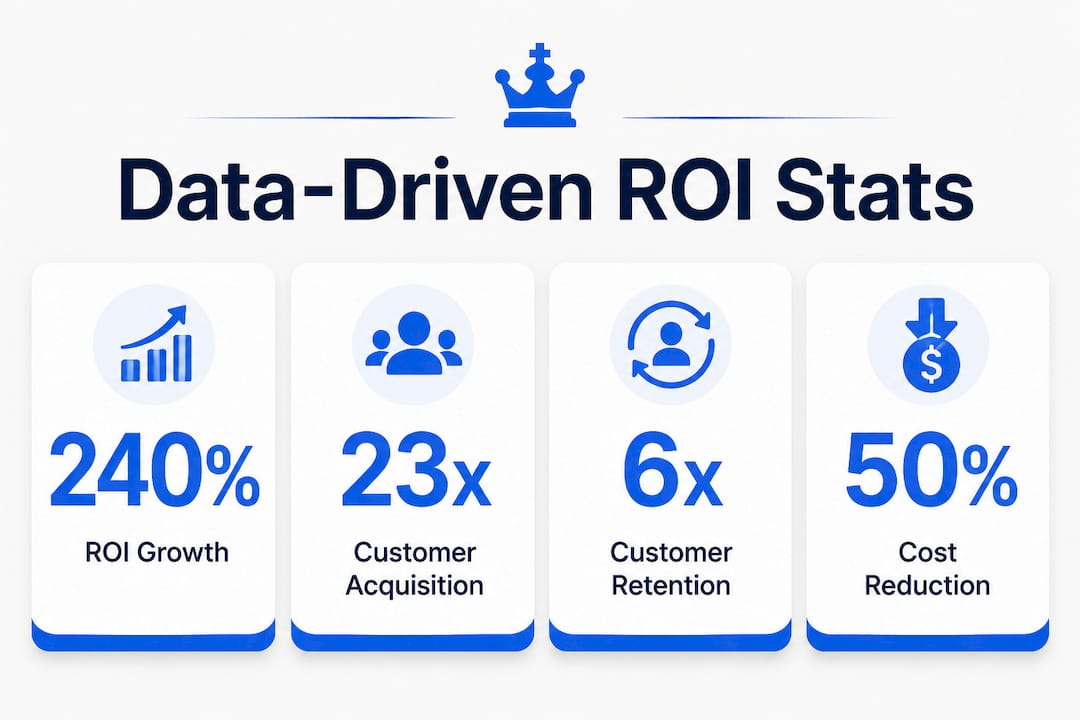
Data-driven marketing is the practice of making every marketing decision based on customer data rather than gut instinct, and organizations that do it well are 23x more likely to acquire customers than those that don’t. That single statistic from McKinsey reframes the entire conversation. This isn’t a nice-to-have upgrade for your marketing program. It’s the difference between spending your budget confidently and spending it hopefully. Whether you run a local business in Albuquerque or manage marketing for a growing company, understanding the importance of data-driven marketing is the foundation of every smart campaign decision you’ll make in 2026.
Why data-driven marketing outperforms traditional methods
Traditional marketing runs on assumptions. You pick a channel, craft a message, and hope it lands with the right people. Data-driven marketing replaces that hope with evidence. The advantages of data-driven strategies show up immediately in three areas: who you reach, what you spend, and what you earn back.
The financial case is hard to argue with. A composite organization using Amazon Ads ad tech achieved 240% ROI over three years, reducing costs and significantly increasing return on ad spend. That result came from tying every campaign decision to measurable performance data, not from spending more money.
Here’s how the two approaches compare side by side:
| Factor | Traditional Marketing | Data-Driven Marketing |
|---|---|---|
| Audience targeting | Broad demographic assumptions | Behavioral and purchase data segments |
| Budget allocation | Fixed by channel preference | Shifted in real time based on performance |
| Campaign decisions | Experience and intuition | A/B test results and attribution data |
| Success measurement | Reach and impressions | Revenue, retention, and customer lifetime value |
| Customer personalization | Generic messaging | Individualized content based on behavior |
Beyond ROI, data-driven decision making also improves retention. Organizations using customer data systematically are 6x more likely to retain customers. Retention is where real profitability lives, because acquiring a new customer costs significantly more than keeping an existing one.
Pro Tip: Track your customer acquisition cost and lifetime value side by side. When your data shows lifetime value rising faster than acquisition cost, your data-driven strategy is working.
The benefits of data-driven marketing also include better personalization. When you know what a customer browsed, purchased, or ignored, you can send them the right message at the right moment. Generic email blasts become behavior-triggered sequences. Broad ad campaigns become precise retargeting. Every touchpoint gets sharper.
What stops most businesses from acting on their data?
Collecting data is not the hard part. Acting on it is. Fewer than 30% of enterprises successfully translate data insights into marketing action. That gap between measurement and action is where most marketing budgets quietly bleed out.
The barriers are predictable, and they show up in businesses of every size:
- Siloed data. Your CRM holds customer history. Your ad platform holds click data. Your website analytics holds behavior data. When these systems don’t talk to each other, you’re making decisions with incomplete information.
- No decision thresholds. Without predefined rules for when data triggers a change, teams sit on insights for weeks. By the time someone acts, the opportunity has passed.
- Dashboards without decisions. Marketing dashboards that nobody acts on are a reporting problem, not a data-driven marketing success. A dashboard that shows a 40% drop in email open rates means nothing if no one changes the subject line strategy.
- Culture that resists evidence. Adobe’s 2026 guide frames data-driven decision making as a cultural shift, not a software purchase. If leadership still overrides data with personal preference, the system breaks.
The cultural challenge is the one most businesses underestimate. You can buy the best analytics tools on the market and still run intuition-based marketing if your team isn’t trained to trust the numbers. Building a data-first culture means rewarding decisions that are backed by evidence, even when those decisions feel uncomfortable.
Pro Tip: Set a standing rule: no campaign budget change over $500 without a data point to support it. That one rule forces your team to build the habit of evidence-based decisions.
A closed-loop marketing system connects data collection through segmentation to campaign activation and back to measurement. Without that loop, you’re measuring results but not feeding them back into your next campaign. The loop is what turns one good campaign into a continuously improving program.
How technology and real-time data power modern campaigns
The mechanics of data-driven marketing strategies have changed significantly. First-party data is now the foundation. With third-party cookies phasing out, the data you collect directly from your customers through your website, email list, and purchase history carries more weight than ever.
Customer.io’s 2026 overview identifies three operational conditions that separate effective data-driven programs from ineffective ones:
- First-party data reliability. Data collected directly from your audience is more accurate and more durable than purchased lists or third-party signals.
- Near real-time behavioral triggers. Acting on customer behavior within minutes, not days, produces dramatically better engagement. A cart abandonment email sent within one hour converts at a far higher rate than one sent 24 hours later.
- Measurement tied to retention and revenue. Vanity metrics like impressions and clicks don’t tell you if marketing is working. Retention rate, customer lifetime value, and revenue per campaign do.
AI plays a growing role in making this practical for smaller teams. AI tools now handle campaign performance analysis, audience segmentation, and content personalization at a scale no human team could manage manually. The result is that a small business with the right tools can run campaigns with the precision of a much larger operation.
| Metric Type | Vanity Metric | Outcome Metric |
|---|---|---|
| Email campaigns | Open rate | Revenue per email sent |
| Paid ads | Impressions | Cost per acquired customer |
| Content marketing | Page views | Leads generated per post |
| Social media | Followers | Conversions from social traffic |
Behavior-triggered emails are one of the clearest examples of how real-time data improves marketing. When a customer visits your pricing page three times without converting, a triggered email with a specific offer responds to demonstrated intent. That’s the impact of data on marketing in its most direct form. You can explore how to connect these signals to your marketing ROI measurement to see which triggers actually drive revenue.

How to operationalize data-driven marketing step by step
Knowing the theory is one thing. Building the system is another. Here’s how to move from scattered data to a working data-driven program:
- Build a unified customer view. Pull your CRM, website analytics, email platform, and ad data into one place. Tools like customer data platforms (CDPs) exist specifically for this. Reducing data fragmentation is the single most important step for accurate attribution.
- Define your key metrics before you launch. Decide in advance what success looks like. Revenue per campaign, customer acquisition cost, and retention rate are the metrics that connect marketing to business outcomes.
- Run structured A/B tests. Test one variable at a time: subject line, offer, landing page headline, ad creative. Document results and apply the winner to your next campaign. This is how online marketing metrics compound over time.
- Set decision thresholds. If your cost per click rises above a set number, pause the ad group. If email open rates drop below a set percentage, test a new subject line. Teams without decision thresholds detect problems slowly and lose optimization opportunities.
- Build an optimization cadence. Weekly reviews of campaign performance, monthly reviews of channel allocation, and quarterly reviews of overall strategy keep your program improving continuously.
The compounding effect of this process is significant. Each test teaches you something. Each optimization makes the next campaign more efficient. Adobe describes this as a continuous improvement cycle that feeds learnings back into strategy to improve revenue and customer lifetime value over time.
- Use attribution models to understand which channels actually drive conversions, not just which ones get the last click.
- Automate repetitive decisions like bid adjustments and email triggers so your team focuses on strategy.
- Revisit your customer segments quarterly. Behavior changes, and your segments should reflect that.
- Connect every campaign to a business outcome before it launches. If you can’t explain how the campaign affects revenue or retention, reconsider running it.
For businesses focused on customer acquisition growth, this structured approach turns marketing from a cost center into a measurable growth engine. You can also use an advertising ROI calculator to model the financial impact before committing budget.
Key takeaways
Data-driven marketing works because it replaces guesswork with evidence, and organizations that build a closed loop from data collection to campaign action consistently outperform those that don’t.
| Point | Details |
|---|---|
| Customer acquisition advantage | Data-driven organizations are 23x more likely to acquire customers than intuition-led competitors. |
| ROI is measurable and significant | Amazon Ads ad tech users achieved 240% ROI over three years using data-connected campaign decisions. |
| The action gap is the real problem | Fewer than 30% of enterprises translate data insights into action, making execution the critical skill. |
| First-party data is now the foundation | Reliable first-party data, real-time triggers, and outcome metrics are the three conditions for success in 2026. |
| Optimization compounds over time | A structured testing and review cadence turns each campaign into a learning that improves the next one. |
The uncomfortable truth about data and marketing decisions
I’ve worked with business owners who have Google Analytics, a CRM, an email platform, and paid ad dashboards all running simultaneously. They have more data than they know what to do with. And their marketing still runs on gut feel because nobody ever built the bridge between the numbers and the decisions.
That’s the real challenge. Data-driven marketing isn’t about having more data. It’s about building a system where data actually changes what you do next. I’ve seen small businesses with modest budgets outperform larger competitors simply because they committed to testing, measuring, and adjusting every single week. The compounding effect of that discipline is remarkable after six months.
The businesses that struggle are the ones that treat analytics as a reporting function rather than a decision function. They pull a monthly report, nod at the numbers, and then make the same decisions they made last month. That’s not data-driven marketing. That’s data-decorated guessing.
My honest recommendation: start smaller than you think you need to. Pick two metrics that connect directly to revenue. Build one feedback loop around those metrics. Run one structured test per month. After 90 days, you’ll have more useful insight than most businesses gather in a year. The analytics and retention connection is real, but only when you act on what the data tells you.
— Bernadette
Ready to put your marketing data to work?
If you’ve read this far, you already understand that data-driven marketing isn’t optional for businesses that want to grow. The question is whether your current setup actually connects data to decisions, or whether you’re sitting on insights that never change anything.
King Digital Marketing Agency works with small and medium-sized businesses to build marketing programs grounded in real performance data. From campaign attribution to conversion tracking and local search strategy, we build the systems that turn your marketing budget into measurable results. Explore our digital marketing solutions to see how we approach data-driven growth for businesses like yours. You can also review our full guide to effective digital marketing to understand how each service connects to your bottom line.
FAQ
What is data-driven marketing in simple terms?
Data-driven marketing is the practice of using customer data, such as purchase history, browsing behavior, and engagement patterns, to guide every marketing decision rather than relying on assumptions or intuition.
How much better is data-driven marketing compared to traditional marketing?
Organizations using data-driven approaches are 23x more likely to acquire customers and 6x more likely to retain them compared to businesses using traditional, intuition-based marketing methods.
What is the biggest challenge in data-driven marketing?
The biggest challenge is translating data into action. Fewer than 30% of enterprises successfully act on their data insights, meaning most businesses collect data without changing their marketing decisions based on what it reveals.
What data should small businesses track first?
Start with customer acquisition cost, conversion rate, and customer lifetime value. These three metrics connect directly to revenue and give you a clear picture of whether your marketing is generating a return.
How does first-party data improve marketing performance?
First-party data collected directly from your customers is more accurate and reliable than third-party sources. It powers precise segmentation, behavior-triggered campaigns, and better customer retention because it reflects actual behavior rather than inferred signals.
Recommended
- How to measure marketing roi: Unlock 5:1 Potential
- Marketing ROI Calculator: 1 Simple Boost to Profit
- How to calculate roi for marketing activities without a PhD | King Digital Marketing Agency
- How to Calculate ROI for Email Marketing: Essential 2025
