TL;DR:
- Link building involves acquiring relevant, high-quality backlinks from local sources to boost search engine trust and rankings. Focusing on community relationships, local directories, and content creates sustainable, impactful links that outperform sheer volume. Consistent engagement over time is essential for measuring success and building lasting online authority for small businesses.
Link building is defined as the process of acquiring hyperlinks from other websites to your own, signaling trust and authority to search engines like Google. In SEO, these hyperlinks are called backlinks, and they function as votes of confidence. The more credible sites that link to you, the more Google trusts your site and ranks it higher in search results. Tools like Moz and Ahrefs have made it easier than ever to track and analyze these backlinks. Understanding what is link building, and doing it well, is one of the highest-leverage moves a small business can make for long-term online visibility.
What is link building and why does it matter for your website?
Link building improves site authority and helps search engines discover, understand, and rank your pages higher in search results. Think of each backlink as a recommendation from one website to yours. When a respected local news outlet or industry blog links to your site, Google interprets that as a credibility signal. The more credible the source, the stronger the signal.
The link building definition has evolved significantly over the past decade. Early SEO rewarded sheer volume of links, which led to spammy directories and link farms. Today, quality, context, and relevance are the pillars of effective link building. Google’s algorithms now discount manipulative or low-quality links that lack genuine editorial endorsement. This shift means a single link from a trusted local chamber of commerce can outperform dozens of links from irrelevant, low-authority sites.
Link building does not operate in isolation. It works alongside content creation, technical SEO, and on-page optimization to build a complete picture of your site’s authority. A well-written blog post earns links naturally. A fast, well-structured website makes those links more impactful. Modern link building is also increasingly aligned with digital PR, where building your brand’s reputation online generates links as a byproduct of visibility.
Here is what effective link building looks like in practice:
- A plumber in Albuquerque earns a link from a local home improvement blog after contributing a guest article on winterizing pipes.
- A restaurant gets listed and linked from the Albuquerque Journal’s “Best of” feature.
- A law firm sponsors a local charity event and receives a backlink from the charity’s website.
- A retail shop creates a locally focused gift guide that gets picked up by a neighborhood news site.
Pro Tip: Don’t chase every link opportunity. Focus on sites that your ideal customers actually read. Relevance to your audience matters as much as the domain’s authority score.
How does local link building differ from general link building?
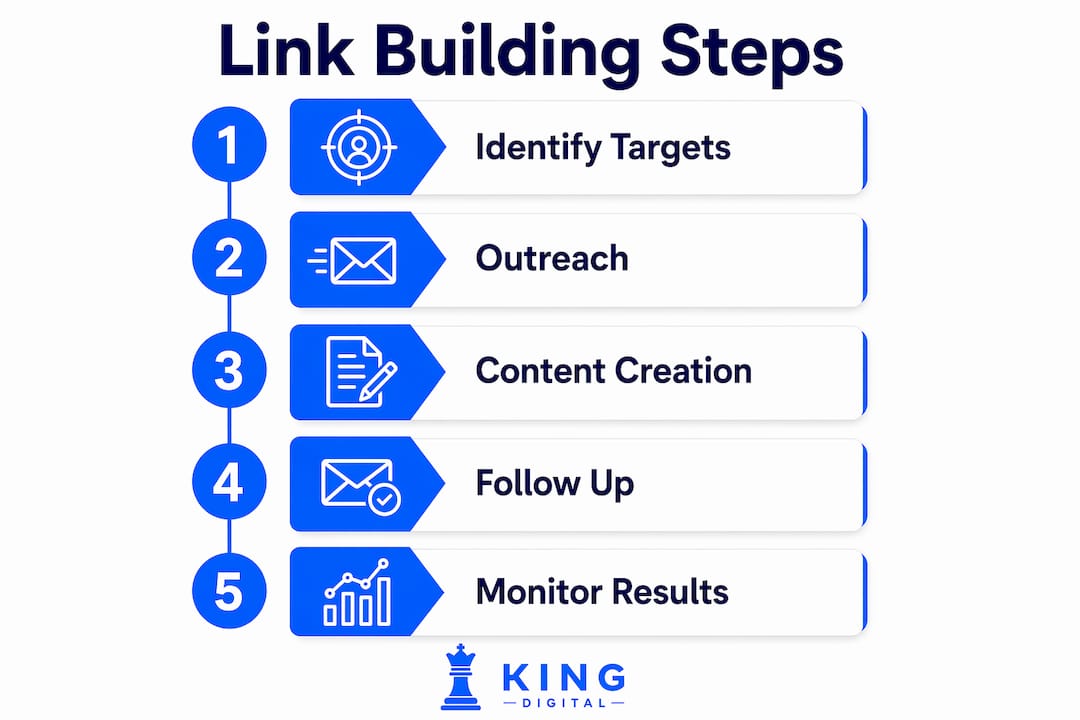
Local link building is the practice of acquiring backlinks from geographically relevant sources to improve your visibility in local search results, including Google’s map pack. It is a subset of general link building, but the strategy and source selection are fundamentally different. Where national campaigns target high-authority sites regardless of location, local campaigns prioritize geographic and topical alignment.

A domain authority 30 link from a local chamber of commerce impacts local rankings more than a high-authority national blog link without geographic relevance. This is a counterintuitive truth that many SMB owners miss. They spend months chasing links from major publications when a mention in the Albuquerque Business Journal or a link from a neighborhood association website would move the needle faster for local search.
Here is a direct comparison of the two approaches:
| Factor | General link building | Local link building |
|---|---|---|
| Primary goal | Improve national or global rankings | Improve local map pack and local organic rankings |
| Source priority | High domain authority, broad audience | Geographic relevance, community trust |
| Typical sources | Industry publications, national blogs | Local newspapers, chambers of commerce, community blogs |
| Volume needed | Higher volume often required | 15 to 40 quality links can dominate most local niches |
| Relationship type | Often transactional or content-driven | Relationship-based, community-centered |
Local link building builds trust that withstands Google core updates and creates a competitive advantage that national brands cannot easily replicate. A national competitor may have thousands of backlinks, but if none of them signal local relevance, your 30 well-placed local links can outrank them in your city.
Pro Tip: When evaluating a local link opportunity, ask yourself: “Would my ideal customer in this city actually visit this website?” If yes, pursue it. If not, move on.
What are effective local link building strategies for small businesses?
The most effective local link building strategies are grounded in genuine community relationships, not cold outreach templates. Here are the tactics that consistently produce results for SMBs:
-
Partner with local organizations. Reach out to your local chamber of commerce, business improvement districts, and trade associations. Many of these organizations maintain member directories with live backlinks. A listing in the Albuquerque Hispano Chamber of Commerce, for example, carries both authority and geographic relevance. You can learn more about this approach through local citation building and why it matters beyond Google.
-
Sponsor local events and causes. Sponsoring a Little League team, a neighborhood festival, or a nonprofit fundraiser often results in a backlink from the event’s website. These links are editorially placed, geographically relevant, and completely natural. They also build goodwill in the community, which compounds over time.
-
Create locally relevant content. A roofing company that publishes a guide on “How Albuquerque’s monsoon season affects flat roofs” earns links from local home improvement blogs, real estate sites, and neighborhood forums. Content tied to local geography, events, or issues attracts links that a generic national article never would.
-
Get listed in quality local directories. Beyond Google Business Profile, directories like the Better Business Bureau, Yelp, and local city guides provide credible backlinks. Avoid low-quality, generic directories that exist solely for link placement.
-
Use digital PR with a local angle. Pitch story ideas to local journalists and bloggers. A unique data point about your industry in your city, a community initiative you are leading, or a local trend you have spotted can earn coverage and links from local news outlets.
Local link building requires relationship-based outreach with local businesses, sponsorships, and community events to create relevant backlinks and build trust signals. This is not a one-time campaign. It is an ongoing practice of showing up in your community, both online and offline.
Pro Tip: Targeting 15 to 40 quality local backlinks is sufficient to compete effectively in local map packs for most niches. You do not need hundreds of links. You need the right ones.
How to measure the success of your link building efforts
Measuring link building success requires looking beyond raw link counts. Here is a structured approach to evaluating what is actually working:
-
Track your backlink profile with Moz or Ahrefs. SEO tools like Moz and Ahrefs are the standard for tracking backlink profiles, anchor texts, and link quality metrics. Log in weekly and look for new links, lost links, and any spammy links that may have appeared.
-
Monitor your local search rankings. Use Google Search Console to track keyword ranking changes after new links are acquired. If you earn a link from a local news site and your rankings for “Albuquerque plumber” improve within four to six weeks, that is a strong signal the link is working.
-
Check referral traffic in Google Analytics. Quality links send real visitors to your site. If a link from a local blog drives 50 visitors per month who spend time on your pages, that link has dual value: SEO authority and direct traffic.
-
Assess domain authority and relevance together. A link from a site with a Moz Domain Authority of 25 but strong local relevance is often more valuable than a DA 60 site with no geographic connection to your market.
-
Watch for toxic links. Spammy backlinks from link farms, foreign directories, or irrelevant sites can dilute your profile. Use Google Search Console’s disavow tool if you identify links that appear manipulative or harmful.
Pro Tip: Do not obsess over Domain Authority as a single metric. A link from a locally trusted source with a modest DA score will often outperform a high-DA link from a site your customers have never heard of.
Common link building pitfalls and how to avoid them
Many SMB owners make the same mistakes when they start building links. Recognizing these traps early saves you time, money, and potential penalties.
-
Chasing volume over quality. A modest profile of high-quality, relevant backlinks can ensure local SEO dominance in most niches. Fifty irrelevant links from generic directories will not move your rankings. Five links from respected local sources will.
-
Buying links or joining link schemes. Spamming links or participating in link schemes can harm your ranking and waste resources. Google’s guidelines explicitly prohibit paid links intended to manipulate rankings. The risk of a manual penalty is real and recovery is slow.
-
Ignoring content quality. Links earned through genuinely useful content are the most defensible. If your content is thin or generic, no outreach strategy will compensate for it. Invest in content that actually helps your audience.
-
Overlooking local relevance. For a business serving Albuquerque, a link from a New York lifestyle blog adds almost no local SEO value. Every link you pursue should pass the local relevance test: does this source serve or reference your geographic market?
-
Treating link building as a one-time project. Search engines reward consistent, ongoing link acquisition. A burst of links followed by months of inactivity looks unnatural and does not compound the way a steady, relationship-driven approach does.
Key takeaways
Link building is the single most effective off-page SEO tactic for SMBs when it prioritizes geographic relevance, editorial quality, and consistent community relationships over raw link volume.
| Point | Details |
|---|---|
| Link building definition | Acquiring backlinks from other sites to signal trust and authority to search engines. |
| Quality over quantity | A small number of relevant, local links outperforms hundreds of low-quality or irrelevant ones. |
| Local relevance wins | Geographic relevance often matters more than domain authority for local search rankings. |
| Proven local tactics | Sponsorships, local directories, community content, and chamber memberships build strong local links. |
| Measure what matters | Use Moz, Ahrefs, and Google Search Console to track link quality, rankings, and referral traffic. |
Why I believe local link building is the most underused asset in SMB SEO
I have worked with dozens of small business owners who were convinced they needed to land links from Forbes or Entrepreneur to compete online. That belief costs them months of wasted outreach and real money. The truth I keep coming back to is simpler and more encouraging: local link building is a powerful yet often overlooked off-page SEO signal, giving local businesses an unfair advantage when competing against national players.
What I have seen work, time and again, is consistent community presence. The HVAC company that sponsors the local school fundraiser. The accountant who writes a guest column for the neighborhood business journal. The dentist whose office is listed on every local parenting blog. None of these feel like “SEO tactics.” They feel like being a good neighbor. And that is exactly why they work so well. Google’s algorithms are increasingly designed to reward trust, and trust is built through relationships, not manipulation.
My practical advice for any SMB owner reading this: start with the five to ten organizations in your city that your customers already trust. Get listed, get involved, and create content that speaks to your local community. You do not need a massive budget or a full-time SEO team. You need consistency and genuine engagement. That combination, applied over six to twelve months, will outperform most paid link campaigns I have seen at twice the cost.
— Bernadette
Ready to build links that actually grow your business?
At King Digital Marketing Agency, we work with small and medium-sized businesses in Albuquerque and beyond to build link profiles that drive real local visibility. Link building is not a side task you can set and forget. It requires the kind of ongoing relationship-building and local knowledge that a boutique agency is built for.
If you are ready to stop guessing and start growing, our team can build a digital marketing strategy tailored to your market, your budget, and your goals. We combine local SEO expertise with proven link building tactics to help you rank where your customers are searching. Explore our local marketing SEO services and see how we help businesses like yours compete and win locally.
FAQ
What is link building in simple terms?
Link building is the practice of getting other websites to link to your site, which signals to Google that your site is trustworthy and worth ranking higher in search results. Each backlink acts as a vote of confidence from one site to another.
What is local link building?
Local link building is the process of acquiring backlinks from geographically relevant sources, such as local newspapers, chambers of commerce, and community blogs, to improve your rankings in local search results and Google’s map pack.
How many backlinks does a small business need?
For most local niches, 15 to 40 quality local backlinks are sufficient to compete effectively in local map packs and organic rankings. Quality and relevance matter far more than volume.
How much does link building cost?
Quality link building ranges from $50 to $200 or more per link depending on site authority and niche relevance. Many local link opportunities, such as chamber memberships and community sponsorships, cost far less and deliver strong geographic relevance.
What tools should I use to track my backlinks?
Moz and Ahrefs are the industry standard tools for monitoring your backlink profile, and Google Search Console provides free data on which sites link to you and how those links affect your search performance. Use all three together for the clearest picture.
Recommended
- Web Design for SMBs: What You Need to Know
- How to Boost Organic Leads for Your SMB in 2026
- Local SEO Best Practices 2025: Essential for Small Business
- Your SEO Secret Weapon Why Local Citations Matter Beyond Google | King Digital Marketing Agency
