TL;DR:
- Optimizing marketing budgets ensures every dollar is allocated based on verified performance and data-driven frameworks. Small and medium-sized businesses can recover 10-20% of wasted spend, improving ROI and aligning spending with business goals. Regular, structured reviews and unified data tracking are essential for effective resource allocation and sustained growth.
Marketing budget optimization is the deliberate process of allocating funds to the channels and activities that generate the highest return on investment, so every dollar you spend drives measurable business growth. For small and medium-sized businesses, this discipline is not optional. Marketing budgets plateaued at 7.7% of total revenue for consecutive years, meaning there is no new money coming. The only path to growth is spending what you have more intelligently. Frameworks like the 70-20-10 rule and data-driven budgeting tools like Google Analytics 4 and Meta Ads Manager exist precisely to help you do that.
Why optimize marketing budgets: the core case for SMBs
The industry term for this practice is marketing resource allocation, and it sits at the intersection of financial discipline and growth strategy. When you optimize your marketing budget, you stop funding channels out of habit and start funding them based on evidence. The benefits of marketing budget optimization are concrete and measurable, not theoretical.
“Granular budget reallocation can recover 10 to 20% of marketing spend by cutting underperforming channels, and reinvesting those savings can drive 5 to 10% growth.” — CMSWire
That recovery is not a rounding error for an SMB. It is the difference between a profitable quarter and a flat one.
Here is what optimized budget management delivers in practice:
- Improved ROI. Shifting spend from low-performing channels to proven ones raises your return without increasing total spend. Learning to measure marketing ROI accurately is the first step.
- Reduced waste. 8.5% of paid ad spend is lost to invalid traffic alone. Optimization closes that leak before it drains your budget.
- Better alignment with business goals. Budget decisions tied to revenue targets are easier to defend and easier to scale.
- Flexibility to experiment. When your core spend is efficient, you free up room to test new channels without risking the business.
- Budget protection during downturns. 44.6% of executives cut marketing first when volatility hits. A budget tied to clear revenue outcomes is far harder to slash.
The importance of budget efficiency is not just about saving money. It is about building a marketing operation that earns its seat at the table every single quarter.
How does data drive marketing budget decisions?
Data is the engine of every sound allocation decision, but most SMBs are running on incomplete fuel. 80% of marketers optimize without verified purchase data, creating what the industry calls optimization lag. You are making decisions based on signals that do not yet reflect actual outcomes, which means your budget shifts are chasing ghosts.

The fix starts with unified measurement. Unified data platforms enable cross-channel performance clarity and reduce the fragmented decision-making that causes budget waste. When your Google Ads, Meta Ads Manager, email platform, and CRM feed into a single dashboard, you can see which channels are actually moving revenue, not just generating clicks.
Pro Tip: Do not confuse correlation with causation. If email revenue spikes the same week you run a paid campaign, incrementality testing, not assumption, tells you which channel deserves the credit.
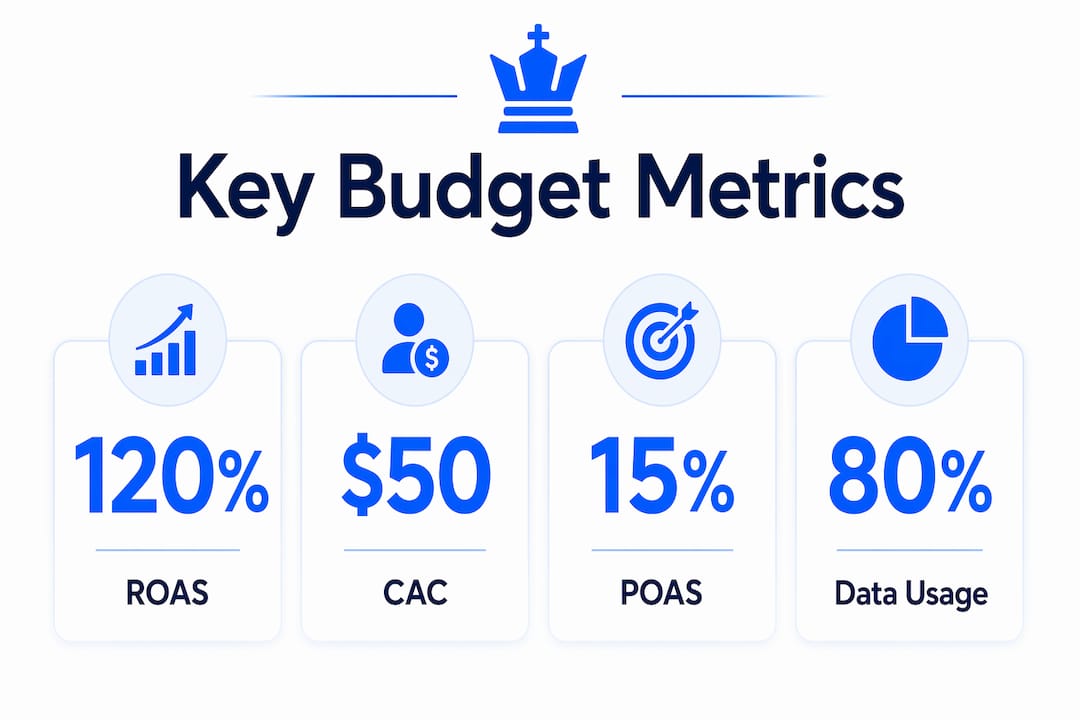
The metrics that matter most for budget allocation are ROAS (return on ad spend), CAC (customer acquisition cost), and POAS (profit on ad spend). Vanity metrics like impressions and follower counts tell you nothing about where to put your next dollar. Over two-thirds of senior marketers estimate at least 11% of media budgets are wasted due to bad optimization signals. That waste is a direct result of measuring the wrong things.
| Metric | What it measures | Why it matters for allocation |
|---|---|---|
| ROAS | Revenue generated per ad dollar | Shows channel-level efficiency |
| CAC | Cost to acquire one customer | Reveals true cost of growth |
| POAS | Profit generated per ad dollar | Accounts for margin, not just revenue |
| Incrementality | Lift caused by a specific channel | Separates real impact from coincidence |
Building a solid data foundation before you reallocate a single dollar is not a luxury. It is the prerequisite for every other strategy in this article.
What frameworks help SMBs allocate budgets effectively?
Knowing you need to allocate better is one thing. Having a system to do it is another. These are the frameworks that work for businesses without a 10-person finance team.
-
Apply the 70-20-10 rule. Commit 70% of your budget to proven, high-performing channels. Allocate 20% to emerging tactics you are actively testing. Reserve 10% for pure experimentation. This structure keeps your core revenue engine funded while building tomorrow’s winners.
-
Use zero-based budgeting for annual reviews. Instead of rolling last year’s budget forward with a percentage increase, justify every line item from scratch. This forces you to confront channels that have been funded by inertia rather than performance.
-
Separate committed spend from flexible spend. Your committed core covers demand generation activities that cannot be paused without damaging pipeline. Your flexible pool responds to in-year performance data. Keeping these pools distinct removes the politics from reallocation conversations.
-
Set predefined reallocation triggers. Predefined budget reallocation triggers remove emotion and politics from mid-year adjustments. For example: if a channel’s ROAS drops below 2.0 for three consecutive weeks, funds automatically shift to the next best performer.
-
Align spend to the customer journey, not the calendar. Avoid equal monthly budget distribution. Spreading spend evenly across 12 months ignores seasonality, conversion lag, and the natural rhythm of your buyers. A home services business in Albuquerque should not spend the same in January as it does in April.
Pro Tip: Build a comparison table of your top three channels by CAC and ROAS every quarter. The channel that wins on both metrics gets the next budget increment. The one that loses on both gets reviewed for cuts.
Strategies for marketing resource allocation work best when they are written down and reviewed on a schedule. A system you follow inconsistently is not a system.
How can SMBs align budgets with business goals?
The most common reason marketing budgets get cut is that the CFO cannot connect the spend to revenue. Your job is to make that connection impossible to ignore. This is where the impact of budget management becomes a leadership conversation, not just a marketing one.
The “$1 Rule” is a practical narrative tool: for every $1 invested in marketing, the business generates $X in pipeline or revenue. CMOs who use simplified ROI narratives like this secure 18% more funding annually. You do not need a complex attribution model to make this argument. You need clean data and a clear story. Learning how to calculate ROI for your specific activities is the foundation of that story.
Here is how to build that alignment in practice:
- Replace activity metrics (“we sent 12 emails this month”) with revenue metrics (“email generated $8,400 in attributed sales this month”).
- Build a “hard deck” budget that represents the minimum spend required to maintain current demand generation. Present this as a revenue protection line, not a marketing wish list.
- Frame brand and awareness spend as revenue enablers, not direct revenue drivers. Executives understand that you cannot harvest demand you never created.
- Schedule quarterly budget reviews with leadership, not just annual ones. Regular conversations prevent the surprise cuts that derail annual plans.
59% of CMOs report lacking the resources to fully execute their strategy. The businesses that escape this trap are the ones that speak the CFO’s language fluently.
What mistakes should SMBs avoid when managing budgets?
Even well-intentioned budget plans fail when these traps go unaddressed.
- Basing decisions on incomplete data. Optimizing without verified purchase data produces decisions that feel informed but are not. Fix your tracking before you reallocate.
- Chasing vanity metrics. High impressions and low conversions mean you are paying for attention that does not convert. Incrementality testing is the only reliable way to know which channels are actually driving results.
- Over-allocating to bottom-funnel channels. Paid search and retargeting harvest existing demand. If you defund awareness and mid-funnel content, you shrink the pool of buyers those channels can reach. Optimizing your marketing funnel from top to bottom protects against this imbalance.
- Accepting shadow budgets. Accepting supplementary budgets without proportional headcount inflates spending without improving execution quality. More money without more capacity creates chaos, not growth.
- Resisting mid-year adjustments. Annual budgets are plans, not contracts. Markets shift, competitors move, and customer behavior changes. A budget that cannot flex is a budget that wastes money on yesterday’s assumptions.
Pro Tip: Run a quarterly “channel audit” using your CAC and ROAS data. Any channel that has not improved on at least one metric in two consecutive quarters deserves a serious conversation about reallocation.
Avoiding these mistakes is not about being cautious. It is about protecting the efficiency gains you have already worked to build.
Key takeaways
Optimizing your marketing budget means allocating funds based on verified performance data, defined frameworks, and revenue-linked metrics, so every dollar you spend moves the business forward.
| Point | Details |
|---|---|
| Optimization recovers real money | Cutting underperforming channels can recover 10 to 20% of spend and reinvest it for measurable growth. |
| Data quality comes first | 80% of marketers optimize without verified purchase data, making accurate tracking the foundation of every budget decision. |
| Use structured frameworks | The 70-20-10 rule and zero-based budgeting give SMBs a repeatable system for allocation and review. |
| Speak the CFO’s language | ROI narratives like the “$1 Rule” help secure and defend budgets by connecting spend directly to revenue outcomes. |
| Avoid the shadow budget trap | Accepting extra funds without proportional resources inflates costs without improving results. |
What I have learned from watching SMBs manage their budgets
I have worked with enough small business owners to know that the biggest budget problem is rarely the budget itself. It is the absence of a system. Most owners I talk to are making allocation decisions based on gut feel, last month’s results, or what a vendor told them was working. That is not a strategy. It is a hope.
The businesses that get this right share one habit: they treat their marketing budget like a portfolio, not a bill. They hold their channels accountable to performance data the same way an investor holds a stock. When a channel underperforms for two quarters, they do not wait for a third. They reallocate and test something new.
What surprises most owners is how much the data infrastructure investment pays off. Spending time and modest resources to unify your tracking across Google Ads, Meta, and your CRM is not glamorous work. But it is the work that makes every other decision cleaner and faster. I have seen businesses in Albuquerque recover thousands of dollars in wasted ad spend simply by fixing their conversion tracking and running a proper paid search audit.
My honest advice: start with one quarter of clean data before you make any major reallocation. You will be surprised what you find, and you will make better decisions because of it.
— Bernadette
Ready to put your marketing budget to work?
If you are spending money on digital marketing and not seeing clear returns, the problem is almost never the budget size. It is the allocation. At King Digital Marketing Agency, we work with SMBs to audit existing spend, identify waste, and build data-driven plans that connect every dollar to a measurable outcome.

From paid advertising management and local SEO to full digital marketing strategy, our team brings the analysis and execution that turns a scattered budget into a growth engine. If you are ready to stop guessing and start growing, we are ready to help. Explore our digital marketing solutions and find out what a focused, accountable budget can do for your business.
FAQ
Why should SMBs prioritize marketing budget optimization?
Marketing budget optimization allows SMBs to recover 10 to 20% of wasted spend and redirect it toward channels that drive measurable revenue growth, making it one of the highest-return operational improvements available.
What is the 70-20-10 rule in marketing budgets?
The 70-20-10 rule allocates 70% of budget to proven channels, 20% to emerging tactics under active testing, and 10% to experimental spend, balancing stability with the ability to discover new growth opportunities.
How do I know if my marketing budget is being wasted?
If you are not tracking ROAS, CAC, and incrementality by channel, you are likely wasting budget. Over two-thirds of senior marketers estimate at least 11% of media budgets are lost to bad optimization signals.
What metrics should I use to allocate marketing funds?
ROAS, CAC, and POAS are the three metrics that most directly inform allocation decisions. Vanity metrics like impressions and follower counts do not tell you where your next dollar should go.
How often should I review and adjust my marketing budget?
Quarterly reviews are the minimum for SMBs. Annual-only reviews leave too much time for underperforming channels to drain resources before anyone catches the problem.
Recommended
- Unlock Your Ad Potential: The Ultimate Advertising ROI Calculator | King Digital Marketing Agency
- How to calculate roi for marketing activities without a PhD | King Digital Marketing Agency
- How to measure marketing roi: Unlock 5:1 Potential
- Marketing ROI Calculator: 1 Simple Boost to Profit
