TL;DR:
- Most Albuquerque small business websites fail to attract local customers because owners neglect ongoing SEO and content updates.
- To succeed, they must set clear goals, build a structured local SEO foundation, and maintain consistent post-launch improvements.
You put together a website, maybe even paid someone to design it, and still the phone isn’t ringing the way you expected. You’re not alone. Many Albuquerque small business owners launch a site that looks decent enough but fails to attract local customers, rank in local search, or turn visitors into leads. The gap between a basic website and a genuinely effective one comes down to decisions made before, during, and after launch. This guide walks you through every critical step, from defining your site’s purpose to building the technical foundation that puts your business in front of the right Albuquerque customers at exactly the right moment.
Table of Contents
- Clarify your website’s purpose and local goals
- Plan your website structure for local SEO
- Add essential features for local leads and search visibility
- Choose the right approach: Website builder vs. custom design
- Launch, update, and verify your website for lasting results
- Why most local small business websites only get half the formula right
- Connect with local web design and digital marketing experts
- Frequently asked questions
Key Takeaways
| Point | Details |
|---|---|
| Start with purpose | Clarifying your business goal shapes every part of your website design and drives better results. |
| Structure for local SEO | Organize your site with dedicated service, About, and Contact pages for maximum Albuquerque visibility. |
| Integrate local features | Add Google Business Profile, schema, and mobile-ready design to capture and convert local visitors. |
| Pick the right platform | Choose a website builder for built-in local SEO or a custom design for more control and unique branding. |
| Continuous improvement | Your website succeeds when you monitor, update, and grow it—don’t ‘set and forget’. |
Clarify your website’s purpose and local goals
Every strong website starts with one clear question: what do you actually want this site to do? It sounds obvious, but most small business owners skip this step entirely and end up with a site that looks fine but converts nobody.
Your website goal should be specific and measurable. Are you trying to generate phone calls from Albuquerque homeowners? Book appointments for a service? Sell products directly? Build awareness so locals recognize your name? Each of these goals leads to completely different design, content, and technical decisions. As How to Make a Website emphasizes, you need to start with a clear website purpose and target outcomes before touching any builder or template.
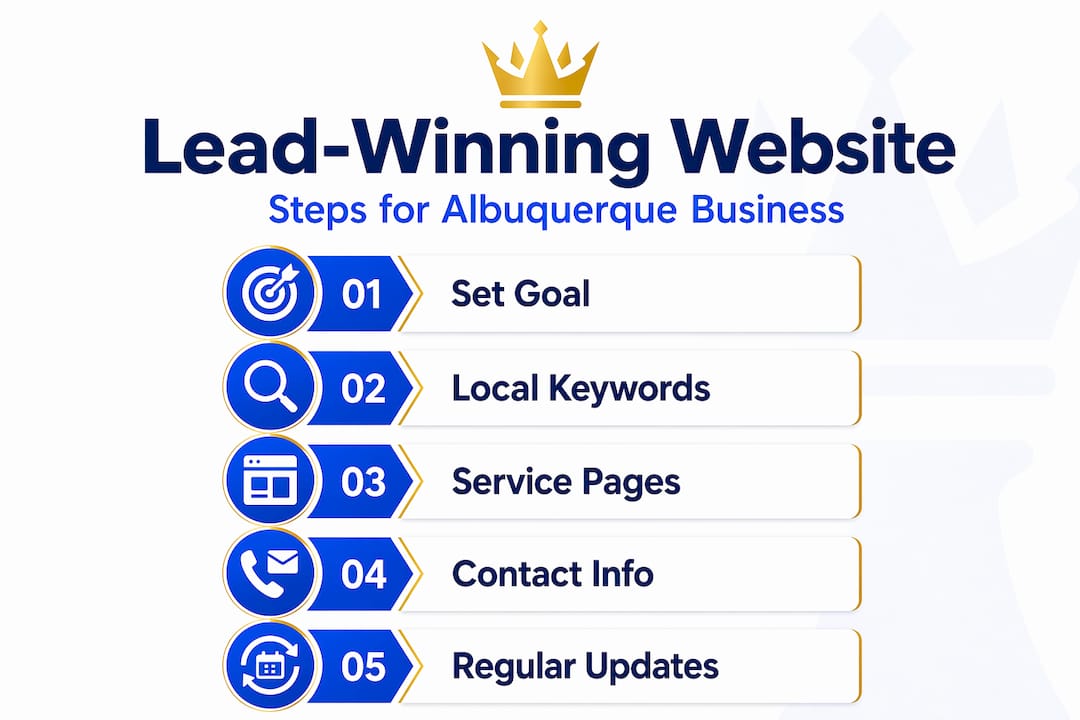
Thinking through web design for Albuquerque visibility early means you won’t have to rebuild later. And when you boost business design impact by aligning purpose with structure from day one, results follow much faster.
Before you select a website builder, complete these four must-do’s:
- Define one primary goal (lead generation, bookings, awareness, or e-commerce) and write it down
- Research 5 to 10 local search phrases your Albuquerque customers actually use
- Decide on a domain name that reflects your business name or local service area
- Confirm you understand your legal obligations around privacy policies and accessibility
Website foundation checklist:
| Element | What to decide | Why it matters |
|---|---|---|
| Purpose | Lead gen, bookings, or awareness | Shapes every design and copy choice |
| Domain | Branded vs. local keyword domain | Affects trust and search signal |
| Privacy policy | Required for data collection | Legal compliance and user trust |
| Accessibility | WCAG basics covered | Reaches more users, reduces legal risk |
| Mobile readiness | Responsive from the start | Google ranks mobile-first |
Pro Tip: Choose a domain that includes your business name or a local keyword, but don’t sacrifice clarity for cleverness. “ABQplumbing.com” tells visitors exactly what they’re getting and sends a geographic signal to search engines from day one.
Plan your website structure for local SEO
With your website’s goals clarified and the foundation mapped out, the next step is organizing your content to speak directly to Albuquerque customers and Google alike.
A single-page or homepage-only website might feel simpler to manage, but it severely limits your ability to rank for multiple local search terms. Think of each service page like a dedicated storefront window. A plumber in Albuquerque who has separate pages for “water heater repair,” “drain cleaning,” and “leak detection” can show up in three completely different local searches. A homepage that mentions all three services in passing ranks for none of them consistently.
Your local SEO checklist will confirm what research and experience both show: a dedicated page per service, plus clear About and Contact pages with consistent NAP (name, address, phone number) placement, is the proven foundation for local search success.
Step-by-step website structure for local search success:
- Start with your homepage. It should immediately communicate who you are, where you serve, and what problem you solve for Albuquerque customers.
- Create one dedicated page for each core service you offer. Use local language and specific neighborhood or city references where relevant.
- Build a strong About page that humanizes your business and establishes community credibility. Mention Albuquerque specifically and any local associations or certifications.
- Create a Contact page that lists your full business name, address, phone number, and hours. This is where your NAP information lives, and it must match your Google Business Profile exactly.
- Add a Blog or Resources section if you plan to publish local content. Even quarterly posts about Albuquerque-related topics build authority over time.
- Consider a Testimonials or Reviews page. Social proof matters enormously to local customers comparing options.
Homepage-only vs. multi-page structure for local SEO:
| Factor | Homepage only | Multi-page structure |
|---|---|---|
| Search ranking potential | Limited to 1-2 keywords | Ranks for multiple local terms |
| User experience | Can feel cluttered | Clear, focused content per page |
| Conversion clarity | Diluted calls to action | Targeted CTA per service |
| Crawlability | Minimal internal links | Strong internal link structure |
| Ongoing content growth | Very limited | Scalable with service additions |
Pro Tip: Don’t rely on your homepage alone to convert service or local-intent searches. Google wants to send searchers to the most relevant page for their query. If you only have one page, you’re asking a single page to compete for dozens of different searches. It won’t win many of them.
Add essential features for local leads and search visibility
Once your website’s navigation and page structure are planned, you’ll boost visibility and conversion by adding technical features that build local trust and signal authenticity to search engines.

These aren’t optional extras. They are the infrastructure that separates a website that gets leads from one that just sits there looking nice. Local website builder features research shows that for local visibility and lead generation, businesses must prioritize Google Business Profile integration, LocalBusiness structured data (schema), service-area pages, CRM integration, and strong mobile performance.
Non-negotiable features for local lead generation:
- Google Business Profile integration: Link your site to your verified GBP listing and embed your Google Map on your Contact page
- LocalBusiness schema markup: This structured data tells Google your business name, address, phone, hours, and service area in a language search engines read perfectly
- Service-area pages: If you serve multiple Albuquerque neighborhoods or surrounding areas like Rio Rancho or Corrales, dedicated area pages dramatically expand your reach
- Mobile-responsive design: More than 60% of local searches happen on mobile devices
- Review widget or testimonials section: Display real customer feedback prominently to build instant trust
- Fast load times: Pages that load slowly on mobile cause visitors to leave before they convert
- Click-to-call button: Make it effortless for mobile visitors to contact you instantly
- CRM or lead capture form: Every visitor who fills out a form is a potential customer. Don’t lose those leads.
For tips on managing your Google Business page effectively alongside your site, and to understand what Google My Business really does for Albuquerque businesses, those resources are worth reviewing in detail.
When it comes to mobile SEO best practices, speed and responsiveness aren’t just nice to have. They directly affect whether Google shows your site to local searchers or buries it behind competitors.
Statistic callout: Google treats your website and your Google Business Profile as an integrated system for local search ranking. A well-optimized site with a verified GBP listing reinforces both signals, while neglecting one weakens the other. The two must work together.
Pro Tip: Use a website platform or plugin that supports LocalBusiness schema and review displays out-of-the-box. Manually adding structured data is error-prone. Automating it reduces mistakes and keeps your local signals consistent.
Choose the right approach: Website builder vs. custom design
With features and structure in mind, you’ll need to decide how your website gets built, either DIY with bundled tools or custom for maximum control.
This decision shapes everything from your monthly cost to how much flexibility you have when your business grows. Neither option is universally better. The right choice depends on your budget, technical comfort, and how competitive your local market is.
Some businesses benefit from builders because local-SEO features are bundled in and easy to activate. Others prefer a custom build for deeper control over performance, design, and content. Here’s how to think through both options.
Pros and cons of website builders:
- Pro: Faster and less expensive to launch
- Pro: Built-in SEO tools, mobile templates, and local features in many platforms
- Pro: Easy to update content yourself without a developer
- Con: Limited design flexibility and harder to differentiate from competitors
- Con: Some platforms restrict custom code, making advanced schema or integrations difficult
- Con: Monthly subscription costs add up over time
Builder vs. custom design comparison:
| Factor | Website builder | Custom design |
|---|---|---|
| Upfront cost | Low to moderate | Moderate to high |
| Design flexibility | Limited | Full control |
| Local SEO features | Bundled, easy to activate | Requires intentional build |
| Performance optimization | Platform-dependent | Fully customizable |
| Long-term scalability | Can hit ceilings | Grows with your business |
| Maintenance | Handled by platform | Requires ongoing support |
“Regardless of which platform you choose, integrating structured local signals, such as schema markup, consistent NAP, and service-area content, is what actually moves the needle in local search. The platform is just the vehicle. The strategy is what drives results.” — King Digital
For a deeper look at how local marketing SEO strategy connects to platform choice, and how Bricks Builder can be optimized for search, those are practical resources to explore.
Launch, update, and verify your website for lasting results
After making smart decisions about your website platform and features, a strategic launch and ongoing improvements will deliver steady local leads for your Albuquerque business.
Here’s the truth most web designers won’t tell you: the launch is not the finish line. It’s the starting gun. The businesses that consistently generate local leads treat their website as a living tool, not a one-time project. As website management research confirms, if your primary goal is lead generation, continuous improvement after launch is essential. That means monitoring performance, updating content, and maintaining the site over time.
Steps to verify your site is visible and effective:
- Connect your website to your Google Business Profile and verify both are consistent in NAP details
- Submit your sitemap to Google Search Console so your pages get indexed quickly
- Test every page on a real mobile device, not just a desktop preview
- Set up a simple lead tracking method, whether that’s a CRM, a spreadsheet, or call tracking software
- Collect and respond to at least 5 to 10 customer reviews on your Google Business Profile within the first month of launch
- Check your page load speed using free tools and fix anything loading slower than 3 seconds
- Monitor your rankings for your target Albuquerque search phrases monthly and adjust content as needed
Common post-launch mistakes Albuquerque business owners make include forgetting to update their hours during holidays, letting outdated service information sit on pages for months, and never adding fresh content or reviews. Each of these mistakes quietly erodes your local search visibility over time.
For a complete breakdown of local SEO verification steps specific to Albuquerque businesses, that resource walks through the exact process.
Pro Tip: Set a quarterly calendar reminder to review your website. Update service pages, add new reviews or testimonials, test every contact form and click-to-call button, and check your top traffic pages in Google Search Console. Fifteen minutes every three months protects the investment you made at launch.
Why most local small business websites only get half the formula right
Having learned how to monitor and improve your website post-launch, let’s step back for a perspective on what actually separates the top-performing local sites from everyone else.
After working with dozens of Albuquerque small businesses, I’ve noticed a consistent pattern. Most owners put real effort into getting their website launched. They spend time on the design, they write service descriptions, they even add photos. And then they stop. The website goes live, and in their mind, the “website project” is complete.
But the businesses that dominate local search don’t treat their website and their local SEO presence as two separate projects with a finish line. They treat them as one integrated system that requires regular attention. The biggest missed opportunity we see? Business owners who have a beautiful website but a Google Business Profile that hasn’t been updated in a year, with NAP information that doesn’t quite match the website. That inconsistency alone quietly signals unreliability to Google.
The second pattern is even more common: a website that was built “for local SEO” but has no service-area pages, no schema markup, and no review strategy. It looks the part but doesn’t function as a lead generation tool. Looking good and performing well are not the same thing.
The businesses winning in Albuquerque right now are doing something simple. They’re publishing fresh content consistently, responding to every review, keeping their GBP updated with posts and photos, and checking their website’s web design and SEO essentials at regular intervals. There’s no magic. There’s just strategic consistency.
Don’t build your website and walk away. Treat it like your best salesperson. You’d check in with a salesperson regularly, give them new materials, and make sure they’re representing your business accurately. Your website deserves the same attention.
Connect with local web design and digital marketing experts
Building a website that consistently generates Albuquerque leads takes more than a good template. It takes strategy, technical knowledge, and ongoing commitment.
At King Digital, we specialize in exactly this kind of work. Whether you need a web design marketing boost or are starting from scratch with website design in Albuquerque, our team builds local-first sites that are engineered for lead generation, not just appearances. We integrate Google Business Profile optimization, schema markup, mobile performance, and review strategy into every project. If you’re ready to stop guessing and start growing, explore how mastering digital marketing with a dedicated local partner makes the difference between a website and a genuine business asset.
Frequently asked questions
What pages are essential for a small Albuquerque business website?
Every site should have a homepage, dedicated service pages, an About page, and a Contact page with consistent NAP info. A dedicated page per core service, plus clear About and Contact pages, is the proven structure for local search success.
Should I use a website builder or hire a web designer for local SEO?
Website builders are great for bundled local-SEO features, while custom sites offer more design and content control. Some businesses benefit from builders with bundled tools, while others prefer the flexibility of a custom build.
How do I make my site visible in Albuquerque local search?
Include service-area pages, use LocalBusiness schema, and integrate fully with your Google Business Profile. Local-specific features like structured data and GBP integration are the most direct path to local search visibility.
What’s the most common mistake small business owners make with website design?
Treating website launch as a one-time project instead of continuously improving content, reviews, and features. Continuous improvement after launch, including monitoring performance and updating content, is what sustains local lead generation over time.
Recommended
- Get More Local Leads: Albuquerque Business Guide
- Website Design Guide for Albuquerque SMBs: Boost Local Presence
- Top Website Design Tips to Boost Albuquerque Service Businesses
- Website design best practices for Albuquerque businesses
