TL;DR:
- Multi-location SEO requires geo-specific signals and unique content for each business branch.
- Common risks include keyword cannibalization and duplicate content, which harm rankings.
- Proper systems and discipline are essential for successful multi-location SEO results.
Running more than one business location sounds like a growth win. And it is — until your SEO strategy starts working against you instead of for you. Many Albuquerque business owners assume that whatever worked for their first location will simply scale up for their second, third, or fourth. That assumption is costly. Multi-location SEO introduces unique risks like keyword cannibalization that are completely absent in single-location strategies. Getting this right requires geo-specific signals, unique content, and a disciplined system for every location you operate.
Table of Contents
- Understanding multi-location SEO: Definition and key concepts
- The biggest challenges of multi-location SEO and how to overcome them
- Building a high-performing multi-location SEO strategy: Step-by-step framework
- Real-world results: What Albuquerque businesses can expect from multi-location SEO
- Why most businesses approach multi-location SEO the wrong way
- Accelerate your Albuquerque business with expert multi-location SEO
- Frequently asked questions
Key Takeaways
| Point | Details |
|---|---|
| Unique pages for each location | Create distinct, optimized pages for every business location to avoid SEO cannibalization. |
| Geo signals matter | Geo-targeting and local relevance are essential for multi-location SEO success. |
| Avoid duplicate content | Generic, copied content across locations weakens search visibility and trust. |
| Use the right tools | Leverage specialized systems and automation to manage and scale your local SEO efforts. |
| Track each location separately | Monitor results for each location to better target growth and improvement. |
Understanding multi-location SEO: Definition and key concepts
Having previewed why regular approaches can falter, let’s clarify what makes multi-location SEO unique and why it matters for businesses with more than one location.
Multi-location SEO is the practice of optimizing your digital presence so that each individual business location ranks well in local search results for its own geographic area. It is not simply copy-pasting your single-location SEO playbook across multiple pages. It is a coordinated strategy that treats every location as its own local entity while keeping your brand voice consistent.
Here’s where many businesses get tripped up. Multi-location SEO scales local SEO but introduces unique risks like cannibalization that don’t exist in single-location SEO. It also differs sharply from national SEO, which relies on broad keywords without geographic specificity. Multi-location SEO demands geo-specific signals, meaning location-based content, local citations, and Google Business Profile optimization for every branch.
Geo-specific signals include things like a unique local address on each landing page, locally relevant customer reviews, neighborhood-specific content, and local backlinks. These signals tell Google exactly which location to surface for a searcher in a specific part of Albuquerque or its surrounding communities. Without these signals, your locations compete against each other rather than against your true competitors.
To understand the landscape better, here’s a quick comparison:
| Type of SEO | Target | Content approach | Geographic focus |
|---|---|---|---|
| Single-location | One business, one address | Unified content | One city or neighborhood |
| Multi-location | Multiple branches, each with own address | Unique content per location | Multiple cities or districts |
| National SEO | Broad audience, no geographic pinpointing | General, broad keywords | Nationwide, no local signals |
The key takeaway from that table: multi-location SEO sits in the middle of that spectrum. It requires the local depth of single-location SEO, replicated strategically for every branch. Using local SEO strategies that were built for one address and applying them without modification across multiple locations is one of the most common and damaging mistakes we see.
- Each location needs its own optimized Google Business Profile
- Each location needs a unique landing page on your website
- Each location needs its own consistent NAP (Name, Address, Phone number) across all directories
- Each location benefits from separate review management and local citation building
The biggest challenges of multi-location SEO and how to overcome them
With the main concepts in place, it’s crucial to understand the specific obstacles you’ll face when running SEO for multiple locations and how to avoid common traps.
The most dangerous issue is also the most overlooked: keyword cannibalization. This happens when two or more of your location pages target the same keywords without enough geographic differentiation. Google sees competing pages from the same domain and doesn’t know which one to rank. The result? Neither page ranks well. Your own locations undercut each other, and a competitor with a focused, single-page strategy walks away with your customers.

Scaling dilutes performance without unique content, and cannibalization is a real risk when locations aren’t adequately differentiated. This is not theoretical. We see it regularly when businesses open a second location and copy their first location’s page with only the address changed.
Here’s how to overcome the most common challenges:
- Duplicate content: Write genuinely unique content for each location page. Mention local landmarks, community events, or neighborhood-specific details. A page for your Northeast Heights location should feel different from your Downtown Albuquerque page.
- Geo-targeting confusion: Use precise, consistent city and neighborhood names in your titles, headers, and content. Don’t mix “ABQ,” “Albuquerque,” and “New Mexico” interchangeably across pages without strategic intent.
- NAP inconsistency: Your business name, address, and phone number must appear identically on every directory, social profile, and your own website. Even small variations like “St.” vs. “Street” confuse search engines and erode your trust signals. Maintaining local citation accuracy is non-negotiable.
- Thin location pages: A page that just lists an address and hours is not enough. Each location page should include unique photos, staff introductions, local testimonials, and area-specific service descriptions.
Watch out for multi-location campaign pitfalls like running the same ad targeting across all locations. Paid and organic strategies both need geographic precision.
“Treating every location as a carbon copy of the first is like opening a second store and expecting customers to find it without signage. Each location needs its own identity online.”
Pro Tip: Use tools like BrightLocal or Whitespark to audit your citations across all locations simultaneously. Set calendar reminders to check for data drift, which happens when third-party directories update your information without your permission and introduce errors.
Building a high-performing multi-location SEO strategy: Step-by-step framework
With a handle on the main challenges, let’s shift to what actually works — the frameworks and tools to make your multi-location SEO perform.
The good news is that a clear, repeatable process makes this manageable even for small teams. Systems and tools like BrightLocal and Yext enable SMB success by streamlining location listings and review management across multiple branches. Here’s how to build your framework from the ground up:
-
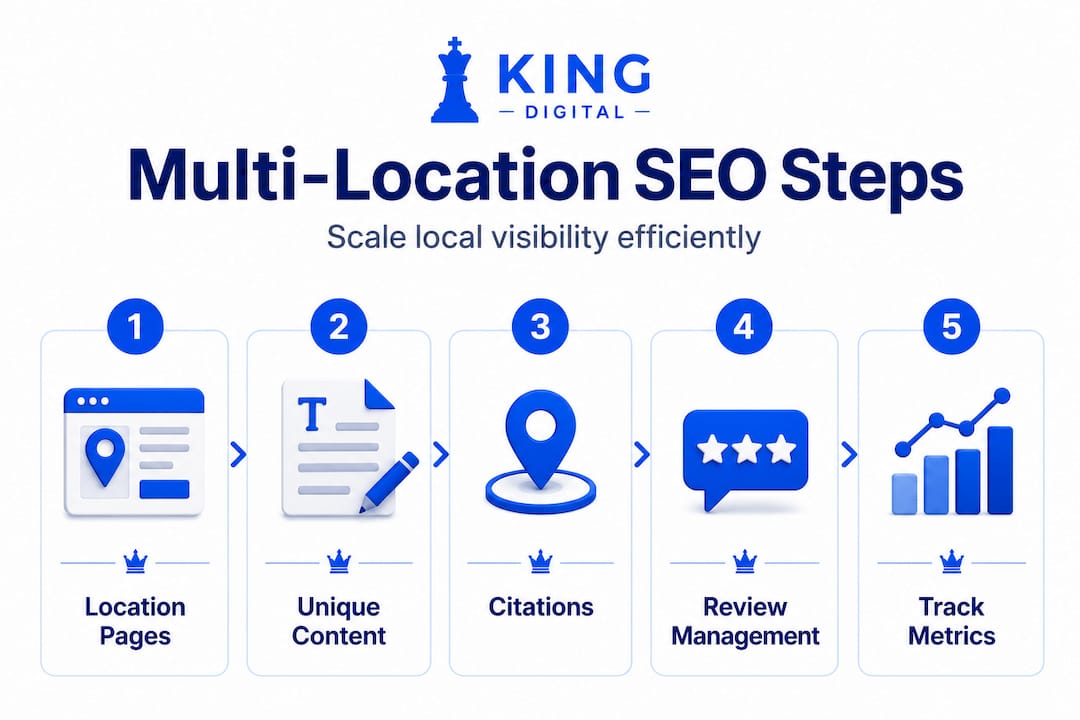
Audit your current assets. Before adding anything new, assess what exists. Which location pages are live? Are Google Business Profiles claimed and verified for each address? Are there duplicate or inconsistent citations floating around in directories?
-
Build unique location pages. This is the cornerstone of your strategy. Each page must have original written content, location-specific keywords, a unique title tag, embedded Google Maps, and structured data markup (schema) identifying the business location. Following location landing page best practices ensures each page sends clear signals to search engines.
-
Optimize NAP consistency across all platforms. Use a citation management tool to push consistent data to the top directories: Google, Yelp, Apple Maps, Bing Places, and industry-specific directories relevant to your business type.
-
Build and manage reviews per location. Reviews are a major local ranking factor. A business with 200 reviews concentrated at one location and only 3 at another will see a significant ranking disparity between those branches. Use a structured multi-location review management process to generate and respond to reviews consistently at each location.
-
Build local citations and backlinks for each location. Pursue backlinks from Albuquerque-area blogs, news sites, chambers of commerce, and community organizations. A backlink from an Albuquerque neighborhood association to your Northeast Heights location page carries real weight.
-
Track, measure, and iterate. Use rank tracking tools that allow you to segment results by location. Monitor each location’s keyword positions, traffic, and review scores separately.
Here’s a practical tool reference:
| SEO task | Recommended tools |
|---|---|
| Citation management | BrightLocal, Yext, Whitespark |
| Rank tracking per location | BrightLocal, Semrush, Local Viking |
| Review monitoring and response | GatherUp, Podium, BrightLocal |
| Schema markup | Google’s Structured Data Markup Helper |
| Keyword research by area | Google Search Console, Semrush |
Partnering with expert local search strategies can accelerate this entire process, especially if your team is stretched thin managing day-to-day operations.
Pro Tip: Set up a separate dashboard view in your analytics and rank tracking tools for each location. When you blend all locations together, you lose the granular data you need to identify which branch is underperforming and why.
Real-world results: What Albuquerque businesses can expect from multi-location SEO
Understanding the right strategies is important; here’s what you can expect business-wise by getting your multi-location SEO right.
The most immediate outcome is expanded visibility. A business with three well-optimized location pages has three separate opportunities to appear in Google’s local pack, the map results that show up at the top of local searches. That’s three times the map visibility compared to a business with a single optimized location, assuming each page is properly differentiated and tracked.
With the right systems, SMBs in local markets can dramatically increase leads and search presence from properly executed multi-location SEO. Here’s what that looks like in practice for Albuquerque businesses:
- More location-specific phone calls. When your Rio Rancho location page ranks for “plumber in Rio Rancho,” callers are already pre-qualified. They’re nearby and actively searching for your service.
- Higher foot traffic to underperforming branches. Often, businesses have one flagship location that drives most traffic while newer branches lag. Multi-location SEO gives underperforming locations their own ranking momentum.
- Stronger trust signals across Albuquerque. When a local shopper sees your brand appearing in search results for multiple Albuquerque neighborhoods, your brand looks established and authoritative.
- Better conversion rates. Visitors who land on a location-specific page that mentions their neighborhood, features local photos, and shows nearby reviews convert at a higher rate than visitors landing on a generic homepage.
Consider this example. An Albuquerque restaurant group with locations in Nob Hill, Downtown, and the Northeast Heights ran a single SEO strategy targeting “best restaurant Albuquerque” across all three. Performance was flat. When they built three distinct location pages with neighborhood-specific content, industry-specific local SEO practices, and separate review funnels, each location began ranking independently. Their total local pack appearances tripled within four months.
If you want a structured starting point, our local search optimization guide walks through the core steps in detail.
Why most businesses approach multi-location SEO the wrong way
With clear outcomes in mind, it’s worth understanding why so many well-meaning businesses stumble on execution — and what local leaders actually do differently.
Here’s the hard truth most agencies won’t tell you. The majority of businesses don’t fail at multi-location SEO because they aren’t trying. They fail because they treat it like a content volume game rather than a content quality and systems game. They build location pages fast, reusing the same template with minor edits, and then wonder why rankings don’t improve or actually drop.
Scaling dilutes performance without unique content, while systems and tools are what enable real SMB success. Both of those things are true simultaneously. You can’t automate your way out of thin content, and you can’t manually sustain multi-location SEO without proper systems in place.
What the businesses that succeed actually do differently is they commit to treating each location like its own micro-business with its own online identity. They invest in genuinely unique content. They build separate review generation workflows. They monitor each branch’s rankings weekly, not monthly. They understand that discipline and consistency compound over time, creating a search presence that competitors cannot easily replicate.
The businesses that cut corners see initial movement, maybe even a small rankings bump, and then stagnate. Google’s algorithm is increasingly skilled at identifying thin, templated content. Following an effective local marketing blueprint gives you a framework that avoids those shortcuts and builds lasting results instead.
Our perspective at King Digital is this: multi-location SEO is one of the highest-leverage investments an Albuquerque SMB can make, but only when it’s done with rigor. Half-measures produce half-results, and in a competitive local market, half-results mean your competitor takes the customer.
Accelerate your Albuquerque business with expert multi-location SEO
If you’re ready to realize these search benefits for all your business locations, here’s a proven partner to get you there.
At King Digital, we work with Albuquerque SMBs every day to build and execute multi-location SEO strategies that actually perform. We don’t use templates. We build each location’s online presence with unique content, precise geo-targeting, and a tracking system that tells you exactly what’s working and where to improve.
Our team handles everything from optimized location page service to citation management, review generation, and ongoing rank tracking by branch. We believe in digital marketing mastery built on data, not guesswork. Whether you have two locations or ten, we build the systems that scale with you. Explore our tailored digital marketing solutions and find out how we can help your business dominate local search across every corner of Albuquerque.
Frequently asked questions
How is multi-location SEO different from regular local SEO?
Multi-location SEO uses geo-specific signals and unique content tailored to each individual business location, while regular local SEO focuses on ranking a single location for its area.
What’s the biggest risk with multi-location SEO?
Duplicate content and keyword cannibalization are the primary risks. When location pages are too similar, scaling dilutes performance and your own pages compete against each other in search results.
Can small businesses handle multi-location SEO on their own?
Yes, with the right tools. Systems and tools streamline management and review tracking across locations, making multi-location SEO achievable for most SMBs who commit to a consistent process.
What metrics matter most when tracking multi-location SEO success?
Track keyword rankings, Google Business Profile views, local organic traffic, and review scores separately for each location. Blending all locations into one report hides the data you actually need to make smart decisions.
How fast can multi-location SEO affect my business’s visibility?
With unique, fully optimized pages and consistent citation management, many businesses begin seeing measurable visibility improvements within two to four months of implementation.
Recommended
- Optimize local search: Ultimate Guide 2025
- Local SEO Location Pages: Master 2025 Success
- Local Marketing SEO: Unfair Advantage in 2025
- Local SEO best practices 2025: Dominate & Grow
- What is ecommerce localisation: boost SEO and global sales | EcomEye
