B2B conversion rate optimisation: Skyrocket in 2025
Why B2B Conversion Rate Optimisation Is Your Revenue Multiplier
B2B conversion rate optimisation is the systematic process of increasing the percentage of website visitors who take desired actions-like requesting a demo, downloading a resource, or booking a consultation. It’s about maximizing the value of your existing traffic without increasing ad spend.
Here’s why B2B CRO is critical:
- Revenue Efficiency: Convert more prospects from the traffic you already have.
- Higher ROI: Even a small conversion lift can significantly increase qualified leads.
- Lead Quality Focus: B2B prioritizes high-quality leads over sheer volume.
- Longer Sales Cycles: The average B2B sale involves multiple stakeholders over several months.
- Proven Returns: High-performing companies see a significant return on their CRO investments.
Unlike B2C, where impulse buys are common, B2B buyers research extensively. They form buying committees with diverse concerns, from technical specs to financial ROI. Your website must nurture these relationships over time, building trust and demonstrating value at every stage.
The numbers tell the story. While average B2B conversion rates hover near 2%, top performers achieve 5-10% by treating CRO as a priority. They run continuous tests, remove friction, and respond to leads within minutes.
If you’re frustrated by traffic that doesn’t convert, you’re not alone. Many B2B websites leave money on the table by using B2C tactics for B2B audiences.
I’m Bernadette King, founder of King Digital Marketing Agency. I’ve spent my career helping businesses transform their digital presence with strategic b2b conversion rate optimisation. In this guide, I’ll show you how to turn more visitors into qualified leads and customers.
Understanding the Unique B2B Buying Landscape
The B2B buyer’s journey is a complex path influenced by logic, risk assessment, and multiple stakeholders. Understanding this landscape is the first step in effective b2b conversion rate optimisation.
The B2B buying process typically involves five stages:
- Problem Identification: The buyer recognizes a business need or problem.
- Information Search: They research potential solutions, suppliers, and best practices. Your website and content are crucial here.
- Evaluation of Alternatives: The buyer assesses vendors based on features, pricing, support, and ROI.
- Purchase Decision: The buying committee reaches a consensus and selects a vendor, often involving contracts and approvals.
- Post-Purchase: The buyer evaluates the solution’s performance, influencing renewals and upsells.
This multi-stage process is why the average B2B sales cycle is just over two months long, and often longer for high-value deals. During this time, a “buying committee” of multiple individuals is involved.
This committee can include:
- Gatekeepers: Control access to decision-makers.
- Champions: Advocate for your solution internally.
- Blockers: Resist change or prefer a competitor.
- Decision-makers: Have the final authority to purchase.
Each member has different priorities that our CRO strategy must address. For a deeper dive into mapping these journeys, explore our guide on Conversion Funnel Analysis.
The B2B vs. B2C Divide: Why Your Strategy Must Differ
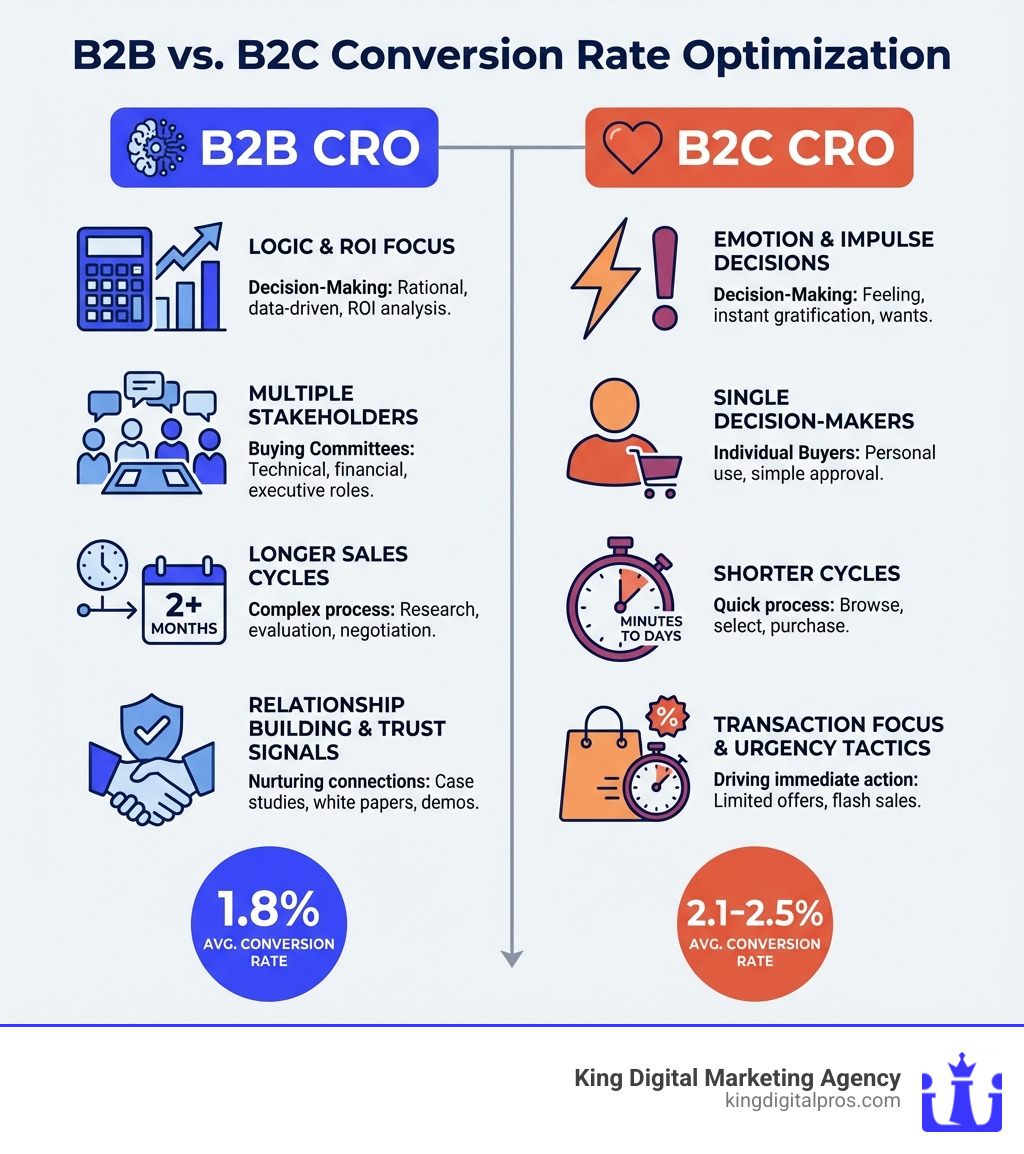
Applying B2C tactics to a B2B audience rarely works. The differences in buyer psychology, purchase value, and decision-making demand a distinct approach.
Here’s a breakdown of the key distinctions:
| Feature | B2B Conversion Rate Optimisation | B2C Conversion Rate Optimisation |
|---|---|---|
| Buyer Motivation | Logic, ROI, efficiency, problem-solving, long-term value, risk aversion. | Emotion, impulse, instant gratification, price sensitivity, personal desire. |
| Decision Process | Complex, involves multiple stakeholders (buying committee), extensive research, formal proposals, approvals, longer sales cycles. | Simpler, often individual decision, shorter sales cycles (minutes to days), fewer considerations. |
| Purchase Value | High-value, recurring contracts, significant financial investment. | Lower-value, one-time purchases, smaller financial commitment. |
| Relationship | Long-term relationship building, trust, partnership, ongoing support. | Transactional, focus on immediate sale. |
| Content Focus | Educational, data-driven, case studies, whitepapers, demos, webinars, ROI calculators. | Product-focused, promotions, visual appeal, social proof, urgency. |
| Average Conversion Rate | Typically lower, around 1.8% (due to complexity and higher stakes). | Generally higher, around 2.1-2.5%. |
In B2B, a “conversion” is often a step toward a sale, like a demo request, not the final purchase. We focus on building credibility and expertise. For a foundational understanding of what conversion rate optimization entails, check out our article, What is Conversion Rate Optimisation?.
Aligning CRO with the Buying Committee
Since B2B purchases involve a committee, our b2b conversion rate optimisation strategy must address the diverse needs of each member.
- Persona-Specific Content: Create content for different roles. A technical user needs specs and integration guides, while a finance executive wants to see ROI and cost savings.
- Addressing Different Pain Points: Your website should speak directly to the varied frustrations of a CEO versus a team lead, showing how your solution provides a comprehensive answer.
- Providing Shareable Assets: Equip your internal champions with shareable one-pagers, executive summaries, and ROI calculators to help them build a business case for your solution.
By understanding the motivations of each persona, we can guide them more effectively. Our Lead Scoring Services can further help in identifying and prioritizing these key individuals.
A Step-by-Step Framework for B2B Conversion Rate Optimisation
B2B conversion rate optimisation is a continuous, data-driven journey, not a one-time fix. It’s a scientific process of hypothesizing, testing, and iterating to achieve compounding improvements. High performers prioritize CRO for its immense potential to drive revenue, as even small gains lead to significant increases in leads.
To structure your efforts, start with a comprehensive CRO plan to guide your strategy.
Step 1: Conduct In-Depth Conversion Research
Before optimizing, you must understand user behavior by diving into quantitative and qualitative data.
Quantitative Data: Use analytics tools to understand behavior at scale.
- Google Analytics reveals traffic sources, navigation paths, and conversion funnels, helping identify drop-off points.
- Tools like Hotjar provide heatmaps and session recordings to show how users interact with your site and where they encounter friction.
Qualitative Data: Numbers tell you what is happening; qualitative data tells you why.
- Customer Interviews: Speak with customers to understand their decision-making process and initial hesitations.
- Sales Team Feedback: Your sales team hears common objections and questions directly from prospects, offering invaluable insights.
- On-page Surveys: Ask visitors direct questions to understand their needs and what’s preventing them from converting.
Combining these sources helps identify friction points and form educated hypotheses. Our guide on Conversion Funnel Optimisation Best Practices offers more strategies for this phase.
Step 2: Define and Track Key B2B Conversion Metrics
In B2B, a conversion is often a step in a longer sales cycle. Track a hierarchy of metrics aligned with business goals.
- Primary Conversions: High-value actions that generate sales opportunities, such as demo requests, trial sign-ups, and contact form submissions.
- Secondary Conversions (Micro-conversions): Smaller engagements that indicate interest, like whitepaper downloads, webinar registrations, and case study views.
Beyond these, track lead progression metrics:
- MQLs (Marketing Qualified Leads): Leads marketing identifies as likely to become customers.
- SQLs (Sales Qualified Leads): MQLs the sales team has accepted for direct engagement.
- Lead-to-Opportunity Rate: The percentage of leads that become sales opportunities.
Defining these metrics is essential for measuring CRO success. To quantify their impact, understanding How to Calculate Lead Value is paramount.
Step 3: Formulate and Prioritize Hypotheses
Translate your research into actionable hypotheses. A good hypothesis identifies a user problem, proposes a solution, and predicts a measurable outcome.
For example:
- Problem: Users abandon the demo form because it’s too long.
- Solution: Reduce the number of required fields from 10 to 5.
- Outcome: Expect a 15% increase in demo form submissions.
Since you can’t test everything at once, prioritization is key. Use a framework like ICE (Impact, Confidence, Ease) to rank hypotheses. Focus on high-traffic, high-impact pages where small improvements can yield significant revenue. For a comprehensive approach, our Conversion Optimization Complete Guide provides further details.
High-Impact On-Page Strategies to Drive Conversions
With research and hypotheses in hand, it’s time to implement on-page changes. Website design is a critical factor for 76% of B2B buyers, so our goal is a seamless user experience (UX) that removes friction and guides prospects toward conversion.
Optimizing Landing Pages and Website Navigation
Landing pages and navigation are crucial for b2b conversion rate optimisation as they create the first impression and guide the user journey.
- Clear Value Proposition: Immediately communicate what you offer and why it matters with a compelling, benefit-focused headline.
- Message Matching: Ensure your landing page headline and content match the ad or search query that brought the visitor. This continuity builds trust.
- Simplified Navigation: B2B buyers need specific information quickly. Avoid cluttered menus. Aim for a visible header CTA, logical page linking, and breadcrumbs to help users find what they need in three clicks or less.
To assess your current site’s performance, ask yourself: Is Your Website Converting?
Reducing Form Friction and Building Trust
Forms are conversion gateways but also major roadblocks; studies show 27% of people abandon long forms. Make the process smooth and trustworthy.
- Shorten Forms: Ask only for essential information. An email may suffice for a whitepaper, while a demo request might require a name, company, and title.
- Progressive Profiling: Collect information over several interactions to build a rich profile without overwhelming users at once.
- Multi-step Forms: Break long forms into shorter steps to make them feel less daunting and improve completion rates.
- Social Proof: Trust is paramount in B2B. Integrate social proof like customer logos, testimonials, case studies, and trust badges. Since 84% of B2B buyers use review sites, showcasing positive feedback on your site is a powerful trust signal.
The Role of Personalization and Dynamic Content
Generic experiences no longer suffice. B2B buyers expect a custom journey, making personalization a powerful tool for b2b conversion rate optimisation.
- Industry-Specific Content: Dynamically display case studies or solutions relevant to a visitor’s industry (e.g., healthcare).
- Persona-Based CTAs: Show a CEO a “Request an Executive Briefing” CTA, while a technical manager sees “Download API Documentation.” This relevance boosts engagement.
- Dynamic Content: Adjust headlines, images, and CTAs based on a visitor’s company or industry to resonate more deeply. Personalized CTAs consistently convert significantly better than generic ones.
Personalization makes visitors feel understood, guiding them toward conversion. It’s a key strategy to help you Attract More Customers.
Advanced Tactics and Technical B2B CRO
Beyond on-page changes, technical performance and innovative tools are key to elevating your b2b conversion rate optimisation. These elements ensure your site is fast, responsive, and intelligently engaging.
Improving Page Speed and Technical Performance
In our digital world, patience is a virtue few online users possess, especially B2B professionals who value efficiency. Page load time directly impacts conversions; a mere 1-second delay can reduce conversions by 7%.
We focus on several technical aspects for optimal performance:
- Image Compression: Large images slow down sites. We compress all images without sacrificing quality.
- Caching: Browser and server-side caching reduce load times for repeat visitors.
- Minimizing Scripts: Streamlining and deferring non-critical JavaScript and CSS improves page rendering speed.
- Mobile Responsiveness: With a majority of B2B buyers researching on mobile, a fast, fluid mobile experience is non-negotiable. Mobile users often convert at lower rates, highlighting a crucial area for optimization.
Tools like Google PageSpeed Insights help identify and fix performance bottlenecks.
Leveraging Conversational AI and Account-Based Marketing (ABM)
Speed and relevance are paramount in B2B. Conversational AI and Account-Based Marketing (ABM) are two powerful strategies to deliver both.
-
Conversational AI (Chatbots): Many modern B2B buyers prefer self-service and immediate answers. AI-powered chatbots provide 24/7 lead qualification, answer FAQs, and offer instant responses. This is critical, as lead conversion rates are much higher when inbound leads are contacted within minutes. Qualified leads can then be seamlessly routed to the right sales rep. For more on streamlining lead processes, explore our Internet Lead Management Complete Guide.
-
Account-Based Marketing (ABM): ABM focuses marketing and sales efforts on specific, high-value target companies. Instead of casting a wide net, ABM identifies key accounts and allows you to retarget decision-makers within them with personalized ads and content, ensuring your message is always relevant.
Unique strategies for B2B SaaS b2b conversion rate optimisation
The Software as a Service (SaaS) model has unique CRO challenges. The goal is to help users experience value quickly and stay engaged.
-
Optimizing Trial Conversions: Free trials are critical, but users will abandon them if they don’t see value fast. Reduce time-to-value with streamlined onboarding, sample data, and in-app walkthroughs that guide users to their “aha!” moment.
-
Improving Demo and Pricing Pages: These are high-stakes pages. Build trust with transparent pricing structures. Reduce friction on demo request forms by using embedded calendars that allow prospects to self-schedule immediately. Place social proof like testimonials and logos near CTAs to build confidence.
-
Gated Content for Champions: Provide in-depth content like ROI calculators or implementation guides that internal champions can use to build a business case for your solution. This empowers them while providing you with valuable lead data.
Effective lead tracking is essential to support these strategies. Find out more in our guide to Best Lead Tracking Services.
Measuring Success: Testing, Benchmarks, and ROI
The power of b2b conversion rate optimisation lies in its measurability. We don’t guess; we test, analyze, and base decisions on hard data. This iterative process drives continuous improvement and maximizes ROI.
Effective A/B Testing for b2b conversion rate optimisation
A/B testing is the cornerstone of CRO, allowing us to compare two versions of a webpage to see which performs better.
- Test One Variable at a Time: To accurately measure impact, test only one element at a time, such as a headline, CTA, form layout, or image.
- Ensure Statistical Significance: Run tests long enough to gather sufficient data, ensuring the results are not due to random chance.
- Segment Results: Analyze results across different audience segments (e.g., small businesses vs. enterprises). A winning variant for one group may not be for another.
Systematically testing and implementing winning variations creates incremental improvements that compound over time.
Understanding B2B Conversion Benchmarks
While every business is unique, industry benchmarks provide valuable context for b2b conversion rate optimisation goals. They help set realistic expectations and identify areas for improvement.
Industry reports show that average B2B conversion rates vary by traffic source:
- The overall average B2B conversion rate is around 2-3%.
- Organic Search (SEO): Higher-intent traffic often converts at a higher rate.
- Paid Search (PPC): Can have lower conversion rates depending on the campaign’s targeting.
- SaaS Industry: This sector often sees a median conversion rate closer to 3-4%.
These are just averages. For high-ticket B2B services, a 1-2% conversion rate can be excellent. The goal is not just to hit a benchmark but to continuously improve upon your own metrics.
Common Mistakes to Avoid
Avoid these common pitfalls that hinder b2b conversion rate optimisation efforts:
- Ignoring Mobile Users: Many B2B sites have a subpar mobile experience, leading to high bounce rates. Always design for mobile first.
- Testing Too Many Elements at Once: Changing multiple elements simultaneously makes it impossible to know what caused the impact. Stick to one variable per test.
- Not Running Tests Long Enough: Ending a test prematurely can lead to misleading results. Wait for statistical significance.
- Focusing on Traffic Over Conversions: Traffic is a vanity metric if visitors don’t convert. Focus on maximizing the value of your existing traffic.
- Treating CRO as a One-Time Project: CRO is an ongoing process of learning and adaptation, not a project with a finite end date.
Avoiding these missteps ensures your CRO strategy remains effective. For more insights, check out our article on Digital Marketing Conversion Rate.
Conclusion
B2B conversion rate optimisation is a fundamental business strategy for revenue efficiency and sustainable growth. It’s about working smarter to turn your existing website traffic into a consistent pipeline of qualified leads and customers.
We’ve covered the B2B buying landscape, a step-by-step framework for implementation, and high-impact strategies from on-page optimization to advanced technical tactics. By understanding your B2B buyer, continually testing hypotheses, and iterating based on data, you can significantly improve your conversion rates and maximize marketing ROI.
At King Digital Marketing Agency, we specialize in implementing these data-driven strategies. Whether you’re in Albuquerque, Rio Rancho, Santa Fe, or surrounding New Mexico communities like Corrales and the East Mountains, we’re here to help you turn more visitors into valuable leads.
Ready to open up your website’s full potential? Get expert help with your Conversion Optimization from King Digital Marketing Agency.
