TL;DR:
- Effective web design builds trust and boosts conversions by shaping first impressions and user experience. Regular updates and professional optimization are essential for SEO, engagement, and staying competitive. Small businesses should treat their website as a continuous growth asset rather than a one-time expense.
Web design is the strategic process of shaping your website’s visual appearance, user experience, and technical performance to build trust, engage visitors, and convert them into paying customers. For small and medium-sized businesses, understanding why web design is important is not optional. It is the difference between a website that generates leads and one that quietly loses them.
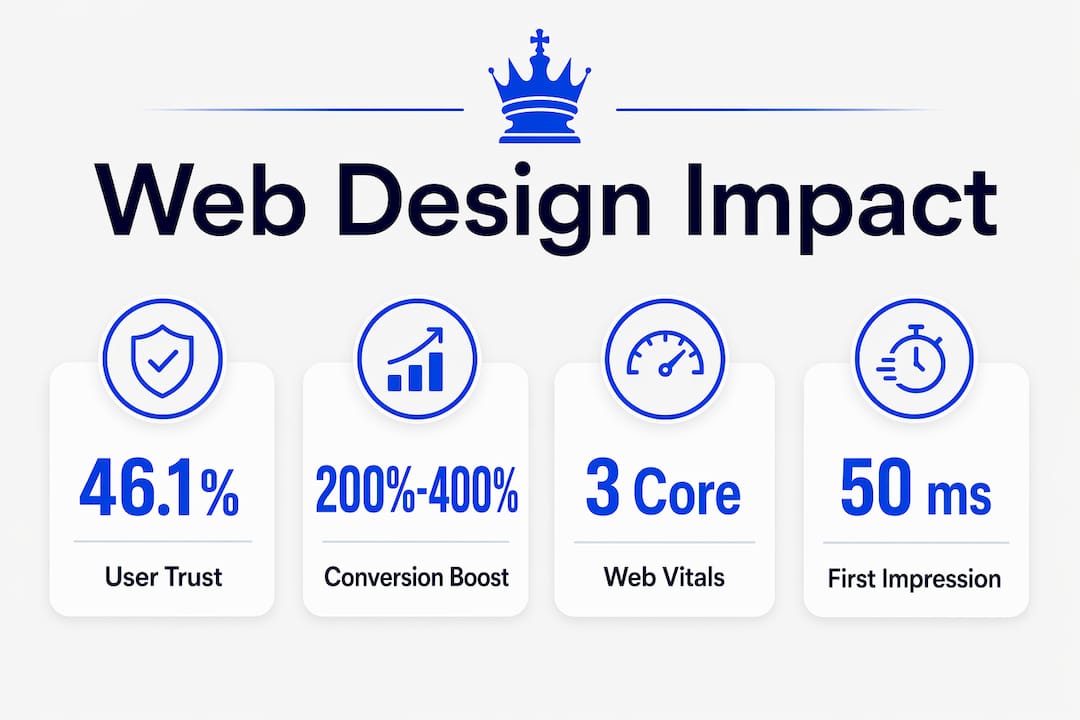
Your website is often the first interaction a potential customer has with your business. Within 50 milliseconds, visitors form an opinion about your credibility based on layout, color, and typography alone. That is faster than a blink. Professional web design gives you control over that first impression, and it shapes every interaction that follows, from how long someone stays on your site to whether they pick up the phone and call you.
Why is web design important for customer trust?
46.1% of users judge a website’s credibility based on its visual design. That single finding from the Stanford Web Credibility Project reframes how you should think about your website. It is not just a digital brochure. It is your most active salesperson, and its appearance determines whether visitors trust you enough to keep reading.
Think of a poorly designed website like a storefront with a cracked sign, dim lighting, and a cluttered window display. Customers walk past. The same logic applies online. When your site looks outdated or disorganized, visitors assume your business operates the same way.
The Stanford Web Credibility Project identified specific design elements that drive credibility judgments:
- Visual hierarchy: Clear headings, logical content flow, and consistent spacing signal professionalism.
- Typography: Readable fonts in appropriate sizes reduce friction and keep visitors engaged.
- Color harmony: A consistent, intentional color palette reinforces brand identity and signals attention to detail.
- Imagery quality: High-resolution, relevant photos outperform stock images in building authenticity.
- Technical polish: Fast load times and zero layout shifts during page load preserve trust from the first second.
“A strong hero area with clear branding and messaging significantly improves inquiry quality.” This is not a design opinion. It is a business outcome tied directly to what visitors see above the fold.
For an Albuquerque plumber, a local law firm, or a regional retail shop, these elements carry even more weight. Competitors with polished sites win the credibility battle before a single word is read. Web design that builds credibility is not a luxury for SMBs. It is a baseline requirement.
How web design shapes user experience and engagement
Good web design and user experience are inseparable. The Aesthetic-Usability Effect, documented by the Nielsen Norman Group, proves that users perceive visually appealing websites as easier to use, even before they interact with a single element. That perception drives behavior. Visitors stay longer, click deeper, and convert more often.
Effective UX design structures content around what your visitors are trying to accomplish, not what you want to show them. A local HVAC company’s website should put “Request a Quote” and “Emergency Service” front and center, not a lengthy company history. When the design guides users toward their goals, friction disappears.
Here are the core design factors that directly lift engagement:
- Page load speed: A 1 to 3 second delay reduces conversions by 32%. Every second of lag costs you real leads.
- Mobile responsiveness: More than half of web traffic comes from mobile devices. A site that breaks on a phone loses those visitors permanently.
- Interactive elements: Websites with interactive features see user engagement increase by up to 50%. Video, image galleries, and calculators keep visitors active rather than passive.
- Clear calls-to-action: Buttons and links placed at natural decision points guide visitors toward contact forms, phone calls, and purchases.
- Reduced cognitive load: Clean layouts with white space and focused messaging prevent overwhelm and keep visitors moving forward.
Pro Tip: Run your website through Google PageSpeed Insights and GTmetrix to get a free baseline score. If your mobile score is below 70, page speed alone may be costing you leads every single day.
High-performing web designs, according to information architecture research, begin with user journey mapping before any visual decisions are made. That means knowing exactly what path a first-time visitor should take from landing page to contact form, and then designing every element to support that path.

Does web design affect SEO rankings?
Web design directly affects your search rankings through Google’s Core Web Vitals. These three metrics, Largest Contentful Paint (LCP), Interaction to Next Paint (INP), and Cumulative Layout Shift (CLS), measure how fast, responsive, and visually stable your pages are. Google uses Core Web Vitals as ranking signals, meaning a poorly designed site can be penalized in search results regardless of how good your content is.
The relationship between design and SEO goes deeper than speed scores. Bounce rate, pages per session, and time on site are all behavioral signals that Google interprets as indicators of content quality. A confusing layout drives visitors away fast, and that spike in bounce rate tells Google your page did not satisfy the search intent.
| Design Factor | SEO Impact |
|---|---|
| Slow LCP (over 4 seconds) | Lower rankings, higher bounce rate |
| High CLS (layout shifts) | Poor user experience signal, ranking penalty risk |
| Non-mobile-friendly design | Excluded from mobile-first index results |
| Poor internal linking structure | Reduced crawlability and page authority flow |
| Fast, stable, responsive design | Removes penalties; supports ranking potential |
One important nuance: fixing severe Core Web Vitals failures removes ranking penalties, but moving from “good” to “excellent” scores provides limited additional SEO benefit. Content relevance remains the dominant ranking factor. The goal is to clear the technical bar so your content can compete. Learn more about how web design drives SEO success for businesses like yours.
Mobile-first indexing means Google primarily evaluates the mobile version of your site. If your desktop site looks great but your mobile experience is broken, your rankings suffer across all devices. This is a design decision with direct revenue consequences.
Professional web design vs. DIY: what SMBs need to know
DIY website builders like Wix, Squarespace, and GoDaddy Website Builder offer a fast, low-cost path to getting online. For a brand-new business testing its concept, that speed has real value. The trade-offs become significant as your business grows.
DIY builders lack customization, scalability, and can introduce security vulnerabilities over time. Template-based designs also tend to look generic, which undermines the brand differentiation that separates you from competitors in a local market.
| Factor | DIY Builder | Professional Design |
|---|---|---|
| Upfront cost | Low | Higher |
| Customization | Limited by templates | Fully tailored to your brand |
| SEO optimization | Basic, often incomplete | Built-in from the start |
| Mobile performance | Variable | Tested and optimized |
| Security | Shared platform risks | Managed and monitored |
| Long-term ROI | Lower conversion rates | Higher conversion potential |
Professional designers optimize for SEO, mobile performance, and user experience from day one. They also align the site’s structure with your specific conversion goals, whether that means generating phone calls, form submissions, or online sales.
Pro Tip: Before hiring a web designer, ask to see three examples of sites they have built for businesses in your industry. Check those sites on mobile, run them through PageSpeed Insights, and look at how clearly the calls-to-action are placed. That review tells you more than any proposal document.
The long-term ROI case for professional design is clear. Professional design produces 200% to 400% higher conversion rates compared to amateur designs. For an SMB spending on paid ads or SEO, sending traffic to a weak site is like filling a bucket with a hole in the bottom.
Practical steps to leverage web design for SMB growth
Improving your website does not require a complete rebuild. These steps give you a clear path to better performance and more leads.
- Audit your current site. Use Google Search Console and PageSpeed Insights to identify technical failures. Fix LCP and CLS issues first since they carry direct ranking consequences.
- Establish a clear visual hierarchy. Your most important message and call-to-action should be visible without scrolling. Visitors decide within seconds whether to stay.
- Invest in professional photography. Real photos of your team, location, and work outperform stock images in building trust with local customers.
- Optimize for mobile first. Test your site on an actual smartphone, not just a browser preview. Tap every button and fill out every form.
- Align CTAs with visitor intent. A visitor searching “emergency plumber Albuquerque” needs a phone number immediately. A visitor browsing “kitchen remodel ideas” needs a portfolio and a soft inquiry form.
- Review and update quarterly. Outdated content, broken links, and slow pages accumulate over time. Schedule a quarterly review to catch issues before they cost you rankings or leads.
Pro Tip: Add a heatmap tool like Microsoft Clarity (free) to your site for 30 days. It shows exactly where visitors click, scroll, and drop off. That data tells you precisely where your design is losing people, and where to focus your next improvement.
The importance of web design compounds when you combine it with a consistent content and local SEO strategy. A well-designed site amplifies every other marketing dollar you spend.
Key takeaways
Web design is a direct driver of business credibility, search rankings, and conversion rates. Every SMB with an online presence needs to treat it as a continuous strategic asset.
| Point | Details |
|---|---|
| First impressions are instant | Users judge credibility in 50 milliseconds based on layout, color, and typography. |
| Design controls conversions | A 1 to 3 second load delay reduces conversions by 32%; professional design can lift them by 200% to 400%. |
| SEO depends on design quality | Core Web Vitals are Google ranking signals tied directly to design and performance decisions. |
| DIY has real limits | Template builders lack the customization and SEO depth that growing SMBs need to compete. |
| Design is ongoing, not one-time | Quarterly audits and updates protect rankings, trust, and lead quality over time. |
What I have learned after years of watching SMBs win and lose online
I have worked with enough small business owners to know the most common mistake they make with their websites. They treat design as a one-time expense rather than an ongoing investment. They spend money on a site, launch it, and then leave it untouched for three years while their competitors update theirs every six months.
The businesses that consistently win online treat their website the way they treat their best employee. They invest in it, check on it regularly, and update it when the market changes. The ones that struggle treat it like a utility bill. They pay it once and forget about it.
Here is what the data confirms and my experience reinforces: your website is not just a marketing tool. It is a credibility signal, a lead generation engine, and a reflection of how seriously you take your business. When a potential customer in Albuquerque searches for your service and lands on a slow, cluttered, or outdated site, they do not give you the benefit of the doubt. They click back and call your competitor.
The good news is that the gap between a weak site and a strong one is not as wide as most business owners think. Clear hierarchy, fast load times, professional imagery, and a mobile-friendly layout are achievable for any budget. The user experience principles that drive results are not secrets. They are well-documented, and they work consistently across industries.
Start with an honest audit of what your site does well and where it fails your visitors. Then fix the most damaging issues first. You do not need perfection. You need a site that earns trust faster than your competitors’ sites do.
— Bernadette
How King Digital Marketing Agency helps SMBs build websites that actually work
Your website should be your hardest-working marketing asset, not a liability that costs you leads every day.
At King Digital Marketing Agency, we build professional websites specifically for small and medium-sized businesses that need to compete in local markets like Albuquerque. Every site we design is built for speed, mobile performance, and search visibility from the ground up. We do not use generic templates. We build around your conversion goals, your brand, and your customers’ behavior. If you are ready to turn your website into a lead generation tool, explore our SMB web design services or review our full digital marketing solutions to see how design fits into a complete growth strategy.
FAQ
Why is web design important for small businesses?
Web design directly shapes whether visitors trust your business and take action. 46.1% of users base credibility judgments on visual design alone, making your site’s appearance a primary factor in winning or losing customers.
How does web design affect SEO?
Google’s Core Web Vitals measure page speed, responsiveness, and visual stability as direct ranking signals. Poor design performance can lower your rankings and increase bounce rates, reducing your organic visibility regardless of content quality.
What is the difference between web design and UX design?
Web design covers the visual and technical construction of a site, while UX design focuses on how users navigate and accomplish their goals. The best websites integrate both, starting with user journey mapping before applying visual decisions.
Is professional web design worth the cost for SMBs?
Professional design produces 200% to 400% higher conversion rates compared to amateur designs. For any business investing in SEO or paid advertising, a professionally designed site significantly increases the return on that marketing spend.
How often should a small business update its website?
A quarterly review is the minimum standard for maintaining performance, security, and relevance. Outdated content, slow pages, and broken links accumulate over time and directly damage both search rankings and visitor trust.
Recommended
- Web Design for SMBs: What You Need to Know
- Web design that builds credibility and grows your leads
- Web design in marketing: boost Albuquerque SMB visibility
- How website design drives SEO success for your business
