TL;DR:
- White hat SEO involves using Google-compliant methods like helpful content and natural link building to achieve sustainable rankings. It emphasizes site-wide content quality, technical hygiene, and ethical practices that grow authority over time, unlike risky black or gray hat tactics. Implementing white hat SEO ensures long-term visibility, trustworthiness, and resilience against algorithm updates.
White hat SEO is defined as the practice of optimizing your website using methods that comply fully with Google’s guidelines to earn higher rankings without risking penalties. Unlike shortcut tactics that game the algorithm, ethical SEO builds visibility that compounds over time. Google’s Helpful Content system, natural link building, and on-page optimization are the three pillars that make this approach work. For business owners and digital marketers, understanding white hat SEO techniques is not optional. It is the foundation of any search strategy that survives algorithm updates and delivers real, lasting traffic.
What is white hat SEO and its core techniques?
White hat SEO centers on helpful, people-first content, legitimate keyword research, natural link earning, and sound technical SEO. Think of it as building your digital presence the way you would build a reputable business: with integrity, consistency, and a genuine focus on serving your audience. Each technique reinforces the others, creating a cycle that grows stronger over time.

People-first content creation
Google’s Helpful Content system evaluates whether your content was created primarily for people or primarily for search engines. Sites with high proportions of unhelpful content can see reduced performance across the entire domain, not just on individual pages. That means one weak section of your site can drag down pages that are genuinely excellent. The standard for white hat content is simple: write to answer a real question, solve a real problem, or teach a real skill.
Keyword research and on-page optimization
Legitimate keyword research means identifying the exact phrases your audience types into Google and placing them naturally in your titles, headers, meta descriptions, and body copy. You are not stuffing a keyword 20 times into a paragraph. You are signaling relevance clearly and honestly. Tools like Google Search Console, Ahrefs, and Semrush surface search volume and intent data that guide this process without guesswork. A well-structured content optimization approach maps keywords to specific pages so every piece of content has a clear purpose.
Ethical link building
Manipulative link practices can lead to ranking drops even without visible manual penalties. White hat link building earns backlinks through editorial outreach, guest contributions, original research, and content that other sites genuinely want to reference. The intent and editorial legitimacy of a link matter more than technical attributes. A single link from a respected industry publication outperforms 50 links from low-quality directories.
Technical SEO fundamentals
Robots.txt handles broader crawl blocking while meta robots tags provide fine-grained, page-level control over indexing and snippets. Proper implementation prevents accidental visibility loss. Site speed, mobile responsiveness, and clean URL structures also fall under technical SEO hygiene. These factors do not generate traffic on their own, but they remove the friction that prevents your content from ranking.
Pro Tip: Run a crawl audit with Screaming Frog or Sitebulb at least once per quarter. Broken links, duplicate meta descriptions, and misconfigured robots directives are silent ranking killers that most business owners never catch.
How does white hat SEO differ from black hat and gray hat SEO?
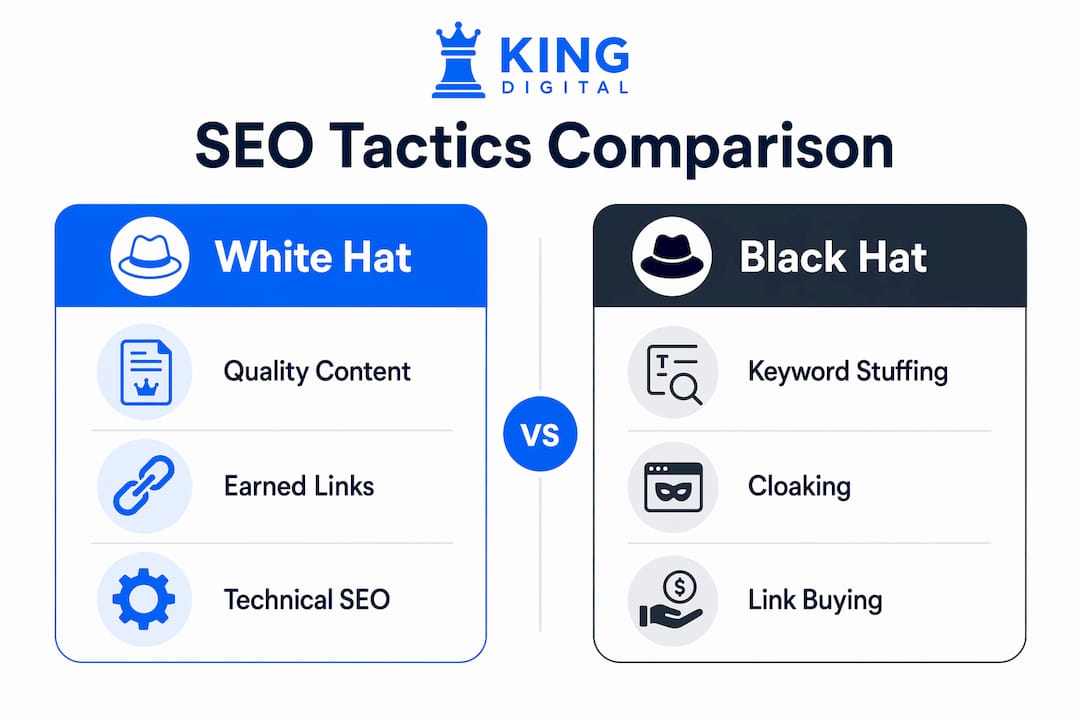
The distinction between these three approaches comes down to risk tolerance and time horizon. White hat SEO builds authority slowly and sustainably. Black hat SEO chases fast rankings using tactics that violate Google’s spam policies. Gray hat SEO sits in the uncomfortable middle, using tactics that are not explicitly banned but carry real risk.
| Approach | Tactics | Risk level | Time horizon |
|---|---|---|---|
| White hat | Quality content, earned links, technical hygiene | Low | Long-term |
| Gray hat | Aggressive anchor text, private blog networks | Medium | Medium-term |
| Black hat | Keyword stuffing, cloaking, link buying | High | Short-term |
Black hat examples include keyword stuffing (repeating a target phrase unnaturally throughout a page), cloaking (showing different content to Google than to users), and buying links. Buying or selling links violates Google’s spam policies directly, risking ranking drops or complete removal from search results. Google may discount purchased links algorithmically even before issuing a manual action, meaning you pay for links that deliver no benefit and carry ongoing risk.
Gray hat tactics are harder to define because they shift as Google’s guidelines evolve. A tactic considered borderline in 2022 may be explicitly penalized by 2026. This is exactly why white hat SEO in 2026 requires more than simply avoiding spam. It now demands transparency about brand authority and content that comprehensively serves user intent, aligning with AI-powered ranking systems that assess expertise and consistency. Choosing white hat SEO is choosing to build something that cannot be taken away by the next algorithm update.
What are the benefits of white hat SEO for your business?
The benefits of white hat SEO extend well beyond avoiding penalties. They compound in ways that paid advertising simply cannot replicate.
- Sustainable organic traffic. Rankings earned through ethical SEO do not evaporate overnight. A well-optimized page built on quality content and earned links continues to attract visitors for months or years without additional ad spend.
- Penalty avoidance. Manual actions from Google can remove your site from search results entirely. White hat practices eliminate this risk by design.
- Brand credibility and user trust. Users who find your content genuinely helpful return, share, and convert at higher rates. Trust is not a soft metric. It directly influences revenue.
- Alignment with AI-powered algorithms. Google’s ranking systems increasingly reward expertise, authoritativeness, and trustworthiness. White hat SEO builds exactly these signals.
- Better user experience. Fast load times, clear navigation, and helpful content reduce bounce rates and increase time on site. These engagement signals feed back into rankings, creating a positive cycle.
Domain-wide content quality is critical because even excellent pages can underperform if the overall site contains too much thin or unhelpful content. This means the benefits of white hat SEO are not page-specific. They are site-wide. Every piece of content you publish either strengthens or weakens your entire domain’s authority. That is a sobering reality, and it is also a significant opportunity. Businesses that commit to consistent quality gain a compounding advantage over competitors who publish volume without substance.
Sites that publish large volumes of thin or AI-generated content without genuine expertise risk overall ranking suppression across their domain. This is not a hypothetical warning. It is a documented outcome that has affected thousands of sites since Google’s Helpful Content updates rolled out.
How can you successfully implement white hat SEO techniques?
Applying white hat SEO techniques requires a repeatable process, not a one-time effort. Here is how to build that process from the ground up.
-
Conduct intent-focused keyword research. Use Google Search Console to identify what queries already bring users to your site. Layer in tools like Ahrefs or Semrush to find related terms with clear search intent. Map each keyword to a specific page so you never compete with yourself.
-
Create high-quality, original content consistently. Every page should answer a specific question better than the current top-ranking results. A smarter content workflow helps you plan, produce, and publish content that serves user intent without sacrificing quality for volume.
-
Build backlinks through genuine outreach. Identify publications, blogs, and directories in your industry that accept editorial contributions. Pitch original data, expert commentary, or case studies. These earn links that Google trusts because a real editor made a real decision to include them.
-
Maintain technical SEO hygiene. Audit your robots.txt and meta robots implementation to confirm you are not accidentally blocking valuable pages from being indexed. Check site speed with Google PageSpeed Insights and address Core Web Vitals failures. Review your internal linking structure to distribute authority across your domain.
-
Audit and improve low-value content regularly. Identify pages with thin content, high bounce rates, or zero organic traffic. Update them with depth and relevance, or consolidate them with stronger pages. Removing or improving weak content raises the overall quality signal for your entire domain.
-
Monitor algorithm updates and adapt. Subscribe to Google Search Central Blog and follow SEO publications like Search Engine Journal and Moz. When Google announces a core update, audit your traffic data against the rollout dates to identify patterns and adjust your strategy accordingly.
Pro Tip: When building your local SEO content, focus each page on a single location-specific topic. Thin, duplicated location pages are one of the fastest ways to trigger the Helpful Content classifier against your entire site.
Key takeaways
White hat SEO builds durable search visibility through ethical content, earned links, and technical hygiene, and no algorithm update can undo that foundation.
| Point | Details |
|---|---|
| Core definition | White hat SEO uses Google-approved methods to earn rankings without risking penalties. |
| Content quality is site-wide | Thin or unhelpful pages suppress your entire domain, not just individual URLs. |
| Link intent matters most | Editorially earned backlinks outperform purchased or automated links in both safety and value. |
| Technical hygiene protects rankings | Correct robots.txt and meta robots implementation prevents accidental indexing loss. |
| Consistency compounds results | Regular content audits and ethical outreach build authority that grows over time. |
Why I believe white hat SEO is the only real long-term play
I have watched businesses chase shortcuts for years. They buy link packages, spin AI content at scale, and celebrate short-term ranking spikes. Then a core update rolls out and they lose 60% of their traffic in a week. I have seen it happen to companies that were genuinely good at what they do. The problem was never their product. It was the foundation they built their visibility on.
What the Helpful Content updates taught me is that Google is no longer just checking individual pages. It is evaluating your entire site as a signal of trustworthiness. One strong article cannot carry a domain full of thin, low-effort content. That changes how I advise every client at King Digital Marketing Agency. We do not just optimize the pages that rank. We audit the pages that should not exist.
The other shift I have noticed is that white hat SEO now requires you to be transparent about who you are and what you know. Google’s AI-powered systems assess expertise and consistency across your content. Anonymous, generic content does not perform the way it used to. Authorship, credentials, and a clear brand voice are now ranking signals in practice, even if Google does not call them that explicitly.
My honest advice: treat your website the way you treat your reputation. Build it carefully, protect it consistently, and never take shortcuts that you would not want your best customer to see.
— Bernadette
How King Digital Marketing Agency helps you build ethical, lasting SEO
At King Digital Marketing Agency, we specialize in white hat SEO strategies built specifically for small and medium-sized businesses in Albuquerque and beyond. Our approach combines people-first content creation, technical SEO audits, and earned link building into a single, cohesive plan designed to grow your organic visibility without shortcuts.
We do not sell you a package and disappear. We work alongside your team to understand your market, your customers, and your goals. Whether you are starting from scratch or trying to recover from a past penalty, our digital marketing services are built to deliver results that last. Ready to build search visibility the right way? Contact King Digital Marketing Agency today and let us put a real strategy behind your rankings.
FAQ
What is white hat SEO in simple terms?
White hat SEO is the practice of improving your website’s search rankings using methods that follow Google’s guidelines, such as creating helpful content, earning backlinks naturally, and optimizing technical performance.
What are the most common white hat SEO techniques?
The most common techniques include people-first content creation, intent-focused keyword research, ethical link building through editorial outreach, and technical SEO practices like proper crawling and indexing controls.
How does white hat SEO differ from black hat SEO?
Black hat SEO uses tactics like keyword stuffing, cloaking, and buying links that violate Google’s spam policies and risk penalties. White hat SEO earns rankings through quality and compliance, making it sustainable over the long term.
Why choose white hat SEO over faster alternatives?
White hat SEO builds rankings that survive algorithm updates and compound over time. Shortcut tactics may deliver quick gains but carry the risk of ranking drops or removal from search results entirely.
How long does white hat SEO take to show results?
Most businesses see measurable organic traffic growth within three to six months of consistent white hat SEO effort, though competitive markets may require longer timelines to build sufficient authority.
Recommended
- What Is Keyword Research? A Guide for Business Owners
- SEO checklist for small businesses: boost local visibility
- Understanding Local Search Ranking for Business Growth
- How website design drives SEO success for your business
