TL;DR:
- Local SEO market share is measured by Share of Local Voice, which tracks visibility across a business’s full service area.
- Monitoring SoLV and Share of Search helps businesses understand their geographic reach and demand capture more accurately.
Market share in local SEO is defined as the percentage of your geographic service area where your business appears in the top three local search results. The industry term for this measurement is Share of Local Voice, or SoLV. Understanding local SEO market analysis starts here, because SoLV connects directly to how many calls, visits, and leads your business generates each month. A complementary metric, Share of Search, captures how much of the total branded search demand in your market belongs to you. Together, these two market share metrics for businesses give you a complete picture of your competitive position, not just a single keyword ranking on a single street.
What is market share in local SEO, and how does SoLV measure it?
Share of Local Voice is the most direct way to measure local SEO market share. It works by running a geogrid scan across your entire service area. Picture a grid of dots laid over your city or neighborhood. Each dot represents a geographic point, and the scan checks whether your business appears in the top three Google results at that location. Your SoLV score is the percentage of those grid points where you rank in the top three.

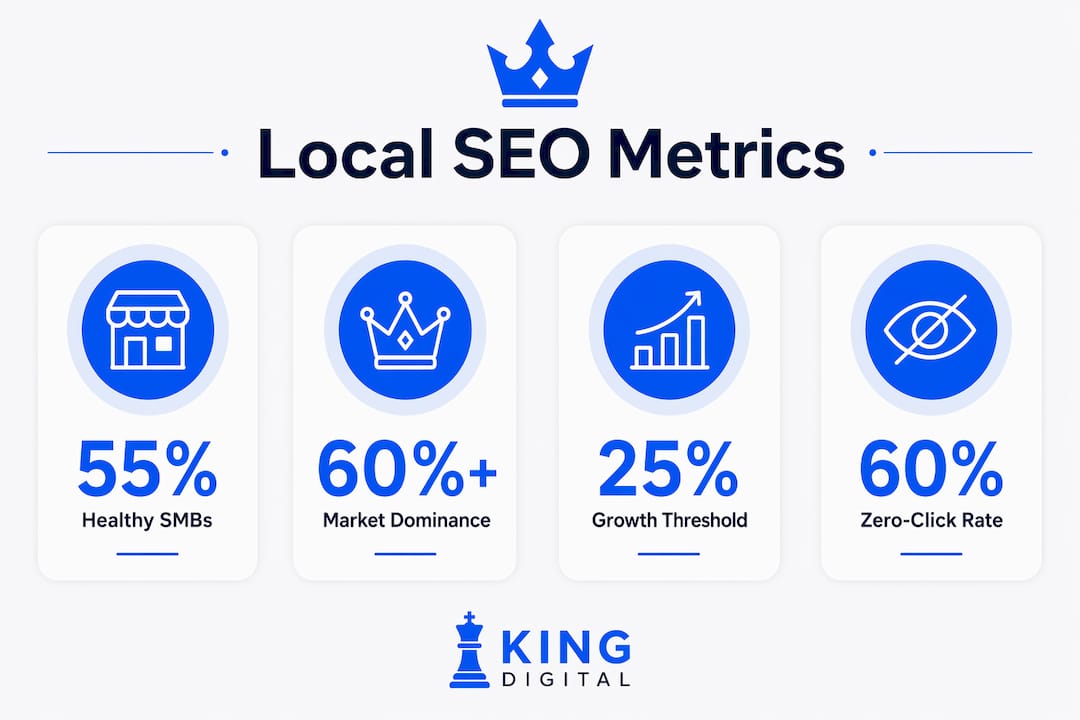
Healthy SMBs in mid-size metros typically score between 25% and 55% SoLV. A score above 60% signals market dominance. These benchmarks give you a realistic target rather than an abstract goal.
| SoLV Range | What It Signals |
|---|---|
| Below 25% | Limited visibility; significant growth opportunity |
| 25%–55% | Competitive presence; room to expand coverage |
| 60%+ | Market dominance across the service area |
The business impact of SoLV is direct and measurable. Doubling your SoLV typically produces proportional increases in Google Business Profile calls and website visits. Conversion rates across local profiles generally run 40 to 90 actions per 1,000 profile views. That means a business moving from 20% to 40% SoLV is not just climbing a ranking chart. It is reaching a larger share of real customers who are ready to act.
Pro Tip: Run your geogrid scan at the same time each month. Consistency removes fluctuations caused by time of day or day of week, so your month-to-month comparisons reflect real progress.
How does Share of Search complement SoLV?
Share of Search measures the percentage of total relevant branded search demand in your market that belongs to your business. The formula is straightforward: your brand’s search volume divided by the total search volume for all businesses in your category within your area.
This metric matters because about 60% of searches are zero-click. A zero-click search is one where Google answers the question directly on the results page and the user never visits a website. Rank-based metrics miss this entire category of demand. A business can rank #1 for a keyword and still lose a large portion of market interest to zero-click results.
Share of Search fills that gap by capturing brand-level demand signals:
- Total branded search volume shows how many people are actively looking for your business by name.
- Category search volume reveals the size of the total market you are competing in.
- Your share percentage tells you whether your brand is growing relative to the market or losing ground.
- Trend direction matters more than a single snapshot. A rising Share of Search over three months signals growing brand awareness even before rankings shift.
Tracking both SoLV and Share of Search gives you a fuller view of the impact of market share in SEO. SoLV tells you where you rank geographically. Share of Search tells you how much of the total demand you are capturing, including searches that never produce a click.
What nuances should small businesses understand about local SEO market share?
The biggest misconception about local SEO rankings is that ranking #1 for one keyword in one location equals market share. Geographic coverage in the top three across your entire service area is what actually drives lead volume. A single strong ranking downtown does not protect you from competitors who cover the surrounding neighborhoods.
Proximity bias makes this even more complex. Local rank can vary drastically within a few blocks. A business can be the top result on one street and nearly invisible two blocks away. This is why SoLV, measured across dozens or hundreds of grid points, gives a more accurate picture than any single rank check.
Four factors consistently affect your SoLV and overall local market position:
- NAP consistency. Your business name, address, and phone number must match exactly across every directory, citation, and platform. Inconsistencies confuse Google and reduce trust signals.
- Review volume and recency. A steady stream of recent reviews signals an active, credible business. Responding to reviews adds another positive signal.
- Local landing pages. A dedicated page for each neighborhood or service area you target gives Google a clear geographic signal and gives customers a relevant experience.
- Monthly geogrid reporting. Tracking month-to-month SoLV delta is more useful than watching absolute rank numbers. The delta shows whether your efforts are moving the needle across your full service area.
Pro Tip: Schedule your geogrid scans on the same calendar day each month. Temporal consistency is what makes your reporting data reliable enough to act on.
How can local businesses increase their local market share?
Growing your share of local search is not a single action. Market share in local SEO is composite, built from many signals working together. Profile completeness and local content deliver quick wins, but sustained growth depends on closing the gaps where competitors outrank you.
Here are the core strategies that move the needle on how to increase local market share:
- Complete your Google Business Profile fully. Fill in every category, service, product, and attribute. Profiles with complete data consistently outperform incomplete ones in local pack results. This is the fastest win available to most small businesses.
- Build reviews systematically. Ask every satisfied customer for a review. Respond to every review, positive or negative. Review acquisition and response are among the strongest signals in local SEO ranking algorithms.
- Create neighborhood-level landing pages. If you serve five zip codes, build a dedicated page for each one. Each page should include location-specific content, not just a swapped city name. Google rewards geographic relevance with geographic visibility.
- Analyze competitor signals where you are weak. Pull a geogrid scan and identify the grid points where competitors outrank you. Study their profiles, review counts, and local content in those zones. Then close the gap by improving your own signals in those specific areas.
- Build local links and citations. Earn mentions from local news sites, neighborhood blogs, chambers of commerce, and community organizations. Each local link reinforces your geographic authority.
- Publish local content regularly. Blog posts about neighborhood events, local guides, and community news build topical relevance for your area. This content also supports your local search visibility by giving Google more geographic context about your business.
Sustained growth in local market share comes from consistently improving signals in the exact areas where competitors currently rank higher. It is a targeted process, not a broad campaign.
Key Takeaways
Local SEO market share is best measured by Share of Local Voice, which tracks top-three visibility across your full service area and directly predicts lead volume.
| Point | Details |
|---|---|
| SoLV defines market share | Measure the percentage of geogrid points where you rank in the top three locally. |
| Benchmarks guide your goals | Scores of 25%–55% are competitive; 60%+ signals dominance in mid-size markets. |
| Share of Search fills the gap | Capture zero-click demand by tracking branded search volume relative to your market. |
| Proximity bias is real | Rank varies block by block, so geogrid scans beat single-keyword checks every time. |
| Growth requires multiple signals | Reviews, NAP consistency, local pages, and competitor gap analysis all contribute to SoLV gains. |
Why I think most local businesses are measuring the wrong thing
I have worked with small business owners who obsess over one keyword ranking. They check it daily, celebrate when it hits #1, and panic when it drops to #3. That single number tells them almost nothing about their actual market position.
The shift that changes everything is moving from “where do I rank for this keyword?” to “what percentage of my service area can find me when it matters?” That is the geographic footprint mindset, and it is the only framework that connects local SEO activity to real business outcomes like calls and foot traffic.
The businesses I see growing their local presence in 2026 are the ones running monthly geogrid scans, tracking their SoLV delta, and using that data to prioritize where they invest next. They are not chasing a single ranking. They are building coverage. The practical challenge is that this approach requires patience. SoLV does not double in a week. But the businesses that commit to it for six months consistently outpace competitors who are still fixated on one keyword in one location.
If you own a local business and you are not yet tracking your geographic footprint, you are likely underestimating both your gaps and your opportunities. The data, once you see it, makes the path forward obvious.
— Bernadette
How King Digital Marketing Agency helps you grow your local market share
King Digital Marketing Agency works with small and medium-sized businesses across the Albuquerque region to build the kind of local SEO presence that generates consistent leads. The team handles Google Business Profile optimization, review management, neighborhood landing pages, and geogrid-based reporting so you always know where you stand and where to focus next.
Every client engagement starts with a clear picture of current SoLV and the gaps where competitors are winning. From there, King Digital Marketing Agency builds a targeted plan to close those gaps. If you are ready to move from guessing to knowing, explore the local marketing SEO services that King Digital Marketing Agency offers and see what a geographic footprint strategy looks like in practice.
FAQ
What is Share of Local Voice in local SEO?
Share of Local Voice (SoLV) is the percentage of geographic grid scan points where your business appears in the top three local search results. It is the most direct measure of local SEO market share across your full service area.
How is SoLV different from a standard keyword ranking?
A standard keyword ranking shows your position for one search term at one location. SoLV measures your visibility across dozens or hundreds of points in your service area, giving a far more accurate picture of your competitive reach.
What is a good SoLV score for a small business?
Healthy SMBs in mid-size metros typically score between 25% and 55%. A score above 60% indicates market dominance. Scores below 25% signal significant room for growth.
Why do zero-click searches matter for local market share?
About 60% of searches end without a click because Google answers the query directly on the results page. Share of Search captures this demand, making it a critical complement to rank-based metrics like SoLV.
How often should I track my local SEO market share?
Monthly geogrid scans run on the same day each month give the most reliable trend data. Tracking the month-to-month change in SoLV is more useful than monitoring absolute rank numbers.
Recommended
- Understanding Local Search Ranking for Business Growth
- Why Focus on Local Keywords: A 2026 Guide
- Top Mistakes in Local SEO: 2026 Fix-It Guide
- Digital Marketing Local: 2026’s #1 Smart Strategy
